Category Archives: death

2024 ➤ Andy Polaris reminds us of Quincy Jones’s legacy as a titan of 20th-century showbiz

Tribute, concert review, Quincy Jones, Michael Jackson, Grammy awards,

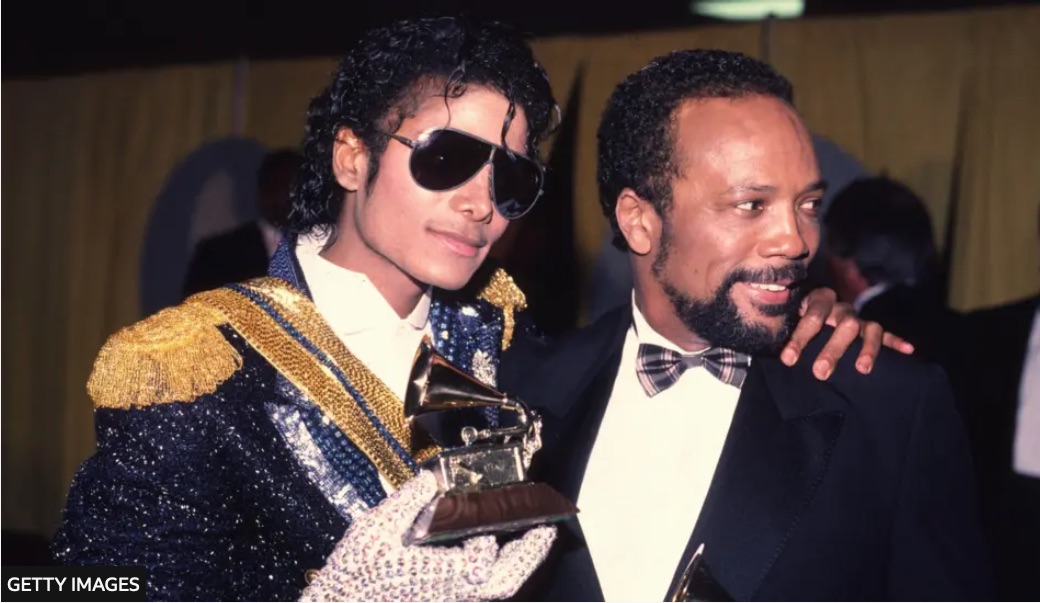
1984: Quincy Jones with Michael Jackson at the 1984 Grammy Awards, where they won eight

❚ The cross-cultural pioneer Quincy Jones died this week
aged 91 in Los Angeles. In tribute, we republish Andy Polaris’s appreciation of his genius when he brought a huge
orchestra to London’s O2 arena on 25 Jun 2019…

Excerpt from the review at the Polaris music blog: Quincy Jones Jr is a titan of 20th-century entertainment whose creative talent has spanned decades as composer, multi-instrumentalist, singer-songwriter, arranger, producer and publisher. He has received the most Grammy nominations, a staggering 80, and won 28, plus seven Oscar nominations, and a Jean Hersholt Humanitarian award in 1996 amongst other industry accolades. He has worked with superstars from Aretha Franklin, Frank Sinatra, Count Basie, Miles Davis, Dizzy Gillespie to Michael Jackson. In 2018 a Netflix film Quincy won the Critics Choice Documentary award.

As a teenage prodigy Quincy Jones had been tutored by Ray Charles and mentored by Count Basie, by 19 was touring Europe with Lionel Hampton for three years, at 24 studied at the feet of the godlike Nadia Boulanger in the American School at Fontainebleau, and soon after became a troubleshooting vice-president for Philips Records of Holland.

This week [in 2019] sees the 10th anniversary of Michael Jackson’s death and despite the controversy and those clamouring on social media to cancel his music, the audience at this O2 concert showed that, whatever your feelings, it’s nigh on impossible to crush the joyous memories and mood of his repertoire. In addition, we were treated to the formidable playlist of our youth unfolding before our ears thanks to the savvy musicianship of the band and huge orchestra, which even included a harp, all conducted and hosted by Jules Buckley… / Review continued at Apolarisview


➢ Guardian obituary: Quincy Jones was the first black composer to find acceptance in Hollywood and won 28 Grammys

FRONT PAGE

2024 ➤ London’s Evening Standard publishes my obituary of Linard the wild child of UK fashion

Stephen Linard, Blitz Kids, fashion, New Romantics, Swinging80s,

Photo by Kate Garner

❚ A LAVISHLY DESIGNED OBITUARY of Stephen Linard written by me appears in today’s Evening Standard online and stands as a well-deserved memoir for one of my best friends…
➢ The life of Stephen Linard – A flamboyant Canvey Island boy who went on to shape the Blitz Kids silhouette in the 1980s

FRONT PAGE

2024 ➤ Farewell to Linard, the craziest man I’ve known

Stephen Linard, Blitz Kids, fashion, New Romantics, Canvey Island,

Stephen Linard in 2018: A last pint at his local pub before moving away from Canvey Island. (Photo @ Shapersofthe80s)

INCREDIBLE!!!! Update – Shapersofthe80s has received 8,100 hits during the three days since Stephen’s death. Thank you to his fans

❚ HARD TO ACCEPT THAT STEPHEN LINARD has now died from the extensive throat cancer that had caused him so much pain recently. He was one of the craziest of eccentrics who frequently made me laugh out loud. We met at a party at Steve Strange’s flat in 1980 when he was among the sharpest half-dozen Blitz Kids who changed their looks daily and put the Blitz Club on the map. We hit it off immediately and I soon latched onto the star trio of Stephen, Kim Bowen and Lee Sheldrick who went everywhere together.

I photographed his degree show and over the years helped him through various projects in that era when St Martin’s School of Art failed to equip its graduates with any guidance for running their own businesses. Luckily, pop stars from Pet Shop Boys to U2 and even Bowie readily adopted his strong styles and in 1983 the American fashion press included him among the eight most influential London designers [see link below], noted for his strong eye for colour.

From 1983 to ’86 Stephen lived in Tokyo designing for Jun Co, the fashion giant, on a salary which, he liked to boast, exceeded the prime minister Margaret Thatcher’s. From 1989 until recently Stephen was a key player on the design team at Drake’s, the respected men’s haberdasher off Savile Row (pictured below). The main photo (above) marked a last pint at his local pub on Canvey Island where he lived in his late mother’s house until 2020 before joining the Old Romantic Folks who go on retiring to St Leonard’s-on-Sea.

Only six months ago, as if in anticipation of the worst, Stephen staged a striking exhibition of his early illustrations, titled Total Fashion Victim after the club-night he had hosted at Soho’s coolest hang-out, the Wag. I was lucky enough to write the outline catalogue with him.

drakes-london, Stephen Linard, British tailoring, haberdashery,fashion

Former Blitz Kid and St Martin’s fashion graduate Stephen Linard in 2011: a designer with Drake’s, the gentlemen’s haberdasher, seen here at a staff preview for the opening of its first shop just off Savile Row. (Photograph © Shapersofthe80s)

MORE ON STEPHEN INSIDE

➢ Previously at Shapersofthe80s: 2023, Total Fashion Victim – Linard’s exhibition of his early work

➢ Previously at Shapersofthe80s:
The Blitz Kids WATN? No 28, Stephen Linard

➢ Previously at Shapersofthe80s:
1980, Linard’s Alternative student show gives
Goths their archaic name

➢ Previously at Shapersofthe80s:
1982, Six British designers take London fashion
to the French

➢ Previously at Shapersofthe80s: Overseas influencers
declare eight hot fashion Brits for 1984

THE PROFESSIONAL TRIBUTES

➢ Stephen Linard, London designer, image maker and Blitz Kid, dead at 64 – Detailed analysis of his talents at Women’s Wear Daily, March 2024

➢ Goodbye, Stephen Linard: It was a privilege to know you – by novelist Maggie Alderson

➢ Linard’s entry at the Encyclopedia of Fashion – by Alan
J. Flux; updated by Daryl F. Mallett

➢ Blitz Kid Stephen Linard’s 1980 Neon-Gothic collection anticipated “Heavenly Bodies” by 38 years – from Vogue, 2018

FRONT PAGE

2023 ➤ Witnessing the performance of Gambon’s life as his tribute to Pinter

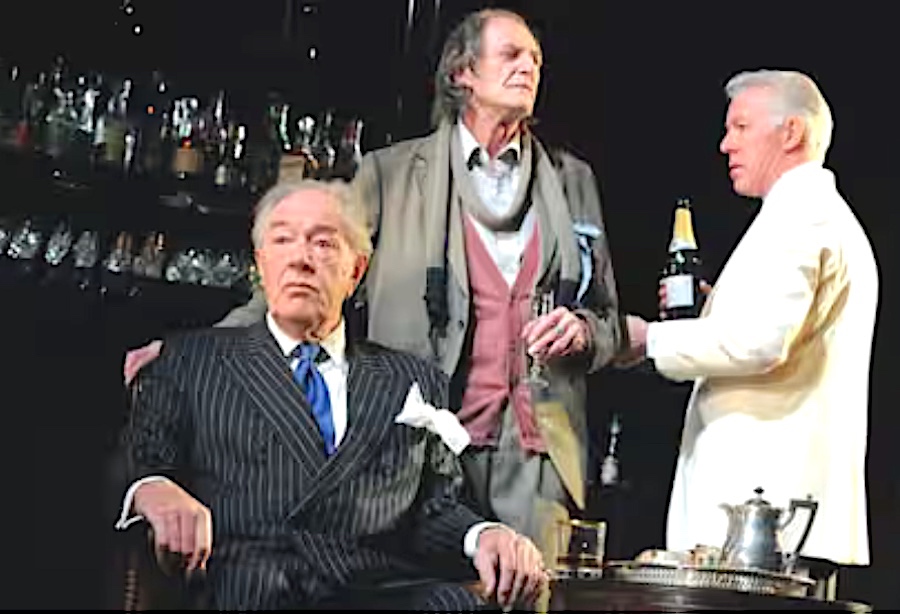
Tributes, theatre No Man’s Land, Michael Gambon, Harold Pinter, David Bradley,

Duke of York’s, 2008: Michael Gambon, David Bradley and Nick Dunning in No Man’s Land. (Photograph: Tristram Kenton)

❚ MICHAEL GAMBON WAS UNDOUBTEDLY Britain’s greatest living actor for much of his career and remained so until his death this week. So, indeed, Harold Pinter had also become our greatest playwright by the end of his life. In the week of Pinter’s death at Christmas 2008, Gambon was playing in the West End in this, one of the master’s most enduring plays, No Man’s Land, and on Boxing Day he marked the theatre’s loss in ways I shall never forget.

That day, on Radio 4’s World at One, Michael Gambon promised to give the performance of his life, so I determined to go and see again the performance I’d already enjoyed the previous month in one of the Pinter’s most haunting masterpieces about two men in their maturity reflecting on their tenuous – or had it been non-existent? – friendship. As Michael Billington had written in his Guardian review: “Every new production of Pinter’s tantalising, poetic play yields new meanings.”

I’d seen it premiered in 1975 with those grandees John Gielgud and Ralph Richardson at the Old Vic and again when transferred to the Lyttelton in 1977 – several times. The great air/earth partnership of Gielgud/Richardson undoubtedly brought compassion to the roles of Spooner and Hirst, yet when Pinter himself played “the Richardson role” at the Almeida in 1993, opposite the sprightly Paul Eddington, the author turned his second act opening almost into a two-handed farce that had us aching in our seats with continuous laughter and subsequently wondering whether he’d always longed for our two greatest actors to loosen up a bit in the original production.

By the time this day’s greatest living actor Gambon put on the mantle of Hirst, a litterateur haunted by dreams and memories, in this new production at the Duke of York’s, we had learnt to laugh heartily at the humour in Pinter, yet now both Gambon and David Bradley as Spooner were also suffusing the prose with more poetry which the renowned “Pinter pauses” punctuate than I could recall from the past.

Tributes, theatre 
No Man’s Land, Paul Eddington, Harold Pinter,

Almeida theatre, 1993: Paul Eddington and Harold Pinter in his own play No Man’s Land. (Photograph: Tristram Kenton)

A month earlier, I’d been caught short by the intensity of Gambon’s stage presence as he made his demons all but tangible before us. Then on Boxing Day, after the hilarious Act 2 recollections of the men’s seemingly shared past, Gambon suddenly changed gear and dropped timbre to whisper the crucial “Good Ghost” speech about the passing faces in his photograph album with an ethereal beauty and clarity of Shakespearean proportions. It was an unparalleled moment to witness.

Following the curtain calls, the cast paused to pay brief onstage tributes to Pinter. Gambon told us that, after rehearsals, the playwright had asked him if he would read the Good Ghost speech at his funeral (which indeed he did only days later). Suddenly for the second time this night, Gambon delivered the speech again there and then. Alas the words lost something of the ineffable truth they had touched when, minutes earlier, Gambon had been in character and had delivered them “trippingly on the tongue”.

Without doubt, the actor brought greatness to the role of Hirst this night – in fairness, all the cast were on the balls of their feet too. More satisfying, in the fleeting moments of live performance, fresh glimpses had been revealed of Pinter’s bleak insights into memory and ageing. All in all, the essence of theatre.

➢ Billington’s review of No Man’s Land in The Guardian, 2008
➢ Michael Gambon’s obituary in The Guardian, 2023

FRONT PAGE

2023 ➤ Bowie anniversaries: One fan’s teenage love remains undimmed

David Bowie, 1976, Man Who Fell to Earth, pop music, films, anniversary, birth, death,

Bowie’s new look for 1976 when he became The Man Who Fell to Earth, here in a Haywain shirt. Photographed by Steve Schapiro and published on the cover of the Sunday Times Magazine

David Robert Jones
8 January 1947 – 10 January 2016

Every January, two dates stir the souls of Bowie fans: the 8th being his birthday and the 10th the day he died. On the seventh anniversary of his death, Eighties Blitz Kid and pop singer ANDY POLARIS recalls the dramatic influence Bowie had on his early teens in the way that his fan base would also be galvanized by his art to inspire their own creative dreams. This extract comes from a much longer piece at his own website Apolarisview.wordpress.com … Andy writes:

Much has been written about Bowie’s Starman performance in 1972. I had begun a fascination with his image a little earlier after the Melody Maker interview, thanks to an older teenager who also had the album, Hunky Dory.

I began to spend the little pocket money I had on buying all the magazines and music papers that featured him, especially on the cover. Fab 208, PopSwop, Music Star, Music Scene and Jackie thankfully were relatively cheap and I began my scrapbook collection. Ziggy Stardust with his bold make-up and glamorous wardrobe (courtesy of Freddie Burretti and Kansai Yamamoto) was unlike anything seen before and blurred the line between sexes. This beautiful creature offered a world of possibilities to this youth already bored with football and the teenybop fandom that dominated our era. Clothes, style, identity – normal teenage rites of passage – all took on a greater importance over the next few years but now helped define a more alternative journey.

Seeking out Bowie’s references in lyrics opened a new door to imagination. His creative output eased my inner void of loneliness and probably kick-started my interest in science-fiction. Humdrum suburbia was replaced by the magical worlds of Alfred Bester, Philip K Dick, George Orwell and Robert Heinlein to a soundtrack of Ziggy Stardust, Aladdin Sane and Diamond Dogs.

Scissors, Pritt Stick or Gloy Gum and a large desk were my 1970s iPad, and all that were needed, as I lovingly read and then pasted articles onto A4 note paper into a hard grey binder. This became a ritual that continued for my teenage life. I never liked to create collages because I hated cutting up articles too much and words were equally important. What Bowie was saying or what people were saying about him seemed as important as the visuals. That shape-shifting style (musically and visually) meant I never got bored and felt that I evolved along with him, my anticipation becoming almost tangible with news of a new release or a TV appearance…

➢ Read Andy’s full article on Bowie: First anniversary of his death and my teenage love is undimmed

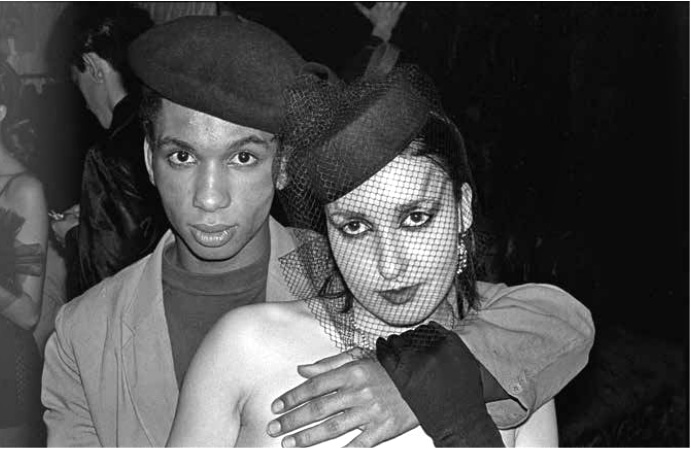
Andy Polaris , Billy's club, Derek Ridgers, nightlife

Future singer Andy Polaris and Sue at Billy’s in 1978. (Photograph © by Derek Ridgers)

FRONT PAGE