Monthly Archives: May 2012

➤ The day Gary Kemp reduced hard-nosed Guardianistas to tears

+++
◼ AS WITH ANY ARTICLE AT THE GRAUNIAD about New Romantic cheerleaders Spandau Ballet, the resulting comments published online are always riotously entertaining. This is the one band that really winds up Guardianistas to a pitch of fury. When the 80s band announced their reunion tour in 2009, Michael Hann declared how much he’s always loathed them in a Graudina music blog which then provoked 342 comments — 342! — most of them apoplectic. How many other bands can claim such a following?
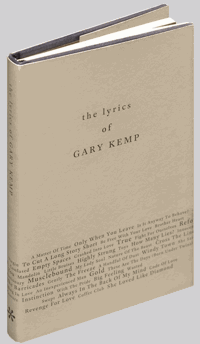
books, Lyrics of Gary Kemp,Lyric Book Company,

As it happens the Spandau songwriter has recently published an 88-page coffee-table book, titled The Lyrics of Gary Kemp from Lyric Book Company

Today for no apparent reason, the Guranaid runs an item about how Gary Kemp and Steve Norman made Spandau’s 1983 No1 hit True, in which lyricist Kemp admits: “I’m still berated for the line Take your seaside arms, but it’s straight out of Lolita by Vladimir Nabokov.”

Readers of Shapersofthe80s already know that the song was inspired by Kemp’s unrequited pash for poppette Clare Grogan — he was 22, she was 18 — who fronted an 80s band of Scottish cuties called Altered Images. On the same page, Steve Norman deconstructs his self-taught sax solo which has a key change in reply to Grover Washington’s Just The Two of Us.

All of which strangely prompts tearful blubbing at the Graun, rather than the usual explosion of acerbic outrage. Specimen comments follow after this gratuitous excuse to run a video…

VIDEO OF DARLING CLARE IN HER HEYDAY,
NOT TO MENTION SWIVEL-HIPS TICH

+++
➢ Meanwhile back to today’s Grauniad Online:
❏ Nietzsche39 (who else?) notes: “You don’t bastardise Nabokov. Seaside arms is absurd. Seaside limbs is genius.”

❏ Nepthsolem moans: “It always sounds to me like See side arms, as though referring to the service revolver I imagine was issued to all New Romantics, but sadly never used on TOTP.”

❏ DeeSawdeley says: “I always thought it was seaside aunt, which (for those of us with a seaside aunt, anyway) makes much more sense. Bet he wishes he’d written that now!”

❏ Stolencar comments: “Note also he says she gave him a copy of Lolita not that she had read it.”

❏ To which Vastariner responds: “There’s a picture of her reading it on the front of the Best Of Altered Images compilation released in 1991. Some might call me obsessed for knowing that, or because I have a username taken from one of her lyrics… etc etc.”

❏ From another planet, Golgafrinchan sobs: “I had unrequited love for Clare Grogan, still do to be fair. If you’re reading this Clare, get in touch, there’s still time.”

❏ DameHedwig adds: “I’ve often told my son that if things had worked out for me, Ms Grogan would be his Mum.”

❏ And Mccaugh: “As for the sublime Miss Grogan, well, just how many times did we go and see Gregory’s Girl? Helped, of course, by the fact that it ran at the Dominion Cinema in Edinburgh for three years non-stop.”

❏ Finally Bloodydoorsoff tells a despicable and blatant untruth about darling Clare, so you’ll just have to go to Grunadia Online to see it. And plenty more.

John Gordon Sinclair, Scott Neil), Clare Grogan, Glasgow Film Festival ,Gregory’s Girl

Glasgow Film Festival 2010: Darling Clare seen with Gregory’s Girl sidekick John Gordon Sinclair. In 1994 — sorry, lads — she married bandmate Stephen Lironi in Glasgow and today the couple live in Haringey, London, with their adopted daughter. (Photography by © Scott Neil)

FRONT PAGE

➤ Will Hawking give Sheldon the funniest bang since the Big One?

Jim Parsons , Sheldon Cooper , Stephen Hawking, Big Bang Theory, TV series, E4

Hero and uber-geek: Jim Parsons as Sheldon Cooper is clearly dead chuffed to meet Stephen Hawking as guest star on The Big Bang Theory

❚ “POSSIBLY, THE BEST EPISODE. EVER.” Let’s hope TVfanatic’s Carla Day isn’t overselling this week’s Series 5 episode 21 of the US’s highest rated comedy show. The States saw it last month, and Carla reported “non-stop laughs”. The Big Bang Theory is the cult comedy series that has come to define the age of Geek Chic. The sitcom revolves round four nerdy friends who all have impressive jobs and degrees in science. They play video games, collect comic memorabilia, discuss complex scientific topics.

Now TBBT can claim the ultimate accolade: the world’s most famous scientist steps up to guest star in The Hawking Excitation, which airs in the UK on Thursday (E4, 8pm). Yes, Britain’s 70-year-old cosmologist, Stephen Hawking, visits California to lecture at Caltech university (renowned as much for its practical jokers as its Nobel prizewinners). There, engineer Howard Wolowitz is given the job of maintaining his wheelchair. This makes theoretical physicist and uber-geek Dr Sheldon Cooper (played by Golden Globe and Emmy winner Jim Parsons) green with envy.

As the Prof’s most ardent admirer, Sheldon stops at nothing for the chance to share his hero’s “beautiful mind”, so his put-upon rival Howard sets Sheldon various tasks to earn a meeting with Hawking, and one is to walk into the cafeteria in a French maid’s costume. “What are you all staring at?” quips Sheldon. “You ever seen a man try to get a meeting with Stephen Hawking before?” The encounter itself produces a pretty ripe exchange between the pair of geniuses.

 Stephen Hawking ,Big Bang Theory,Simon Helberg,Kunal Nayyar,Jim Parsons,Johnny Galecki,E4

Let’s not forget Big Bang is an ensemble show: superstar Stephen Hawking is circled by satellites Leonard, Raj, Sheldon and Howard

Executive producer Bill Prady said: “When people would ask us who a dream guest star for the show would be, we would always joke and say Stephen Hawking — knowing that it was a long shot of astronomical proportions. In fact, we’re not exactly sure how we got him. It’s the kind of mystery that could only be understood by, say, a Stephen Hawking.”

Fact is however that Hawking has guested on Futurama and appeared more than once as himself in The Simpsons.

This week’s episode isn’t the only dream come true for Sheldon. In March the world’s most famous Vulcan actor, Leonard Nimoy, was heard when Star Trek’s Spock spoke to Sheldon in his sleep and deployed some snappy logic, as ever. And in 2010 Apple’s Steve Wozniak had a cameo in which he interacted with a virtual Sheldon who tells Wozniak he’s his “15th favourite technological visionary”. Only 15th, note.

Big Bang Theory, Leonard Nimoy, Jim Parsons,Sheldon Cooper,E4

Vulcan brothers: Jim Parsons brought some method acting to his role when Leonard Nimoy appeared on The Big Bang Theory this year

➢ Catch up online at 4OD with The Hawking Excitation until June 15

➢ David Hockney paints Stephen Hawking — watch a glittering new portrait emerge as a movie

FRONT PAGE

1928–2012 ➤ Sassoon’s revolution: No teasing. No hair spray. Just the cut.

Vidal Sassoon,the bob, Mary Quant, hairstyles

1963: Sassoon creates the “bob” on designer Mary Quant. (Photo: Getty)

“He revolutionised not just hair but fashion” — model-turned-Vogue fashion editor Grace Coddington

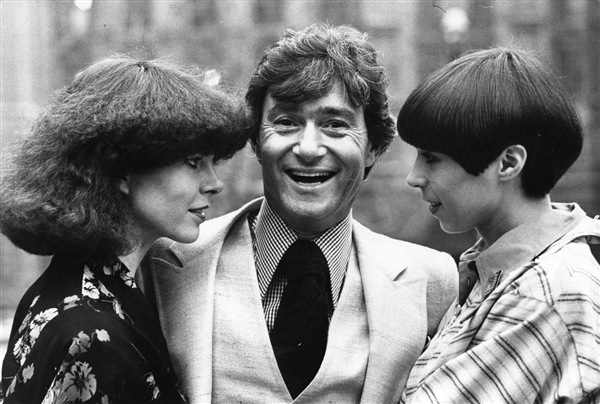
Vidal Sassoon , Albert Hall,

Comeback 1975: Vidal Sassoon between two contrasting examples of his hairdressing for a teach-in at the Albert Hall, where he returned to hairdressing after a five-year break. (Photograph by Tim Graham / Getty)

➢ The Daily Telegraph reports the death at 84 of celebrity hairstylist Vidal Sassoon, whose 1960s wash-and-wear cuts freed women from the tyranny of hairspray…

Vidal Sassoon, who was found dead at home on Wednesday, was at the cutting edge – literally and metaphorically – of hairdressing. His sharp, geometric, low-maintenance 1960s hairstyles revolutionised his craft, sounding the death knell for the stiff, set hairdos of the 1950s. An astute businessman, he made a fortune from his salons and products, and became a household name. “I wanted to eliminate the superfluous and get to the basic angles of cut and shape,” he said… / continued online

+++
❏ Craig Teper’s 2010 documentary Vidal Sassoon: The Movie follows the true rags-to-riches tale of how a boy from a London orphanage went on to open his own Bond Street salon in 1958 and — influenced by the Bauhaus designs he had studied — he create the “shape” that became his signature cut, the five-point bob. It revolutionised hairdressing. His geometric wash-and-wear cuts marked the end of the beehive and the bouffant hair styles of the 50s. Admirers included the Duchess of Bedford, model Jean Shrimpton, actor Terence Stamp, and film star Mia Farrow. In 1963 he devised the classic “bob” for fashion designer Mary Quant, who called him the “Chanel of hair”. By 1964 he’d gone international by opening his first salon in New York.

Vidal Sassoon, Movie

Sassoon The Movie: the London crimper freed women from 50s bouffants by pioneering the low-maintenance hairstyles that defined the 60s

FRONT PAGE

➤ Sukita-san’s eye view of the weird world according to Bowie

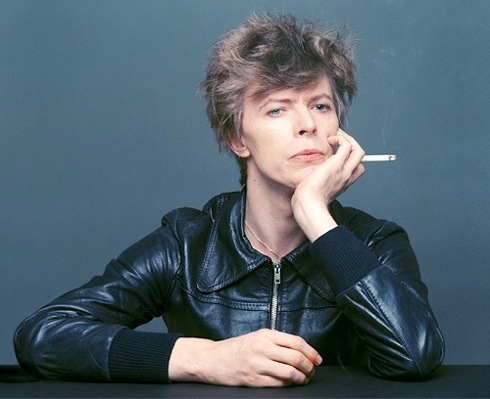
David Bowie, Masayoshi Sukita,Speed of Life, Genesis Publications,

Heroes-era Bowie in 1977 © by Masayoshi Sukita

David Bowie,Yamamoto Sukita, Kansai Yamamoto ,Speed of Life, Genesis Publications

Bowie as Ziggy in 1973 costumed by Kansai Yamamoto and photographed © by Masayoshi Sukita

❚ HERE WE SEE CLASSIC PIX of the early glam incarnations that broke the rules of rock and roll and put the gender-bending David Bowie into the headlines. Since 1972 Japanese photographer Masayoshi Sukita has gone on capturing the prolific flow of creations from the ever-inventive Bowie. This week in London his long-awaited book Speed of Life documenting their 40-year collaboration is launched by Genesis Publications in its 2,000-copy limited edition. Signed by both Bowie and Sukita, it is priced at £360 ($581) for 300 pages which they caption with their own recollections and memories. Bowie says: “It’s very hard for me to accept that Sukita-san has been snapping away at me since 1972 but that really is the case… May he click into eternity.”

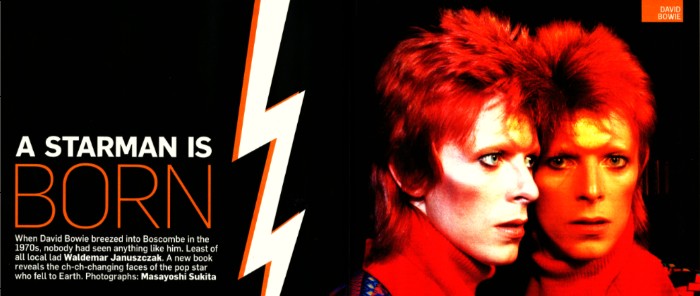
Meanwhile in today’s Sunday Times Magazine art critic Waldemar Januszczak recalls his teenage outing in 5-inch platforms when he paid 90p on the door of Starkers in Boscombe, Dorset, to discover the eye-popping mystique of Ziggy Stardust in August 1972 — minutes after Sukita the photographer arrived in Britain and caught Bowie’s shock show at London’s Royal Festival Hall. He described it as “like an astronomer finding a new planet”.

David Bowie, Masayoshi Sukita,Speed of Life, Genesis Publications,

Today’s Sunday Times Magazine: Bowie in 1972 © by Masayoshi Sukita

Januszczak writes: “It was Andy Warhol who invented the immensely attractive cultural idea that anyone could be whoever they wanted to be. It became Bowie’s big idea as well. And the tour he set out on in 1972 featured his most determined efforts yet to become lots of people at once: Ziggy Stardust, Aladdin Sane, Major Tom, The Man Who Saved the World. That was just the beginning. The bewildering multi-identitied career photographed for us so sympathtically by Sukita-san in Speed of Life features enough different David Bowies to constitute a football crowd…”

David Bowie, Masayoshi Sukita,Speed of Life, Genesis Publications,

Bowie in 1989 © by Masayoshi Sukita

Above images copyright Masayoshi Sukita, courtesy Genesis Publications

David Bowie, Masayoshi Sukita,Speed of Life, Genesis Publications,

Sukita then and now: left, with Bowie in the 70s

MAY 8: INVETERATE LIGGERS AT THE LONDON
BOOK LAUNCH PARTY

Paul Simper, Steve Norman, Bowie, Sukita, books, Speed of Life,Genesis Publications,Dover Street Arts Club,

Lads insane: The Spand sax-man also known as Spiny Norman ingratiates himself with Ballet biographer Paul “Scoop” Simper at tonight’s Speed of Life book launch. Spandau’s own official photo-book is promised for 2013 from Genesis Publications. Photograph by © Shapersofthe80s

➢ Condé Nast president Nick Coleridge tells book-launch party of his teen obsession with Bowie and his encounter with Angie — Evening Standard Diary, May 9

FRONT PAGE

➤ Shapersofthe80s is declared an “invaluable website” by British historian

“winter of discontent” ,  Leicester Square, strikes,

Britain’s infamous “winter of discontent” that brought down the Labour government in 1979: as public service workers went on strike, rubbish piled-up even in London’s Leicester Square

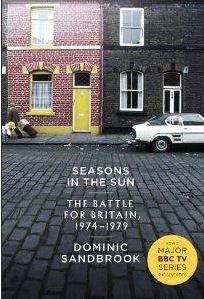
Seasons in the Sun,Battle for Britain, Dominic Sandbrook, books, history, Allen Lane,❚ AN “INVALUABLE WEBSITE” — this is the verdict on Shapersofthe80s by historian Dominic Sandbrook, author of the rich new cultural analysis, Seasons in the Sun: The Battle for Britain, 1974–1979. It’s a doorstep of a book, yet highly readable, which reveals numerous upbeat aspects to the chaotic decade many write off as worthless.

Chapter 31 is especially inspirational! Sandbrook gives generous credit to key characters who Shapersofthe80s has long maintained deserve recognition as movers and shapers pivotal to the energy of the 80s. And, having quoted chunks from our own texts, the historian gives due acknowledgement in his extensive bibliography. Indeed, the scope of his research is more impressive than for much other contemporary history, as Sandbrook not only cites political and economic mandarins, but also sifts fine detail from popular culture and eye-witness reportage across the whole social spectrum.

Sandbrook writes: “Behind the lurid news stories, the late 1970s were the decisive point in our recent history. Across the country, a profound argument about the future of the nation was being played out, not just in families and schools but in everything from episodes of Doctor Who to singles by the Clash. These years marked the peak of trade union power and the apogee of an old working-class Britain – but they also saw the birth of home computers, the rise of the ready meal and the triumph of a Grantham grocer’s daughter who would change our history for ever”

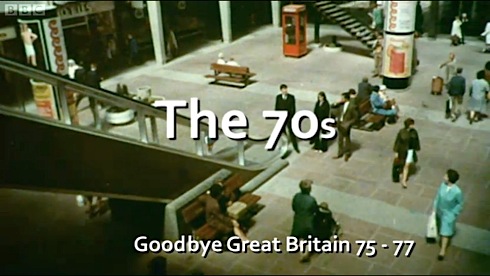
Seasons in the Sun is the fourth title in Sandbrook’s survey of postwar Britain. His unstuffy combination of high and low life is behind the BBC2 series The Seventies currently viewable live and on iPlayer.

BBC2 series The Seventies,Seasons in the Sun ,Dominic Sandbrook

Sandbrook’s Seasons in the Sun forms the basis of the current BBC2 TV series The Seventies

REVIEWS OF SEASONS IN THE SUN

❏ “The first three volumes of Dominic Sandbrook’s epic history of Britain between 1956 and 1979 were exceptionally good. The fourth, Seasons in the Sun, is magnificent … marked by its pace, style, wit, narrative and characterisation as by its exhaustive research.” — Roger Hutchinson, Scotsman

❏ “Sandbrook has created a specific style of narrative history, blending high politics, social change and popular culture … his books are always readable and assured, and Seasons in the Sun is no exception … Anyone who genuinely believes we have never been so badly governed should read this splendid book.” — Stephen Robinson, Sunday Times

1977, Jayaben Desai, Grunwick, strike, picket

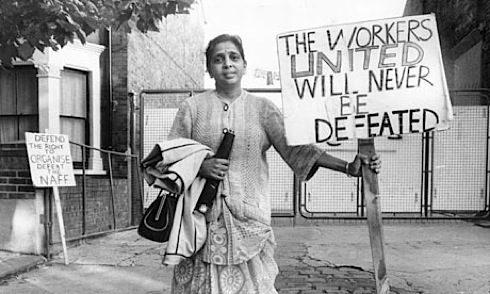
August 1977: Jayaben Desai, treasurer of the strike committee at the Grunwick photo-processing plant, had been picketing for a year, supported by white, male trade unionists while postmen blocked the company’s mail. (Photograph by Graham Wood/Getty)

EVEN WIDER PERSPECTIVE FROM LEADING PLAYWRIGHT

➢ Playwright David Edgar draws together the Sandbrook quartet in The Guardian, May 9, 2012: The 1970s was the moment when our century arrived… As Sandbrook insists, the women’s liberation movement was as much about Hull’s fishermen’s wives and female machinists at Ford Dagenham as feminist activists disrupting Miss World. In 1971, workers campaigning against the closure of Upper Clyde Shipbuilders borrowed the student tactic of the sit-in. As 1970s chronicler Andy Beckett argues, the gay groups who stood shoulder to shoulder with trade unionists outside Grunwick prefigured an alliance which “would become commonplace in the decade to come”. The identity politics that were to become such a satirised feature of the left of the 1970s arose not just out of campus and culture but class war… / continued at Guardian online

FRONT PAGE