Tag Archives: Stephen Linard

➤ INDEX of posts for June 2011

Boy George, 50th birthday,Jon Moss, Barbara Moss,

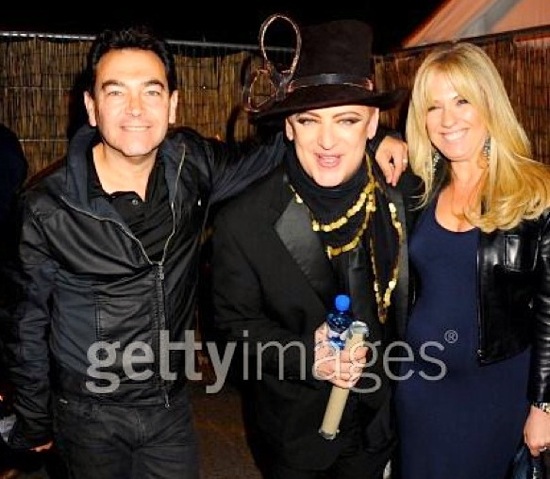
That Man in the Middle: George O’Dowd at his 50th birthday party with former Culture Club drummer and father of three children, Jon Moss and his wife Barbara. © Dave Benett/Getty

➢ Jarvis takes his lyrics to Eliot’s publisher Faber — video interview with Pulp’s songwriter

➢ Too cool to crow — Paradise Point just happen to be gigging in Hyde Park before Grace and Pulp top the bill

➢ Lest we forget: man has changed his ways since Peter Wyngarde cracked the sickest joke on vinyl

➢ Irrational, Professor Cox! Discussing science in a tent at Glastonbury?

➢ Martin Kemp’s Stalker gets autumn DVD release

➢ Will the magical blasts from the past follow St Martin’s out of Soho? Plus — Pulp’s finest hour at the art school’s farewell party

➢ Heaven 17 remind us how electronic music can send the soul soaring!

➢ The Blitz Kids WATN? No 28: Stephen Linard, fashion designer

➢ Hot days, cool nights, as Blue Rondo join the new Brits changing the pop charts — first glimpse of the crazy seven-piece as the 1981 charts fill with the new British pop

Pepsi DeMacque, Shirlie Holliman, Pepsi & Shirlie, then and now,Here & Now, tour

Back on tour: Pepsi & Shirlie in 1987, and this year photographed by Shirlie Kemp’s daughter, Harleymoon

➢ When Shirl asked Peps if she fancied an arena tour, Peps said to Shirl, Why not? — TV interview

➢ EPIC forecasts for the 2015 media landscape loom closer than we think

➢ Aside from the freaks, George, who else came to your 50th birthday party?

➢ One million people think Charlie really is SoCoolLike — meet  the UK’s most popular YouTuber

➢ 1904, The day Nora made a man of Joyce — Bloomsday celebrated

➢ Boy George hits the big Five-0 and he now says, yes, he has ‘lots of regrets’

Paradise Point, Run In Circles , video, Cameron Jones,pop music

Cameron Jones: Paradise Point vocalist

➢ Hear about the many lives of Midge Ure, the Mr Nice of pop — This Is Your Life, 2001

➢ Wise-cracking Sallon shimmies back onto London’s party scene — Boy George’s best friend recovers after assault

➢ Mix your own version of Bowie’s Golden Years with a new iPhone app

➢ 2010, Lady Gaga ousts Lily Allen as UK’s most played artist

➢ Martin Rushent is dead — friends pay tribute to the man who made stars of the Human League and shaped the sound of 80s electro-pop

➢ What happens when retromania exhausts our pop past — Simon Reynolds on our compulsion to relive and reconsume pop history

➢ Up close and cool — Paradise Point’s first official video wins Boy George’s approval

Farewell St Martin’s, Pulp, Jarvis Cocker,University of the Arts, CSM,

Pulp playing at St Martin’s: Jarvis Cocker bids farewell to his old art school at the best party for years. Grabbed from gstogdon’s YouTube video

FRONT PAGE

➤ The Blitz Kids WATN? No 28, Stephen Linard

drakes-london,Stephen Linard,British tailoring, haberdashery,Drake’s,Michael Hill,luxury shops, Clifford Street , London

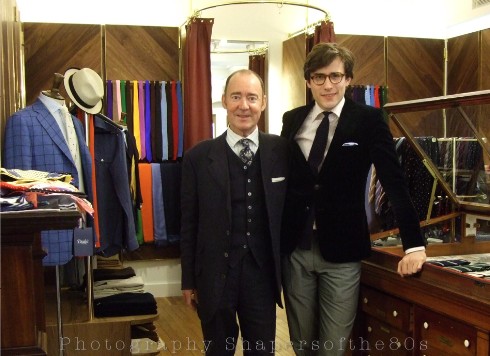
Former Blitz Kid and St Martin’s fashion graduate Stephen Linard: today he is a designer with Drake’s, the gentlemen’s haberdasher, seen here at a staff preview for the opening of its first shop just off Savile Row. Photographed © by Shapersofthe80s

❚ WACKIEST AMONG THE 80s BLITZ KID RACERS was Stephen Linard, the Essex boy who nevertheless graduated from St Martin’s art school with a first-class degree in menswear 30 years ago this summer. Modelled by six of his hunky clubland pals, his collection titled Reluctant Emigrés featured swishy draped greatcoats, pinstripe trousers and city shirts that all evinced an Edwardian air of immaculate tailoring while declaring edgy details with organza and contrast patches. Amid the women’s outfits shown by most of the other fashion graduates, Linard’s chic street-savvy lads had a gasp-out-loud impact, as commentator Suzy Menkes noted after the show. The influential South Molton Street shop Browns immediately wanted to develop the range, but Stephen decided instead to sell his original garments to a short-lived synthpop band called Animal Magnet. “I needed the money,” he says now in a shocking confession of short-termism.

A hugely original and resourceful talent, Stephen was feted by the fashion press upon graduation. His high-visibility fashion leads were key among the 15 sharpest Blitz Kids who shaped the New Romantics silhouette from Covent Garden’s Blitz club — Stephen Jones, Kim Bowen, Lee Sheldrick, Helen Robinson, Melissa Caplan, Fiona Dealey, Judi Frankland, Michele Clapton, David Holah, Stevie Stewart, Julia Fodor, Dinny Hall, Simon Withers and über-wag Chris Sullivan were the others. Most significantly, Linard advertised his bizarre imagination by changing his appearance on an almost daily basis, from his foppish Fauntleroy dandy, to the Endangered Species outfit made from animal skins, to the Bonnie Prince Charlie tartans copied for his character in Worried About the Boy, last year’s TV biodrama on Boy George, who became a soulmate the moment Stephen walked into Billy’s club, where the Swinging 80s were hatched in 1978.

Click any pic below to enlarge Linard’s degree collection 1981:


So… where is he now, the dignified Stephen Linard pictured this month sporting a three-button, three-piece linen suit in a faded shade of indigo, and handmade in Venice? Well, since 1989 Stephen has been on the design team at Drake’s, the respected men’s haberdasher which has just opened its first shop at No 3 Clifford Street, just off Savile Row, the global epicentre of serious tailoring. Those with fond memories of Bowring Arundel & Co — for whom Stephen’s late father once supplied handmade leather goods — have welcomed the arrival of the new shop.  Though Drake’s was founded in 1977, the firm has never had its own retail outlet.

Michael Drake, a former head of design at Aquascutum, was its co-founder (and incidentally, “my grandmother’s nephew,” Stephen said). He began making the finest accessories, from cashmere scarves and printed silk handkerchiefs to knitwear, shirts and the elegant neckwear that has made Drake’s the largest independent producer of handmade ties in England. It enjoys a prodigious export market, by designing collections for international luxury shops and collaborating with such style-leaders as the Japanese fashion label Commes des Garçons.

drakes-london,British tailoring, Clifford Street,London, Michael Drake, handmade ties, haberdashery,Adam Dant

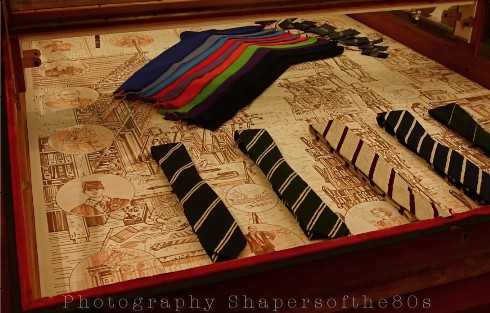
The young Linard by artist Adam Dant: lining this antique vitrine at Drake’s new shop is a busy tableau of life at the firm’s Clerkenwell factory. At lower left we see a youthful portrait of the designer alongside some of the handmade ties in fine Shantung silk Drake’s is renowned for. Photographed © by Shapersofthe80s

Today the creative director Michael Hill encourages his designers to refresh the seasonal ranges with new textiles, both for readymade production and for bespoke handcrafting at Drake’s workrooms in the artisan quarter of Georgian Clerkenwell. A revival of bespoke suit-making has seen a new appetite for accessories in raw shantung and Indian tussah silk — its slubbed texture playing well with both formal suits and casual jackets — as well as traditional madder silk from Macclesfield in Cheshire, where Stephen is a frequent visitor ensuring that exacting standards are met.

A stylish touch to Drake’s new strategy has been to recruit the impish graphic artist Adam Dant, whose witty drawings adorn the shop and the stylishly written Drake’s website. In particular it commissioned him to create one of the Hogarthian “mockuments” which won him the Jerwood Prize. Rather like flowcharts, these reveal the inner workings of an institution and its people, and Dant’s depiction of Drake’s Clerkenwell factory provides the lining to one antique vitrine, formerly property of the Victoria and Albert museum and now in Clifford Street, displaying shantung ties and enormously long (in the Italian style) knee-socks.

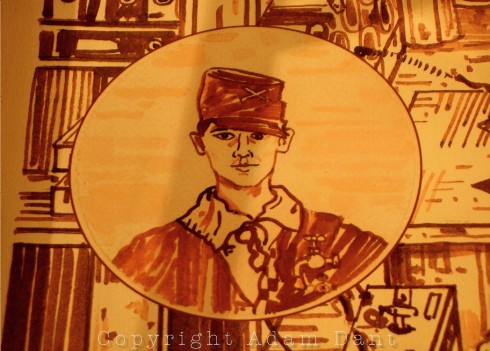
Included among Dant’s portraits of colleagues who are said to have influenced Michael Drake is Stephen Linard’s and it echoes an emblematic photograph published in i-D magazine in which he wears a Yohji jacket and jaunty Confederate Army leather cap, “bought in Anchorage airport in the days when I was rich — bathtubs filled with champagne”. This is a reminder of the period 1983–86 when he lived in Tokyo designing for Jun Co, the fashion giant, on a salary which, he liked to boast, exceeded the prime minister Margaret Thatcher’s. In the mid-80s, to be an English designer brought you popstar status in Japan, as those fellow Blitz Kids Stephen Jones and Lee Sheldrick also discovered.

drakes-london,British tailoring, Clifford Street,London, Michael Drake, handmade ties, haberdashery,Adam Dant

Close-up of the portrait: Linard is one of many talents associated with Drake’s who have been captured by the artist Adam Dant. His reference was a photograph dating from 1983 — note the ornamental bath tap. Courtesy of Adam Dant and Drake’s

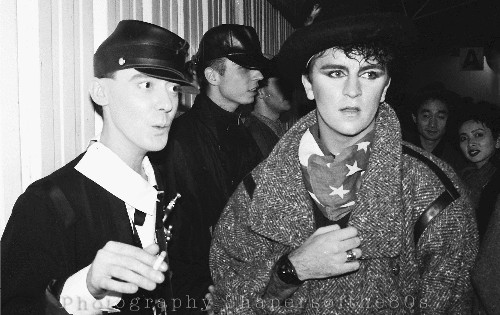
The 1983 look that inspired the portrait: Stephen Linard sports a leather Confederate Army cap $15 from Alaska, and Yohji Yamamoto jacket £250, over giant-collared Yohji shirt £120. Artfully placed on his left lapel is a silvered bathroom tap £60 and faucet brooch £40, both from a jewellery collection for Chloe, Paris. Seen here with Lee Sheldrick (rear) and Steve Strange at the Worlds End fashion show in Paris that October. Photographed © by Shapersofthe80s

Long before he joined the “Japanese invasion” effected by Britain’s emergent new wave of streetwise fashionistas, Stephen had gained the admiration of the international fashion glossies. With 1983 came his collection Angels With Dirty Faces, inspired by the Bogart-Cagney gangster movie set in the 30s depression. It was both pretty and poignant and it sold worldwide. That year, the snappiest magazine of the day, New York, headlined a special fashion section The British Are Here, and selected as the UK’s five leading lights Jean Muir, Zandra Rhodes, Katharine Hamnett, Vivienne Westwood — and Stephen Linard, “one of the most creative of the young designers”.

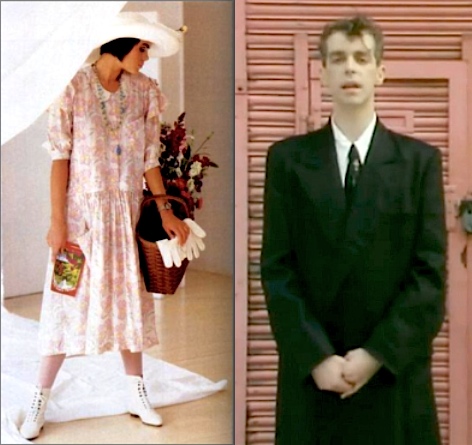
Linard designs from his heyday: bias-cut tea dress, $100 in Bloomingdale’s, from his 1983 Angels With Dirty Faces collection, here photographed by Tony McGee for New York magazine. Right, Neil Tennant wears a Reluctant Emigrés topcoat by Linard in the Pet Shop Boys video for West End Girls (Parlophone 1984)

Stephen’s clothes had always been sought after by his popstar contemporaries from Spandau Ballet, Boy George and The Slits, to U2, Womack & Womack, even Cliff Richard and Johnny Mathis, and ultimately to the great god David Bowie himself. (Stephen had to turn down the invitation to go on location to appear in the Ashes to Ashes video in 1980 “because I was on a disciplinary warning at St Martin’s over attendance”!) His Reluctant Emigrés collection enjoyed a curiously long life and in 1984 we see Neil Tennant lording it in one of the black linen topcoats in the Pet Shop Boys video for West End Girls, their first single which went to No 1 in the UK and US.

Many Linard looks have been coveted by the fashionistas but, as with so many gifted designers, let’s say a head for business came second to his eye for fashion. The timing of funds hit the rocks in more than one of Stephen’s creatively successful ventures, and decades ago he complained loudly that the St Martin’s fashion department didn’t do enough to equip graduates with basic business skills. (This, we are assured, has since been addressed by the college.) In the end it wasn’t surprising that he accepted the offer to join the Drake’s family, which seems to have dealt him a lucky hand.

One tip for wearing the perfect handmade tie? “Never tuck the smaller blade through the ‘keeper’— the loop on the back of the large blade. Much more stylish to let it flap free. Like undoing the button-cuff on your jacket, to show you don’t care.”

drakes-london,British tailoring, Clifford Street,London,Augustin Vidor, Michael Drake, handmade ties, haberdashery,Stephen Linard

The new shop in Clifford Street: Linard joined the Drake’s design team in 1989 whereas sales assistant Augustin Vidor is currently an intern. Photographed © by Shapersofthe80s

FRONT PAGE

1980 ➤ 2010, the stage magic that inspires Romantics ancient and Neo

An exceptional cabaret performer called Taylor Mac
hit London this week in 2010. He subverted not only
theatrical conventions but several classic Bowie songs
to glorious effect. His shimmering presence sent out
echoes of how we defined itzy-Blitzy when 1980 dawned…
Billy’s club,Helen Robinson, nightlife, London ,Steve Strange, PX

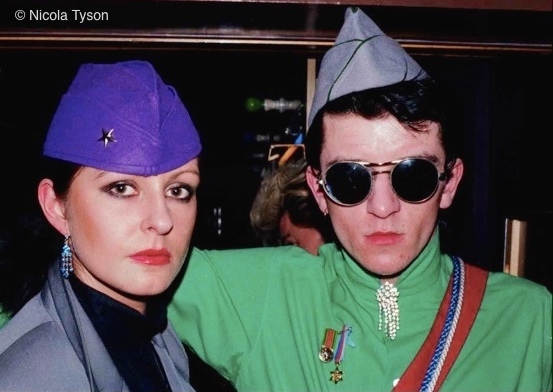
Billy’s club 1978: Strange as Ruritanian Space Cadet alongside PX designer Helen Robinson. (Photograph by © Nicola Tyson)

❚ LET’S RECALL WHAT MADE THE BLITZ KIDS unique in 1980. Singer Andy Polaris said soon after: “Anyone who thought it was all a pantomime got the wrong end of the Pan Stik. Blitz people had to be larger than life. It was a compulsion. If it doesn’t possess you, you can’t acquire it.”

An evening within the orbit of London’s Blitz club superstars – and we’re talking about 50 people here – was more than entertaining. You were zapped with a very tangible electric shock – what we’d call today “sensory overload” – as if these exquisite, compulsive posers had revitalised Gilbert & George’s notion from 1969 of processing through the world as living sculptures. The Blitz Kids generated their own crackling versions of hyper-reality that defined the space around them. They included Kim, Julia, Judi, Melissa, Fiona, Jayne, Theresa, Myra, Scarlett, Clare, Michele, Darla, Sade, Kate, Stevie, Naomi, Mandy, Helen, Jo, Perri, Christine and Franceska . . . the Stephens Linard and Jones, Lee, John, Cerith, Simon, Iain, Andy, George, Marilyn, Wilf, Greg, Jeffrey, Christos, Graham, Neil, Dencil, Robert, the Holah brothers, the Richards Ostell and Sharah. A fair few other Blitz Kids, like Strange, Egan, Elms, Sullivan, Dagger, Haines, Ure, O’Donnell, Mole, Ball and Lewis, had the motormouth skills of energetic talkers and schemers who were, as we say today, “good in the room”. Above all, the best among them “made things happen” wherever they set foot. That’s why spending time with them was the best kind of fun – stimulating, argumentative and constructive, whether idling at a bar or bounding around the beach on Bournemouth bank holidays.

Kim Bowen, Stephen Linard, Blitz Kids, London

Doyennes among the Blitz Kids, 1980: Kim Bowen and Stephen Linard stamp themselves on that week’s zombie leitmotif. Photographed © by Derek Ridgers

Even so, what marked out the fashionistas especially was that, not only in the club, but in shop, café and bus, the style stars were constantly emitting auras of the force you imagined once surrounded Dietrich or Garland or Bogart or Caine. There’s nothing accidental about style. It is by definition a considered stance. In the presence of the Blitz superstars you could hold up your hands and almost feel the crumpet-toasting tingle. Even jaded Londoners turned their heads when Kim walked the half mile from Warren Street to St Martin’s school of art swathed only in surgical bandages. Or when George paraded past Buckingham Palace as a helmeted and toga’d Britannia at the annual royal ceremony of trooping the colour.
Princess Julia, Chris Sullivan, deejays, Vintage 2011,Southbank Centre, clubbing

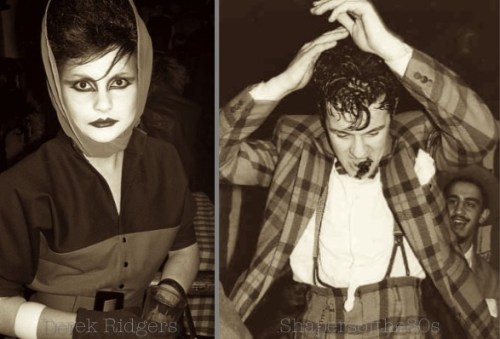
Vintage deejays: original Blitz Kids such as Princess Julia and Chris Sullivan have continued spinning the vinyl that recreated legendary 80s club soundtracks from the Blitz to the Wag

Wherever there was a party, premiere, exhibition or club opening you’d see a dozen more such creatures who lived hyper-reality 24 hours a day… Lee perhaps as Nosferatu, Julia as Bride of Frankenstein, Fiona saying “Non!” to couture by wearing a grosgrain coat back-to-front, Sullivan as 1920s cad, blue-lipped Linard as 1920s flapper, Marilyn as, well, Monroe, Stewart as geisha boy, Theresa as Little Bo Peep, a part she played at work in the Fleet Street offices where our paths often crossed.

Aplomb came naturally to Kim Bowen as the queen of the Blitz Kids. One night when some friends came back to mine after celebrating my birthday, Kim walked into the kitchen and said: “I’m not going to let you live with this wallpaper one more day.” She picked at the edge of a stiff vinyl-coated strip, printed with very 1960s pepperpots and pans. Then she ripped it off the wall in one heave. The kitchen walls were bare within 20 minutes. Kim declared: “Minimalism, David, that’s you need.”
Clare Thom, Michele Clapton, Blitz Kids

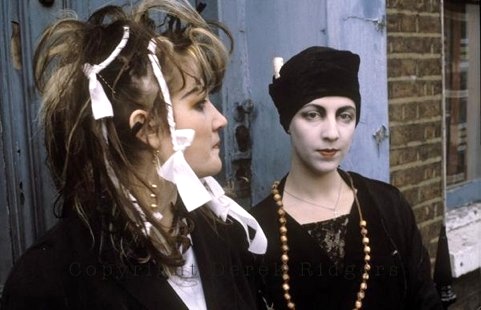
Blitz Kid style: Outside the Carburton Street squat, Clare-with-the-Hair and Michele Clapton displaying awesome repose. Photographed © by Derek Ridgers

As time would reveal, the lead Blitz Kids outflanked not only their peers, but most of the copyists who followed their Bowie-inspired passion for change. You’d find the second-league clubbers at Studio 21 in Oxford Street, or in a back barrel at Birmingham’s Rum Runner – those were the self-proclaimed New Romantics you see dancing in the YouTube videos, and being photographed wearing too much of everything, from Boots No 7 to lacy frills. A couple of years after the Blitz caravanserai had passed, designer Fiona Dealey said candidly: “You look at these little Bat-people with it dribbling down their necks and you feel like saying, ‘Sorry darling, not enough loose powder’. The difference was that our make-up was stage slap, Leichner not Factor. The clothes came from a costumier, Charles Fox, not Flip. Dressing for the Blitz was real theatre. It wasn’t just another uniform. You felt glamorous.”
Stephen Jones, Blitz Kids

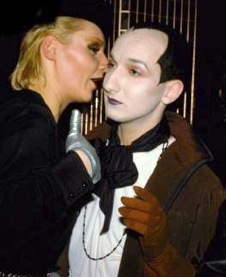
Immaculate: Hatter Stephen Jones

Aha, real theatre! This is the realm Shakespeare championed as “an improbable fiction” and John Updike blasted as the “unreality of painted people”. A flesh-and-blood craft where the basic requirement is for a living audience to be watching living actors. The Blitz Kids fully understood what Shakespeare’s Player has to explain to Rosencrantz and Guildenstern in Tom Stoppard’s spoof version of Hamlet: “We’re actors. We’re the opposite of people.” Actors pledge themselves to the belief that somebody will be watching. Nothing to do with vanity. Entirely a means of confirming their identity. Ditto the Blitz Kids.

The digital natives (and the self-styled Neo Romantics) of Generation Z who today are being raised on computer shoot-em-ups and quaking cinema enjoy precious little exposure to live theatre, to the “magic” that emanates from the contract eagerly agreed between actor and audience – for the one to perform at the same time as the other watches. Only when, as one towering example, Sir Michael Gambon allows a Pinteresque pause to elapse onstage can auras crackle “in the moment” with sufficient intensity to be felt physically, and thrillingly, by a theatre audience. Gambon’s aura crackled like a fire god’s last Christmas in No Man’s Land, before a wrapt audience the day after its author Harold Pinter had died.
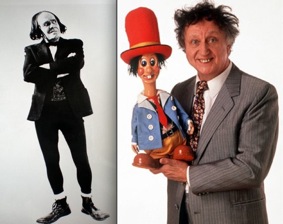
Max Wall, Ken Dodd

Masters of the comedian’s art: Max Wall and Ken Dodd

Comedy is where the theatrical contract of give-and-take fights for life most ostentatiously. As you laugh helplessly at the veteran comic Ken Dodd’s rapid-fire patter, you needn’t know that he has subjected his live stand-up routine to a lifelong time-and-motion study that concluded he must hurl eight gags per minute at his audiences to ensure everybody laughs at least once every minute he’s onstage.

Travesties, Tom Stoppard, theatre

Travesties: what a coincidence that in 1917 the revolutionary Lenin, the novelist James Joyce and the Dadaist poet Tristan Tzara all happened to live in Zurich

In London in 1982 it was no less a pleasure to witness the top-of-the-bill variety legend Max Wall give wondrous live masterclasses entitled An Evening with Max Wall in which, aged 74, he laid bare how comedic timing works from one second to the next, how facial expression and vocal cadence, as well as silly walks can turn laughter instantly on and also off. Demonstrating with us as guinea-pigs how performer’s and viewer’s mutual responses keep each other on their toes.

The playwright Tom Stoppard has spent his career writing pyrotechnic scripts that read wittily enough sitting on the page, but are transformed several hundredfold the moment they are enacted on the stage, by for example exploiting the improbability of time-warps where the actors and the action are rewound and rerun in “unreal time” – actors reverse back through doors to leave the stage and re-enter immediately giving a subtly adjusted performance – as in Travesties, his hilarious comedy of coincidence. His plays are overtly “about” theatricality, yet shrouded by the mischievous apologia that, as one of his characters ultimately insists, “It’s a mystery”.

☐++++++☐++++++☐

GETTING BACK TO Taylor Mac,
his little bit of itzy-Blitzy glitz gives
shape to all of the above

Taylor Mac, Glasgow, London, Bowie, Comparison is Violence,cabaret

Taylor Mac 2010: sequinned, painted and bewigged as Bowie-cum-Tiny Tim. Photographed © by Tim Hailand

SO WHERE MAY TODAY’S young Neo Romantic seek inspiration if he or she wishes to aim beyond the slap and the zhoosh to summon up solar-powered charisma of Blitz Kid proportions? The answer is in the UK right now (Soho Theatre London this week, The Arches in Glasgow next) and he is an incandescent and witty Californian called Taylor Mac.

TAYLOR MAC

Mac as himself

Clad in more sequins than a sultan’s harem could shake at you, he gives a full-throttle musical cabaret that is unexpectedly poignant, invigorating and original. You also laugh more than you ever did at Eddie Izzard’s last side-splitting tour. Mac’s audacious dissection of the essence of theatre, vaudeville and other performing arts evokes Merman and Garland, Wainwright and Brel while asserting his own unique brio. He reinvents pop classics by David Bowie and Tiny Tim (yes, you do remember his hits Tiptoe Through the Tulips and I’ve Never Seen a Straight Banana) by delivering them with an earnestness that moistens the tear-ducts. The evening’s ironic sub-title is The Ziggy Stardust Meets Tiny Tim Songbook, because these are the comparisons reviewers draw about Mac, yet they seldom remark on how he turns Starman and Heroes, those holy invocations of the 80s Bowie fan, into altogether heart-rendingly new songs.

His themes are love and longing and role-play and tolerance for what society calls a gender-bending misfit who sprang fully formed from the egg, craving the glue that fixes eyelashes. What results is the most stupendous spectacle, charged with insights as mere as how to signal the end of a song, one way being a sustained high note, another to deliver a wide-eyed “Cha-cha-cha!” through smiling teeth, but the coup de grace is a solemn downward arm gesture LIKE SO! For 90 minutes Mac fills the Soho Theatre many times over with a sustained rush of theatre magic. And yes of course he’s on YouTube, but that entirely defeats the point the past 1,700 words have been making.

➢➢ Read Donald Hutera’s London review of Mac
in The Times, June 3, 2010

➢➢ Read Charles Isherwood on Mac’s 2009 play
The Lily’s Revenge in the New York Times

FRONT PAGE