Tag Archives: Nick Knight

2023 ➤ The Blitz Kid poser who reshaped Eighties fashion

An exhibition of fashion legend Stephen Linard’s archive of drawings, photographs and garments runs for a month from 8 September and provides eye-opening insights into his startling influence on the other Blitz Kids and on the fashion jetset…

rel=nofollow

Ex-St Martin’s fashion designer Stephen Linard at the height of his commercial success in 1984, when he worked for three years for Jun Co in Japan. Here pictured by Toscani for i-D magazine’s issue No 15 in “An illustrated guide to detail”. He sports a leather Confederate Army cap $15 bought in transit through Anchorage airport in Alaska. The jacket £250 over giant-collared shirt £120, and trousers £200 are all by Yohji Yamamoto. Waistcoat £180 by Gianni Versace. Artfully placed on his left lapel is a silvered bathroom tap £60 and faucet brooch £40, both from a jewellery collection for Chloe, Paris. He said: “It was worth it for the stir it caused at the Paris collections.”

❚ THE PRESS CALLED THEM the New Romantics and the Blitz Kids, declaring the Eighties the Age of the Pose. Art-school tutor Rosetta Brooks compared their self-consciously styled poses to “street theatre ultimately extended into continuous performance as a post-punk embodiment of Gilbert and George in one person (the individualist).” Each poser, she believed, is a ready-made. Step forward fashion student Stephen Linard for ticking all the above boxes – a flamboyant Canvey Island boy from Southend School of Art (1975-78) who yearned to make a statement in every street or room he graced.

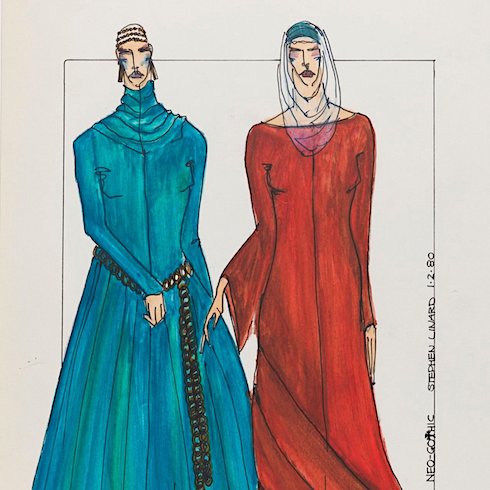
Arriving at St Martin’s School of Art in London (1978-81), Linard pushed the boundaries of excess. Annually, second-year students organised an Alternative Fashion Show but in May 1980 the college’s resoundingly prim middle-class students were out-gunned when Linard sent out his sensational Neon Gothic collection – a stark collision of Space 1999 meets liturgical Gothic meets the masonic livery which was displayed in shops serving the Freemasons’ Hall just along the street from the Blitz Club, the capital’s coolest nightspot.

The audience erupted in cheers. Strutting the runway to the Human League came the then-unknown George O’Dowd sporting a soaraway post-punk mullet atop sharp grosgrain suit with dog collar, Michele Clapton and Myra Falconer wearing risen-from-the-dead pallor beneath shaven heads, along with Fiona Dealey and Julia Fodor (today a Princess). Their vestments were accessorised with religious motifs while emanating a curiously spare chic. Finally, all in white as a “space-age pope”, came gifted Lee Sheldrick, modelling a white silk grosgrain suit with his head shaved bald to become the embodiment of Nosferatu the Vampyre. Resonances abounded for the show’s title to be adopted by the nascent Goth movement.
Stephen Linard, Total Fashion Victim, St Leonards on Sea, East Sussex, Graham Smith, Rogue Gallery, September 2023, exhibition, fashion illustrations, art for sale,

A stark collision of Space 1999 meets liturgical Gothic: Two robes from Stephen Linard’s sensational Neon Gothic collection in his second year at St Martin’s

One year later Linard was determined to submit menswear for his degree collection, despite the efforts of the head of the fashion department to insist on women’s wear. She actually threatened to eject Linard from the college until strong internal protests backing Linard’s pursuit of menswear ultimately prevailed. Modelled by six of his hunky clubland pals, his collection titled Reluctant Emigrés featured swishy draped cashmere greatcoats, patched pinstripe trousers and city shirts that all evinced an Edwardian air of immaculate tailoring punctuated with edgy details.

Linard’s street-savvy lads made a gasp-out-loud impact, as Fleet Street’s Suzy Menkes noted in print. Historians Alan J. Flux and Daryl F. Mallett have also written: “The clothes were instantly covetable, thoroughly masculine in an entirely new way, and electrifying as only the truly innovative can be.” Linard won his first-class Honours degree.

The fashion press feted him upon graduation. His outrageous fashion details flagged direction for the two dozen sharpest Blitz Kids who shaped the New Romantics silhouette from the Blitz onwards. Most significantly, Linard changed his own appearance daily from his foppish Fauntleroy dandy, to the Endangered Species outfit made from animal skins, to the cowboy gilded from hat to toe. Linard has admitted: “The competition pushed you on, especially Lee Sheldrick. At the Warren Street squat [where they lived] you might change what you were going to wear eight times on a Tuesday to try to outdo everyone else at the Blitz.”

Inspiration was all around. In 2020 Linard said: “The Blitz was an art students’ club. The place was choc-a-bloc with artists: Brian Clarke, Zandra Rhodes, Molly Parkin, Antony Price, Duggie Fields, Kevin Whitney and us because it was halfway between Central School and St Martin’s. People who said ‘Oh you Blitz Kids don’t DO anything’ were talking rubbish, because WE all did. We were the ones with our work in the glossy magazines long before the rest.”

Stephen Linard, Total Fashion Victim, St Martins School, degree show, Reluctant Emigres, menswear

Smiles from the press at Linard’s degree show: The Reluctant Emigrés wore pinstripe trousers in Savile Row fabrics and city shirts in feminine couture fabrics evoking Edwardiana. (Photo by Shapersofthe80s)

Linard’s styles had always been sought after by pop-star contemporaries from Spandau Ballet, Boy George, Frankie Goes to Hollywood, Haysi Fantayzee and The Slits, to U2, the Bee Gees, Womack & Womack, even Cliff Richard and Johnny Mathis, and ultimately to the great god David Bowie himself.

In 1982 the Railway Children collection of stripey Edwardian coats and frocks for school-girls became the first of Linard’s two womenswear collections. He was one of six budding British designers taken to Paris by Blitz Club host Steve Strange to help launch his Anvil album, but also to show that the English could be as stylish as the French – staged at Europe’s coolest nightclub, Le Palace.

Meanwhile Linard’s reputation went on growing among the international fashion set. 1983 brought his collection Angels with Dirty Faces, inspired by the Bogart-Cagney gangster movie set in the Thirties depression. It was both pretty and poignant and it sold worldwide. That year, the snappiest magazine of the day, New York, headlined a special fashion section “The British Are Here”, and selected as the UK’s five leading lights Jean Muir, Zandra Rhodes, Katharine Hamnett, Vivienne Westwood — and Stephen Linard, “one of the most creative of the young designers”.

As recently as 2018, Laird Borrelli-Persson was writing in Vogue online: “Stephen Linard deserves credit for many innovations in fashion and its presentation that we take for granted… One of the Blitz Kids whose dandyish ways had an outsize impact on 1980s style, his early work was distinguished not only by irreverence, but also by a strong sense of narrative… Linard insists his aim was not to cause outrage. ‘I was into doing couture stuff and I was ‘just making clothes,’ really, as Sonia Rykiel used to say’.”

PS: Since you ask, Total Fashion Victim was the name of the one-nighter Linard hosted at the Wag Club during the Eighties.

➢ The Total Fashion Victim exhibition is hosted by Ray Gange at the Rogue Gallery, 65 Norman Road, St Leonard’s On Sea TN38 0EG

rel="nofollow"

St Martin’s Alternative Fashion Show 1980: Linard’s Neon Gothic collection modelled by his most stylish Blitz Kid friends – from the left, Michele Clapton, George O’Dowd, Lee Sheldrick in white as a space-age pope, and Myra Falconer

➢ Previously at Shapersofthe80s: 1980, The year the Blitz Kids took their first steps into the headlines

POSTSCRIPT FROM i-D’s FIFTH ANNIVERSARY
Stephen Linard, Total Fashion Victim, i-D magazine, Nick Knight, photography, fashion,

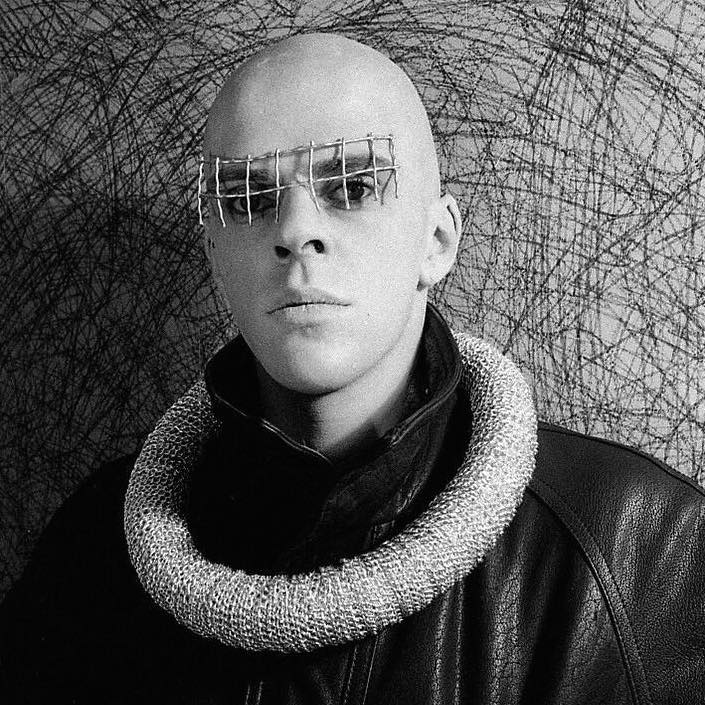
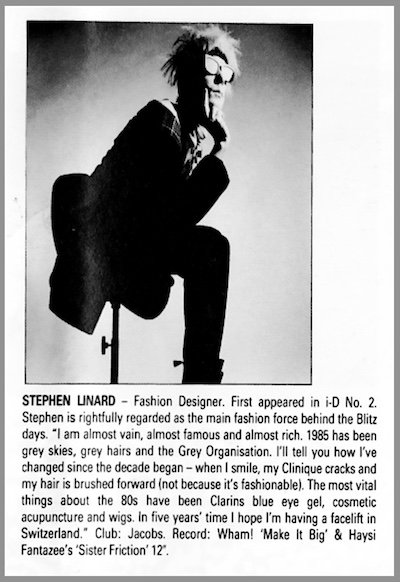
Stephen Linard seen in i-D magazine’s fifth birthday issue, No 30 in 1985, as one of their gallery of creative protagonists they titled 99 People of the 80s, all photographed by Nick Knight.

FRONT PAGE

➤ The makings of Scarlett, a perfect muse for the Eighties

DuoVision , Scarlett Woman, Photography, painting, sculpture, exhibition, Swinging Eighties, The Gallery Liverpool,

Scarlett Cannon at her preview: flanked by DuoVision curators James Lawler and Martin Green. (Photo © Melanie Smith)

WHICH ICON OF THE EIGHTIES catapulted herself to fame using a single name, sculpted hair and red lips? The clue is in the exhibition title just opened in Liverpool: Scarlett Woman. The Gallery in Stanhope Street is crammed with dozens of instantly recognisable images of her in all media – posters, prints, drawings, photos, videos, holograms, mosaics, sculpture and even painting. Fortunately the savviest interpreter of 80s style is at hand to make sense of the life and times of Scarlett Cannon, since she began fronting a club-night called Cha-Cha in 1981. In a guide to the exhibition, the lynchpin fashion editor Iain R Webb outlines how he promoted her career as model and muse.

He writes with intense concision: “It was a time of transformation and transgression, self-expression and collective empowerment. I was immediately taken by Scarlett’s uniqueness, an individual look being our club-kid rallying cry. With her startling peroxide blond haircut and a profile almost as flat as her reflection in the mirror she was magnificent!”

Scarlett says: “I wanted to look like a black and white photograph.” And Webb was happy to oblige, styling her in fashion spreads for BLITZ magazine. “She was an ideal made real, the perfect muse. We shared a common aim: to present our version of the world that celebrated difference and redefined beauty.” Scarlett, he reports, emerged from London’s demi-monde “artfully constructed from captured moments from yesteryear movies and imagined narratives. We made it up as we went along. . . Scarlett has always lived on the outskirts.” She adds: “It was extreme, we were really not afraid and we lived in a different world then.”

DuoVision , Scarlett Woman, The Gallery Liverpool,

Scarlett with Maude, alongside David Hiscock’s 1985 photograph, scarfed by Hermès. (Liverpool photo by Marc Albert)

Never before has there been such a perfect summary of the ingredients that made the Swinging Eighties unique, though Webb’s consummate book As Seen in Blitz: Fashioning ’80s Style came close in 2013. Coincidentally that was the year that Scarlett was visible across London as the poster girl for the V&A’s brave exhibition Club to Catwalk, a sharp retrospective nailing London fashion in the Eighties.

What’s impressive about the Liverpool retrospective mounted by the DuoVision team James Lawler and Martin Green is the number of artists whose work it embraces. . . Andrew Logan, Derek Jarman, Nick Knight, Robyn Beeche, Monica Curtin, Mark Lebon, Thomas Degen, Donald Urquhart, David Hiscock, Julian Kalinoswki, Sadie Lee, Judy Blame and others – most intriguingly the Polish expressionist painter Feliks Topolski, whose huge Punk Triptych makes a rare outing.

VIDEO TOUR BY MARK JORDAN

➢ Scarlett Woman runs until 15 September at The Gallery Liverpool, 41 Stanhope St, Liverpool, L8 5RE

➢ Gender-bending 1980s muse paints the town Scarlett – review in the Art Newspaper

➢ Previously at Shapers of the 80s: Scarlett from i-D cover girl to glamorous gardening mode

➢ Previously at Shapers of the 80s:
2013, Webb’s flipside of the 80s fashion revolution

DuoVision , Scarlett Woman, Photography, painting, sculpture, exhibition, Swinging Eighties, The Gallery Liverpool,

Scarlett Cannon with a slice of history: Feliks Topolski’s enormous Punk Triptych en route to Liverpool

REMEMBERING TOPOLSKI

➢ Feliks Topolski’s reputation reaches back to King George V’s silver jubilee while his monumental postwar mural of people and events called Topolski Century was unveiled by the Duke of Edinburgh and housed in the artist’s studio in the Hungerford Bridge arches beside the Festival Hall, where his legacy at Bar Topolski today is well worth a visit. His caricatures adorned the opening credits of John Freeman’s landmark series of TV interviews, Face to Face.

FRONT PAGE

2018 ➤ Judy Blame dies: cherry-picker of cultural detritus

Judy Blame ,Nicola Tyson,fashion, stylist, photography,

Judy Blame in 1983, photographed by Nicola Tyson

THE VERY DAY THIS WEEK WHEN HM THE QUEEN put a smile on the face of the British fashion industry, by attending London Fashion Week for the first time, also brought the sad news of Judy Blame’s death, aged 58. He (yes, he) was one of those self-taught iconoclasts who was acquiring a luminescent reputation in the electric 1980s when Fashion Week came into being, driven in part by the streetwise youth culture that Shapers of the 80s celebrates.

Blame shared friends with the charismatic Ray Petri whose flair gave kudos to the word “stylist” by injecting attitude and dash into the role of the humble gofer who gathered props and make-up for a photo shoot. This was the generation of creatives who asserted their urban savviness and shifted the word style itself from meaning a suspect and second-rate lure with which marketeers sold their wares. By the end of the decade, style and fashion had become distinct goals in their own right, the first announcing individuality in consumer choice and mainstream media, while fashion confirmed convention.

Blame’s own talents as an image-maker were celebrated in 2016 at an Institute of Contemporary Arts exhibition titled Never Again which displayed his DIY jewellery, objets trouvés, clothing, photomontages, sketchbooks and T-shirts, and gave insights into working with Neneh Cherry and Massive Attack.

➢ Pictures and fulsome tributes to Judy Blame
on our inside page

Born Chris Barnes in 1960, Blame died on 19 February 2018 and the tributes flowed in. Dylan Jones, editor-in-chief of GQ, wrote: “He was an artist, a genuine one, someone who could cherry-pick cultural detritus and then mix it all together to create something new, something lasting.”

Nick Knight, photographer and director of SHOWstudio, wrote: “Always totally unique, always a champion of the underdog, always fiercely anti-fascist and anti-establishment, always inspiring, always so immensely talented and always one hundred % brilliant.”

Scarlett Cannon, Blame’s dearest friend and partner in fronting the Cha-Cha club-night 1981-82, said: “I’m heartbroken but so happy to have had him in my life all these years. He left such a rich heritage of inspiration and touched so many people.”

Judy Blame,Scarlett Cannon, fashion, nightclubbing

Judy Blame with his long-standing friend Scarlett Cannon, and little Maude


➢ So much purpose. So much talent – Tribute by Paul Flynn at Guardian online, 20 Feb 2018

FRONT PAGE

➤ A big wink to i-D on its 30th birthday

i-d magazine,covers,30th anniversary, Then Now Next

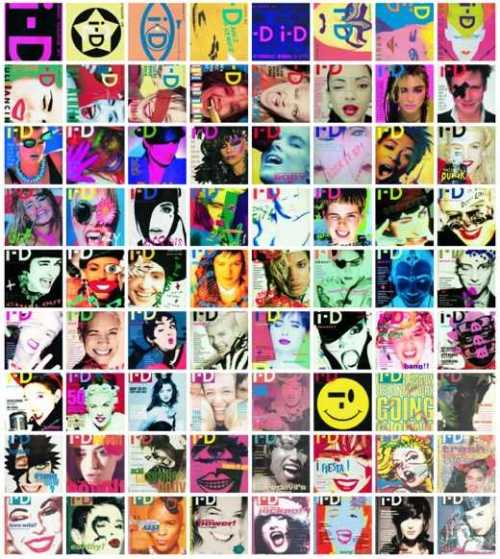
Launched August 1980: who’d have guessed that 72 covers and almost as many winkers later the magazine would have arrived at the end of its first decade?

❚ A MONTH AFTER i-D MAG’S LAUNCH in August 1980, cub-editor Perry Haines was bright-eyed and bushy-tailed, fresh from the St Martin’s fashion journalism course. Armed with such axioms as “Pitch and stitch dance hand in hand”, he was launching his club night at Gossip’s in Soho, calling it the i-D Sink or Swim night, admission £2.50. “We play 100mph dance music,” he said, meaning sounds like James White and the Blacks. “People are waiting for something to run with. They’re at the starting blocks.” Shapersofthe80s was there like a shot.

Launched as a quarterly in A4 fanzine format, economically printed in black-and-white and stapled, i-D was soon dubbed the UK “manual of style” for inventing the so-called straight-up more or less on the hoof: kids were photographed full-length, as and where they were found on the streets of Britain, then captioned down to the last thrift-shop nappy pin. Today editor-in-chief Terry Jones celebrates identity as the theme that has sustained his unique mag for three decades by turning the 30th birthday pre-fall issue of i-D over to the talented photographer Nick Knight, who was appointed an OBE in the most recent Queen’s birthday honours. It is one stunning run of superb black-and-white portraits of 200 people the mag believes are brainy, beautiful and downright gorgeous — from The xx, Phoebe Philo, Sir Paul Smith, Florence Welch to a rude Cerith Wyn Evans and a raunchy Vivienne Westwood, both enjoying their age disgracefully, plus three alternative cover stars epitomising this issue’s title of Then, Now and Next, Kate Moss, Naomi Campbell and Lady Gaga.

The key question is: How many of i-D’s 100 People of the 80s from Knight’s fifth anniversary shoot have made it into the 20-tens?! Uh-oh, only 12 found so far. Still counting.

Nick Knight, i-D 30th anniversary, Then Now Next

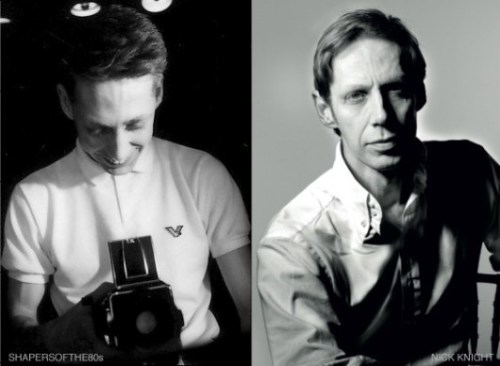
Nick Knight, then and now, separated by 25 years: captured by yours truly during his first shoot for i-D, titled People of the 80s, on the magazine’s fifth anniversary ... right, this year’s self-portrait as one of the world’s most innovative fashion photographers, taken for i-D’s 30th anniversary issue which he also art directs. Photographs © Shapersofthe80s and Nick Knight

FRONT PAGE

2010 ➤ Lady Gaga spices up i-D’s 30th birthday

❚ A LIGHTNING-FAST PHOTOSHOOT with Lady Gaga (above) was previewed before Christmas at Showstudio, the showcase website directed since 2000 by Nick Knight. Today Knight ranks among the world’s most original fashion photographers, but his association with i-D, launched as a street-style magazine in 1980, goes back to its earliest days. On i-D’s fifth birthday he photographed 100 “People of the 80s” (➢➢ link below) who had all appeared in the magazine’s formative issues.

During December 2009, as part of his Fashion Revolution exhibition at London’s Somerset House, Knight photographed a further 100 of London’s current creative leaders — including models, actors, musicians, artists and Lady Gaga — in the space of 20 days.

Nick Knight, People of the 80s, i-D fifth anniversary,

The snapper snapped: Nick Knight caught framing up yours truly during the i-D shoot, June 6, 1985. Photographed © by Shapersofthe80s

Knight says: “We started saying that we were going to do five portraits a day, so we did five one the first day and we thought it felt too easy. So we pushed it to 10, it felt reasonable, but then we sort of let things happen and we were looking at 20 a day!”

The 100 portraits are slated for inclusion in i-D’s 30th anniversary issue later this year, with video portraits captured from each of the sitters viewable on Showstudio in the weeks before publication.

➢➢ For more pix and the full monty on i-D’s metamorphosis from stapled fanzine to international fashion glossy, read on here…

FRONT PAGE