Tag Archives: New Romantics

2010 ➤ Ure rallies support for Japan’s bassist Karn

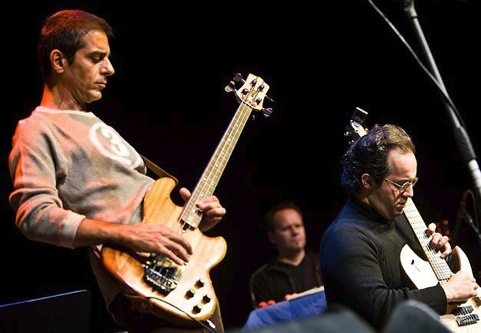
Mick Karn, ex-Japan, bass player

Mick Karn: former 80s popstar today struggling to make ends meet

❚ BITTER-SWEET NEWS TO HEAR THAT MIDGE URE has leapt straight into the breach to organise a benefit concert [See update at foot of this post] for Mick Karn, the former bass-player with 80s hit group Japan. Karn’s website has announced that he has been diagnosed with “advanced stages of cancer” and is struggling to pay his medical bills in Cyprus where he lives with wife and child.

One aspect of this sad news is to be reminded that not all chart-topping “popstars” become millionaires, especially the drummers and sax-players and guitarists who don’t get a chance to write lyrics, which is what generate the big money in royalties. The typical pop group makes two albums in as many years. As hugely influential pathfinders for the glam-into-synth-pop era, Japan had a very good run: over eight years, six studio albums and one live, plus umpteen compilations. Yet the pop industry is not noted for its pension schemes.
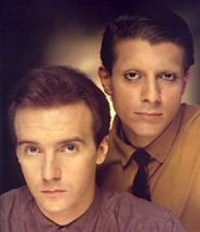
Midge Ure, Mick Karn, After a Fashion

Ure and Kahn: Fashion single in 1983

Another aspect of this week’s news is to be starkly reminded of our own mortality. Mick Karn will be “only” 52 on his birthday next month. When Michael Jackson died last June, he was “only” 50 and more than a few among our pop pals from the Swinging 80s generation said they suddenly felt the hairs prickle on the backs of their necks. Jacko was exactly their age. So was Steve (Stella) New when he died last month, at “only” 50.

What seems to chill us is the threat of the Big C. For most of the past three decades various forms of heart disease have been the most common cause of death in the UK. But whether as a result of dietary change or gym culture, circulatory diseases have shown the greatest decline, while life expectancy at birth has increased by six years on average to 79. It’s often said that if the heart doesn’t get you in the end, cancer will, but what’s little appreciated is that cancer is the prime cause of death among men when they’re younger – in their thirties. From there on, cardiovascular causes and, curiously, geography become more decisive. So, given a man’s susceptibility, perhaps we ought not to be surprised when cancer claims him earlier in life than a woman.

“We understand death for the first time when he puts his hand upon one whom we love,” it is said. “Only” 50, if we’ve come this far, brings ever more frequent intimations of our own mortality, that tilt us from the Wordsworthian vision towards a more pragmatic view of our role as a toiler in the scheme of things. The hot-blooded proclamations of Jimmy Dean, Pete Townshend and Roger McGough starts sounding like romantic indulgence: “Live fast, die young”? You have to be kidding! “Hope I die before I get old”? Oh no, you don’t really! “Let me die a young man’s death”? Absolutely not! As the grand old man of British sculpture, Henry Moore, told The Face shortly before he died at 88: “The work is what’s important, and I haven’t got much time left.”
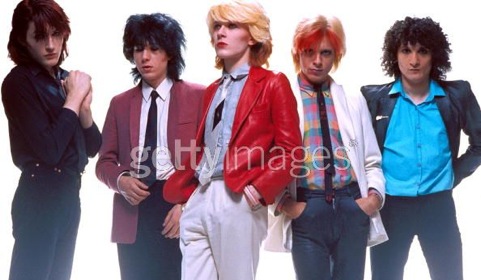
Japan, pop group,

Japan in May 1979: Steve Jansen, Richard Barbieri, David Sylvian, Mick Karn, Rob Dean. Photographed © by Fin Costello

So all power to Midge Ure for grasping the nettle and planning to celebrate a life not yet fully run. He has urged fans to give Karn both “financial help and emotional help”. In addition, Ure, as the joint-founder of Band Aid, 1984’s fund-raising supergroup, is well versed in how to organise a benefit for Karn. BBC 6Music reports: “While no acts are confirmed yet for the concert, which is to take place some time this year, Ure has his sights on reuniting Japan for the show.” (Karn’s website later said these had not been Midge’s words.)

Ure said of Karn’s diagnosis: “The situation is not very good. The cancer has spread, he is going through chemo right now — but surrounded by family and friends, he has a positive attitude.”

❚ IN 1982 WHEN PETE TOWNSHEND WAS PUTTING TOGETHER a supergroup to launch the first Prince’s Trust Gala, he chose Karn for the line-up and described him as by far the best bassist in the UK. This event was the showcase that led to his collaborations with Kate Bush, Joan Armatrading, Pete Murphy (Dalis Car, 1984), Midge (the chart single After a Fashion, 1983) and many more. The intervening years have yielded 13 solo albums, among which The Tooth Mother (1995) is a standout for its juzz-funky innovation.

Of Karn’s musicianship, Ure said: “Until I heard Japan, I had never heard a bass guitar played like that. It was almost like playing a lead instrument, incredibly percussive and melodic, something that inspired me.”
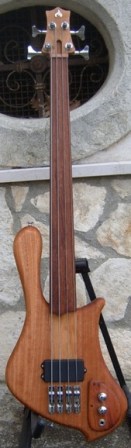
Prometeus Guitars, Italy, Armando Pugliese, auction

Mick Karn Appeal – This Fretless
Bass could be yours

Armando Pugliese from Prometeus Guitars in Italy has kindly agreed to donate the proceeds from the auction of a fretless bass guitar to Karn’s appeal – either the bass pictured here, which he lovingly made for himself, or one built to your spec. This a serious instrument worth a high three-figure sum. Auction ends Friday June 25.
[Update: Auction now ended. Winning bid, 1502 Euros.]

O

Karn’s unusual fretless bass technique is at once surreal, exotic and sinuous, practised in the early days on an aluminum-necked Travis Bean instrument. His best friend guitarist David Torn once said: “It’s like if Bootsy was Moroccan.”

Motown’s James Jamerson insisted that the bass can actually drive a melody, and Karn agrees. It was one of the hallmarks of Japan’s music. The group was founded in 1974 (when Karn was 15) with schoolmates in south London: David Sylvian, David’s younger brother Steve Jansen, and Richard Barbieri. They decided to play Roxy-ish art-rock, both pre-punk and despite punk. By 1979 and the release of their pivotal third album, the synth-driven Quiet Life, Japan’s long hair, glam make-up and progressive melodies saw them branded as New Romantics in all but club membership. In reality they presaged the UK’s edgy new pure pop by going off on their own musical tangent with Sylvian’s sardonic crooning, quirky Eastern influences and saxophone arrangements.

Talk of a reunion might just be a bridge too far, given the deep personal tensions that drove Karn and Sylvian apart in 1982. In 2006, Karn told Beatmag: “For all four of us to agree would be nigh-on impossible. But there’s something I’d really, really enjoy about being on stage with them again, and I’d enjoy playing the old Japan songs again, with my fellow bandmates. That was an enjoyable period of my life, and I’d like to experience it again.”

➢ Extract from Mick Karn’s response on his website, June 14:

“Your comments and well wishes have left me speechless, in the same way that our news had affected you. The support and love you give me is felt by all of us here, every day . . .

“At the time of first posting my news I was striving to obtain a medical card that would pay for treatment here in Cyprus and I am pleased to say that in recent days, since becoming officially diagnosed through a series of specific tests, the state will now take care of my basic medical costs . . . Donations that have been received will remain in a fund which will be used to augment the state care  . . .

“Words cannot truly express the full scope of my gratitude and feeling of good fortune to have so many friends, both near and far.”

➢ Another response on his website, Sept 3:

“Thanks to the appeal fund, Mick and his family were able to move to London where he is currently being treated. This really wouldn’t have possible without the support of Mick’s friends and all of you who have raised money for the fund. When it’s appropriate, there will be further updates. Mick also hopes to work with Peter Murphy on a follow up to their Dali’s Car album, The Waking Hour, towards the end of September.”
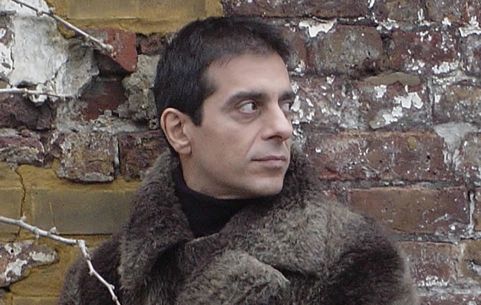
Mick Karn, Japan, bass player, re:VOX, interview, autobiography, album

Karn at home: searching music, candid memories

➤ Latest reflections by the restless Karn on a road well travelled

O

❚ MICK KARN GIVES AN INTERVIEW to Rob Kirby in the next issue of re:VOX, a pocket magazine dedicated to 80s electronica. The guitarist says of the restless and searching quality in much of his latest album, The Concrete Twin, which was released in January: “My recordings are always a way of dealing with unresolved issues, most of them mentioned in the book [his autobiography] . . . It’s impossible not to hear music wherever you go. Everything I hear will eventually turn into an influence on some level, subconsciously.”

Mick Karn, album, The Concrete Twin,download, CDWho, or what, is The Concrete Twin of the album’s title (£7.99 as a download, £17.49 as CD from Karn’s site)? It brings to mind the self-sculpture of Antony Gormley. Karn, who has been admired as a sculptor for 30 years alongside riding the music industry rollercoaster, says: “I guess it’s the closest I’ll come to mixing music with sculpture. The concrete twin is another self we all have. The ‘hard’ side of us that can withstand all the trials and tribulations that life has to offer.”

What prompted you to commit your thoughts on your past life so candidly to the book, Japan and Self Existence (£16.96 from Lulu), which has roused strong reactions? Was it the relocation to Cyprus? “Just tired of meeting so many people that have the wrong idea, and that well-known people can have the same human flaws as anyone else. I feel glad that people know the truth due to the book, but contented, no. I’m never contented. It’s my motivation for carrying on. Self-publishing was the last option. Debi spent three years on my behalf, approaching every publisher that we could think of. The reaction was always positive, but the explanation the same: too many biographies by musicians on the market.”

❏ Extracts from Musique Concrete, an interview with Mick Karn in re:VOX #9, on sale in late June at £1.50 from Rob Kirby, 2 Bramshott Close, London Road, Hitchin, Herts SG4 9EP.

➢ Mick Karn’s own website – Download his latest album The Concrete Twin, order his autobiography, view his sculpture online (“amazingly accomplished” – John Russell-Taylor)

➢ Honorable tension: Karn gives a substantial interview to music journalist Anil Prasad in 1996 for Innerviews, the web’s longest-running music magazine. Extract here . . .

On the line-up for Japan’s 1989 reunion as Rain Tree Crow: “We really wanted a soloist and a guitarist. David Torn was my first choice. I recommended him to everyone. It looked as if it was going to happen for a while. But the David Sylvian we’d always known was one of complete control. That made it very difficult for us to work with him. And that was another reason why the band just couldn’t work. We found that as more time went by, the more and more control David [Sylvian] wanted to take — to the point of not wanting David Torn to come into the picture, because he decided to take care of the guitar himself . . .”

➢ VIEW ♫ ♫ Japan on Top Ten New Romantics – Paul Morley: “There was a wonderful moment when it happened for Japan with the album Ghosts, when us serious NME people embraced them, because they seem to have left behind the weird clothing and the makeup” !!! Oh yes.

FRONT PAGE

1980 ➤ Can birthday-boy George tell his Boudica from his Britannia?

Jayne Chilkes , George O'Dowd, Blitz Kids

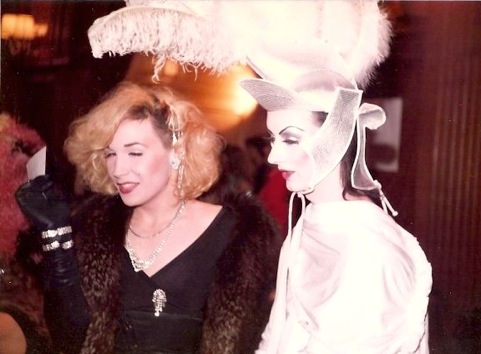
George-before-the-Boy: posing as Queen Boadicea with Jayne Chilkes at Steve Strange’s 1980 party on the Circle Line. Photographed © by Andy Rosen

❚ WHO’S A NATIONAL ICON THEN? On this day 30 years ago not only was it George O’Dowd’s birthday, as it would be every year. But in 1980, at the age of 19, he was prancing around the Mall dressed so he claimed, as Boadicea, Queen of an ancient tribe of Britons, wielding union-jack shield and trident. While our current Queen ERII processed down the road to Trooping the Colour, this was his “quest for publicity” as the Blitz Kids competed at getting their pictures in smart magazines. He was livid the next day to find not one mention of him in the tabloids to boost his own growing scrapbook of cuttings.

The look had been unveiled a couple of weeks earlier on the 21st birthday of his pal (ha!) Steve Strange, host at the Blitz, who had decided to throw a party on the Circle Line. About 50 ornamental clubbers piled into the bar on the platform at Sloane Square station aiming to pub-crawl their way by train to the other subterranean bars at Paddington, Baker Street and stations beyond (all now long gone) while armed with ghettoblasters, booze and fags. Prevailing fashion priorities prompted an unholy alliance between ecclesiastical drapery and Norton biker jackets.

Quiffs were being worn very high that summer – Strange’s rose a foot above his head, while below he had opted for a cowled satin surplice that might have appealed to a decadent monk. True to their competitive spirit, George had gone for an all-out pagan toga topped with a warrior’s silver helmet and monumental feathered plume (a gifted work of metallurgy in silver lamé by Stephen Jones). The big picture shows George modelling the outfit onboard the train in the arms of Jayne Chilkes (the elder of the two sisters, who claimed to receive ghostly messages from Oscar Wilde and then scribbled them all over his books).

Boudica, Britannia

Celtic battleaxe Boudica or Roman goddess Britannia: which would you rather be?

Actually, the origins of the Boadicea who was turning heads in 1980 lay in a madcap jaunt to the south of France (ultimately abandoned) with his squat-mate Marilyn who’d arranged a cabaret booking for them – Marilyn playing, well, Marilyn, and George playing some alien rock star as well as this toga’d character Boadicea. Well, the outfits had proved “too amazing to give back”, so George had walked off with them. In 30 years, I don’t think anybody has had the nerve to tell him he was really dressed as Britannia, the Roman goddess who became an emblem of the British Empire which at its height ruled a third of the world’s population. With her Corinthian helmet and the sea-god Poseidon’s three-pronged trident, Britannia has been pictured on our coins since Emperor Hadrian’s day.

Boadicea (or Boudica as smart people call her these days) was the one who led a barbaric revolt against the Roman occupation under Suetonius in about AD60, burnt London to the ground and today sits on Westminster Bridge still shaking her single-headed spear at Parliament. Did you ever see Boudica toting a trident? I don’t think so. Or shaded by a Grecian visor against dazzling British sunshine? I don’t think so. Nasty scythes projecting from her chariot wheels, yes. Her daunting right breast exposed, yes. Woad from head to toe, yes. So. If we’re in need of icons, let’s get them right.

Talking of which . . . How does an icon live? George was last month greeted as a “chalk-faced convicted thug” by the Asia News Nework on his visit to strife-torn Bangkok. Today he’s en route to Cape Town for a gig tomorrow, returning for the Glastonbury festival diary date on the 24th. A 16-track album Extraordinary Alien is promised for, er, “very soon”. And to celebrate his 49th birthday, his Twitter account has been turned off. Scythed wheels of steel are a’spinning.

Marilyn, George O'Dowd,Blitz Kids

Another day, another premiere: Marilyn and George as Boadicea on the town in 1980. Pictured © by Robert Gordon

FRONT PAGE

2010 ➤ Duffy, the man who shot Aladdin Sane

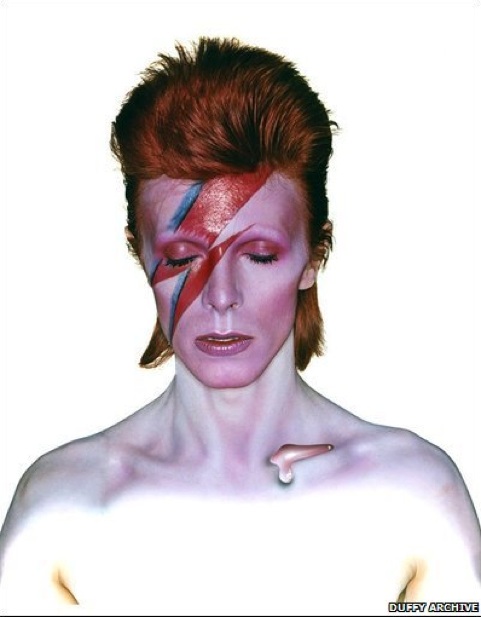
❚ BRIAN DUFFY, THE PHOTOGRAPHER who helped to capture the spirit of the Swinging 60s, has died. Among the many showbiz stars he shot was David Bowie, and if any images deserve to be called iconic, these do. Known to friends and colleagues by his surname alone, Duffy was a rival of David Bailey and Terence Donovan throughout the 1960s. Film producer Lord Puttnam said Duffy helped push the stultifying conservatism of the 1950s into permanent retreat. Duffy is also famed for once burning part of his work in a bin in 1979.

➢➢ Read the full BBC News report

David Bowie, Aladdin Sane, Brian Duffy

Duffy shot three album covers for Bowie, here Aladdin Sane, 1973, artfully created long before Photoshop had been invented. © The Duffy Archive Limited

Vogue, Brian Duffy, photographer

In May 2003, Vogue magazine paid tribute to Bowie by dressing up Kate Moss in some of his original costumes. A nod to the 1973 Duffy photo graced its cover, which Vogue’s editor Alexandra Shulman said was his favourite cover of all time (see Iconic Photos, below). Right, the photographer Duffy at his lightbox

David Bowie, Lodger, Brian Duffy, Derek Boshier

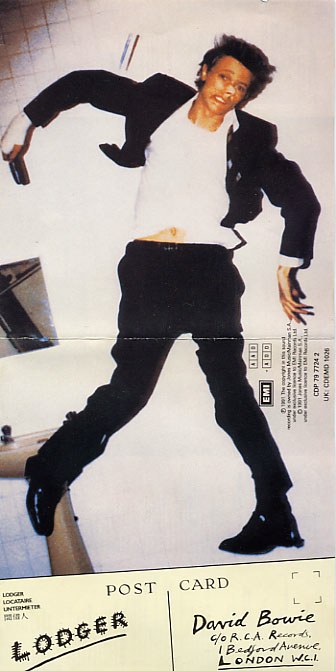
Bowie’s Lodger album, 1979, photograph © The Duffy Archive Limited. Artist Derek Boshier wrote: “The cover for Lodger was a collaboration between David, the photographer Duffy, and myself. I loved the resolution to the problem of David being photographed falling. Shooting him from above, on a specially made table built to match the falling form. The table was designed to be completely obscured by David’s body”

Brian Duffy, David Bowie, Scary Monsters

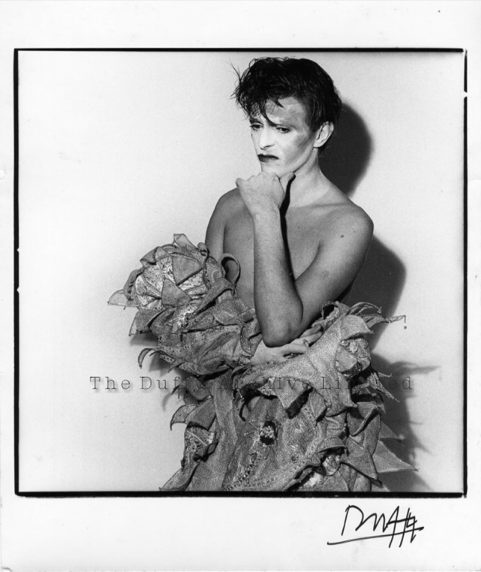
Duffy’s shoot for Bowie’s Scary Monsters album, 1980 © The Duffy Archive Limited

David Bowie, Brian Duffy

Bowie by Duffy, 1980: not chosen for Scary Monsters and published only once, in a blog last September. © The Duffy Archive Limited

➢➢ Sara Wiseman, Duffy’s archive assistant, wrote last September in her blog:

“Whereas Duffy’s more iconic images such as his Aladdin Sane cover, have been retouched, consciously selected and then admired by many to achieve such status, I love the fact that this one [shot but not chosen for Scary Monsters and never before been published] was forgotten for thirty years and for that reason I loved discovering it. I could perhaps align the thrill to that of finding buried treasure. There is something about Bowie’s unperfected facial expression that gets me every time. In a way I find the photograph to be extremely revealing in that it humanizes Bowie. This scornful look which, was not included in his contrived and manufactured public image, lowers him from the elevated, almost superhuman level of the pop/rock star. What we have before us here, is a man in a ridiculous costume looking pretty indifferent.

“I asked Duffy what his thoughts on the photograph were: ‘You like it? Yes me too. You may have noticed that in many of my male portraits my subjects look as if they’re on the verge of smacking me … ha! (Duffy acquired a reputation, of which he is proud, for being a bit of an anarchist.) That was my technique, I would say something to rile them or wind them up. It won me some great photographs – full of genuine male aggression. You may also notice that the same can not be said for my female portraits!’ ”

☐ ☐ ☐


➢➢ Visit Duffy’s website

➢➢ Surviving contact sheets from the Aladdin Sane session
➢➢ Famous, Infamous and Iconic Photos
➢➢ Derek Boshier Art

THE TRIBUTES

➢➢ Fearlessly innovative photographer who in countless striking images helped to define the mood and style of the Swinging Sixties – The Times, June 5, 2010
❏ Duffy, Bailey and Donovan invented a new documentary style of fashion photography, and fed off each other’s creativity. Duffy produced a body of work that spanned everything from portraits and reportage to advertising — he was one of the few photographers to have shot two Pirelli calendars, and successfully undertook campaigns for brands including Smirnoff, Aquascutum and Benson & Hedges, for whom he created a series of surreal advertisements in 1977.

➢➢ Central figure in the visual revolution that echoed the wider changes in British society during the 1960s – The Daily Telegraph, June 6, 2010
❏ With David Bailey and Terence Donovan, he formed what was dubbed the “Black Trinity” by Norman Parkinson, the photographer whose pastoral style seemed to embody all that the young trio wanted to challenge. If Bailey was the most creative of them, and Donovan the most amusing, the art school-trained Duffy was the most provocative and intellectual. “Before 1960 the fashion photographer was tall, thin and camp,” he reflected. “But we three were different: short, fat and heterosexual.”

➢➢ One of the “terrible trio” with David Bailey and Terence Donovan who broke the mould of fashion photography – The Guardian, June 6, 2010
❏ The three men became far more famous than many of the models with whom they worked, and were – for a while – bigger than the glossy magazines that published their pictures. The photographer Norman Parkinson called Duffy, Bailey and Donovan the “black trinity”. There was some merit in the label. The cravat-wearing old guard felt threatened by these freewheeling young men in leather jackets, who took their models on to the streets and snapped them with newfangled, small 35mm cameras.

➢➢ Brian Duffy: The Man Who Shot The 60s by George’s Journal

FRONT PAGE

1980 ➤ 2010, the stage magic that inspires Romantics ancient and Neo

An exceptional cabaret performer called Taylor Mac
hit London this week in 2010. He subverted not only
theatrical conventions but several classic Bowie songs
to glorious effect. His shimmering presence sent out
echoes of how we defined itzy-Blitzy when 1980 dawned…

Billy’s club,Helen Robinson, nightlife, London ,Steve Strange, PX

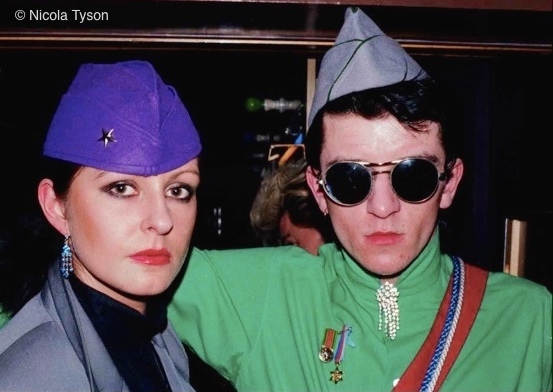
Billy’s club 1978: Strange as Ruritanian Space Cadet alongside PX designer Helen Robinson. (Photograph by © Nicola Tyson)

❚ LET’S RECALL WHAT MADE THE BLITZ KIDS unique in 1980. Singer Andy Polaris said soon after: “Anyone who thought it was all a pantomime got the wrong end of the Pan Stik. Blitz people had to be larger than life. It was a compulsion. If it doesn’t possess you, you can’t acquire it.”

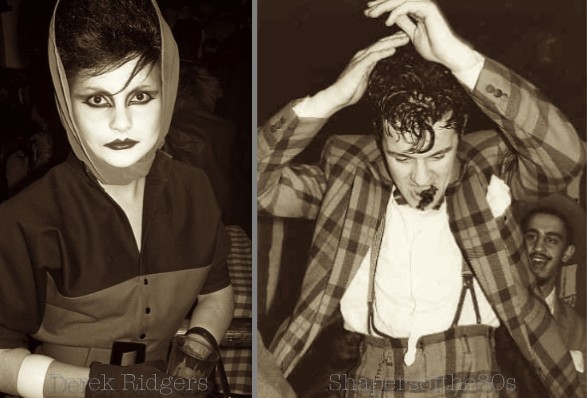
An evening within the orbit of London’s Blitz club superstars – and we’re talking about 50 people here – was more than entertaining. You were zapped with a very tangible electric shock – what we’d call today “sensory overload” – as if these exquisite, compulsive posers had revitalised Gilbert & George’s notion from 1969 of processing through the world as living sculptures. The Blitz Kids generated their own crackling versions of hyper-reality that defined the space around them. They included Kim, Julia, Judi, Melissa, Fiona, Jayne, Theresa, Myra, Scarlett, Clare, Michele, Darla, Sade, Kate, Stevie, Naomi, Mandy, Helen, Jo, Perri, Christine and Franceska . . . the Stephens Linard and Jones, Lee, John, Cerith, Simon, Iain, Andy, George, Marilyn, Wilf, Greg, Jeffrey, Christos, Graham, Neil, Dencil, Robert, the Holah brothers, the Richards Ostell and Sharah. A fair few other Blitz Kids, like Strange, Egan, Elms, Sullivan, Dagger, Haines, Ure, O’Donnell, Mole, Ball and Lewis, had the motormouth skills of energetic talkers and schemers who were, as we say today, “good in the room”. Above all, the best among them “made things happen” wherever they set foot. That’s why spending time with them was the best kind of fun – stimulating, argumentative and constructive, whether idling at a bar or bounding around the beach on Bournemouth bank holidays.

Kim Bowen, Stephen Linard, Blitz Kids, London

Doyennes among the Blitz Kids, 1980: Kim Bowen and Stephen Linard stamp themselves on that week’s zombie leitmotif. Photographed © by Derek Ridgers

Even so, what marked out the fashionistas especially was that, not only in the club, but in shop, café and bus, the style stars were constantly emitting auras of the force you imagined once surrounded Dietrich or Garland or Bogart or Caine. There’s nothing accidental about style. It is by definition a considered stance. In the presence of the Blitz superstars you could hold up your hands and almost feel the crumpet-toasting tingle. Even jaded Londoners turned their heads when Kim walked the half mile from Warren Street to St Martin’s school of art swathed only in surgical bandages. Or when George paraded past Buckingham Palace as a helmeted and toga’d Britannia at the annual royal ceremony of trooping the colour.

Princess Julia, Chris Sullivan, deejays, Vintage 2011,Southbank Centre, clubbing

Vintage deejays: original Blitz Kids such as Princess Julia and Chris Sullivan have continued spinning the vinyl that recreated legendary 80s club soundtracks from the Blitz to the Wag

Wherever there was a party, premiere, exhibition or club opening you’d see a dozen more such creatures who lived hyper-reality 24 hours a day… Lee perhaps as Nosferatu, Julia as Bride of Frankenstein, Fiona saying “Non!” to couture by wearing a grosgrain coat back-to-front, Sullivan as 1920s cad, blue-lipped Linard as 1920s flapper, Marilyn as, well, Monroe, Stewart as geisha boy, Theresa as Little Bo Peep, a part she played at work in the Fleet Street offices where our paths often crossed.

Aplomb came naturally to Kim Bowen as the queen of the Blitz Kids. One night when some friends came back to mine after celebrating my birthday, Kim walked into the kitchen and said: “I’m not going to let you live with this wallpaper one more day.” She picked at the edge of a stiff vinyl-coated strip, printed with very 1960s pepperpots and pans. Then she ripped it off the wall in one heave. The kitchen walls were bare within 20 minutes. Kim declared: “Minimalism, David, that’s you need.”

Clare Thom, Michele Clapton, Blitz Kids

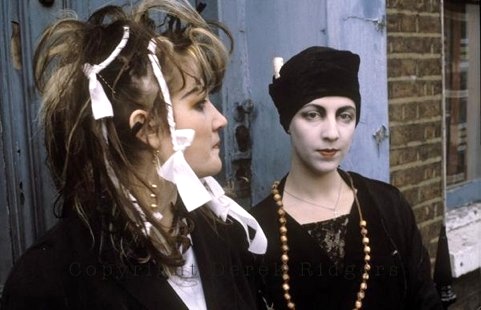
Blitz Kid style: Outside the Carburton Street squat, Clare-with-the-Hair and Michele Clapton displaying awesome repose. Photographed © by Derek Ridgers

As time would reveal, the lead Blitz Kids outflanked not only their peers, but most of the copyists who followed their Bowie-inspired passion for change. You’d find the second-league clubbers at Studio 21 in Oxford Street, or in a back barrel at Birmingham’s Rum Runner – those were the self-proclaimed New Romantics you see dancing in the YouTube videos, and being photographed wearing too much of everything, from Boots No 7 to lacy frills. A couple of years after the Blitz caravanserai had passed, designer Fiona Dealey said candidly: “You look at these little Bat-people with it dribbling down their necks and you feel like saying, ‘Sorry darling, not enough loose powder’. The difference was that our make-up was stage slap, Leichner not Factor. The clothes came from a costumier, Charles Fox, not Flip. Dressing for the Blitz was real theatre. It wasn’t just another uniform. You felt glamorous.”

Stephen Jones, Blitz Kids

Immaculate: Hatter Stephen Jones

Aha, real theatre! This is the realm Shakespeare championed as “an improbable fiction” and John Updike blasted as the “unreality of painted people”. A flesh-and-blood craft where the basic requirement is for a living audience to be watching living actors. The Blitz Kids fully understood what Shakespeare’s Player has to explain to Rosencrantz and Guildenstern in Tom Stoppard’s spoof version of Hamlet: “We’re actors. We’re the opposite of people.” Actors pledge themselves to the belief that somebody will be watching. Nothing to do with vanity. Entirely a means of confirming their identity. Ditto the Blitz Kids.

The digital natives (and the self-styled Neo Romantics) of Generation Z who today are being raised on computer shoot-em-ups and quaking cinema enjoy precious little exposure to live theatre, to the “magic” that emanates from the contract eagerly agreed between actor and audience – for the one to perform at the same time as the other watches. Only when, as one towering example, Sir Michael Gambon allows a Pinteresque pause to elapse onstage can auras crackle “in the moment” with sufficient intensity to be felt physically, and thrillingly, by a theatre audience. Gambon’s aura crackled like a fire god’s last Christmas in No Man’s Land, before a wrapt audience the day after its author Harold Pinter had died.

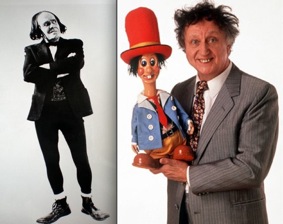
Max Wall, Ken Dodd

Masters of the comedian’s art: Max Wall and Ken Dodd

Comedy is where the theatrical contract of give-and-take fights for life most ostentatiously. As you laugh helplessly at the veteran comic Ken Dodd’s rapid-fire patter, you needn’t know that he has subjected his live stand-up routine to a lifelong time-and-motion study that concluded he must hurl eight gags per minute at his audiences to ensure everybody laughs at least once every minute he’s onstage.

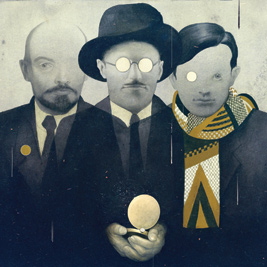
Travesties, Tom Stoppard, theatre

Travesties: what a coincidence that in 1917 the revolutionary Lenin, the novelist James Joyce and the Dadaist poet Tristan Tzara all happened to live in Zurich

In London in 1982 it was no less a pleasure to witness the top-of-the-bill variety legend Max Wall give wondrous live masterclasses entitled An Evening with Max Wall in which, aged 74, he laid bare how comedic timing works from one second to the next, how facial expression and vocal cadence, as well as silly walks can turn laughter instantly on and also off. Demonstrating with us as guinea-pigs how performer’s and viewer’s mutual responses keep each other on their toes.

The playwright Tom Stoppard has spent his career writing pyrotechnic scripts that read wittily enough sitting on the page, but are transformed several hundredfold the moment they are enacted on the stage, by for example exploiting the improbability of time-warps where the actors and the action are rewound and rerun in “unreal time” – actors reverse back through doors to leave the stage and re-enter immediately giving a subtly adjusted performance – as in Travesties, his hilarious comedy of coincidence. His plays are overtly “about” theatricality, yet shrouded by the mischievous apologia that, as one of his characters ultimately insists, “It’s a mystery”.

☐++++++☐++++++☐

GETTING BACK TO Taylor Mac,
his little bit of itzy-Blitzy glitz gives
shape to all of the above

Taylor Mac, Glasgow, London, Bowie, Comparison is Violence,cabaret

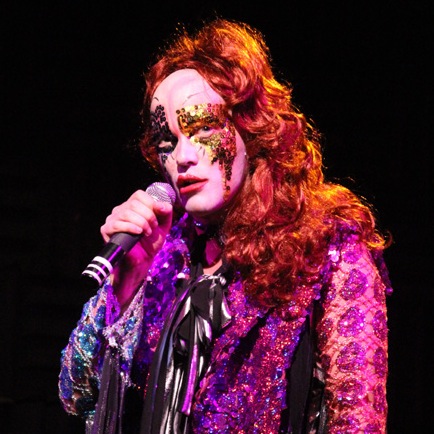
Taylor Mac 2010: sequinned, painted and bewigged as Bowie-cum-Tiny Tim. Photographed © by Tim Hailand

SO WHERE MAY TODAY’S young Neo Romantic seek inspiration if he or she wishes to aim beyond the slap and the zhoosh to summon up solar-powered charisma of Blitz Kid proportions? The answer is in the UK right now (Soho Theatre London this week, The Arches in Glasgow next) and he is an incandescent and witty Californian called Taylor Mac.

TAYLOR MAC

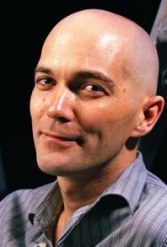
Mac as himself

Clad in more sequins than a sultan’s harem could shake at you, he gives a full-throttle musical cabaret that is unexpectedly poignant, invigorating and original. You also laugh more than you ever did at Eddie Izzard’s last side-splitting tour. Mac’s audacious dissection of the essence of theatre, vaudeville and other performing arts evokes Merman and Garland, Wainwright and Brel while asserting his own unique brio. He reinvents pop classics by David Bowie and Tiny Tim (yes, you do remember his hits Tiptoe Through the Tulips and I’ve Never Seen a Straight Banana) by delivering them with an earnestness that moistens the tear-ducts. The evening’s ironic sub-title is The Ziggy Stardust Meets Tiny Tim Songbook, because these are the comparisons reviewers draw about Mac, yet they seldom remark on how he turns Starman and Heroes, those holy invocations of the 80s Bowie fan, into altogether heart-rendingly new songs.

His themes are love and longing and role-play and tolerance for what society calls a gender-bending misfit who sprang fully formed from the egg, craving the glue that fixes eyelashes. What results is the most stupendous spectacle, charged with insights as mere as how to signal the end of a song, one way being a sustained high note, another to deliver a wide-eyed “Cha-cha-cha!” through smiling teeth, but the coup de grace is a solemn downward arm gesture LIKE SO! For 90 minutes Mac fills the Soho Theatre many times over with a sustained rush of theatre magic. And yes of course he’s on YouTube, but that entirely defeats the point the past 1,700 words have been making.

➢➢ Read Donald Hutera’s London review of Mac
in The Times, June 3, 2010

➢➢ Read Charles Isherwood on Mac’s 2009 play
The Lily’s Revenge in the New York Times

FRONT PAGE

JUNE ➤ 30 or so years ago today

ON THIS DAY IN 1978…

Human League, Being BoiledJune 17 — Fast Product releases the darkly mystical Being Boiled by Sheffield’s original Human League, and Bowie declares it “the future of music”. John Peel also champions the single on radio and it becomes a cult among the Billy’s and Blitz clubbing circle in London, though it does not chart until January 1982 on its second release. In the present day this is considered to be the first massively influential British electronic pop track.
VIEW ♫ Being Boiled live in 1978 on Granada TV, though the audio is dire!

+++

June 21 — Tim Rice and Andrew Lloyd Webber’s musical Evita opens at London’s Prince Edward Theatre to run for 2,900 performances. A novel ploy has been to release a double album two years earlier — some songs are already chart hits
June 29The Swinging 80s start here as David Bowie plays Earl’s Court, London. Sundry misfits recognise kindred spirits in the audience and gather afterwards at Billy’s club in Soho, long before the phrase New Romantics has been invented.

ON THIS DAY IN 1979…

June 9 — Music weekly Sounds publishes Mods Without Parkas by Garry Bushell
June 14 — The 70s “dressing up” imperative sees Flick’s in Dartford throw a VE Night deejayed by Radio London’s Robbie Vincent

ON THIS DAY IN 1980…

June 14 — George O’Dowd parades past Buckingham Palace as a helmeted and toga’d Britannia at the annual royal ceremony of trooping the colour

ON THIS DAY IN 1981…

June — The mainstream deejay’s bible Disco International publishes a plain man’s guide by yours truly, titled Who are the New Romantics and how do they dance?
June — John Boorman’s epic Arthurian movie Excalibur opens in London starring Nigel Terry and Helen Mirren
June 4 — Steve Strange and Rusty Egan open Club for Heroes in Baker Street
June 21 — Arty Latin popsters Blue Rondo à la Turk are unveiled in Chelmsford after weeks of secret tease dates. Yours truly is there to introduce the band to readers of New Sounds New Styles under the headline He thinks he is Geronimo but Chris Sullivan is turning fantasy into fact

ON THIS DAY IN 1982…

Blitz Kids, Kate Garner, Jeremy Healy ,Haysi Fantayzee ,Paul Caplin, John Wayne Big Leggy

Haysi Fantayzee 1982: ex-Blitz Kids Kate Garner, Jeremy Healy and manager Paul Caplin

June 9 — Kasper de Graaf, editor of New Romantic magazine New Sounds New Styles, tells the Rebel Writers the title is to close and they are out of jobs. We retire to the Red Lion to seek consolation!
June 14 — The Falklands War ends with the Argentine surrender. Its occupation of the Falkland Islands in the South Atlantic had provoked a war that lasted 74 days and results in the deaths of 260 Britons and 649 Argentinians
June 21 — At the V&A the Middlesex fashion degree show is stolen by Stevie Stewart and David Holah. Their Matelots and Milkmaids collection establishes Bodymap as the label for the young and daring
June 25 — As Haysi Fantayzee, Blitz Kids Kate Garner and Jeremy Healy release their debut single John Wayne is Big-leggy

ON THIS DAY IN 1983…

June 14 — Capital Radio’s Gary Crowley starts deejaying at Bogart’s club, Harrow

FRONT PAGE