Tag Archives: Books

1980 ➤ The Lennon we knew: unfulfilled talent with a genius for making friends the world over

John Lennon, Yoko Ono, New York City, 1980,Allan Tannenbaum

The last pictures: Allan Tannenbaum photographed John Lennon and Yoko Ono throughout November 1980, the month before the murder. The couple were emerging from a self-imposed five-year seclusion to prepare for the release of Double Fantasy, Lennon’s final album

❚ ON THIS DAY IN 1980, ex-Beatle John Lennon, one the few gods in the international pantheon of pop, was shot dead in a New York City street, aged 40. Today it’s impossible to describe convincingly the impact of The Beatles throughout the exhilarating decade we call the Swinging 60s, when their songs themselves became barometers of change.

John Lennon death,Time magazine, Newsweek, 30th anniversary
Here is how music journalist and Beatles expert Paul Du Noyer encapsulated the contribution of the Lennon & McCartney partnership (1957-1970) in a mighty partwork published by The Sunday Times in 1997 titled 1000 Makers of Music:

“Whether measured in statistics or simply the love of the common people, the Beatles’ achievement looks unbeatable. And the engine of it all was the songwriting team of John Lennon and Paul McCartney. Before them, nobody dreamt that rock and roll would spawn enduring songs or that English rock could rule the world. Musically illiterate, the two Liverpool teenagers began by aping their American heroes and grew into writers of prolific originality. From the sunny simplicities of She Loves You, or A Hard Day’s Night, to the artful ingenuity of Penny Lane and Strawberry Fields Forever, they dazzled at every turn. Each was rocker and balladeer, lyricist and composer. They were a marriage of truth and beauty: Lennon soul-baring and verbally acrobatic (Norwegian Wood, I Am the Walrus); McCartney having the greater gift for melody (Yesterday, Hey Jude). Mostly they wrote alone, but raised one another’s game. Neither displayed the same consistency after the split [in 1970]. They lacked anyone with the nerve to say ‘Why don’t you change that bit?’ Their key work was A Day In the Life, 1967.”

➢ An index to Paul Du Noyer’s
published work on The Beatles

Today The Beatles hold the records for selling more albums in the United States than anybody else, and they head Billboard’s all-time top-selling Hot 100 list of singles artists, compiled in 2008. At home The Beatles have enjoyed more number one albums in the UK charts than anyone.

In the 60s, the mass media we know had scarcely left the starting line. This was a simpler era when any globally successful pop group was a novelty. When Beatlemania burst, it was a bombshell. The Fab Four, as the band were dubbed, found themselves writing many new rules in the celebrity game which fan worship then transmuted into the cultural phenomenon called Beatlemania — hordes of girls who stalked, pounced and screamed in frenzy — all accurately parodied in Dick Lester’s effervescent films, Help! and A Hard Day’s Night, based on the Beatles’ sudden worldwide fame. It also resulted in a deranged fan shooting his hero Lennon dead.

Beatlemania 1965, LHR

Typical Beatlemania: the band fly out from Heathrow bound for Austria and public vantage points are abrim with fans. Picture from Getty

Such sway did The Beatles hold, that their Merseyside cheek inspired provincial British pop groups not only to dare take on the unimaginative impresarios of the London entertainment mafia for whom blandness was the key to an act’s success, but then to take on the world showbiz mafia dominated by America, where within corporate frameworks artistic spontaneity might actively be indulged. The Beatles’ music — like the self-expressiveness of rock and roll — had a passion that chimed with the forces of grassroots social change, of liberation, emancipation, the debunking of authority figures, and the reform of cobwebbed institutions such as government, church and unions, all of which had been under attack by the stormtroopers of the satire movement since its dawn in 1960 with Beyond the Fringe.

The early Beatles hits captured the essential “sunny simplicities” of pop, though these acquired darker overtones as the decade matured and the increasingly “affluent society” of the West drew criticism from the New Left. By 1968, the daftness of the hippy dream saw The Beatles setting up Apple Corps. In 25-year-old Paul McCartney’s words this was to be “a business with a social and cultural environment where everyone gets a decent share of the profits. I suppose it’ll be like a sort of Western Communism”. Whateva.
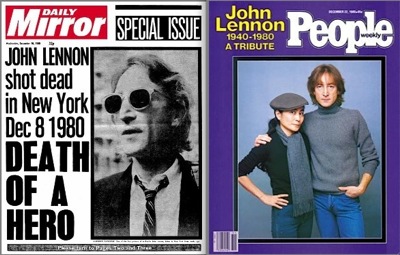
John Lennon death, Daily Mirror, people magazine, 30th anniversary
One secret to The Beatles becoming fab was being born in the port city of Liverpool, which had long bred its own resilient sense of humour. The band empathised with the working-class values of their community in ways the few young bloods in London’s middle-aged mainstream media found refreshing. Their heritage also included Liverpool’s role as the “New York of Europe” and home to Britain’s oldest Black African community. Little Richard and Berry Gordy’s Motown were in their blood, and The Beatles maintained the noble trade between Britain and North America which has seen each enhance and export the other’s music in a continuing chain of call-and-response since World War 2.

The songwriting partnership of Lennon & McCartney was unique, as also was their distinct vocal style absorbed from heroes such as Ben E King, and they transformed popular music utterly, never to be equalled. In his most infamous article, The Times’s music critic William Mann concluded in 1963: “They have brought a distinctive and exhilarating flavour into a genre of music that was in danger of ceasing to be music at all.” [See more, below]

Lennon’s own undoubted greatness was co-dependent on McCartney. Moreover, it becomes impossible to estimate the loss to music caused by his early death, when many people feel that, despite his wit and intelligence, his shortcomings hindered him from fully realising his true potential. This was the unsentimental verdict of journalist Maureen Cleave — who had known The Beatles since writing the first significant piece about them — as expressed in her frank and moving obituary for The Observer magazine in December 1980.

Beatles, life magazine, tribute
My other Evening Standard colleague who knew Lennon well during the Beatles’ later years is Ray Connolly, Liverpudlian author of many illuminating articles on Lennon. Connolly was due to meet him the day after he was shot. (“The last phone call I made before going to bed was to the Lennons’ apartment in New York to tell them that I would be in New York at lunchtime the following day.”) He agrees the Beatle was no saint, but he was “someone who wrote and played rock and roll music better than virtually anyone else”. In addition: “When he died millions of people mourned the loss of a friend. His real genius was in his ability to communicate. He was to perfection a creature of his times.”

In his instant paperback published by Fontana within two months of Lennon’s shooting, Connolly writes:
“[The American composer] Aaron Copland once said that when future generations wanted to capture the spirit of the 60s all they would have to do was to play Beatle records. That’s true, but I would go further. Future historians will find that understanding of the 60s and the 70s widened immeasurably by focusing on the life of John Lennon. From Liverpool war baby to killer’s victim just across the road from Central Park, Lennon’s every interest told a story of the times. The widespread grief at his death was compared with the mourning which followed the assassination of President Kennedy [in 1963]. No one should have been surprised, though many were.”

One of the reasons was that “Lennon chose the role of anti-hero for much of his life, casting off the trappings of glamour, throwing aside the shell of lovable immortality. John Lennon would never have made a politician. Political heroes are pragmatists. That is their job. John Lennon had no time for pragmatism. He was outspoken about everything and everybody, and then bore the consequences for his outrageousness.”

Ray Connolly, John Lennon biography, Fontana— Extracted from John Lennon 1940-1980, a biography by Ray Connolly (Fontana 1981). For many more interviews with all the Beatles, visit Connolly’s website and archive that includes Lennon: The Lost Interviews in which the journalist claims that “arguably one of Lennon’s most inspired acts was his deliberate destruction of The Beatles in 1969”. Connolly’s latest novel The Sandman arose from his years writing about rock music, not least about John Lennon and the Beatles, and is now available on Kindle

HARMONIC ORIGINALITY AND RICHNESS
UNKNOWN TODAY

In 1000 Makers of Music critic Ian MacDonald summarised the contribution of the Beatles as a band:
“As expressive of England in the 1960s as the music of Benjamin Britten in the 1950s, The Beatles made some of the world’s best music during their decade (1960-1970)… from the infectious melodies of their early beat-group years, through the LSD adventure of their central period (Revolver, 1966, and their key work Sgt Pepper’s Lonely Hearts Club Band, 1967). Each member of this Liverpool foursome made a vital contribution to a sound that blended boldness of melody and rhythm with a harmonic originality and richness of detail unknown in today’s pop… The Beatles redefined pop, revolutionised studio recording and completely dominated the culture of the 1960s. Their influence remains omnipresent.”

Ian MacDonald, Revolution in the Head, Lennon death, 30th anniversary— Ian MacDonald was the author of the monumental song-by-song analysis, Revolution in the Head: The Beatles Records and the Sixties (Pimlico).

His real name was Ian MacCormick and the book is worth consulting also for his essay Fabled Foursome, Disappearing Decade, on the social effects of the 1960s.

FOOTNOTES TO HISTORY

Richard Williams’s obituary for Ian MacDonald (1948-2003) in the Guardian noted: “Probably no other critic — not even the late William Mann of The Times, with his famous mention of pandiatonic clusters — contributed more to an enlightened enjoyment of the work of The Beatles than Ian MacDonald, who has died aged 54. In his book Revolution In The Head, first published in 1994, MacDonald carefully anatomised every record The Beatles made, drawing attention to broad themes, particular examples of inspiration and moments of human frailty alike. What could have been a dry task instead produced a volume so engagingly readable, so fresh in its perceptions and so enjoyable to argue with that, in an already overcrowded field, it became an immediate hit.”

Sample William Mann’s legendary and hilarious critique of Beatles technique from 1963:
“… One gets the impression that they think simultaneously of harmony and melody, so firmly are the major tonic sevenths and ninths built into their tunes, and the flat submediant key switches, so natural is the Aeolian cadence at the end of Not A Second Time (the chord progression which ends Mahler’s Song of the Earth) … Those submediant switches from C major into A flat major, and to a lesser extent mediant ones (eg, the octave ascent in the famous I Want To Hold Your Hand) are a trademark of Lennon-McCartney songs … The other trademark of their compositions is a firm and purposeful bass line with a musical life of its own; how Lennon and McCartney divide their creative responsibilites I have yet to discover, but it is perhaps significant that Paul is the bass guitarist of the group.”

➢ Extracted from What Songs The Beatles Sang
by William Mann, music critic of The Times

➢ William Mann’s monumental review of the Sgt Pepper album in 1967: The Beatles revive hopes of progress in pop music

FRESH INSIGHTS INTO BOY AND MAN

Over the past year Lennon’s life has twice been intelligently dramatised. In Nowhere Boy, visual artist Sam Taylor-Wood made her film debut directing several exceptional acting perfomances in an emotionally convincing evocation of Lennon’s adolescence during the austere 1950s, based on a novel by Lennon’s sister. For BBC television, Edmund Coulthard directed Lennon Naked, an unsentimentally credible account of Lennon’s confronting the desperate emotional crossroad that caused him to destroy the Beatles and abandon his wife and son for Yoko Ono.

DISILLUSIONED LENNON ON SELLING OUT

“When we played straight rock, there was nobody to touch us in Britain. As soon as we made it [as The Beatles], the edges were knocked off us, and Brian put us in suits. But we sold out. The music was dead before we even went on the theatre tour of Britain [Feb-June 1963, supporting other acts such as Roy Orbison]. We had to reduce an hour or two of playing to 20 minutes and go on and repeat the same 20 minutes every night. The Beatles’ music died there. As musicians we killed ourselves then.”

➢ John Lennon speaking in The New York Years
— this week’s BBC Radio 2 documentary by Susan Sarandon

Lennon’s Aunt Mimi Smith on his music
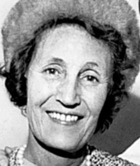
Aunt Mimi Smith, John Lennon“He used to drive me mad with his guitar playing, and I’ll always remember telling him, ‘The guitar’s all right for a hobby, John, but it won’t earn you any money’.”
➢ View the complete 1981 video interview
with Aunt Mimi

➢ 20 most underrated John Lennon tracks in NME Dec 14, 2010
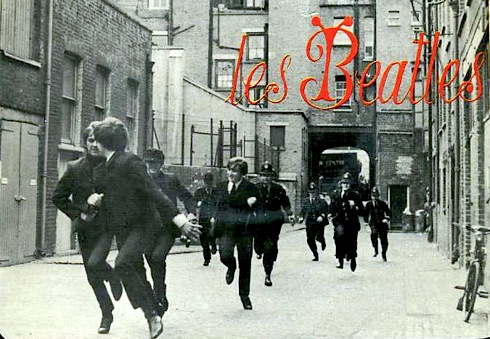
Beatlemania, Hard Day's Night,

Beatlemania: the band on the run from fans and police in Dick Lester’s 1964 film A Hard Day’s Night
FRONT PAGE

2010 ➤ Index of posts for November

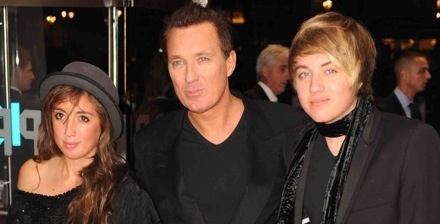
Martin Kemp, HarleyMoon Kemp, Roman Kemp, Paradise Point

On the town: Spandau's Martin Kemp with his children HarleyMoon and Roman, whose band Paradise Point made their debut this month. © Richfoto

➢ This £5m iPhone has to be a spoof! Yes, that’s $7.8m or €6m or 52m Chinese Yuan or 245m Russian Rubles

➢ Amazon “Fail” — no show for Kevin Cann’s new Bowie photo-book

➢ Rottweiler Dawkins croons his way into our hearts and minds

➢ 1984, On this day, pop made its noblest gesture but the 80s ceased to swing

➢ If Paradise Point aren’t the pop tip for 2011, you decide who is!

➢ How Roman Kemp helped his dad Martin to pick up the bass again

➢ 1918, War: the 20th-century way to build a new world

➢ The Princess known as Julia becomes an art object for sale

➢ Hear a clip from Duran Duran’s new album — lucky No 13?

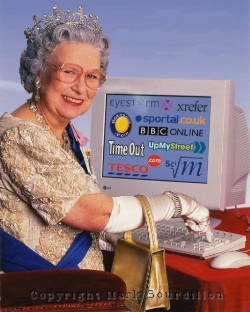
Her Majesty Queen Elizabeth II, Facebook

Her Majesty Queen Elizabeth II goes networking

➢ Status update: QueenLiz2 goes live on Facebook, though Her Maj will not be abused

➢ Killing a king tells you who you are — so do your haircut and shoes

➢ 2011, Pulp: the Britpop comeback everyone’s been waiting for, hooray!

➢ 19 gay kisses in pop videos that made it past the censor

➢ Why Lady Gaga “gets it”, Pixie Lott doesn’t, and the jury is out on Rihanna

➢ Was the Band With No Past truly wafted here from Paradise?

FRONT PAGE

➤ Miss Parkin regrets that she said no to Cary… and can’t wait to meet Orson, Lee and Walter

Molly Parkin, Mollywood,Barrington De La Roche, Chelsea Arts Club

Molly Parkin at her book launch with Barrington De La Roche. Photograph by Inesa and Barrington De La Roche © Dark Theatre

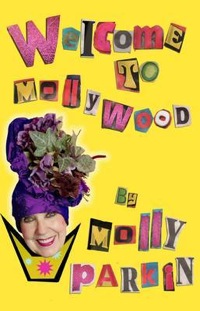
Molly Parkin,Mollywood, Chelsea Arts Club❚ AS ALL READERS OF SHAPERSOFTHE80s should know, the godhead of all things stylish is not “the Posing Doughnut” as gossip columns were once wont to call Steve Strange, but our true icon, Molly Parkin. If you need reminding why, click on the Giants Who Went Before.

Molly has been a font of mischief and outrage for almost eight decades and the 80s were no exception. Yesterday she wowed a launch party at the Chelsea Arts Club for her newest auto-exposé, Welcome to Mollywood, about which actor turned nightclub buccaneer Robert Pereno has said: “Well done Moll.” A couple of newspaper pieces this week give the flavour of a life thoroughly well lived, so click away…

The Sunday Telegraph’s new men’s mag asked Moll for 12 things every man should know about women, and here is one of them:

“You should think of women as goddesses. I regard myself as a goddess. Even if you pluck a few flowers from a neighbour’s garden after dark and bring them in, that is a small gesture towards the goddess. It’s a question of nourishing that romantic spark that was between you when you first got together.”

And the Daily Mail — who else? — trailed a serialisation with this bait: “Molly Parkin’s racy confessions turn to her wild affairs with George Melly, John Mortimer and a host of others”. Among her regrets, Moll writes:

“I regret not accepting Cary Grant’s offer of an evening out in London, when he was flying back to the States the next morning… And I’d like to say to the late Orson Welles, Lee Marvin and Walter Matthau, whom I’ve always fancied more than any of the pretty boys of Hollywood: ‘I’m on my way’.”

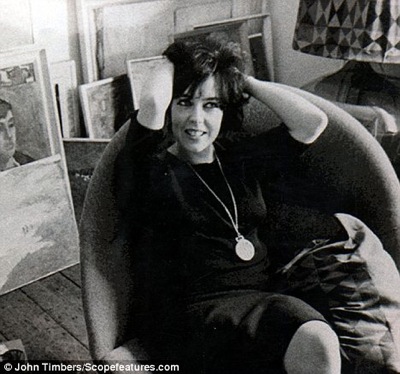
Molly Parkin, John Timbers

In her heyday: Molly aged 29 at her first art exhibition. Photographed © by John Timbers

FRONT PAGE

➤ How Keith Richards’s life of debauchery became an inexplicable sign of alien invasion at The Times

Keith Richards, autobiography, sex-and-drugs-and-rock-and-roll

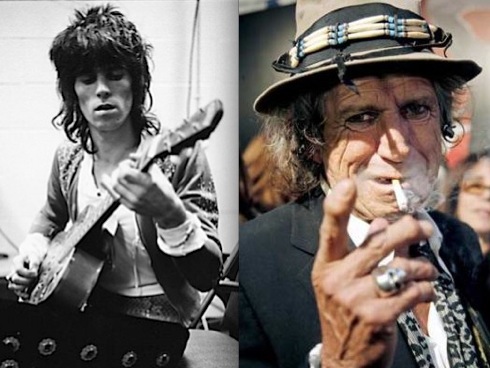
Boy into man: Keith Richards in 1969 and after 40 years of living the life (EPA). Note in particular the hat and read on...

❚ BY THE MID-60S THE ROLLING STONES had become global superstars, though demonised for the raw sexuality of their songs and performance style. Guitarist Keith Richards is the man whose debauchery epitomises the ethos of sex-and-drugs-and-rock-and-roll, and on October 26 his “long-awaited” autobiog called Life is published by Weidenfeld & Nicolson. As if the UK’s tenth richest musician needed the cash — he is worth £175m in The Sunday Times Rich List — reports say he received an advance of £4.8m ($7.3m!!!) after a bidding war for the text, written with James Fox.

It amounts to a tawdry sequence of profane, drug-fuelled, low-life anecdotes from which nobody emerges with much integrity, like a bunch of amoral delinquents. Quite what excited The Times of London to devote three days-worth of space to this book is beyond comprehension. Under the headline Muddy Waters, Saturday’s main editorial in the paper actually damned the Richards yarn as “filthy” and “depraved”, while seeking to justify serialising massive chunks on the ground that “the music of the Rolling Stones has endured”, thanks to the band’s “sheer work ethic” !!! (Since they didn’t rise up to ridicule this lavish serialisation, we can only assume the entire staff of The Times has been zombified under Plan 9 from Outer Space.)

Almost the whole front page of The tabloid Times trailed the Richards extracts with the stark headline “Sex, drugs and me”. Highest common denominators, evidently, for Her Majesty’s newspaper of record. And a spectacular nadir for dignity in the Thunderer’s 225-year history.

As a time-saving service to discriminating readers of Shapersofthe80s, here are the juiciest bits, but be warned — do not raise your expectations above the navel. Ready with the sickbag, James!

In Friday’s interview with 66-year-old Richards, 35-year-old Caitlin Moran called the book a “total hoot” and through its sordid junkie haze introduced us to every mother’s idea of the son-in-law from hell. Right from chapter one, she said, he’d worn a hat made of drugs (“There was a flap at the side in which I’d stowed hash, Tuinals and coke”) and driven a car made of drugs (“I’d spent hours packing the side-panel with coke, grass, peyote and mescaline”).

Moran reports that Richards “gave up heroin in 1978, after his fifth bust, and he reveals today that he has finally given up cocaine, too — in 2006, after he fell from a tree in Fiji and had to have brain surgery:

❏ “Yeah, that was cocaine I had to give up for that,” he says, with a sigh. “You’re like: ‘I’ve got the message, oh Lord’.” He raps on the metal plate in his head. It makes a dull, thonking sound. “I’m just waiting for them to invent something more interesting, ha ha ha. I’m all ready to road-test it when they do.”

Throughout the Moran interview, he was of course smoking Marlboros and drinking vodka. His idea of totally clean, presumably.

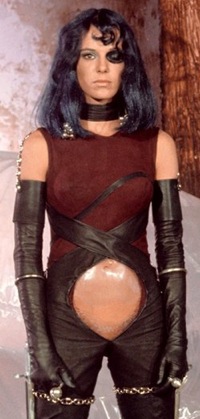
Anita Pallenberg ,Barbarella

Anita Pallenberg in the Roger Vadim film Barbarella, 1968

In Saturday’s Times serialisation of Life, Richards recalls the Stones’s founding guitarist Brian Jones, who originally proposed the band’s name in 1962 and was to drown needlessly at the age of 27 in circumstances that remain unclear. He was neurotic, suffered from deteriorating health, he pushed friendships to the limit and treated women despicably. In Marrakesh in 1967 he and his girlfriend Anita Pallenberg had reached the end of their tethers. Richards writes:

❏ “They’d beaten the shit out of each other. And of course Brian starts trying to take Anita on for 15 rounds… Once again he breaks two ribs and a finger… Then Brian dragged two tattooed whores down the hotel corridor and into the room, trying to force Anita into a scene, humiliating her in front of them. He flung food at her. At that point Anita ran into my room… She was in tears. She didn’t want to leave but she realised that I was right when I said that Brian would probably try to kill her.”

Having “stolen” Anita Pallenberg from Jones to become Richards’s common-law wife, back in the 1970s some reciprocal bed-hopping took place between Richards and Mick Jagger’s girl Marianne Faithfull, and between Anita and Mick. This was when Richard learned his best friend was a disappointment in the sack, giving rise to his verdict on the over-rated Jagger jewels:

❏ “[Anita] had no fun with his tiny todger. I know he’s got an enormous pair of balls, but it doesn’t quite fill the gap, does it?”

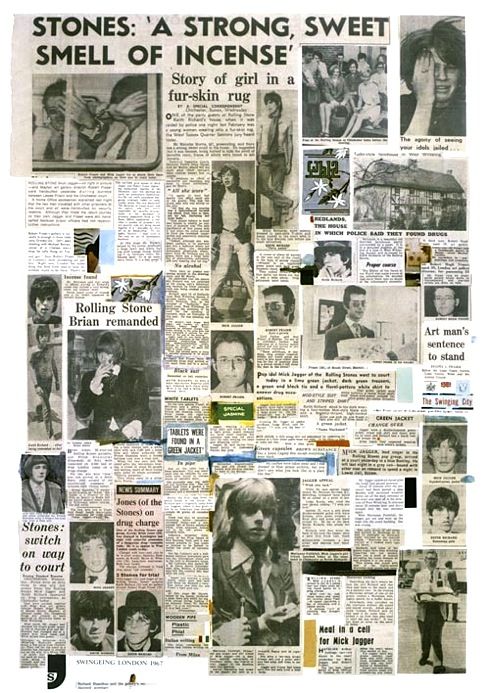
Swingeing London 67 — Poster 1967-8: One of pop artist Richard Hamilton’s protest pictures in his Swingeing London series, commenting on the severe judgment passed on his friend, gallery owner Robert Fraser, and popstar Mick Jagger, for possession of drugs. (Photolithograph © Richard Hamilton published by ED912, in Tate collection)

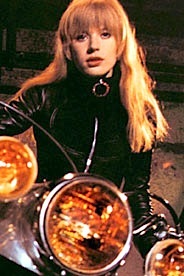
Marianne Faithfull, Girl on a Motorcycle

Marianne Faithfull in the British film Girl on a Motorcycle, 1968

Life describes in detail the fabled 1967 drug bust at the Richards Sussex house, Redlands [reported in the collage above], which became a totemic cause célèbre when William Rees-Mogg — the down-with-the-kids editor of The Times — took on the crusty old establishment by denouncing the harsh jail sentences which followed. Richards writes that the raid was “a collusion between the News of the World and the cops, but the shocking extent of the stitch-up, which reached to the judiciary, didn’t become apparent until the case came to court”. He also sets the record straight on the role of a legendary Mars bar:

❏ “[Marianne Faithfull] had taken a bath upstairs, and I had this huge fur rug, and she just wrapped herself up in that. How the Mars bar got into the story I don’t know. There was one on the table — there were a couple, because on acid you get sugar lack and you’re munching away. And so she’s stuck for ever with the story of where the police found that Mars bar. And you have to say she wears it well.”
Etc etc etc etc

➢ “The Mars bar was a very effective piece of demonizing” — Marianne Faithfull in her own autobiography. More pictures and background at Another Nickel In The Machine

➢ Who was the Redlands informer? — All about the police drugs raid on Keith Richard’s home on Feb 12, 1967 at the History of Rock Music

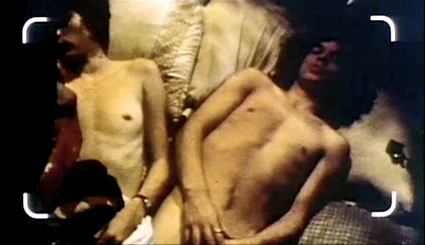
Michele Breton ,Mick Jagger, Performance, films

“The most sexually charged film ever”: the androgynous Michele Breton and Mick Jagger in Performance, 1970

➢ Judge the Jagger todger for yourself at Another Nickel: Anita’s footage of Mick’s meat and two veg filmed during the making of Performance at 81 Powis Square in 1968

➢ Rolling Stone magazine has more Richards book excerpts plus slideshow on October 28, 2010

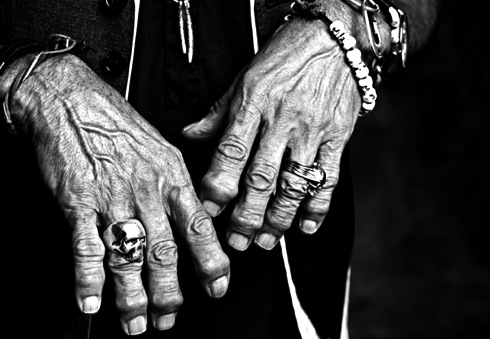
Keith Richards, David Courts , Bill Hackett, skull ring,

The guitarist’s hands in 2010, photographed © by Mario Sorrenti: the original skull ring that has become a rock-and-roll icon was given to Richards by London goldsmiths David Courts and Bill Hackett as a birthday present in 1978

FRONT PAGE

➤ In the face of Cowell X-culture, Polhemus discovers the style supermarket afresh

Street Style, Ted Polhemus, the Book Club, PYMCA,Viva Las Vegas Festival

Street cred: Janette Beckman’s cover shot of the rude-boy twins, Chuka & Dubem Okonkwo, shot for The Face in London 1980. Right, two 50s fans at the Viva Las Vegas Festival, USA 2006. Photograph © Tim Scott/PYMCA

❚ IN ITS FIFTH ANNIVERSARY ISSUE, i-D MAGAZINE asked its photo-gallery of People of the 80s to sum up that year, 1985. Shapersofthe80s replied: “It is the year the style supermarket repackaged the previous four as an over-the-counter culture.” What was being signalled was the end of the Swinging 80s, the symbolic sub-cultural “decade” which had seen Soho become the crucible for new sounds and new styles as they broke free from the stadium-rock and post-punk past. 1985 saw a torrent of colour and attitude and tunes drive the mainstream of British youth culture that then came to characterise the “Thatcher decade”, at best personified by Stock Aitken Waterman, and at worst traduced by nightclub impresario Peter Stringfellow.

Ted Polhemus, Street Style, PYMCA

Polhemus as 70s hippie — wardrobe master for Starsky and Hutch, or his idea of irony?

Tonight in Shoreditch, the new London pool of cool, an eponymous exhibition opens to launch an updated edition of Street Style, the 1994 picture book by Ted Polhemus that celebrated the style-tribes which postwar Britain’s class-ridden society excelled at evolving, from mods and rockers, to goths and casuals, to ravers and what he called riot grrrls (which inevitably invoked the dread term bricolage, so much more cultural studies than saying DIY). Publication coincided then with a groovy exhibition around the V&A costume court.

Images and graphics from the new Street Style inevitably feature many of our original Shapers of the 80s, if current Facebook twitterings are any indication. These are being exhibited (Sep 30-Oct 31)  in the former Victorian warehouse in EC2 refurbished as The Book Club. Polhemus’s new publisher is PYMCA, the Photographic Youth Music Culture Archive which was established in 1997 by Jon Swinstead, brains behind Jockey Slut and Sleazenation. His aim was “to create a collection of images that capture the real essence of life as a young person”. PYMCA was launched this spring as a research resource, having teamed up with leading cultural commentators to offer detailed analyses of youth subcultures, music and movements around the world. Swinstead maintains: “PYMCA is both edgy and documentary and the newest material will visually reflect the hottest stuff happening among the youth of today.”

Next month Polhemus, the self-styled “anthropologist, author and photographer extraordinaire”, leads a discussion at The Book Club titled “Supermarket of Style in the 21st century” (Oct 27, tickets £8). This is the theme that introduces his new book and which he calls “his latest theory”. Well, better late than never! The supermarket has certainly entertained us for 25 years but a general consensus agrees that Britain’s youthful creative juices finally ran dry in the noughties as Cowell X-culture came to dominate our televised lives. Presumably Ted has fresh observations to offer…

Rockabilly, Paul Sturridge, Ted Polhemus,Dale Cammack, Susan Cammack

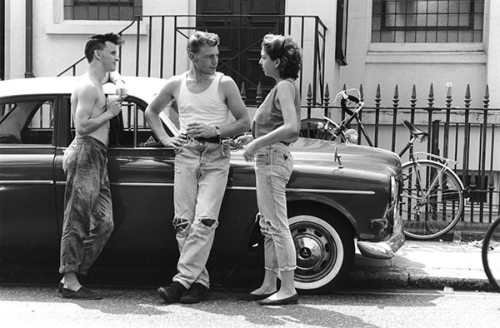
The no-socks “hard times” style promulgated by the itinerant Dirtbox club-nights: The ever-photogenic Paul Sturridge caught in 1984 with Dale and Susan Cammack, plus his Volvo Amazon outside the Chelsea Potter. From the Street Style exhibition at the V&A, photographed © by Ted Polhemus

AT THE EVENT, STURRIDGE CATCHES THE MOMENT . . .

Chuka Okonkwo, Dubem Okonkwo , Theola Sturridge, Street Style

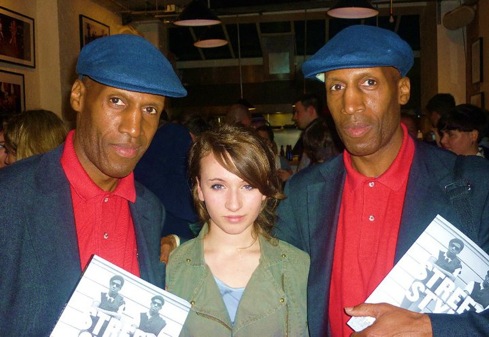
At the book launch: cover stars the Okonkwo twins with Theola Sturridge. Photograph © by Paul Sturridge

Theola Sturridge, Paul Sturridge, Street Style

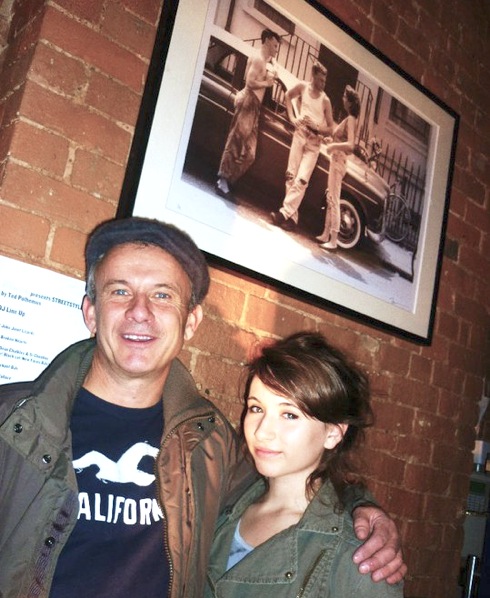
A lifetime later: Paul Sturridge with daughter Theola beneath the photo of him in his “hard times” guise. Photograph © by Paul Sturridge

FRONT PAGE