➤ Sir Harold’s memories of Fleet Street: cut and thrust, or be cut dead

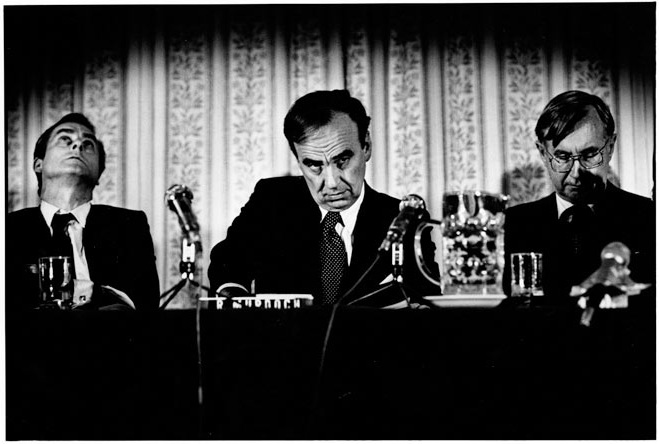
The media “sale of the century”: Rupert Murdoch announcing his purchase of Times Newspapers on Jan 22, 1981. He is flanked by Harold Evans, editor of The Sunday Times, and William Rees-Mogg, editor of The Times. Captured here in what the photographer © Sally Soames calls her “best shot”

❚ HOW EXCITING THAT HARRY EVANS can still recount his rows with Rupert Murdoch in 1982 were as if they were “the day before yesterday”. The legendary former editor of The Sunday Times yesterday regaled the Leveson inquiry into British press standards via a video link from New York where he lives. He described one row almost ending in “fisticuffs”.

Murdoch had transferred Evans from The Sunday Times to its daily stablemate, The Times, once he had purchased the UK’s two most important newspapers in 1981. Evans told the inquiry there followed a year of constant editorial interference from Murdoch. Under the headline “Harold Evans tells Leveson of conflict and ‘vindictive’ atmosphere at Times”, today’s Guardian was impressed, 30 years later, that the ex-editor seemed to be “replaying the events as if they had occurred the day before yesterday”.

An insight into why the memories remain so fresh is delivered in an irresistible report elsewhere, at The Daily Beast website, doubly spiced because its editor-in-chief is Sir Harold’s wife, Tina Brown. Amid a blizzard of other Murdoch coverage, we see this headline:

➢ Sir Harold Evans Fights Back Against Rupert Murdoch
At Leveson Inquiry:

Evans described how he and Murdoch “almost came to fisticuffs” when Murdoch disagreed with a story published in The Times by an anti-monetarist writer. Evans resigned after only a year, over what he has long described as disagreements with Murdoch’s editorial interference. “I was disgusted, dismayed, and demoralized,” he said today… The vitriol between the two men has festered ever since Evans’s departure from The Times.

Sir Harold might as well have been reading Chapter 15 from the rip-roaring book Good Times Bad Times that he wrote the moment after resigning in 1982 and exiling himself to America soon after. The fireworks turn to warfare in the chapter headed “Plots” when Murdoch is giving Evans a dressing-down at The Times:

Murdoch: “Whad d’ya stand for? Nothing! The Times has no convictions.”
Evans writes: I accepted the provocation. I was glad to have it out in the open. I outlined five policy lines…
Then [Murdoch] added acidly: “Of course, I’m not supposed to speak to you like this. I’m supposed to ask the national directors” … [Murdoch] was not looking for debate. He was looking for weapons.

Today’s digerati will seldom experience the adrenaline rush produced by such instinctive cut and thrust.† It was survival of the fittest on a daily basis which was the lifeblood of old Fleet Street — or Print as we used to call it.

➢ 1981, The day they sold The Times, both Timeses
— read more at Shapersofthe80s

❏++++++❏++++++❏

THE THREE BEST BOOKS FOR UNDERSTANDING
HOW BRITISH JOURNALISM WORKS

+++
books, journalism TOUGHING IT
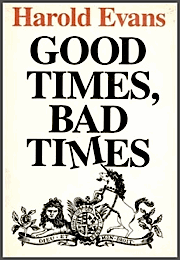
➢ Good Times Bad Times
by Harold Evans

The best account ever of the pitiless manners and mores of British newspaper executives and those they serve. The 525-page paperback is a thriller that starts with the Foreword: “Early in 1982, 10 months after he had taken over The Times and The Sunday Times, Rupert Murdoch went to see the prime minister Mrs Thatcher. They shared a problem: it was me.” The book is unputdownable. As my former editor Charles Wintour wrote in his review: “Enthralling… the narrative pace is tremendous… an immediacy and an excitement worthy of le Carré.”
Scoop , Evelyn Waugh, TV, films,Gavin Millar, DVD,Michael Maloney, books, journalism

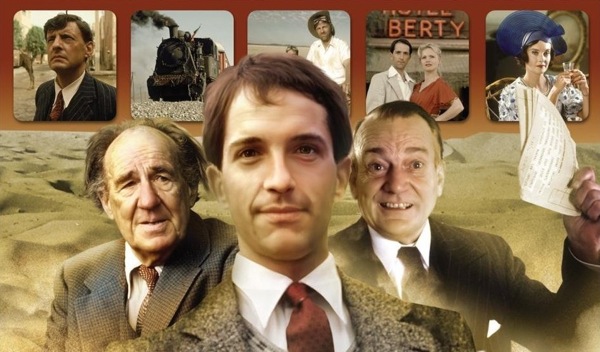
Gavin Millar’s TV film of Scoop, 1987, now on DVD: Michael Hordern as Uncle Theodore, Michael Maloney as William Boot, Denholm Elliott as Salter

THE HOLLOW LAUGH
➢ Scoop by Evelyn Waugh

A satire so lithely comic that it prompts tears of mirth on almost every page. Though published in 1938, every one of its sublime characters is alive and well and working on national newspapers today. More, the all-too-plausible gaffe on which the entire plot tilts — a dinner-party name-drop sends wrong reporter off to cover a war — is true to the serendipitous decision-making that lands journalists in the least suitable of jobs. The novel’s inspiration was the dynastic rivalry between the best-selling newspapers of their day, the Daily Mail (owned by Lord Northcliffe then his nephew Lord Rothermere) and the Daily Express (Lord Beaverbrook), all fictionalised in the megalomaniac universe of Lord Copper of The Beast and Lord Zinc of The Brute. Most famous line: When Lord Copper was right, [the foreign editor] said: “Definitely, Lord Copper”; when he was wrong: “Up to a point.”
books, journalismTOOTH AND CLAW
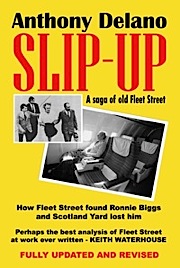
➢ Slip-up: How Fleet Street Found Ronnie Biggs and Scotland Yard Lost Him, by Anthony Delano

Verdict of playwright and columnist Keith Waterhouse: “Perhaps the best analysis of Fleet Street at work ever written.” Every word is true (allegedly) in this preposterous page-turner, starring Fleet Street’s finest, Scotland Yard’s finest, and the Great Train Robber. The sheer guile, grit and ratlike cunning displayed by newsroom hacks from the 14 rival national newspapers is breath-taking as they try to second-guess each other during the manhunt for Ronnie Biggs, the most infamous of the villains who had pulled off what was then the greatest robbery of all time. During his 30-year sentence he escaped from jail. Years later, in 1974, the Daily Express discovered the fugitive in Brazil.

This was the scoop of the century and the 4million-selling Express endeavoured to keep the scoop secret from everybody except Detective Chief Superintendent Jack Slipper, head of the legendary Flying Squad. He was invited to join the hacks in Rio to deliver his best line: “Hello Ronnie. Long time no see.” Then a bombshell exploded. The secrecy of the mission meant nobody had applied for Biggs’s extradition. Fact was: Brazil had no extradition treaty with Britain. Slipper’s humiliation was crowned by the picture stealthily snatched by Mike Brennan of the Daily Mail showing him flying back home asleep beside the empty seat that should have held Biggs. Still, the exclusive Express story had already scooped the world. And Delano’s book became a £1m BBC TV drama in 1988.
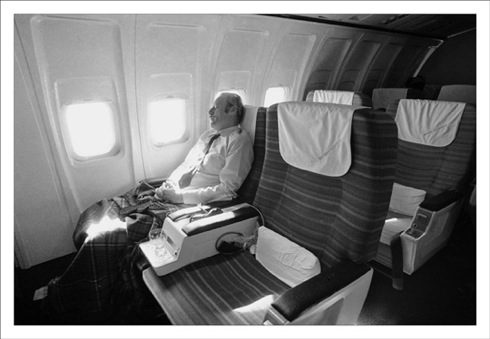
Detective Chief Superintendent Slipper flies home from Brazil: photographer Michael Brennan snapped him asleep in flight. The caption was “The Empty Seat”

➢ The story behind the story of Slip-Up — In a 2008 update, Anthony Delano spilled more beans: keep scrolling to find Revel Barker’s account, more by Delano himself and by Keith Waterhouse who scripted the 1986 TV version titled The Great Paper Chase.

➢ Ten of the best books about journalism — As Vincent Mulchrone said: “Journalism is the only human activity where the orgasm comes at the beginning.”

† HISTORICAL FOOTNOTE ON
THE CUT V THE THRUST
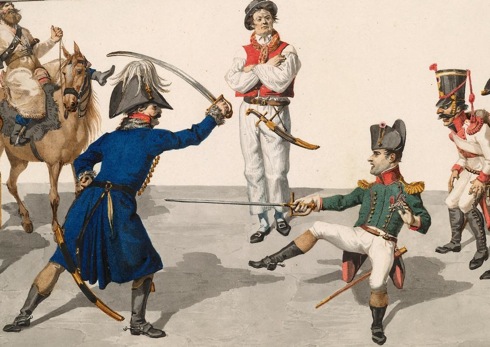
cut and thrust, swordplay,debate,conflict,competition

Point over edge in swordplay: attacks with the point rely more on speed and finesse while those with the edge rely more on strength and momentum. Different swords do one or the other better. The fact is that thrusting requires much less strength to make a lethal wound while an effective cut can require a powerful blow. Both demand skill. Both will kill. You decide which one suits Rupert and which suits Harold

➢ Napoleonic Flame War by Richard Marsden — During the late 18th and early 19th century the definition of a proper sword varied from nation to nation. Initially, nations sought to choose the “best” sword for their light and heavy cavalry units so that on the battlefield they would be more effective. Tests and studies were done, data collected and proposals put forth. Somewhere along the line, however, the matter of the cutting sword or thrusting sword became more than one of facts and figures — it became one of national pride.

FRONT PAGE

2012 ➤ “Very doubtful” — Tony Hadley on the future of Spandau

ITV, Loose Women, Spandau Ballet,Ruth Langsford, Tony Hadley, Janet Street-Porter,

Tony Hadley today: flanked by two of ITV’s Loose Women, Ruth Langsford and Janet Street-Porter who shot the first TV doc about Spandau Ballet in 1980

❚ MORE COLD WATER HAS BEEN POURED on any future reunion for Spandau Ballet. The leaders of the 80s New Romantics movement haven’t worked together since their Reformation reunion tour ended in 2010. Today on ITV’s Loose Women chat show, Janet Street-Porter asked 51-year-old singer Tony Hadley whether he would ever tour again with Spandau. He replied straight away: “Very doubtful.” His life is busy and full of hoovering these days, he says. Big Tone is now the father of five children — baby Genevieve Elizabeth was born in February.

➢ VIEW Tony Hadley’s eight-minute interview on the ITV Player for the next seven days, in Part 4 of Loose Women

➢ Hadley’s own plans include Rewind The 80s Festival returning for a fifth successive year Aug 18–19 at Henley-on-Thames with Kool & The Gang, OMD, Grandmaster Flash, Rick Astley, Soul II Soul, Five Star, Starship, Jimmy Somerville, Sinitta, Marc Almond, Midge Ure, Adam Ant and more, plus festival fun

THOSE HADLEY BOMBSHELLS AT SHAPERSOFTHE80s

➢ The Hadley bombshell no Spandau Ballet fan will welcome
— Dec 2011

➢ Bombshell for Spandau Ballet fans as Hadley unwinds after
US solo tour — Aug 2011

➢ As Big Tone Hadley goes West he tosses out a few interview squibs
— Aug 2011

➢ Spandau Ballet turn east for their final furlong
— Tour’s end, June 2010

FRONT PAGE

➤ The day Gary Kemp reduced hard-nosed Guardianistas to tears

+++
◼ AS WITH ANY ARTICLE AT THE GRAUNIAD about New Romantic cheerleaders Spandau Ballet, the resulting comments published online are always riotously entertaining. This is the one band that really winds up Guardianistas to a pitch of fury. When the 80s band announced their reunion tour in 2009, Michael Hann declared how much he’s always loathed them in a Graudina music blog which then provoked 342 comments — 342! — most of them apoplectic. How many other bands can claim such a following?

books, Lyrics of Gary Kemp,Lyric Book Company,

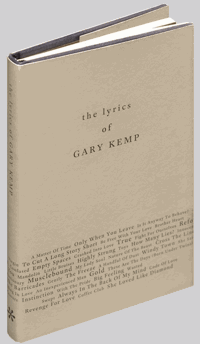
As it happens the Spandau songwriter has recently published an 88-page coffee-table book, titled The Lyrics of Gary Kemp from Lyric Book Company

Today for no apparent reason, the Guranaid runs an item about how Gary Kemp and Steve Norman made Spandau’s 1983 No1 hit True, in which lyricist Kemp admits: “I’m still berated for the line Take your seaside arms, but it’s straight out of Lolita by Vladimir Nabokov.”

Readers of Shapersofthe80s already know that the song was inspired by Kemp’s unrequited pash for poppette Clare Grogan — he was 22, she was 18 — who fronted an 80s band of Scottish cuties called Altered Images. On the same page, Steve Norman deconstructs his self-taught sax solo which has a key change in reply to Grover Washington’s Just The Two of Us.

All of which strangely prompts tearful blubbing at the Graun, rather than the usual explosion of acerbic outrage. Specimen comments follow after this gratuitous excuse to run a video…

VIDEO OF DARLING CLARE IN HER HEYDAY,
NOT TO MENTION SWIVEL-HIPS TICH

+++
➢ Meanwhile back to today’s Grauniad Online:
❏ Nietzsche39 (who else?) notes: “You don’t bastardise Nabokov. Seaside arms is absurd. Seaside limbs is genius.”

❏ Nepthsolem moans: “It always sounds to me like See side arms, as though referring to the service revolver I imagine was issued to all New Romantics, but sadly never used on TOTP.”

❏ DeeSawdeley says: “I always thought it was seaside aunt, which (for those of us with a seaside aunt, anyway) makes much more sense. Bet he wishes he’d written that now!”

❏ Stolencar comments: “Note also he says she gave him a copy of Lolita not that she had read it.”

❏ To which Vastariner responds: “There’s a picture of her reading it on the front of the Best Of Altered Images compilation released in 1991. Some might call me obsessed for knowing that, or because I have a username taken from one of her lyrics… etc etc.”

❏ From another planet, Golgafrinchan sobs: “I had unrequited love for Clare Grogan, still do to be fair. If you’re reading this Clare, get in touch, there’s still time.”

❏ DameHedwig adds: “I’ve often told my son that if things had worked out for me, Ms Grogan would be his Mum.”

❏ And Mccaugh: “As for the sublime Miss Grogan, well, just how many times did we go and see Gregory’s Girl? Helped, of course, by the fact that it ran at the Dominion Cinema in Edinburgh for three years non-stop.”

❏ Finally Bloodydoorsoff tells a despicable and blatant untruth about darling Clare, so you’ll just have to go to Grunadia Online to see it. And plenty more.

John Gordon Sinclair, Scott Neil), Clare Grogan, Glasgow Film Festival ,Gregory’s Girl

Glasgow Film Festival 2010: Darling Clare seen with Gregory’s Girl sidekick John Gordon Sinclair. In 1994 — sorry, lads — she married bandmate Stephen Lironi in Glasgow and today the couple live in Haringey, London, with their adopted daughter. (Photography by © Scott Neil)

FRONT PAGE

➤ Will Hawking give Sheldon the funniest bang since the Big One?

Jim Parsons , Sheldon Cooper , Stephen Hawking, Big Bang Theory, TV series, E4

Hero and uber-geek: Jim Parsons as Sheldon Cooper is clearly dead chuffed to meet Stephen Hawking as guest star on The Big Bang Theory

❚ “POSSIBLY, THE BEST EPISODE. EVER.” Let’s hope TVfanatic’s Carla Day isn’t overselling this week’s Series 5 episode 21 of the US’s highest rated comedy show. The States saw it last month, and Carla reported “non-stop laughs”. The Big Bang Theory is the cult comedy series that has come to define the age of Geek Chic. The sitcom revolves round four nerdy friends who all have impressive jobs and degrees in science. They play video games, collect comic memorabilia, discuss complex scientific topics.

Now TBBT can claim the ultimate accolade: the world’s most famous scientist steps up to guest star in The Hawking Excitation, which airs in the UK on Thursday (E4, 8pm). Yes, Britain’s 70-year-old cosmologist, Stephen Hawking, visits California to lecture at Caltech university (renowned as much for its practical jokers as its Nobel prizewinners). There, engineer Howard Wolowitz is given the job of maintaining his wheelchair. This makes theoretical physicist and uber-geek Dr Sheldon Cooper (played by Golden Globe and Emmy winner Jim Parsons) green with envy.

As the Prof’s most ardent admirer, Sheldon stops at nothing for the chance to share his hero’s “beautiful mind”, so his put-upon rival Howard sets Sheldon various tasks to earn a meeting with Hawking, and one is to walk into the cafeteria in a French maid’s costume. “What are you all staring at?” quips Sheldon. “You ever seen a man try to get a meeting with Stephen Hawking before?” The encounter itself produces a pretty ripe exchange between the pair of geniuses.

 Stephen Hawking ,Big Bang Theory,Simon Helberg,Kunal Nayyar,Jim Parsons,Johnny Galecki,E4

Let’s not forget Big Bang is an ensemble show: superstar Stephen Hawking is circled by satellites Leonard, Raj, Sheldon and Howard

Executive producer Bill Prady said: “When people would ask us who a dream guest star for the show would be, we would always joke and say Stephen Hawking — knowing that it was a long shot of astronomical proportions. In fact, we’re not exactly sure how we got him. It’s the kind of mystery that could only be understood by, say, a Stephen Hawking.”

Fact is however that Hawking has guested on Futurama and appeared more than once as himself in The Simpsons.

This week’s episode isn’t the only dream come true for Sheldon. In March the world’s most famous Vulcan actor, Leonard Nimoy, was heard when Star Trek’s Spock spoke to Sheldon in his sleep and deployed some snappy logic, as ever. And in 2010 Apple’s Steve Wozniak had a cameo in which he interacted with a virtual Sheldon who tells Wozniak he’s his “15th favourite technological visionary”. Only 15th, note.

Big Bang Theory, Leonard Nimoy, Jim Parsons,Sheldon Cooper,E4

Vulcan brothers: Jim Parsons brought some method acting to his role when Leonard Nimoy appeared on The Big Bang Theory this year

➢ Catch up online at 4OD with The Hawking Excitation until June 15

➢ David Hockney paints Stephen Hawking — watch a glittering new portrait emerge as a movie

FRONT PAGE

1928–2012 ➤ Sassoon’s revolution: No teasing. No hair spray. Just the cut.

Vidal Sassoon,the bob, Mary Quant, hairstyles

1963: Sassoon creates the “bob” on designer Mary Quant. (Photo: Getty)

“He revolutionised not just hair but fashion” — model-turned-Vogue fashion editor Grace Coddington

Vidal Sassoon , Albert Hall,

Comeback 1975: Vidal Sassoon between two contrasting examples of his hairdressing for a teach-in at the Albert Hall, where he returned to hairdressing after a five-year break. (Photograph by Tim Graham / Getty)

➢ The Daily Telegraph reports the death at 84 of celebrity hairstylist Vidal Sassoon, whose 1960s wash-and-wear cuts freed women from the tyranny of hairspray…

Vidal Sassoon, who was found dead at home on Wednesday, was at the cutting edge – literally and metaphorically – of hairdressing. His sharp, geometric, low-maintenance 1960s hairstyles revolutionised his craft, sounding the death knell for the stiff, set hairdos of the 1950s. An astute businessman, he made a fortune from his salons and products, and became a household name. “I wanted to eliminate the superfluous and get to the basic angles of cut and shape,” he said… / continued online

+++
❏ Craig Teper’s 2010 documentary Vidal Sassoon: The Movie follows the true rags-to-riches tale of how a boy from a London orphanage went on to open his own Bond Street salon in 1958 and — influenced by the Bauhaus designs he had studied — he create the “shape” that became his signature cut, the five-point bob. It revolutionised hairdressing. His geometric wash-and-wear cuts marked the end of the beehive and the bouffant hair styles of the 50s. Admirers included the Duchess of Bedford, model Jean Shrimpton, actor Terence Stamp, and film star Mia Farrow. In 1963 he devised the classic “bob” for fashion designer Mary Quant, who called him the “Chanel of hair”. By 1964 he’d gone international by opening his first salon in New York.

Vidal Sassoon, Movie

Sassoon The Movie: the London crimper freed women from 50s bouffants by pioneering the low-maintenance hairstyles that defined the 60s

FRONT PAGE