30 years ago today ➤ First survey of their private worlds as the new young trigger a generation gap

John Maybury, Marek Kohn,Blitz culture,  ZG

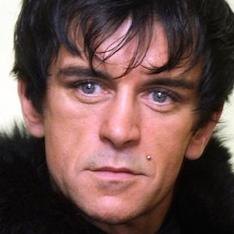
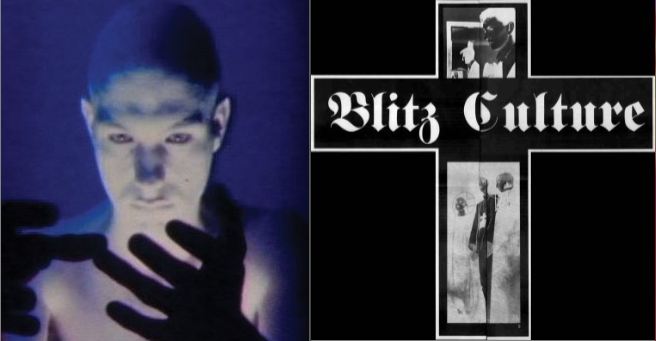
Left, film-maker John Maybury in Tortures That Laugh © John Maybury 1978, artist’s collection; right, graphic from ZG magazine, issue one, 1980

❚ THE BLITZ CLUB SCENE EVOLVED RAPIDLY during the summer of 1980 as media coverage caught up, and it became clear that the New Romantics were not the only social group making waves. In the London Evening Standard’s On The Line column I had been following the Blitz Kids all year and, unsurprisingly, my nocturnal antics raised eyebrows at the Standard by day. “Do they talk sort of funny?” colleagues would ask about my bizarre playmates, meaning did they say “Leave it aht” instead of “OK yah”? Over time the generation gap I was reporting caught the attention of the Standard’s perceptive film critic Alexander Walker, who couldn’t read enough about Britain’s self-possessed youth movement. “Not so much a generation gap,” he observed sagely. “More a genus gap!” In this respect, the parallels with the digital natives of today’s Generation Y are spooky.

A key difference was the naked ambition of the media-savvy Blitz Kids who shunned rock music as a stone-age relic. They were spreading inspiration through Britain’s clubland, even as Steve Strange’s Tuesday nights at the Blitz ended suddenly on October 14, as also did Hell, their Thursday offshoot. Key players were changing trains. That very week Spandau Ballet had signed their first record deal, while I had been darting daily from concert to club to Kensington Market surveying the many competing expressions of youthful endeavour, then trying to persuade the editor Charles Wintour that A Significant Youthquake Was About To Break.

A month earlier during London fashion week I’d only just scraped into print with my first Pose Age report showing Melissa Caplan’s unisex tabards which were being worn to shock. “You’re making this up,” raged one senior editor whose veto against publishing was over-ruled by Wintour. Now I was proposing that this sweeping survey for On The Line should make a spectacular centre spread in the paper. Yet the eye-searing kids in our pictures were a bridge too far even for the enlightened Wintour, who sent me a memo saying it was all “Rather too esoteric for us”. Under protest, he finally conceded splitting the survey between two separate pages a week apart.

By Christmas Spandau’s single became a chart hit, along with Fade to Grey by Visage, fronted by Steve Strange. We could not know then how quickly Britain’s clubbing grapevine was to hurtle yet more clubland bands into the charts, many unveiled by sharp young managers the same age as the talent. Or that 1981 would soon be spinning like a New Romantic dynamo.
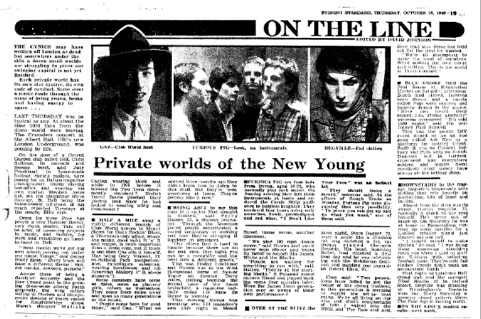
Evening Standard, Oct 16, 1980

First published in the Evening Standard, Oct 16, 1980

THE CYNICS may have written off London as dead in 1980 but somewhere under the skin a dozen small worlds are struggling to prove our swinging capital is not yet finished. Each private world has its own star system and its own code of conduct. Some steer a scenic route through the maze of being young, broke and having energy to spare. . .

➢ Click to continue reading
One week in the private worlds of the new young
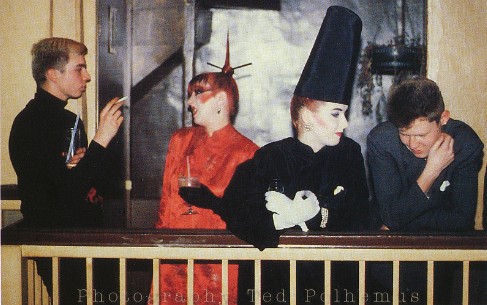
Shaping ambitions at the Blitz in 1980: Lee Sheldrick, Melissa Caplan, Kim Bowen and Bob Elms

FRONT PAGE

2011 ➤ Sade comes home to tour UK but even a cheap seat will cost you £158 !

Sade, Soldier of Love,BabyFather,O2 arena,European tour, American tour, first UK tour in 18 years,highest selling British female,Rich List,Kylie
❚ BRITISH FANS GET TO SEE the soul singer and former Blitz Kid Sade Adu live on her first UK tour in 18 years at three dates in 2011: Manchester’s MEN Arena on May 27, then Birmingham’s LG Arena May 29 and London’s O2 Arena May 31. Tickets go on sale officially from Oct 18, though today you can find £134 Upper Tier seats at MEN on sale with £24 booking fee through Stereoboard.

The 70-date global tour starts in Europe at Nice on April 29, reaching Dublin on May 25, and continues through North America from June 16. Since its February launch the group’s sixth studio album Soldier of Love has sold 3m copies, while the British website for “the band Sade” claims Sade is the highest selling “British female artist” of all time (not quite the same thing), with sales of 57m albums worldwide — so as a solo singer Kylie might dispute this with her 40m albums and 60m singles. Earlier this year Kylie just pipped Sade in the Sunday Times Rich List, with an estimated fortune of £35m, against her rival’s £30m.

➢ Official Sade VIP Ticket packages priced from £399 / Euro 399
➢ 2010, Comeback Shard comfy as ‘Auntie Sade’
➢ VIEW ♫ ♫ video for the single BabyFather
➢ More links in sidebar at right

FRONT PAGE

1980 ➤ The day Spandau signed on the line and changed the sound of British pop

Spandau Ballet, Virginia Turbett,Chrysalis,Steve Dagger, New Romantics

The way they wore: Spandau Ballet minutes before signing their record record deal in October 1980. Photographed at London’s Waldorf Hotel © by Virginia Turbett

◼ AS THE COOLEST CULT LEADERS OF 1980, Spandau Ballet’s songwriter Gary Kemp claimed: “We want the band to be at all times the most contemporary statement we could possibly make on modern London.” In the face of the post-punk new wave, it took courage to decide to play fresh sexy dance music in a corporate landscape dominated by adult-oriented rock supergroups. In the event, the five boys from the Angel, Islington, quickly assumed the role of houseband to the Blitz club and by placing the bass guitar and the bass drum at the front of the sound made it hip once more to play pop.

Spandau Ballet were being managed by their onetime schoolmate Steve Dagger, aged only 23, while three record labels competed to secure them. On this day 30 years ago they signed a deal with Chrysalis Records and walked into the future clutching an advance cheque for £85,000 — at the time, a record sum for an untried band that had played all of eight bookings and had refused to cut demo discs.

“We were strong, it was a real gang, a real team mentality. It was: We’re Spandau Ballet, who the f*** are you?” — John Keeble, Spandau drummer

By breaking all the industry rules, Spandau triggered a fashion and dance music movement that had been evolving in the nightclubs of Britain. At the very moment that the Blitz closed its doors, the press dubbed their followers the New Romantics, and a slipstream of more than 100 new image bands was born. The new sounds and new styles of this, the last of the Babyboomer generation, went on to dominate the international landscape of pop and over the next three years put more British acts in the US Billboard charts than the 1960s ever achieved.

ELSEWHERE ON SHAPERS OF THE 80s

➢ Oct 16, 1980: One week in the private worlds of the new young
➢ Birth of the New Romantics and the band who made it hip to play pop
➢ How the rhythm of the pop charts changed

Spandau Ballet, The Makers,The Cut,Roots, Dame Alice Owens

Tony Hadley fronts The Makers: Spandau as a school band playing to the fourth form at Dame Alice Owens — grabbed from video

➢ VIEW ♫ Early footage of Spandau Ballet in the Young Guns documentary from 2000
➢ New Romantics: I Was There — ex-Sounds hackette Betty Page’s recollections for Record Collector, written with the benefit of hindsight in 2004

FRONT PAGE

1980 ➤ Rik and pals detonate a timebomb beneath another kind of strip for Soho

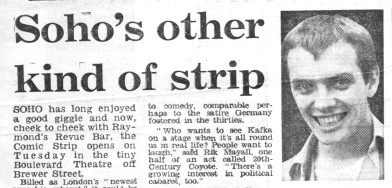
On this autumn day 30 years ago, a handful of comics in their twenties broke free from the bear-pit formula of the Comedy Store, which had opened in London in 1979, modelled on its Hollywood precursor. These soon-to-be-famous clowns were angry with Britain’s complacency in the face of recession and decided to define a new kind of comedy. First news of the breakaway faction that would eventually make household names of French & Saunders, Rik Mayall, Adrian Edmondson, Nigel Planer, Peter Richardson and Alexei Sayle appeared in the Evening Standard’s On The Line page …

Comic Strip, Rik Mayall, Alexei Sayle,Michael White

First published in the Evening Standard, October 2, 1980

❚ SOHO HAS LONG ENJOYED A GOOD GIGGLE and now, cheek to cheek with the king of strip Raymond’s Revue Bar, the Comic Strip opens on Tuesday in the tiny Boulevard Theatre off Brewer Street. Billed as London’s “newest anarchic cabaret”, it could be called Son of the Comedy Store, a nightspot already well established as a Gong Show for would-be comedians.

“The Comic Strip’s going to feature the best of the Comedy Store and more,” explained Peter Richardson, one of a comedy duo called The Outer Limits, who are launching the enterprise with West End impresario Michael White (the man behind the musical Annie). “There was too much experimentation in the Comedy Store. We want to establish a certain standard at the Comic Strip.”

alternative cabaret,comedy, Soho, Comic Strip,1980,Rik Mayall

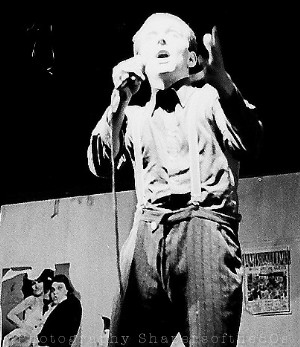
Angry Feminist Poet: Rik Mayall at the Comic Strip, Nov 1980. Photographed by © Shapersofthe80s

He and the comedians he has brought with him — including the Comedy Store’s acerbic compere, Alexei Sayle —believe the traumas of the 1980s have brought a sharper cutting edge to comedy comparable perhaps to the satire Germany fostered in the 30s. “Who wants to see Kafka on a stage when it’s all round us in real life? People want to laugh,” said Rik Mayall, one half of an act called 20th-Century Coyote. “There’s a growing interest in political cabaret too.”

This self-styled “alternative” comedy isn’t all heavy social comment by any means, its roots going back more to clowning. What these comics are attempting is deliberately to shake off the influence of the Footlights clan who have shaped British humour for the past 20 years. Mayall himself has a talent for the merciless lampoon. One of his sketches, a punk commuter lamenting his daily lot, is the funniest invention since John Cleese’s Ministry of Silly Walks.

Last weekend he and The Outer Limits were playing to packed houses at the Three Horseshoes, a pub theatre in Hampstead, as if to prove that alternative humour is booming. The Comic Strip promises a varied line-up which this month includes Pamela Stephenson from BBC-tv’s Not The Nine O’Clock News. Entrance will cost a flat £3.

➢ 1980, A new decade demands new comedy
— Birth of the Comic Strip

FRONT PAGE

1976 ➤ When Iain met Stephen, London traffic stopped and St Martin’s stood still

❚ ON CENTRAL ST MARTIN’S ALUMNI PAGES, Iain R Webb — later CSM professor and fashion editor of The Times newspaper — recalls the unforgettable instant he arrived there as a student and clapped eyes Stephen Jones, who this month celebrates his 30 years as milliner to the stars…

Stephen Jones, milliner, Iain R Webb,fashion,St Martin’s School of Art, journalist,

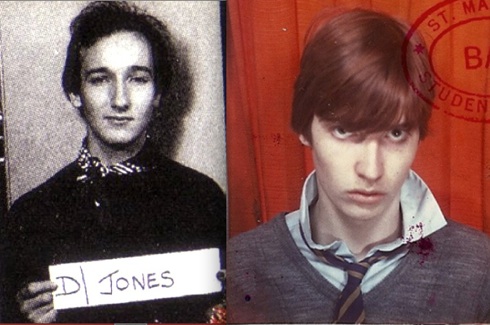
Side-knotted scarf versus thin school tie: despite their differences in 1976, Jones and Webb became firm friends at St Martin’s

“I remember vividly the day I visited St Martin’s School of Art (now Central Saint Martin’s) in the autumn of 1976. Before I even entered the building I was convinced this was the place for me. Standing on the pavement outside, plucking up the courage to go in and wondering if I cut the sartorial mustard wearing a liquorice-thin school tie, plastic sandals and sloppy orange mohair sweater (knitted by my Mum). The doors swept open and out sashayed a boy (or at least I guessed it was a boy) who looked like… well, I wasn’t sure what he looked like, only that I had never seen anyone look like that before. Not in the real world, anyway.

“He was wearing a skinny matelot T-shirt with giant shoulder pads, exaggerated peg-top pants and stiletto-heeled boots. Around his neck was a scarf knotted at the side and the finishing touch (it should have been a clue) was a black beret worn at a very jaunty angle. He looked breathtaking and fearless and was ‘traffic-stopping’. Literally. He was Stephen Jones, later to become the celebrated and much-loved milliner to the stars, from Carla Bruni to Marilyn Manson.

“After a spell of work experience at London couture house Lachasse, where his head was turned for ever under the tutelage of Shirley Hex, for his final collection at St Martin’s in 1979 Stephen created silvery draped cocktail suits, accessorised with turbans featuring peacock feathers. The mood was 1950s couture with a punk attitude. ‘The last two looks were white court presentation dresses worn with broken tiaras with dead seagulls in them,’ he remembers, as adamant today as he was then that creativity is often born out of necessity. If you don’t have a lot of money it forces you to think alternatively. You have to be more creative. Like when I left college I bought hats from Oxfam and reworked them’.”

FRONT PAGE