2011 ➤ Kraftwerk now: from machine music to visions in 3D

+++

Wallpaper magazine,october 2011, Kraftwerk, Ian Schrager, 3D video,Munich,concerts

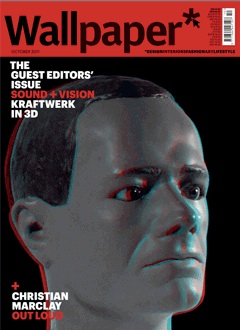
3D cover by Kraftwerk: view with blue-red glasses supplied with the mag

❚ THE ELECTRONIC BAND KRAFTWERK exploded into the hippy haze of 1970 and filled the air with an insistent machine-made beat that spoke of the future. Indisputably, the German four-piece formulated a revolutionary kind of non-guitar music that reshaped the thinking of musicians as diverse as Bowie, Afrika Bambaataa, Coldplay, New Order, Johnny Marr, Franz Ferdinand and Radiohead. New genres such as house, synth-pop and techno were heralded by the 1974 hit album Autobahn.

Today, however, the pioneering Ralf Hütter (a Beach Boys fan) and his usually reclusive pals slip out of their comfort zone to become guest editors on the October issue of Wallpaper magazine, which features a new portfolio of Kraftwerk imagery in 3D. Oops!

Of necessity in print, they have chosen the vintage blue-red 3D technology from the 50s to create ten graphics as double-page spreads. Yet however hard you try to flatten the glossy and flexible magazine, the deep gulley down the middle beams out its own distracting reflections! (The images might well improve if viewed on the iPad edition.) Successful, they are not: 70s minimalism always teetered tinglingly on the brink of being boring, and creatively Kraftwerk’s bland graphic renderings of autobahn, calculator, PC, pills, robots, cyclists and the band themselves say nothing new. They wouldn’t guarantee a pass degree at a British art school. Disappointingly, the 3D effects grab you in only two illustrations — one of breaking glass, another of a car’s dashboard radio — prompting the message to Ralf, especially at the age of 65, that, as graphic artists, his band may have seen better days.

There’s much more value in a brief evaluation by the leading British designer Peter Saville of how Kraftwerk opened his horizons to the European cultural canon.  The advantages of the analogue era, he reasons convincingly, can be fully appreciated only now, from the perspective of the digital age.

➢ Electronic Sound Pictures — It could be that Kraftwerk’s specially developed multi-channel 3D video installation may offer a more immersive gallery experience. Fans will have to travel to Germany, to the Kunstbau at the Lenbachhaus, Munich, where the exhibition runs Oct 15–Nov 13. There’s also an accompanying book, Kraftwerk 3D, with 3D-glasses.

♫ First Kraftwerk concerts for two years will be held at the Alte Kongresshalle in Munich, October 12–13. Seats from £260 via Guardian Tickets.

♫ Kraftwerk’s Kling Klang Machine No 1 — 24-hour interactive music generator as an app for iPhone/iPad

➢ VIEW VIDEO: Kraftwerk and the Electronic revolution: Prism Films documentary, 2008

+++

SCHRAGER ANNOUNCES THE PEOPLE’S HOTEL

Ian Schrager, Public hotels, Wallpaper magazine, interview

Schrager: delivering a wake-up call

❏ Incidentally, the October issue of Wallpaper also interviews Ian Schrager, notorious partner behind Studio 54, the definitive New York nightclub of the 70s, who was jailed for income tax evasion. He later went on to invent the “boutique hotel” along with its “lobby socialising” and philosophy of “hotel as lifestyle” that has been ripped off by hoteliers across the globe.

At 65, with millions in the bank, he is about to launch his new Public hotel chain in Chicago. Business writer John Arlidge reports that “the master tastemaker senses the universe is turning on its axis again, just as it did when old-fashioned class divisions that ruled New York nightlife were swept away, enabling him to create Studio 54”. Schrager insists that there’s “a new simplicity” and “it’s structural”. He argues that many big hotel chains have failed to keep up with the consumer. The essential-services-only Public brand, he says, “will be an entirely new class of hotel that will be a big wake-up call to the industry”.
➢ Public Chicago begins previews on September 12

FRONT PAGE

➤ What it’s like working with Martin Kemp

Stalker, blackandbluefilms, video,Martin Kemp,horror

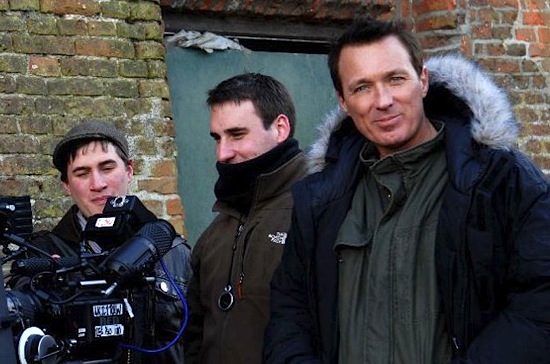
Pop star turned film director: Martin Kemp with the Stalker camera crew

➢ VIEW A BEHIND-THE-SCENES VIDEO from Stalker featuring Jane March and Anna Brecon talking about their director (UK release October 17)

➢ Stalker updates: trailer, interview with the producers

FRONT PAGE

2001 ➤ The other 9/11 assassination: could Massoud have become his nation’s spiritual leader?

Ahmad Shah Massoud and followers photographed by the Japanese photographer and anthropologist Hiromi Nagakura who knew him over two decades... “Massoud said to me, ‘We are fighting against terrorism. If we don’t fight here, the war will only expand.’ After September 11, I finally understood what he was talking about.”

❚ SUNDAY IS THE TENTH ANNIVERSARY of the 9/11 terrorist attacks on the United States, but this week also marks a decade since Al Qaeda assassinated the one figure who was holding out against its protectors, the Taliban. This was Ahmad Shah Massoud, an Afghan guerrilla commander known variously as The Lion of Panjshir and the Afghan Che Guevara who became the nation’s defence minister. Following his death he was nominated for a Nobel Peace Prize, declared a National Hero of Afghanistan and Sept 9 is now observed there as a national holiday known as Massoud Day.

He was assassinated at the age of 48 two days before the Twin Towers fell, ostensibly as part of the 9/11 process to draw the US into the Afghan war in 2001. Two Tunisian suicide bombers posed as overseas television journalists to interview Massoud in Khvajeh Ba Odin, a small village in north Afghanistan, where they detonated a bomb hidden in their camera.

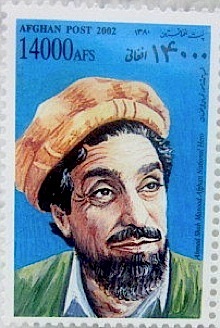
Ahmad Shah Massoud, postage stampIn 1996, during the civil war in Afghanistan, the Taliban seized the capital city, Kabul, and soon the majority of their fighting force were soldiers imported from abroad by Al Qaeda, the Sunni Islamist militant group founded by Osama Bin Laden and designated a terrorist organisation by the United Nations.

In 1989, Massoud had been instrumental in driving the Soviet army out of Afghanistan. In the 90s, with the Taliban gaining control of 90% of the country, he opposed them by creating the United Front (Northern Alliance), and so posed a constant threat to Al Qaeda.

What was revealed only last December, when the 30-year rule released previously secret UK Cabinet papers, was that western powers had decided in 1980 to provide “discreet support for Afghan guerrilla resistance” after the Soviet invasion of their country. This not only meant Britain secretly supplying arms to Massoud, but also that one faction of the mujahideen fighters were covertly funded by the CIA. These went on to become founding members of the Al Qaeda terrorist network.

➢ Afghanistan’s “lost pillar of stability” — Listen to yesterday’s flagship Today show on BBC Radio 4, when security correspondent Gordon Corera discussed why Massoud had to die before the Twin Towers fell. If he had lived, many believe Massoud would have become a vital pillar of stability for his nation.

Massoud Tomb, Afghanistan,video,DocsOnline

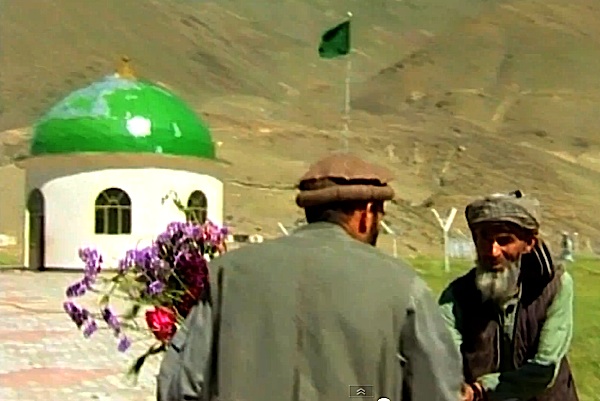
Annual pilgrimage: Ahmad Shah Massoud’s chauffeur brings flowers from his leader’s garden to his tomb overlooking the Panjshir Valley. (Grabbed from video documentary by Iqbal Malhotra)

➢ VIEW a scene from Ahmad Shah Massoud, a documentary (above) by Indian film-maker Iqbal Malhotra (from DocsOnline)

An Intimate Portrait of the
Legendary Afghan Leader

A freedom fighter, a warrior, a man of God, an intellectual, a humanitarian, a liberal… the list goes on. Massoud was a renaissance man, though his modesty would never acknowledge it. This is perhaps his greatest quality – humility. Unlike radical leaders such as Che Guevara, his desires were modest: Freedom and prosperity for his people.

Massoud was a passionate enemy of terrorism. He strongly objected to any terrorist-style actions by mujahideen during the war with the Soviets, and identified the war against the Taliban as a war against terrorism.

Massoud was a deeply spiritual man and a devout Muslim. It is important to make these distinctions, for “Massoud the man” has perhaps more in common with Mahatma Gandhi than Che. We are exposed to a man of grace, who revelled in the beauty of his country and his creed.

➢ Read more: the biography of Massoud by Marcela Grad is appraised by Justin McCauley in the Vienna Review of Books

FRONT PAGE

2011 ➤ Duran win Lifetime Achievement gong in GQ Men of the Year awards

DD with their GQ award last night: it was presented by Alex James from Blur at London’s Royal Opera House. Photograph: Rex

The online men’s magazine GQ.com says today:

❏ “After 30 years the perennially stylish supergroup Duran Duran are still producing the goods, with new Mark Ronson-produced album All You Need Is Now joining the likes of Notorious and Rio as essentials in any man’s collection.”

❏ Nick Rhodes says “Our original manifesto has been to collaborate with fashion, art, photography, design and architecture. I guess I’ve always thought of Duran Duran as a kind of ongoing art project.”

❏ GQ.com highlight “The supermodel power summit: bringing together Cindy Crawford, Naomi Campbell, Eva Herzigova, and Helena Christensen with director Jonas Akerlund for the upcoming video for Girl Panic!”

➢ DD’s acceptance speech: “I think we should have an award just for putting up with each other for 30 years” — Simon Le Bon

➢ View the videos of Jonas Akerlund

➢ Read Jonas Akerlund interview on Lady Gaga

➢ Read the full Duran interview plus all the GQ Men of the Year 2011 coverage in the October issue of British GQ

FRONT PAGE

2011 ➤ i-D Now reveals trade secrets and catches up with Scarlett from Cha-Cha

i-D NOW, pop-up exhibition ,Red Gallery ,photography, fashion,style,

i-D NOW: a pop-up exhibition at the Red Gallery in Hoxton

❚ THE ORIGINAL FASHION AND STYLE BIBLE, i-D, has decided to celebrate its 31st birthday with i-D NOW. This is a pop-up exhibition of historic covers, plus interactive events featuring industry-leaders, in conjunction with the Taschen anthology, i-D Covers 1980–2010, which was published last year. The event aims to give a behind-the-scenes look at how some of those covers and their hallmark winks were created.

Scarlett Cannon ,Helen Carey ,i-D magazine, i-D Now, exhibition

Straight-up from i-D issue 003: Scarlett Cannon and Helen Carey photographed by Thomas Degen

Details are being announced tantalisingly via Twitter but known tasters include past i-D fashion editor and broadcaster Caryn Franklin leading a discussion about fashion.

There’s a musical treat from boilerroom.tv and photographer Billy Ballard is staging a couple of Beauty Now shoots while i-D makeup expert Lucy Bridge does the styling. Other contributions will come from i-D family members including Terry Jones, Richard Buckley, Pat McGrath, Nick Knight, Simon Foxton and Edward Enninful.

i-D magazine,Scarlett Cannon,Head to Toe Guide,1982

i-D issue 008: Scarlett photographed by Thomas Degen

Coincidentally, by way of promoting the pop-up, i-D Online catches up with a couple of style-setters who first appeared together in a straight-up shot for the magazine’s third issue back in 1981. This was the height of the Pose Age when Scarlett Cannon and her startling haircut fronted the ultra-hip Cha-Cha club and she subsequently became the cover girl on i-D’s eighth issue.

Helen Carey with her own unique hairplay worked with designer Martin Degville in Kensington Market, where she was pictured here by Shapersofthe80s. They’re still up for striking a pose 30 years on, during which time Scarlett tells me she been “in full-blown glamorous gardening mode” as a garden tutor and food-growing consultant, among other things. For i-D she talks about her friend Helen’s business Vintage Vacations, which offers holiday retreats in classic silver American trailers.

➢ Read Scarlett’s piece Take A Vintage Vacation at i-D Online

➢ i-D NOW is a pop-up exhibition at London’s Red Gallery, 3 Rivington Street, EC2A 3DT (Sep 1–18, 11am–8pm, closed Sundays). For minute-by-minute updates visit #iDNOW on Twitter

FRONT PAGE