1980 ➤ Ribald tales of excess as the kids from The Blitz took over West End clubbing

+++
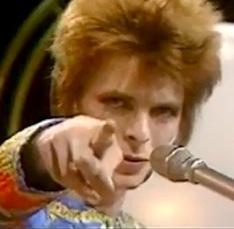
❚ FRIDAY NIGHT WAS AN EXCUSE for the wags to tell their tall tales of clubbing in the 80s. This was the first reunion in recent memory of the bright sparks the media once called Blitz Kids and New Romantics. We’re talking about the straighter faction tonight — the make-up brigade had their day at Boy George’s 50th birthday party in June. All of them, whatever their persuasion, were diehard nightowls, the spiritual offspring of the mighty innovator who shaped the 1970s pop scene almost singlehandedly, David Bowie. He taught them to adopt stances: individualism, transgression. He bequeathed them principles for living amusing lives: disposable identities, looks not uniforms. In turn, they then shaped the sounds and styles of the Swinging 80s set in motion by 1976 and the birth of punk, along with a passion for black dance music, on through the decadent glamour of the Blitz Club years, to the watershed of Band Aid in 1984.

On Friday, photographer Graham Smith took over Soho’s newest rendezvous, the Society Club, for a gallery show of his 80s photographs, which capture the panache and derring-do of style leaders such as PX, Stephen Jones, Kim Bowen Melissa Caplan, Stephen Linard, Fiona Dealey, John Maybury and such nascent popstars as Spandau Ballet, Visage, Animal Nightlife, Sade, Blue Rondo à la Turk and others.

Our two videos capture the essence of Smith’s collaborators, Robert Elms and Chris Sullivan, powering through their often unprintable anecdotes, edited on video down to bite-sized chunks and garnished with Graham’s images. The highspot was meant to be Sullivan as guest speaker, but when he was reportedly “still on his way”, in stepped writer and broadcaster Elms to recall the early one-night clubs he also helped to run. He sounded genuinely shocked by the precociousness of his peers — “We were kids!” — who persuaded West End nightclubs to hand over door control to them as teenagers. Eventually, Sullivan  arrived in the guise of Vladimir Ilyich Lenin, and of course excelled at spinning his “ribald tale of excess” about the mayhem he helped cause in clubland, en route to running Soho’s Wag club for 19 years.

+++
The photos form a dossier creative endeavour, as we’ll soon see in We Can Be Heroes, a 320-page coffee-table book containing 500 mostly unseen images and 100 voxpop interviews by Graham Smith. Warts-and-all main text is penned by the mellifluous Welshman Sullivan, with other contributions from Robert Elms, Boy George, Steve Strange and Gary Kemp.
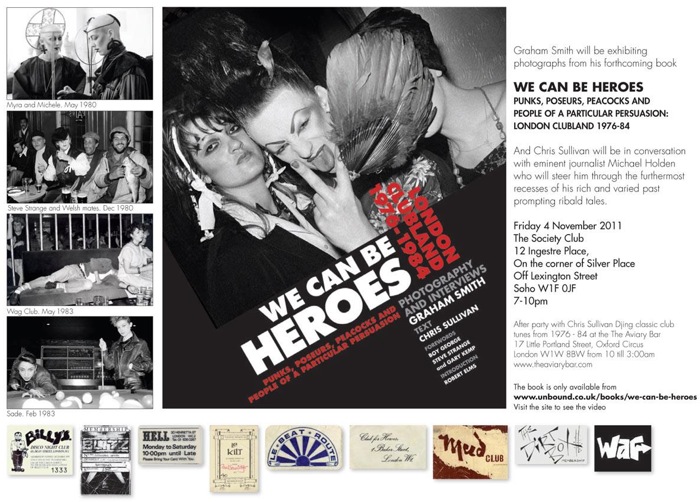
We Can Be Heroes, Graham Smith, Chris Sullivan, Robert Pereno, Society Club , Soho ,books,Unbound Publishing,photography, exhibition,afterparty, Aviary Bar, Robert Elms, Boy George, Gary Kemp ,Steve Strange, Blitz Kids,Wag club,

Smith & Sullivan’s invitation to a party

➢ Visit the publisher Unbound.co.uk to place your order for We Can Be Heroes and secure your name in the limited first edition. This month the authors aim to hit an advance sales target by this new “crowd-funding” technique in order to guarantee publication.

➢ Visit The Society Club, London W1F 0JF where Graham Smith’s photographs are on sale until Christmas. Subjects include Boy George, Sade, Steve Strange, Spandau Ballet, Iggy Pop, Siouxsie Sioux, the Sex Pistols and many more.

➢ Skimmable list of media coverage of We Can Be Heroes so far
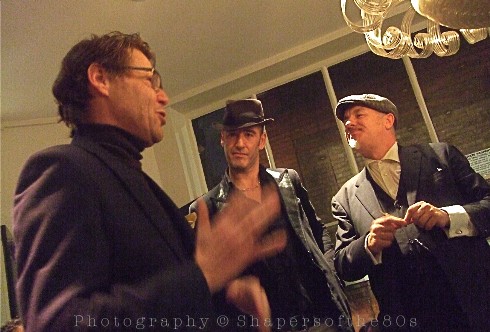
Making up the rules of 80s clubbing: Robert Elms, Phil Dirtbox and Chris Sullivan at Friday’s nostalgia fest. Photograph by Shapersofthe80s
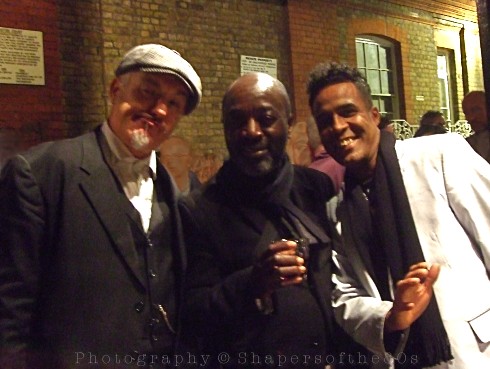
Fanatical about music: Chris Sullivan, Jo Hagan (remember 1983’s Gold Coast?) and Darrell Gayle at the Society Club. Photograph by Shapersofthe80s

FRONT PAGE

➤ No panic at Duran HQ — when you want glamour, glitz and shiny just outsource your video

+++
❚ SPONSORSHIP, EH? Why fork out your own money to make a pop video when you’re a penniless 80s retro band and you can persuade an international luxury brand to pay for it? In return for a few words of gratitude of course. So before we get to see the real thing, here is the 12th tease trailer, yes 12th, posted today, for Duran Duran’s next video. The first eleven can be viewed on DD’s YouTube channel.

This one is the “making of” version, and do not view it unless you’re braced for a hair-raising and shameless suck-up to their wonderful sponsor by all four members of the film-it-grab-it-and-run Rio gang. They are seen on location at London’s Savoy Hotel (B&B from £455 per night) shooting the archetypal DD lush-life single, Girl Panic! (Musically, the stand-out track on the album, more’s the pity.)

The Birmingham-born and high-school educated former nightclub disc jockey turned keyboardist Nick Rhodes whispers seductively from behind a cut-crystal glass curtain: “We teamed up with Swarovski who have provided some fantastic elements, crystals, for us in the video. You really do need to try to work with people who fit the aesthetic of what you’re trying to do, and with Swarovski, er, I think they, er, [he did pause, twice, let’s hope for ironic effect, though we cannot be sure] they represent quality, glamour and glitz and shiny things.” Yes, Nick did say shiny things. And yes again, dear reader, the key word there was aesthetic, with its very scholarly diphthong. As we discover, “Hey, this is only rock’n’roll” — the final words of the real video — is nearer the OTT mark.

Models ARE Duran Duran (No, not really, it’s just make-believe) ... Cindy Crawford, Helen Christensen, Naomi Campbell, Eva Herzigova and Yasmin Le Bon play Duran Duran for a photoshoot in the December issue of Harper’s Bazaar UK

Guitarist John Taylor adds his tuppenceworth of product plug for the Austrian gemstones-to-home-decor-to-optics-to-luminous-road-markings brand, yes, road markings, whose energy-intensive glass grinding processes take advantage of hydroelectricity in the local mountains: “That connection has brought a beauty to the look of the video that we wouldn’t have had without them.” And yes, everything from guitar straps to hand mikes were vajazzled with Austrian glitzy bits — 700 on the singer’s microphone alone, we are told.

Off-screen Rhodes spoke about the project from New York, where the band have just completed a six-week US tour: “Harpers UK had approached us about collaborating with the magazine on something really special when the new album came out. I’d had this crazy idea for a video for the song Girl Panic! that looked fantastic on paper — to recreate a day-in-the-life of the band, with five of the world’s greatest supermodels playing all of us. The magazine loved the idea of doing a cover shoot within the video itself.” (Domenico Dolce and Stefano Gabbana play Harper’s guest fashion editors for the day, during a photoshoot scene which will form a 22-page cover story for the December issue. Yes, 22!)

+++
Giving their services free are the supermodels: Naomi Campbell IS lead singer Simon Le Bon, Cindy Crawford IS bassist John Taylor, blonde Eva Herzigova IS blond keyboardist Nick Rhodes, Helena Christensen IS drummer Roger Taylor, while Yasmin Le Bon does a droll turn as “the anonymous guitarist”. (Only joking about the free bit.) Directed by Jonas (Telephone) Åkerlund, Girl Panic! will have its world premiere at the Harper’s Bazaar Women of the Year Awards 2011 at Claridge’s Hotel on Monday, and is released next day online at Vevo.

Wags at YouTube commented today: “It could be a Duran Duran commercial brought to us by Swarovski” … or “This Swarvoski commercial is brought to you by Duran Duran.”

❏ Wikipedia footnote: “Swarovski is also product-placed in the 2011 J-Lo promo video for the single On The Floor.” Eat your heart out, J-Lo.

➢ The Daily Mail gets the exclusive modelly pix from the Harper’s Bazaar shoot… while Grazia magazine declares the video a “Grand Fashion Moment”

➢ Previews of the December issue at Harper’s Bazaar

Duran Duran, Girl Panic, Naomi Campbell, video

“Naomi Campbell IS Simon Le Bon”... Videograb © Jonas Akerlund/Harper’s Bazaar UK

FRONT PAGE

➤ Toyah’s odyssey from Viennese Woods to Wicked Queen

+++
❚ AS TOYAH’S 30th ANNIVERSARY TOUR, From Sheep Farming To Anthem, comes to an end in London on Saturday after months on the road, let’s compare and contrast the manic bouncing Toyah from the Rainbow Theatre in 1981 (above) with the smiling mumsy Toyah 22 studio albums and a stage career later (having happily admitted to having had a facelift in 2008). Earlier this summer she seemed genuinely affected by the welcome War Boys received 30 years on (video below) … The hour-long Rainbow video is a brilliant reminder of what a force Toyah was in the singles charts of 1981 when her second album Anthem also went platinum — by year’s end she won the Smash Hits Reader’s Poll as both Best Female Singer and Most Fanciable Female. In 1982 she was voted the Best Female Singer at the Brits.

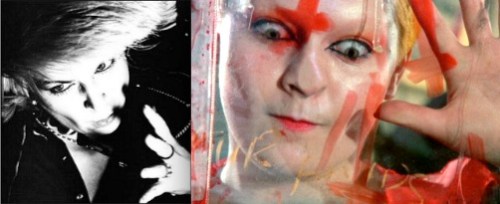
All of which had become a curious adventure following her lucky break aged 18 and fresh from drama school in Birmingham. In 1977 Toyah was cast in the role of Emma in Tales from the Vienna Woods at the National Theatre. The role required her to front a band they called Toyah wearing orange hair, and the rest is history. OK, a couple of edgy parts in Jubilee (video clip with Adam) and Quadrophenia helped too.

Toyah’s lucky year, 1977: playing Emma in Tales from the Vienna Woods, and a shaven-headed punkette in Derek Jarman’s film Jubilee

❏ Back in the present, Toyah can take only a short rest, however, before she’s back onstage, yeahhh! In panto, yeahhh! As the Wicked Queen in Snow White, boooo! Toyah says: “It’s a gift as an actress to play a baddie because you can be really nice and noone believes you, and you can be plain bad and noone loves you.” Panto comes to us all, darlings. Even Cliff Richard. Eventually.

➢ Snow White, Dec 9–Jan 1 at the Alban Arena, St Albans — Visit Toyah’s website for blog and plans of a spring tour

FRONT PAGE

➤ Vision On, Sound On: 75 years since BBC TV beamed out ‘a mighty maze of mystic, magic rays’

The BBC’s opening broadcast, November 2, 1936

➢ Click the picture to watch The Television Song in a new window — from the film Television Comes to London

❚ ONLY ABOUT 400 “LOOKERS-IN” were able to view the world’s first scheduled television service in high-definition (240+ lines) at 3pm on November 2, 1936. The engineers wore white dust-coats and the star wore a cocktail dress. With immaculate middle-class enunciation, she sang a song full of amazement at the newest technology of its day:

♫ A mighty maze of mystic, magic rays
Is all about us in the blu-u-u-u-e,
And in sight and sound they trace
Living pictures out of space
To bring our new wonder to you-u-u-u-u ♫

Everyone knew the musical comedy star Adele Dixon, though not yet the BBC Television Orchestra conducted by Hyam Greenbaum, also glimpsed in the clip above. The opening show was called Variety, and the song was called simply Television — known universally today as The Television Song. It had been specially written for the occasion, with lyrics by James Dyrenforth and music by Kenneth Leslie-Smith. Its innocence still wows us for six.

Alexandra PalaceThe broadcast was being beamed from what became a landmark transmitter tower atop customised studios 350ft over North London at Alexandra Palace, the original “people’s palace of entertainment”. Two different black-and-white television systems were being tested in quick succession on that first afternoon, and then on alternate weeks for six months: in the 70 x 30 feet Studio A the Marconi-EMI 405-line electronic system; and in Studio B, John Logie Baird’s 240-line mechanical system.

Baird the tenacious Scot is usually claimed to be the inventor of television and between 1923–1925 he demonstrated his clunky apparatus with a spiral of revolving lenses in the Soho building which became Bianchi’s restaurant soon after, refurbished today as Little Italy. The Times reported in 1926: “The image was often blurred. But it substantiated a claim that it is possible to transmit and reproduce instantly such things as the play of expression on the human face.”

Baird’s televisor in Frith Street, 1925: before transmission, the received image at left has been scanned by a spiral of revolving lenses, shown at right with inventor Logie Baird. Photo: Hulton/Getty

The flaw lay in Baird’s underlying technology being mechanical. In the end, Marconi’s electronic rival proved to be the future and it endured until the 1960s. Cecil Madden, the BBC’s fledgling TV Programme Organiser, says the differences were all too apparent: “Working in the Baird studio was a bit like using Morse code when you knew that next door you could telephone.”

A kick-start to the novice TV industry had come two months earlier. At very short notice the rival systems had been demonstrated at Radiolympia, the annual exhibition mounted by the Radio Manufacturers’ Association. The radio industry couldn’t sell the stands for the 1936 show (Aug 24-Sep 3) and a desperate call for help went out: could television save the day? (All the more desperate considering that TV sets in 1936 cost a princely £150, which is equivalent to £8,300 in today’s money.) Given only nine days’ warning, Cecil Madden appointed himself producer of its first broadcast.

+++
➢ The Alexandra Palace Television Society tells the tale alongside this film documentary about Radiolympia 1936…

❏ On August 26 at 11:45 a piece of Duke Ellington was heard, accompanied by a caption card reading, BBC Demonstration to Radiolympia by the Baird System, transmitted from its tiny one-camera studio. This was followed by another ten minutes of music. The highlight of the demonstration was to be a variety show someone had the bright idea of calling Here’s Looking At You, featuring a song with the same title by Ronnie Hill, performed by Helen McKay.

Alexandra Palace, BBC studio,

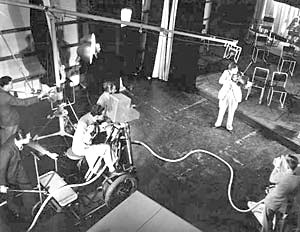
Alexandra Palace: Studio A with an Emitron camera

It was not until the next day, when everything was repeated using the Marconi-EMI system, that the show was seen in its full glory: with three cameras, two mobile and one fixed. This was the version filmed by British Movietone news cameras and featured above. “Hello Radiolympia,” said announcer Leslie Mitchell, standing in front of the first set of curtains. “Ladies and gentlemen, Here’s Looking at You.” And Miss McKay sang:

♫ Here’s looking at you
From out of the blue
Don’t make a fuss
Just settle down and look at us ♫

The 30-minute show that followed went out twice a day. Cecil Madden says: “It’s still unique because noone has ever done 20 programmes live, twice a day for ten days, from Alexandra Palace to the radio show at Olympia.”

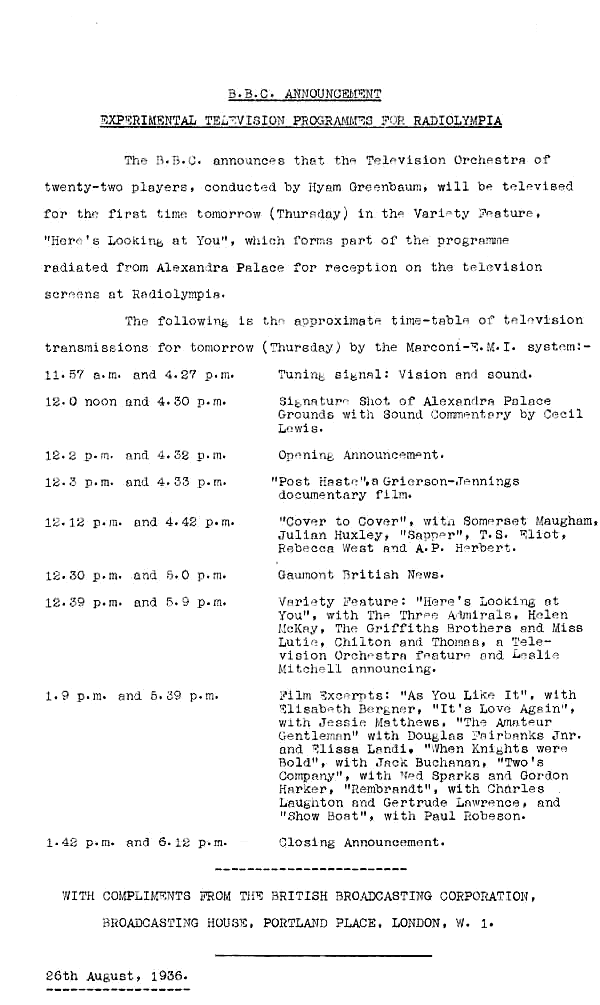
The BBC’s twice-daily running order for Radiolympia 1936. Click for the full document where eagle eyes will note readings by T S Eliot, Aldous Huxley and Rebecca West, and film appearances by Charles Laughton, Gertrude Lawrence and Paul Robeson. Source: Terra Media

The programme was received as far away as Bournemouth and Nottingham, and the Marconi-EMI team, with their mobile camera, were able to include some exterior shots from Ally Pally. All of which resulted in the official inauguration of the BBC Television Service being brought forward to early November. Regular programmes were broadcast twice a day from 3pm to 4pm and from 9pm to 10pm, except on Sundays. One of the early fears was that television would cause eye strain — even after only two hours a day.

FRONT PAGE

➤ On iPads, mobiles and tablets, you’re not even seeing half the story

Shapersofthe80s, British, youth culture,Ashes to Ashes, David Bowie
❚ iPAD, TABLET & MOBILE USERS PLEASE NOTE — You may be viewing only a tiny selection of items, not chosen by the author, here at Shapersofthe80s which is a wide-ranging website about the 1980s, when British youth culture was at its finest. To access fuller background features and full site index either click on “Standard view” or visit Shapersofthe80s on a desktop computer.

Click here to visit a different random item every time you click

FRONT PAGE