Category Archives: Social trends

➤ A second squadron of high-octane British artists zaps the Saatchi space

❚ TODAY’S NEW STARS OF BRITISH ART are quieter and more thoughtful than the YBAs in the Sensation survey of 1997 — this was the progressive critic Waldemar Januszczak’s verdict in June on Part 1 of the millionaire Charles Saatchi’s latest survey when it opened in London. “A rousing exhibition, Saatchi’s best for many a year,” he wrote. Part 2 of Newspeak, British Art Now, opens to the public today and it too proves to be another sprawl of hits and misses, yet the hits do unsettle and send a tingle through your aesthetic nerve. Shapersofthe80s has chosen a dozen of the more hyper-intense images for the gallery below.

This slideshow requires JavaScript.


For the sake of balance, let’s give the caustic old traditionalist his turn. Even after he “walked sickened away” from the 1997 Sensation show, Brian Sewell has actually conceded that “Saatchi did more for British contemporary art and the economic blossoming that it engendered than all the Tates, the Arts and British Councils put together.” Yet faced with the 2010 selection, he pronounced Newspeak Part 1 to be “Oldspeak rather than new, and we have seen it all before… The Newspeak group are hardly new kids on the block, for all have substantial exhibition histories, many of them international, yet very few have reached further than the low levels of skill, aptitude and common sense demonstrated every year in exhibitions mounted by students in the benighted art schools up and down the land.”

He concluded: “Newspeak is at best cliché, kitsch and the ironic subversion that is the joke so often played by the post-postmodernist… One might reasonably conclude that British art is dead.”

Shapersofthe80s sides with Januszczak in finding more experiment and curiosity than indifference at Newspeak. Januszczak identifies the Saatchi touch thus:
“What Saatchi has always done, and what Tate Modern can never do, is back hunches with cash. The Tate doesn’t have any FU money. Its investments are our investments. Which is why it remains so chronically and conspicuously image-conscious. When it comes to rewriting agendas, the Tate is a scaredy-cat. Saatchi, on the other hand, is not.”

Of Newspeak, he concludes: “[The] clash of new and old, scientific and irrational, experiment and belief, is typical of the show’s prevailing mood.”

❏ Newspeak: British Art Now — Part 2 runs at the splendid new Saatchi Gallery in Chelsea, October 27-Jan 16, 2011
➢ “One might reasonably conclude that British art is dead” — Brian Sewell’s review of Part 1 in the Evening Standard, June 3, 2010
➢ “Britain still has talent” — Waldemar Januszczak’s review from the Sunday Times Culture, June 6, 2010
FRONT PAGE

➤ Facebook may well be the mother of all networks but one man needs to check his maths

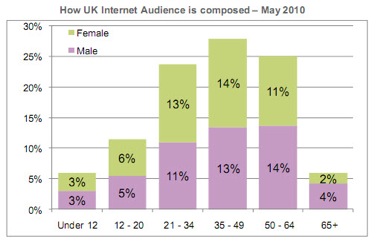
❚ HALF A BILLION USERS “IS JUST A BEGINNING”. So said Colm Long today as Facebook director of online operations for Europe, in a video interview with iMedia, organisers of a London conference. In July the so-called “mother of all social networks” claimed its global audience of active users had grown from 150m to 500m [ie, half a US billion] in less than a year. Today Long claimed 26m of them were UK members which he described as “55% of the population”. This is of course total tosh, since 26m of the actual UK population of 61.79m comes out at only 42%.

Facebook,UK audience stats,household income, UK population,If by any chance he meant the UK online population of 38.8m active web users [source, UKOM], including the 2.3m under-12s, his claim works out at an astonishing reach of 67%. (Remember that, according to Ofcom, nearly 40% of British households are not connected to the internet.) Either way, to maintain his credibility as a director of Facebook, Long needs to go back to his abacus.

In the video, Long speaks as he finds: “What we’re seeing is a dramatic shift of people bringing their real-world identities online… The fastest growing demographic is 35-plus, so it fundamentally changes how people think about social media. What’s more, you know these people are their authentic selves… sharing authentic information about themselves.”

UK web audience, UKOM/Nielsen,UK population,household income

Source: UKOM/Nielsen

Well, “authenticity” on the web is a pretty cloud-cuckoo concept, but we’ll let that pass. Elsewhere UK analyst Nigel Lamb has aggregated statistics for eight social networks, and deduces that one-third of Facebook’s UK members have household incomes between £30k and £50k, which would reflect its gradually ageing membership, and make advertisers smack their lips.

In America, Long says, Facebook has just launched an e-commerce platform to facilitate a payment infrastructure for members running businesses on the network. In terms of e-commerce, he believes, the half a billion “is just a beginning”.

➢ VIEW today’s interview with Colm Long at iMedia UK
➢ Even more riveting stats about Facebook at Manchester SEO

❏ For example — Average user has 130 friends… The United Kingdom has the second highest number of Facebook users (5.54% of global audience) … 51.8% are female, hence 48.2% are male… The most popular brand pages in the UK are: Starbucks, Vodafone, BlackBerry, Espirit, Xbox.

➢ Hitwise charts for top UK sites and search engines

FRONT PAGE

➤ A step up in the world for graffitist Eine, thanks to Potus and lady friends who shop in high places

❚ “I WAS IN MY STUDIO CUTTING OUT A STENCIL, Friday night about 10 o’clock and the phone rang… It was Anya Hindmarch and she said ‘Samantha Cameron’s a big fan of your work’, and I kind of thought, Yeah right, and she said ‘David is looking for a painting to give to the most important man in the world, I can’t say his name but think America. Would you be interested?’ I was like, Yeah!”

Eine Signs,21st_Century_City, Obama, David Cameron, Potus, art

21st Century City by Eine: spray paint and black gloss on canvas, 39x27 inches. © Eine Signs, London

So now we know. Today a new video reveals that the go-between who helped fix the official gift of “hoodie art” from the British prime minister to Potus, leader of the Western world, was handbag designer Anya Hindmarch. We discovered in July during David Cameron’s first trip to Washington as PM that the gift was a painting titled Twenty First Century City, by a graffiti artist whose adopted tag is Eine, and who is regarded in the East End of London as one of the founders of Britain’s street-art movement, alongside Banksy. More important, he was said to be one of the PM’s wife SamCam’s favourite artists.

Yes but, no but … OK, we discovered then that the 39-year-old graffitist’s real name was Benjamin Flynn who’d spent his teens as a hooded tracksuit gang member, had a racy record of convictions for criminal damage and had taken a year to complete 200 hours of community service.

Anya Hindmarch,LootTote,

Hindmarch Loot tote bag in canvas, decorated by Eine, aka Ben Flynn, £145. It is claimed that “Eine is doing for letters of the alphabet what Banksy did for rats and smiley policemen”

Even so, what hasn’t really been spelt out is that much earlier Flynn had collaborated with Anya Hindmarch to design a spring collection of trendy tote bags that drew on his street-cred. The bags feature prominently among the luxury accessories illustrated on the Hindmarch website, and as Eine he had even painted the windows of her upper-crust Sloane Street store during March. Just his luck that Anya turned out to work in the same upmarket retail sector as the PM’s wife, who was also a friend.


The nice irony is the clash of classes. Not only is SamCam the daughter of an 8th baronet, raised on a 300-acre Lincolnshire estate, but Hello magazine also reports that she is the great-great-great-great-great-great-great-great granddaughter of Charles II and his mistress Nell Gwyn. The Sunday Times Rich List compiler Philip Beresford has put the “combined family wealth of David and Samantha Cameron at £30m plus”. Ben Flynn on the other hand, was so hard-up two years ago that he had to move home from London to Hastings with his wife Joanne and three children, Spike, 5, Sunny, 2, and Story, 2. On top of which the millionaire Camerons expected him to donate his chosen painting, valued in the marketplace at £2,500.

“Cameron seems quite a positive kind of guy and Obama’s a dude. I would probably have had issues if it had been for Bush” — graffitist Ben Flynn

Still, the compensation for Flynn was overnight global fame, which has brought him a string of commissions, several trips abroad, and enhanced price tags on his work. In the video by Anthony Austin and Charlie Inman, Flynn’s verdict is direct: “My phone didn’t stop ringing for about a month — interviews and television. It changed my life. David Cameron, I love him.”

➢ Ben (Eine) Flynn’s online gallery
➢ Revealing interview with Flynn by blogger Ashley Morrison

Middlesex Street, London,graffiti, Eine

Alphabet City, Middlesex Street, just up from Petticoat Lane, London’s famed Sunday market: artist Eine spent months persuading shop owners to allow him to spraypaint their shutters. Photograph by Steve Cotton

FRONT PAGE

30 years ago today ➤ First survey of their private worlds as the new young trigger a generation gap

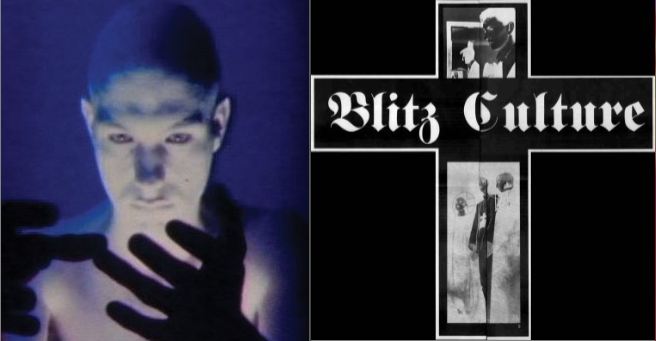
John Maybury, Marek Kohn,Blitz culture,  ZG

Left, film-maker John Maybury in Tortures That Laugh © John Maybury 1978, artist’s collection; right, graphic from ZG magazine, issue one, 1980

❚ THE BLITZ CLUB SCENE EVOLVED RAPIDLY during the summer of 1980 as media coverage caught up, and it became clear that the New Romantics were not the only social group making waves. In the London Evening Standard’s On The Line column I had been following the Blitz Kids all year and, unsurprisingly, my nocturnal antics raised eyebrows at the Standard by day. “Do they talk sort of funny?” colleagues would ask about my bizarre playmates, meaning did they say “Leave it aht” instead of “OK yah”? Over time the generation gap I was reporting caught the attention of the Standard’s perceptive film critic Alexander Walker, who couldn’t read enough about Britain’s self-possessed youth movement. “Not so much a generation gap,” he observed sagely. “More a genus gap!” In this respect, the parallels with the digital natives of today’s Generation Y are spooky.

A key difference was the naked ambition of the media-savvy Blitz Kids who shunned rock music as a stone-age relic. They were spreading inspiration through Britain’s clubland, even as Steve Strange’s Tuesday nights at the Blitz ended suddenly on October 14, as also did Hell, their Thursday offshoot. Key players were changing trains. That very week Spandau Ballet had signed their first record deal, while I had been darting daily from concert to club to Kensington Market surveying the many competing expressions of youthful endeavour, then trying to persuade the editor Charles Wintour that A Significant Youthquake Was About To Break.

A month earlier during London fashion week I’d only just scraped into print with my first Pose Age report showing Melissa Caplan’s unisex tabards which were being worn to shock. “You’re making this up,” raged one senior editor whose veto against publishing was over-ruled by Wintour. Now I was proposing that this sweeping survey for On The Line should make a spectacular centre spread in the paper. Yet the eye-searing kids in our pictures were a bridge too far even for the enlightened Wintour, who sent me a memo saying it was all “Rather too esoteric for us”. Under protest, he finally conceded splitting the survey between two separate pages a week apart.

By Christmas Spandau’s single became a chart hit, along with Fade to Grey by Visage, fronted by Steve Strange. We could not know then how quickly Britain’s clubbing grapevine was to hurtle yet more clubland bands into the charts, many unveiled by sharp young managers the same age as the talent. Or that 1981 would soon be spinning like a New Romantic dynamo.

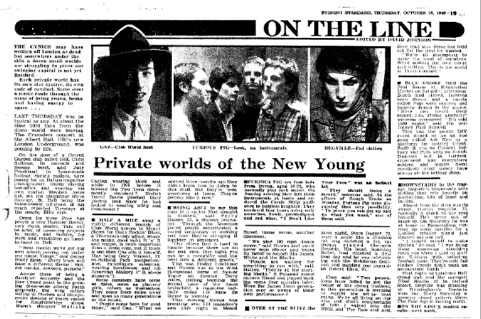
Evening Standard, Oct 16, 1980

First published in the Evening Standard, Oct 16, 1980

THE CYNICS may have written off London as dead in 1980 but somewhere under the skin a dozen small worlds are struggling to prove our swinging capital is not yet finished. Each private world has its own star system and its own code of conduct. Some steer a scenic route through the maze of being young, broke and having energy to spare. . .

➢ Click to continue reading
One week in the private worlds of the new young

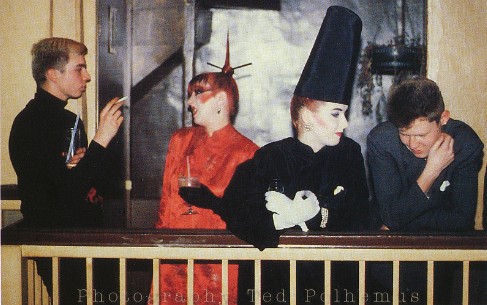
Shaping ambitions at the Blitz in 1980: Lee Sheldrick, Melissa Caplan, Kim Bowen and Bob Elms

FRONT PAGE

1980 ➤ The day Spandau signed on the line and changed the sound of British pop

Spandau Ballet, Virginia Turbett,Chrysalis,Steve Dagger, New Romantics

The way they wore: Spandau Ballet minutes before signing their record record deal in October 1980. Photographed at London’s Waldorf Hotel © by Virginia Turbett

◼ AS THE COOLEST CULT LEADERS OF 1980, Spandau Ballet’s songwriter Gary Kemp claimed: “We want the band to be at all times the most contemporary statement we could possibly make on modern London.” In the face of the post-punk new wave, it took courage to decide to play fresh sexy dance music in a corporate landscape dominated by adult-oriented rock supergroups. In the event, the five boys from the Angel, Islington, quickly assumed the role of houseband to the Blitz club and by placing the bass guitar and the bass drum at the front of the sound made it hip once more to play pop.

Spandau Ballet were being managed by their onetime schoolmate Steve Dagger, aged only 23, while three record labels competed to secure them. On this day 30 years ago they signed a deal with Chrysalis Records and walked into the future clutching an advance cheque for £85,000 — at the time, a record sum for an untried band that had played all of eight bookings and had refused to cut demo discs.

“We were strong, it was a real gang, a real team mentality. It was: We’re Spandau Ballet, who the f*** are you?” — John Keeble, Spandau drummer

By breaking all the industry rules, Spandau triggered a fashion and dance music movement that had been evolving in the nightclubs of Britain. At the very moment that the Blitz closed its doors, the press dubbed their followers the New Romantics, and a slipstream of more than 100 new image bands was born. The new sounds and new styles of this, the last of the Babyboomer generation, went on to dominate the international landscape of pop and over the next three years put more British acts in the US Billboard charts than the 1960s ever achieved.

ELSEWHERE ON SHAPERS OF THE 80s

➢ Oct 16, 1980: One week in the private worlds of the new young
➢ Birth of the New Romantics and the band who made it hip to play pop
➢ How the rhythm of the pop charts changed

Spandau Ballet, The Makers,The Cut,Roots, Dame Alice Owens

Tony Hadley fronts The Makers: Spandau as a school band playing to the fourth form at Dame Alice Owens — grabbed from video

➢ VIEW ♫ Early footage of Spandau Ballet in the Young Guns documentary from 2000
➢ New Romantics: I Was There — ex-Sounds hackette Betty Page’s recollections for Record Collector, written with the benefit of hindsight in 2004

FRONT PAGE