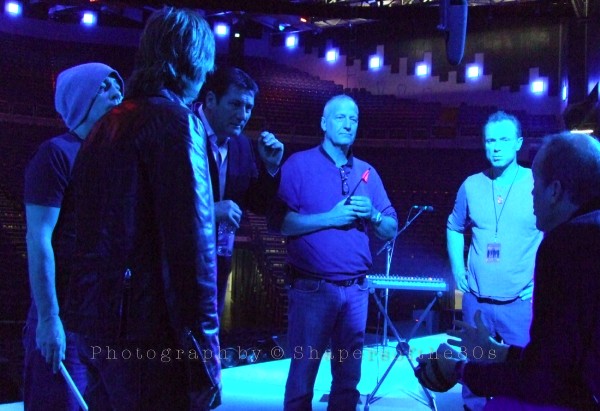
❚ SONGWRITER GARY KEMP recalls the 2009-10 Reformation Tour by his pioneering New Romantic band Spandau Ballet, to be screened as a 2 hours 30 mins broadcast on Sky Arts this weekend:
“ The Reformation Tour was a coming back together I never thought would happen. After years of fighting, this tour taught us that being Spandau Ballet is a thing to be proud of. It turned out to be the best and most successful tour we ever did. If there’s one piece of evidence I’d like to leave for posterity it would be this film. ”
❏ iPAD, TABLET & MOBILE USERS PLEASE NOTE — You may see only a tiny selection of items from this wide-ranging website about the 1980s, not chosen by the author. To access fuller background features and site index either click on “Standard view” or visit Shapersofthe80s.com on a desktop computer. ➢ Click here to visit a different random item every time you click
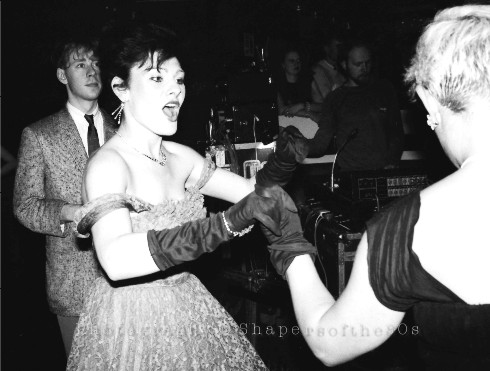
Dressing up on Canvey, 1982: Gold Mine girls maintain the high standards set by the club over the past decade. (Photographed by Shapersofthe80s)
Hill: ushered in Age of the Dance
❚ NOVEMBER 9 SEES maverick deejay Chris Hill front the fourth Official Gold Mine Reunion back this year on Canvey Island at The Monico, a stone’s throw away from the site of the nightspot renowned as the birthplace of British jazz-funk.
Other members enlisted from the South-East’s Funk Mafia who ruled at Caister weekenders and the big soul all-dayers will be Jeff Young and Snowboy and ace record-shopkeeper for the rare groove scene, Gary Dennis. The reunion will be echoing to sounds from Donnie Hathaway to Chick Corea, from BT Express to Mastermind. But first, a taste of the Gold Mine’s tenth year as I reported it 31 years ago…
Ten years of the Canvey Island Gold Mine
[First published in The Face, August 1982]
❏ SOME SAY THE whole of today’s style scene has its roots here… The Gold Mine, Canvey Island, has passed into countless legends for the trends it has set and on August 14 manager Stan Barrett pulls a champagne cork to celebrate his club’s tenth birthday.
Mind you, feet have pounded its original sprung maple dancefloor since 1949. Southend and the towns of the Essex style triangle have reared cults since the word was invented, so when in 1972 the Gold Mine began playing what rivals then called “silly music” – My Guy and all those soul sounds – the local hipsters took their cue. It was that wild man among deejays, Chris Hill, who, as the only one south of Lancashire playing soul, put Canvey Island on the map and ushered in the soulful new Age of the Dance.
Then in 1975, for a reason no more obscure than a simple father to son legacy, came a Glenn Miller Swing revival, which triggered the then unique clubbing fad of nostalgic dressing-up.
Stan Barrett says: “Chris played Singin’ In The Rain one Saturday and of course even kids who couldn’t remember the original knew the words to it. Everyone started being Gene Kelly on the dancefloor, dressing as Gls and Betty Grable. So he played Moonlight Serenade then the Andrews Sisters’ Boogey Woogey – that’s when they all started to jive and to dress up.”
The Sun, the tabloid daily paper which has a remarkably consistent record for picking up trends first, featured the Gold Mine. “Coaches came from Newcastle, Wales, everywhere,” Barrett remembers. The rest is undisputed history for the influence of Essex stylists on emergent London nightlife scene has been visible from the 60s Mod scene to Chaguaramas and the Vortex to the Blitz and beyond.
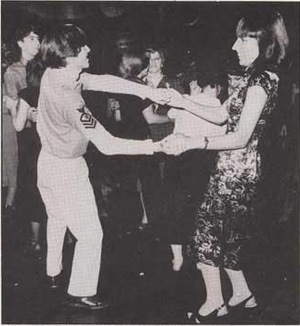
Swing revival 1975: Glenn Miller tunes inspired jiving and GI uniforms at the Gold Mine (courtesy Brian Longman, CanveyIsland.org.uk)
The key to the Gold Mine’s success? Impossible selectivity at the door, which may sound over familiar today. Barrett says: “Nobody too old. And only people into style which means your own style, not Gary Numan’s. It costs you at first but look how it pays off in the end. People have never come to the Gold Mine for a good drink up, always the music and the scene.”
Right now in summer ’82, Essex is a musical ball of confusion with the electronic camp of Depeche Mode and Talk Talk holding sway. Drinking with Talk Talk drummer Lee Harris at the Gold Mine the other night was clubrunner about Southend, Steven Brown, who sports a £100 PW Forte Sixties suit and reckons that psychedelia is still big there, heaven help us. He has also done time with a non-psychedelic local band of jokers called Doodle Sax: “It’s had about 35 people in it at various times but we’re not very serious.” One of them, synthesiser doodler Andy Norton, says the vibes are already about for much heavier rhythms. “Music has to turn much more macho.”
And if there are any visual indicators at the Gold Mine today, they are less fancy, more free. A regular called Andy “from Stanford No Hope” says: “Make up is so out of date, it’s like watching old crows trying to pull. The Gold Mine is much better now that we don’t get all the arty students down.”
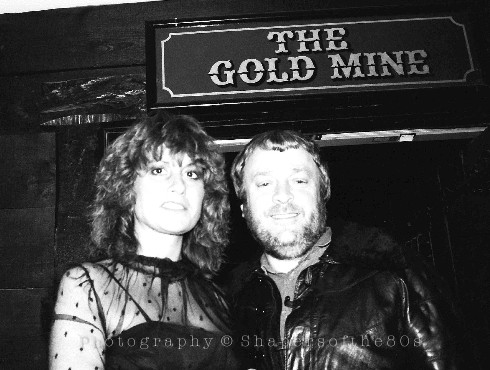
Guardian of the Gold Mine, 1982: manager Stan Barrett and his wife Jayne. (Photographed by Shapersofthe80s)
Nov 11 UPDATE: MOVIN’ AS EVER TO BRASS CONSTRUCTION
Saturday night on Canvey, 2013: shonky screengrab from Trizzles Green Trees’ video at Facebook. Click to view
❏ “Banging best night in ages,” reported Essex Funker Trizzles Green Trees the morning after when she posted this video of the Gold Mine Reunion’s dancefloor heaving to Brass Construction’s 1975 classic Movin’. [Click the pic to run the vid at Facebook.] She added: “We opened the door to the main room and you were just knocked away instantly by the vibe and the atmosphere… everyone was smiling and dancing whether you knew them or not.”
One of the hosts deejay Snowboy Mark called it “a road-block event” at The Monico, Canvey Island. “There were so many old faces there, going way back to the original pre-79 days… Andrea Wingrove-Dunn, Laurence Dunn, Steve Brown, Gary Turner, and pre-76 Gold Miner Molly Brown (she was under age of course!) who loved it more than anyone and stayed right to the end dancing, singing her head off and causing a stir in her immaculate 40s clothing.
“I loved playing Shifting Gears, Inside America, Mary Hartman et al – to me, out and out Gold Mine records for those that were there in the early years.”
❏ Chris Hill interviewed during a live TV visit to the Gold Mine, Canvey Island, broadcast in 1983 on Channel 4’s weekly pop show The Tube. The club closed in 1989.
❏ Northern Soul fans will recall that their legendary venue the Wigan Casino launched its first soul all-nighter in September 1973 (a year after the Gold Mine).
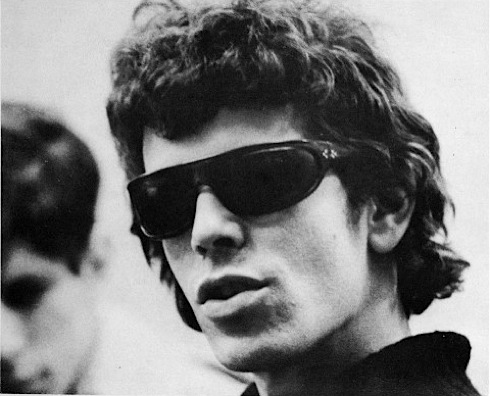
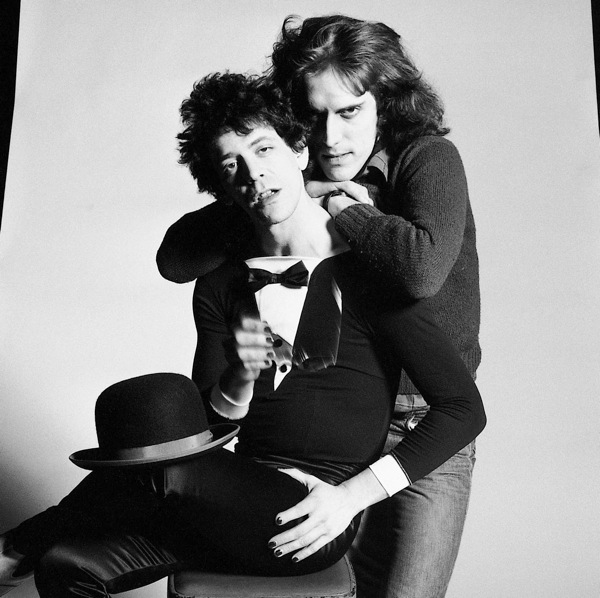
“ After splitting with the Velvets in 1970, Reed traveled to England and, in characteristically paradoxical fashion, recorded a solo debut backed by members of the progressive-rock band Yes. But it was his next album, 1972’s Transformer, produced by Reed-disciple David Bowie, that pushed him beyond cult status into genuine rock stardom. Walk On the Wild Side, a loving yet unsentimental evocation of Warhol’s Factory scene, became a radio hit (despite its allusions to oral sex) and Satellite of Love was covered by U2 and others. Reed spent the Seventies defying expectations almost as a kind of sport. 1973’s Berlin was brutal literary bombast while 1974’s Sally Can’t Dance had soul horns and flashy guitar. In 1975 he released Metal Machine Music, a seething all-noise experiment his label RCA marketed as avant-garde classic music, while 1978’s banter-heavy live album Take No Prisoners was a kind of comedy record in which Reed went on wild tangents and savaged rock critics by name… ” / Continued at Rolling Stone
“Lou Reed… said that the first Velvet Underground
record sold 30,000 copies in the first five years.
But that was such an important record for
so many people, I think everyone who bought one
started a band!” – Brian Eno, 1982
“ Their 1967 debut The Velvet Underground And Nico is the single most influential album in rock history. Certainly, it’s hard to think of another record that altered the sound and vocabulary of rock so dramatically, that shifted its parameters so far at a stroke. Vast tranches of subsequent pop music exist entirely in its shadow: it’s possible that glam rock, punk, and everything that comes loosely bracketed under the terms indie and alt-rock might have happened without it, but it’s hard to see how…
“ … the four gruelling songs that make up side two of his 1973 concept album Berlin are quite astonishing expressions of coldness and cruelty… [but] he could write songs that were impossibly moving, that spoke of a tenderness and sensitivity: the lambent, peerless Pale Blue Eyes; Halloween Parade’s heartbreaking lament for New York’s gay community, devastated by Aids; his meditation on death, Magic And Loss… ” / Continued at Guardian Online
❚ BOY GEORGE WAS ONCE TOP OF THE POPS. He was, as they say, big in the 80s, when his band Culture Club topped the UK singles chart twice and the albums chart once. He then squandered the next 20 years of his life. Now at age 52 he says he has shed six stone (38kg) in weight and decided to resume being a pop singer again. Today The Sunday Times Magazine publishes an interview with him in which the only real topic of interest remains his refusal to express remorse for his past misdeeds. Yet the reasons why still appear to escape him…
“ … After well-documented cocaine and heroin addictions in the 1980s, [George’s] drug problems resurfaced in the noughties. In early 2009 he went to prison to serve four months of a 15-month custodial sentence, for the assault and false imprisonment of a Norwegian male escort. He was accused of shackling the 28-year-old man, Audun Carlsen, to a wall and lashing him with a chain in a drug-fuelled frenzy. There was another accomplice who still hasn’t been identified.
George has never spoken publicly about the incident. “No,” he smiles calmly, “and I’m never going to.”
Why not? “Because it doesn’t benefit anybody. I went to prison, due process was had and that’s the end of it. It’s not part of my life, it’s in the past and I don’t even think about it. It’s almost like it didn’t happen.”
That hasn’t stopped everyone else having their say. The judge sentencing him described the “wholly gratuitous violence” that George inflicted on his victim. In 2011, Carlsen himself gave an interview to The Times in which he described the attack in graphic detail. He said he had first met George through a gay dating website, that the singer had asked him to pose for nude photographs, but then accused Carlsen of stealing the pictures. On the night of the attack, he said, George and a friend had beaten him up, dragged him across the floor and handcuffed him. The friend left, but George came back into the room with a metal chain and started hitting him – it was a purely violent attack, Carlsen said, nothing sexual. Eventually he managed to escape and ran into the street, where he was found in his underwear, bloodied and screaming.
It’s hard to reconcile the brutality of that description with the carefully composed man sitting opposite me today, but without George’s version of events, it’s all we have to go on. Does he feel the need to set the record straight?
“It’s not part of my life, it’s in the past
and I don’t even think about it.
It’s almost like it didn’t happen.”
“No, no. Who for? For titillation? I don’t need to, I’ve made peace with myself, which is the most powerful thing I’ve ever done. It wouldn’t be dignified for me to talk about it now. It wouldn’t help anyone. It would probably hurt him and I’m not prepared to do that. I’m very proud of myself for not talking about it.” He says all this with zen-like control.
One of the problems with not talking about it though, I venture, is that people assume he has no remorse.
“Um… surely that’s something I have to…” he catches himself. “That’s such an attempt to get me to talk about it!” he squeals. “Nice try! All I can really say about all of that period of my life… when I was younger if you’d have said to me ‘Do you regret anything?’ – and I’m not specifically talking about that incident – if you’d said to me 10, 20 years ago, I’d have absolutely said, ‘No, I don’t regret anything’. I would have been so arrogant about it, but as an older man I have so many regrets, and having regrets has allowed me to have boundaries with myself. It’s allowed me to say, ‘This isn’t acceptable, this isn’t acceptable’, and to know myself much more…” / Continued online
❏ All of which suggests no change since 2010 and George’s first cosy breakfast TV chat after being released from jail. No mention of remorse, just an additional layer of psychobabble.
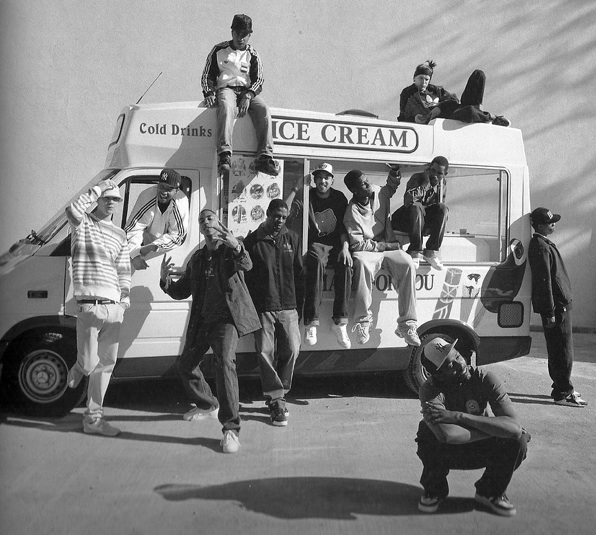
Sound of new London: the influential grime collective Roll Deep in 2009. Photograph by Simon Wheatley
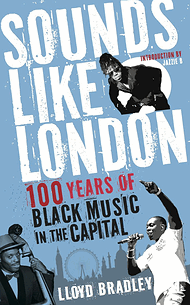
❚ HERE’S AN INSPIRATIONAL BOOK that rocks you on your heels by making a mighty claim that in your guts you know is right. With quiet assurance the author Lloyd Bradbury traces a century of black music in his chunky 430-page Sounds Like London to arrive at this conclusion: that UK black music has dramatically reshaped British culture and mainstream pop. He said last week: “It’s astonishing that we’ve come from Lord Kitchener at the gangplank of the Windrush to Dizzee Rascal at Glastonbury in less than three generations. Today’s music-makers do not think of it as anything to do with black musicians. It is basically London pop music. It is an astonishing evolution.”
If the music’s substantially hidden pre-WW2 history is an eye-opener, the postwar lineage is electrifying. Bradbury draws a continuous arc from the Caribbean immigrant Kitchener singing his calypso “London is the place for me” the moment he disembarked from SS Empire Windrush at Tilbury in 1948, to embrace the jazz bands, blues and clubs and the many hybrid sounds of reggae, highlife, lovers rock and homegrown funk that have led on through peculiar twists to jungle, drum and bass, garage, dubstep and grime and become the soundtracks for British dancefloors today.
The book pays serious tribute to Guyanan-born Eddy Grant whose north London studio brought on a whole generation of musicians (and whose 1979 hit Living on the Front Line lent its name to the Evening Standard’s column about youth culture). The final chapters set out one of the most efficient roadmaps you’ve read to the truly creative UK music-makers of the past 20 years which otherwise saw our charts being despoiled by Cowell’s vacuous talent show victims and tedious bitch-n-gangsta videos from North America.
Bradley, who grew up in Kentish Town, writes: “British black music has never been so prominent. Indeed it’s at the point now where artists such as Labrinth, Tinie Tempah and Dizzee Rascal are bona fide pop stars, with a young mainstream audience that accepts them. The brilliant thing about the current state of British black music is that … our guys have very often succeeded in spite of the UK music business rather than because of it.”
Click any pic to launch carousel
Former radio pirate turned author Lloyd Bradley speaking at last month’s Open East Festival in Stratford
In similar vein, Jazzie B of Soul II Soul writes in his foreword to the book: “Sounds Like London is a story that needed to be told by somebody who really cares about it, and the most important thing about this book is Lloyd Bradley. The reason this story of London’s black music hasn’t been told before is because up until now he wasn’t ready to write it.”
Former sound-system owner, pirate radio deejay, classically trained chef and adviser to the British Council, Lloyd Bradley has been writing about black music in Britain, the US and the Caribbean for over thirty years.
“ Sounds Like London is a riveting read. It’s one to wolf down in a few sessions, and then savour slowly at a more considered pace… He avoids trotting out the usual suspects who pop up perennially as talking heads as part of the dumbing-down documentary epidemic, so the stories and angles seem fresher than might be anticipated. Quite correctly, Eddy Grant is right at the heart of Lloyd’s history lesson, and it is wonderful to read a book that recognises his role in changing pop music for ever. But some of the other choices of, well, witnesses are also inspired. People like Wookie, Root Jackson, Hazel Miller of Ogun Records, Teddy Osei of Osibisa, and Soul II Soul’s designer Derek Yates come across particularly well and have some great tales to tell… ” / Continued online
“ Traditionally, black music in this country has been described by historians, as well as its champions in the rock press, as rebel music… Sounds Like London certainly has its darker moments – Trevor Nelson talks about being asked to DJ at clubs to which, as a punter, he was repeatedly refused entry; producers bristle at the memory of clueless major-label representatives craving their demographics but demanding they make stylistic compromises that damaged their reputations… This is an invaluably materialist book that is often at its most enlightening when it recounts the dramas of distribution – label bosses circulating their records via an alternative network of barbers, grocers, hairdressers and travel agents, for example. The much-missed Stern’s record store began life as an electrical supplies shop on Tottenham Court Road that was popular with African students who paid for repairs with new vinyl from their home countries. For Bradley, black music in London is often creative expression and sometimes art, but almost without exception it is work… ” / Continued at Guardian Online
➢ Choose “View full site” – then in the blue bar atop your mobile page, click the three horizontal lines linking to many blue themed pages with background article
MORE INTERESTING THAN MOST PEOPLE’S FANTASIES — THE SWINGING EIGHTIES 1978-1984
They didn’t call themselves New Romantics, or the Blitz Kids – but other people did.
“I’d find people at the Blitz who were possible only in my imagination. But they were real” — Stephen Jones, hatmaker, 1983. (Illustration courtesy Iain R Webb, 1983)
“The truth about those Blitz club people was more interesting than most people’s fantasies” — Steve Dagger, pop group manager, 1983
PRAISE INDEED!
“See David Johnson’s fabulously detailed website Shapers of the 80s to which I am hugely indebted” – Political historian Dominic Sandbrook, in his book Who Dares Wins, 2019
“The (velvet) goldmine that is Shapers of the 80s” – Verdict of Chris O’Leary, respected author and blogger who analyses Bowie song by song at Pushing Ahead of the Dame
“The rather brilliant Shapers of the 80s website” – Dylan Jones in his Sweet Dreams paperback, 2021
A UNIQUE HISTORY
➢ WELCOME to the Swinging 80s ➢ THE BLOG POSTS on this front page report topical updates ➢ ROLL OVER THE MENU at page top to go deeper into the past ➢ FOR NEWS & MONTH BY MONTH SEARCH scroll down this sidebar
❏ Header artwork by Kat Starchild shows Blitz Kids Darla Jane Gilroy, Elise Brazier, Judi Frankland and Steve Strange, with David Bowie at centre in his 1980 video for Ashes to Ashes
VINCENT ON AIR 2026
✱ Deejay legend Robbie Vincent has returned to JazzFM on Sundays 1-3pm… Catch up on Robbie’s JazzFM August Bank Holiday 2020 session thanks to AhhhhhSoul with four hours of “nothing but essential rhythms of soul, jazz and funk”.
TOLD FOR THE FIRST TIME
◆ Who was who in Spandau’s break-out year of 1980? The Invisible Hand of Shapersofthe80s draws a selective timeline for The unprecedented rise and rise of Spandau Ballet –– Turn to our inside page
SEARCH our 925 posts or ZOOM DOWN TO THE ARCHIVE INDEX
UNTOLD BLITZ STORIES
✱ If you thought there was no more to know about the birth of Blitz culture in 1980 then get your hands on a sensational book by an obsessive music fan called David Barrat. It is gripping, original and epic – a spooky tale of coincidence and parallel lives as mind-tingling as a Sherlock Holmes yarn. Titled both New Romantics Who Never Were and The Untold Story of Spandau Ballet! Sample this initial taster here at Shapers of the 80s
CHEWING THE FAT
✱ Jawing at Soho Radio on the 80s clubland revolution (from 32 mins) and on art (@55 mins) is probably the most influential shaper of the 80s, former Wag-club director Chris Sullivan (pictured) with editor of this website David Johnson
LANDMARK FAREWELLS. . . HIT THE INDEX TAB UP TOP FOR EVERYTHING ELSE
















 ➢➢ Shapers of the 80s ➣➣