Category Archives: obituaries

➤ Captured in 1983: the Westwood-McLaren showdown

Over two weeks I watched fashion gurus Westwood
and McLaren go their separate ways. Daggers-drawn,
they both talked exclusively to the Evening Standard…
Mine were the final pix of them together

Paris fashion, 1983, Vivienne Westwood, Malcolm McLaren, Worlds End, post-punk

Their last dance, Paris 1983… Westwood says: “Malcolm has one more chance to be good.” McLaren says: “I’m not incapable of designing the next collection myself.” Photographed © by Shapersofthe80s

➢ Click here to read my enhanced version about the day
the King and Queen of Outrage realised
the end was nigh, in 1983

First published in the Evening Standard, 4 Nov 1983

➢ Obituary for Dame Vivienne Westwood 1941-2022 at The Guardian

➢ BBC’s in-depth tribute to Vivienne – the godmother of punk

FRONT PAGE

2022 ➤ Farewell Terry Hall, chronicler of social unrest in the Eighties

Terry Hall, ska, pop charts, Swinging Eighties, obituary, singer

Terry Hall on the cover of The Face in July 1981 (Photo © Davies/Starr)

❚ IN POST-PUNK 1979 The Specials and their 2 Tone Records label were just about the only credible sounds in the blandly irrelevant pop charts of the time. This ska-revival band from Coventry defined the anger characterising the concrete jungle in recessionary Britain from their debut single Gangsters to Ghost Town in 1981. They notched seven chart hits while the fashion-conscious stylists who turned London’s Blitz Club into a poser’s paradise set about creating employment among their own ranks by reinventing the UK music scene itself.

The frontman of The Specials, Terry Hall, who from the outset felt uncomfortable becoming a pop celebrity, died on Sunday aged only 63 after a tough and often traumatic life. Yet his singing voice and charisma as a political militant, also expressed with the ironically named Fun Boy Three, ensured a substantial following in later life so that a comeback album titled Encore topped the UK chart in 2019.

Here’s how today’s Guardian obituary of Terry Hall starts, written by Adam Sweeting: “Singer with the Specials whose chart-topping Ghost Town evoked the sense of social collapse gripping Britain at the turn of the Eighties”

Famously deadpan, dour and slightly menacing, Terry Hall, who has died aged 63 after a short illness, shot to fame at the end of the 1970s with Coventry’s ground-breaking multi-racial band the Specials. They emerged in the aftermath of punk, with a fizzing, politically charged mix of ska and new wave, and enjoyed instant success with their debut album, The Specials, which reached No 4 on the UK chart. For a time, the Specials’ 2 Tone Records operation became the UK’s most successful record label, with releases from Madness, the Beat and the Selecter alongside the Specials’ own.

Hall commented that “I don’t believe music can change anything” because “all you can do is put your point across”, but the Specials caught the fraught and dangerous atmosphere of the turn of the 1980s with an eerie intensity. Ghost Town in particular chillingly evoked the sense of social collapse and economic decline gripping a riot-torn Britain.

The Specials found themselves in the eye of the storm, with neo-Nazis frequently targeting their gigs. Hall and the band’s keyboards player, Jerry Dammers, were both arrested when they waded in to try to break up fighting between fans and security guards at a gig in Cambridge. They were found guilty of “incitement to riot” and fined £400 each… / Continued at Guardian online

HALL AS SOLO ARTIST IN 1994:

➢ Previously at Shapersofthe80s: 1981, Chant No 1 – Spandau revive the rumble of funk while hard times loom

FRONT PAGE

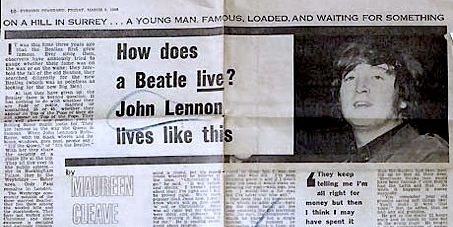
1966 ➤ The interview that made John Lennon US public enemy number one

Evening Standard,Maureen Cleave, Lennon, interview, More popular than Jesus, How does a Beatle live?

First published in the London Evening Standard, March 4, 1966

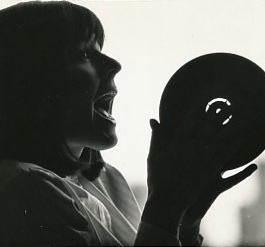
Maureen Cleave, 1964, Evening Standard❚ MAUREEN CLEAVE [left] died this week aged 87. She was a long-time colleague and friend who was refreshing to know and a perfectionist at work. She was the author of this landmark piece of journalism in 1966 in which Beatle John Lennon said ironically: “We’re more popular than Jesus now.” Bang in the middle of the Swinging 60s, at the height of Beatlemania, the most successful pop group in history became possibly the most hated. In America’s Bible Belt, outrage sent fans out to burn The Beatles’ records and radio stations round the world banned their music. The Fab Four never played live concerts again.

Maureen had written the first significant critique of the band in the London Evening Standard in February 1963, headlined “Why The Beatles create all that frenzy”. What she identified was the band’s unique stage presence while acknowledging the Liverpudlian scallywags as fresh young jokers in the Max Miller cheeky-chappie mould. This kick-started her career as probably the most clear-sighted interviewer of her generation and her survey in 1966, “How does a Beatle live?” still makes a riveting read as John Lennon guides her through his 22-room home deep in the Surrey banker-cum-oligarch belt…

➢ Read on at Shapers of the 80s:
1966, More popular than Jesus – Maureen Cleave’s full Lennon interview from the Evening Standard in 1966

Beatles, bonfires,More popular than Jesus, 1966

Christian outrage in 1966: public bonfires were organised in Alabama, Texas and Florida to burn The Beatles’ records

➢ If ever a journalist had a quote taken out of context and rehashed evermore, it was Maureen Cleave – The Times obituary, Nov 2021

➢ Once the Beatles had become the most famous entertainers in the world, Cleave witnessed at first hand the destructive force of modern celebrity – Daily Telegraph obituary, Nov 2021

➢ Journalist who was close to the Beatles and known as one of Fleet Street’s most exacting interviewers – Guardian obituary, Nov 2021

MAUREEN FILMED MEETING
BOB DYLAN IN 1965…

…DISCUSSED HERE IN 2000…

Maureen Cleave elaborates on 1965’s interview with Bob Dylan (above), filmed by D A Pennebaker for his documentary Don’t Look Back. The discussion below is extracted from The Bridge, Number 6, Spring 2000 (courtesy of @bob_notes). Click on image to enlarge…

Maureen Cleave, Bob Dylan, Don't Look Back, interview, DA Pennebaker, Matt Tempest, TheBridge

…AND AGAIN IN 2011

Blogger Stephen McCarthy explored this filmed interview with Bob Dylan in the light of his conversion to Christianity in 1978. We see Maureen Cleave ask Dylan: “Do you ever read the Bible?” because she hears echoes of its ideas in so many Dylan songs. Yet Dylan seemed uneager to follow that line of questioning.

McCarthy writes: “Remember now, this was prior to the recording of songs like Highway 61 Revisited which begins with the lines, “Oh God said to Abraham, ‘Kill me a son’. Abe says, ‘Man, you must be puttin’ me on’” … Granted there were allusions to The Bible in earlier songs, such as Gates of Eden etc, but in my opinion, it was fairly perceptive of Maureen Cleave to have discerned the religious thread that could be found woven into many of Dylan’s earliest songs. And it also begs the question, did she somehow instinctively suspect that times they were a-changin’ for Bob Dylan in some sort of spiritual sense?”

MAUREEN RECALLS JOHN AND PAUL IN 2013

FRONT PAGE

➤ Fond farewells to Joe Allen who revolutionised London’s restaurant scene

Joe Allen, obituaries,Covent Garden, New York City, Orso, restaurants, tributes, theatreland,

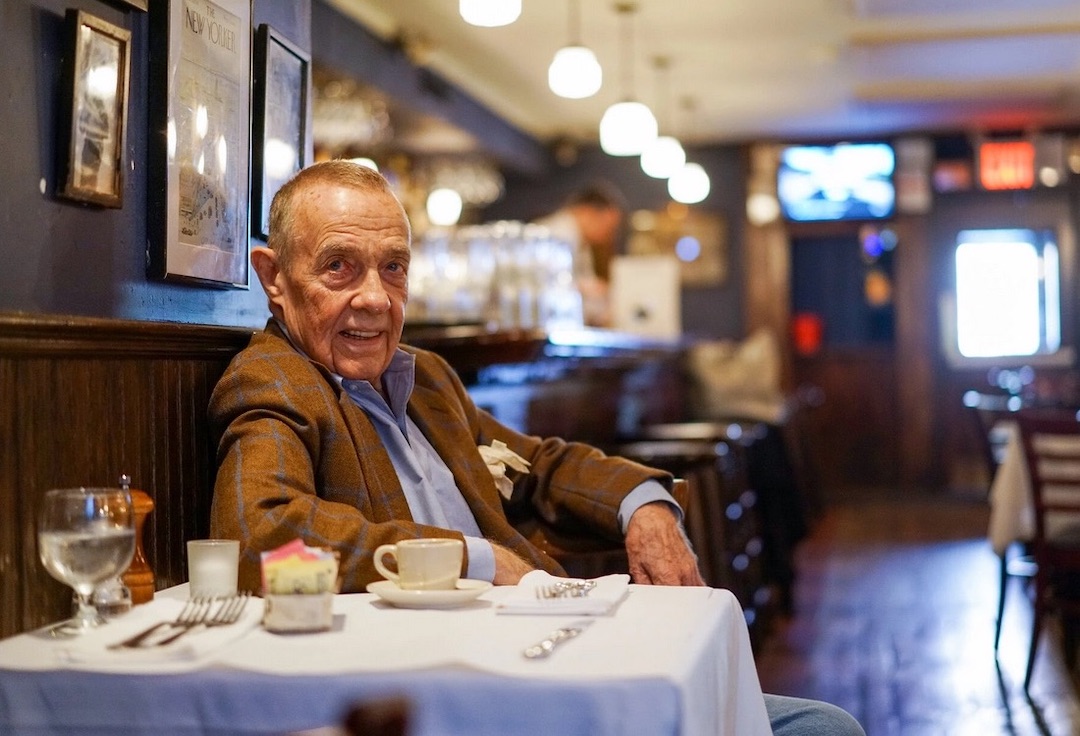
Joe Allen at his regular spot at Joe Allen NYC, opened in 1965, before his block was christened Restaurant Row. (Photo: Todd Heisler/The New York Times)

❚ JOE ALLEN, THE RESTAURATEUR who splashed bazzazz across theatreland, has died aged 87. His photograph confirms the memory of him being a double for Humphrey Bogart, who as Rick also sat alone at his own table in the film Casablanca – though Lauren Bacall always denied any similarity! He pioneered his empire in 1965 with two outlets in New York City on a strip of West 46th Street that would become known as Restaurant Row. Then in 1972 he took the Joe Allen brand to Paris and in 1977 to London, opening both Joe Allen’s in a former orchid warehouse, as well as Orso’s Italian brasserie, during the revival of Covent Garden which had idled since 1974 when the vegetable market moved out.

Immediately lunchtimes became social hubs for publishers from Bloomsbury and newspaper hacks from Fleet Street, both a short walk away. By night both places were packed with stars coming on from their West End shows and I only ever managed to sit on star table No 1 once which was in 1984 when I met Hollywood’s legendary Dorian Gray, the actor Hurd Hatfield, visiting from his home in Ireland, who told a very bawdy joke (sorry, unrepeatable)! On Saturday nights Andrew Neil, editor of The Sunday Times from 1983 to 1994, held court round a large table at Orso with his top team awaiting a courier bringing first-edition proofs for the next day’s paper.

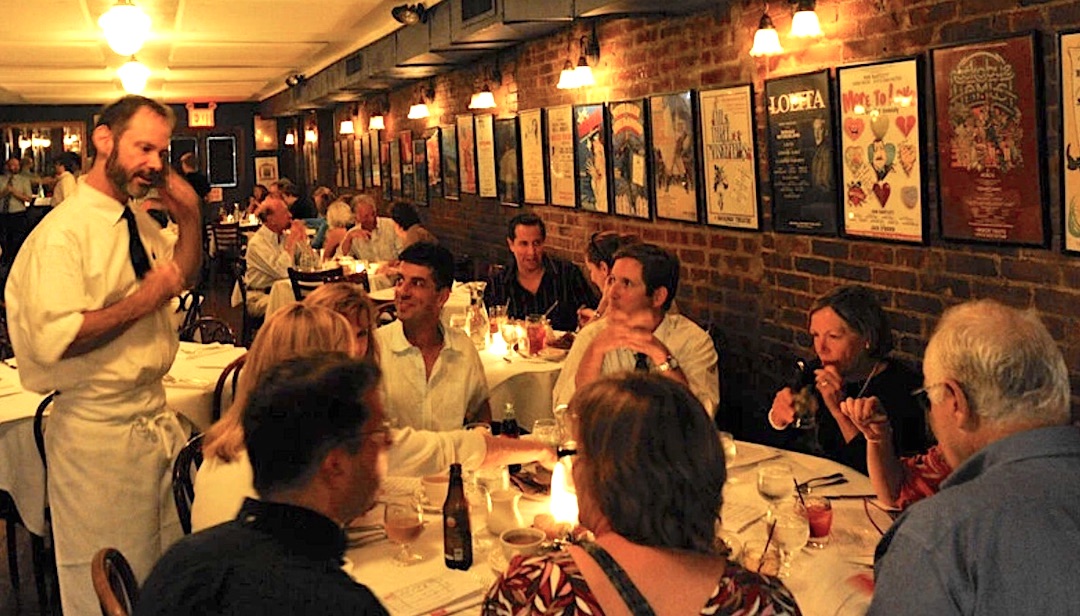
Joe Allen’s personal style was laconic, his restaurants unpretentious and clublike, from red brick walls to an inexpensive hamburger-led menu, and waiting staff who were invariably resting actors. Most famously the walls were lined with theatre posters – of productions that had flopped. Notable patrons have included A-listers such as Al Pacino, Stephen Sondheim, Elaine Stritch, Elizabeth Taylor, Sean Connery and Sir Ian McKellen, while the restaurants maintained a strict no-photograph policy to protect the privacy of its high-profile guests.

Though Joe himself was very visible during the first year in London, often sitting at the table beside the kitchen, in fact the day-to-day operation was run by the baker Richard Polo as a partner, who died in 2019.

❏ Joseph Campbell Allen, born 20 Feb 1933, died 7 Feb 2021.

Joe Allen, Covent Garden, New York City, Orso, restaurants, tributes, theatreland,

Informality the keynote: Joe Allen’s restaurant on West 46th Street. (Photo: Robert Stolarik/The New York Times)


➢ Less about the food than about the atmosphere – Obituary by Joyce Purnick in the NY Times: “West 46th Street’s proximity to New York’s theater district made it viable, and Mr Allen, concluding that actors, directors, writers and theater patrons would always want to eat, created a relaxed pub aimed at attracting the theater crowd. There was nothing quite like the restaurant in the mid-1960s, and it took off.”

➢ Remembering Joe Allen, who fed Broadway in untheatrical style – by Peter Khoury in the NY Times: “Even before Joe opened Joe Allen, he was a partner in an Upper East Side restaurant called Allen’s. If you watch the 1965 Jack Lemmon comedy How to Murder Your Wife, you’ll see a few shots of a handsome, dark-haired bartender there. That’s Joe.”

➢ A magnet for actors, journalists and royalty – Obituary in The Times of London: “Allen kept a flat in Chelsea, visiting London several times a year. Business meetings occupied his mornings. At night he perched at the end of the bar quietly draining a case of his favourite American imported beers and observing more than conversing with a studied determination not to “inflict myself on the customers”. If he sat at a table it was always the worst one in the house.”

Joe Allen, Covent Garden, New York City, Orso, restaurants, theatreland,

Poster wall of flop shows at Joe Allen’s: at centre, “Got Tu Go Disco” a short-lived musical from 1979. (Photo: Sara Krulwich)

FRONT PAGE

2021 ➢ Famous last words from Frau Blücher and Nurse Diesel

Cloris Leachman, Mel Brooks, Nurse Diesel, Young Frankenstein, comedy, films,

Cloris Leachman as Young Frankenstein’s housekeeper: Frau Blücher’s name itself struck a note of terror

❚ EVERY MEL BROOKS FAN knows the face of Cloris Leachman from her outrageous characters, the Transylvanian housekeeper Frau Blücher and dominatrix nurse Charlotte Diesel, so vividly associated with the director’s wild film parodies Young Frankenstein and High Anxiety in the mid-Seventies. Mere mention of stern Frau Blücher’s name caused whinnying horses to rear in fear, and only slowly does Dr “Fronkensteen” Junior work out who she is. “So you and Victor were. . . ?” he asks. “Yes, yes,” she replies. “He vas my… boyfriend.” Later in the Hitchcockian spoof set in an Institute for the Very, Very Nervous, the demented psycho who pronounced her name “Nursh Deezhel” did finally admit: “Perhaps I’ve been a bit too harsh.”

“Cloris’s genius is that she never plays comedy for laughs. She’s deadly serious” – director Mel Brooks

Leachman the actress died this week aged 94 and her dazzling career also embraced an Oscar-winning supporting role in Peter Bogdanovich’s The Last Picture Show, numerous TV residencies from Lassie and The Mary Tyler Moore Show and its spin-off Phyllis to The Beverly Hillbillies, plus cameos in so many TV hits that between 1972 and 2011 she was nominated for 22 Primetime Emmys and won eight. Her twilight years saw her portraying off-beat grandmothers in television and film and competing with celebrities less than half her age on Dancing With the Stars.

Cloris Leachman, Mel Brooks, Nurse Diesel, High Anxiety, comedy, films,

Cloris Leachman as the very strict Nurse Diesel in High Anxiety: viewed with Hitchcockian inspiration from beneath a glass coffee table

➢ The Last Picture Show made Leachman a star – Robert Berkvist in the New York Times: “But she may be best remembered for drawing laughs on Mary Tyler Moore, Phyllis and Malcolm in the Middle.”

➢ Star of film and TV who relished the roles of grandmas and grotesques – Ronald Bergan in The Guardian: “She played Mary Tyler Moore’s manipulative landlady Phyllis Lindstrom for which she was best known.”

➢ Winning the Oscar seemed to liberate Cloris Leachman – Obituary in The Times: “I’m at a point where I’m free to go out and have a little fun with my career,” she said in her acceptance speech.

https://youtu.be/tNKQBJZ8dOY

FRONT PAGE