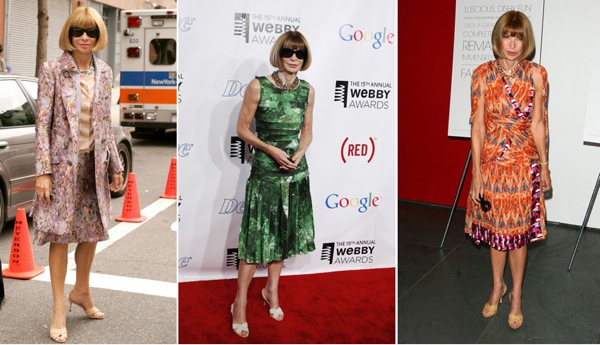
“ One thing that struck me immediately after reviewing the SS12 shows was how well suited the silhouettes were to Anna Wintour’s style. First, let’s look at some quintessential Anna looks: her skirt length always below her knee, her love of prints, her narrow waist… sound familiar? ”
There then follow some key SS12 looks that look “totally Wintoured” …
/ Continued at Layers & Swathes
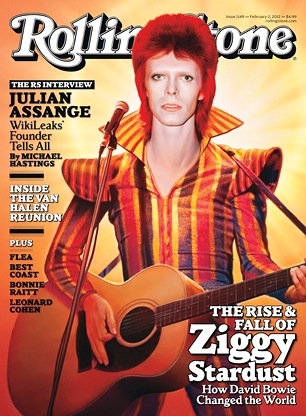
❚ THERE’S A BREATHLESS FOUR-PARAGRAPH teaser online at Rolling Stone magazine’s website in an attempt to sell the February 2 issue. It’s headlined How David Bowie Changed The World. Yet it promises nothing we haven’t read a million times before. Instead, try our own tribute on Bowie’s 65th birthday, linked further down this post.
“ He phoned Angela in London, asking for her help: witches intended for him to impregnate one during Walpurgis Night. He later said Satan was living in his indoor swimming pool. David needed an exorcism (“I really walked into other worlds,” he later said), and Angela got him one – though it was by way of a long-distance phone call. “David was never insane,” Angela wrote. “The really crazy stuff coincided precisely with his ingestion of enormous amounts of cocaine, alcohol and whatever other drugs.” In any event, the rite may have helped break Bowie’s fear of a fiend possessing him. “It was time to get out of this terrible lifestyle I’d put myself into, and get healthy,” he later said. “It was time to pull myself together ” … / Continued online at Rolling Stone
❏ Update Feb 8: Now this Bowie issue has reached the UK, Mikal Gilmore’s account of the Ziggy phenomenon proves a workmanlike retelling of the familiar, but is oh-so relentlessly downbeat. He even cites an alleged quotation from 1998: Bowie is supposed to have said that, “Without Iman, I’d have put my head in the oven by now”. It’s a cheap shot because the quote has never been attributed, so counts for nothing more than hearsay. Rolling Stone claims a circulation of 1.45m.
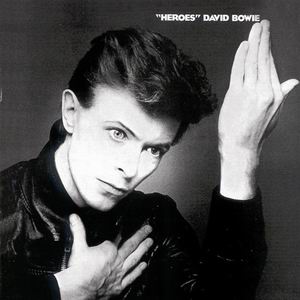
“ As a cultural lightning rod Bowie has bequeathed insights into the realm of the imagination. As a performer he has delivered a repertoire of life-skills through a cast of mythical personalities invented for himself as a popstar, from the self-destructive Ziggy Stardust and the amoral Thin White Duke, to his romanticised “Heroes” (his own quote marks added to emphasise self-awareness). Through their formative years, Bowie invited his acolytes to do A…. and B…. and C…. ” / Read on to discover what
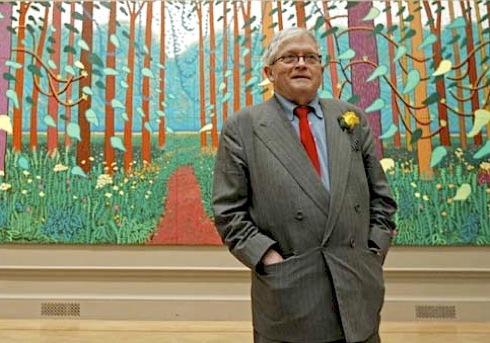
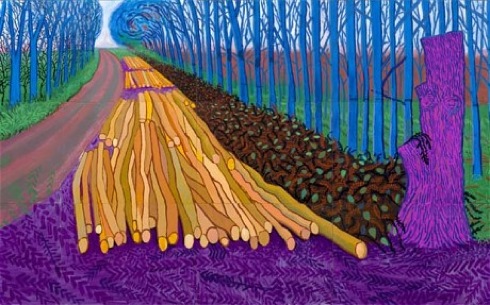
British artist David Hockney posing yesterday at the Royal Academy of Arts in London with his painting The Arrival of Spring in Woldgate, East Yorkshire in 2011. Photograph by Luke MacGregor, Reuters
“ The Royal Academy of Arts in London has never been host to an exhibition quite like David Hockney’s A Bigger Picture. The academy has a history dating to 1768. The one-man show, which runs from Jan 21 to April 9, is a tour de force. It consists almost entirely of new work, using both low-tech media such as painting and the latest high-tech tools. Hockney approaches the time-honored subject of nature in a fresh, contemporary way. The result is spectacular.
Hockney has also come up with a more hi-tech kind of picture created by multiple, high-definition cameras set at slightly different angles. The result is a moving photo-collage: a bigger picture because it sees more, from varying points of view. Most of the films on show are landscapes, though the most recent is a dance spectacular, shot on 18 cameras in Hockney’s studio. It gives a wonderful festive finale to the exhibition, in which Hockney paints the stage in sumptuous color, and shoots the action like a combination of Pablo Picasso and Busby Berkeley ” … / continued online
“ [Hockney] is commanding new technologies in a countercultural quest to prove that painting, in an age dominated by conceptualism and installation, can be as theatrical and monumental as any 21st-century spectacle. ”
“ Hockney is best known as the raunchy Californian sensualist who painted sun-kissed boys gliding through the azure swimming pools of Los Angeles in the Sixties. And yet here he presents himself as a modest pastoralist, content to hymn the bounty of nature with quiet exultation – dancing, like Wordsworth, among the daffodils. Once inspired by distant destinations such as Egypt, China and America’s West Coast, he now seems happy pottering about a neglected nook of England. The prodigal son has returned to within 65 miles of Bradford, where he was born in 1937, and settled down. The internationalist has turned parochial. The radical has come over all conservative … Perhaps it’s a generational thing, but I don’t understand paintings like these. Fresh, bright and perfectly delightful, they are much too polite and unthinkingly happy for my taste: if they offer a vision of arcadia, it is a mindless one… ” / continued online
HOCKNEY REVEALS A ‘new vision of the world’ IN OUR OWN INTERVIEW 30 YEARS AGO
❚ WHILE IN LONDON FOR A FORTNIGHT in 1983 David Hockney says that he has resumed painting after a two-year break pursuing photography. The freshly primed canvases in his London studio testify to the urgency with which he wants “to deal with the ideas that are bubbling away”. He lobs in a shocker: “I’ve looked at some cubist paintings for 25 years without understanding them. Suddenly I see cubism differently, more clearly. And my experiments have led me to a couple of theories of my own . . .”
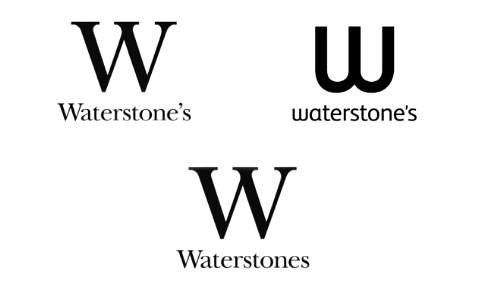
Three logos in as many years: >2010 classic font and grammatically correct, 2010–12 contemporary font and illiterate, 2012< classic font, illiterate but digitally expedient. And this shop sells books.
❏ A press release dated Jan 11 declares: “Waterstones, the UK’s largest high street bookseller, has today revealed a new logo for the company. It reinstates the much-loved Baskerville serif font with a capital W and no longer features an apostrophe. James Daunt, Managing Director of Waterstones said: “Waterstones without an apostrophe is, in a digital world of URLs and email addresses, a more versatile and practical spelling.”
The change is also a slight to the founder Tim Waterstone, who set up the company more than 30 years ago, though long ago stopped having any involvement. Mr Daunt further explained the change in logo: “It also reflects an altogether truer picture of our business today which, while created by one, is now built on the continued contribution of thousands of individual booksellers.” Many on Twitter pointed out that this explanation made no sense, because if the new logo really was meant to reflect the contribution of many, it should include an apostrophe after the S. ”
➢ No apostrophe? No catastrophe — David Marsh at The Guardian “ As many shopping centres boast a Tesco, a Morrisons, a Sainsbury’s, a Marks & Spencer, a Waterstones and a McDonald’s, it is hardly surprising that many young people, and greengrocers of all ages, find apostrophes so difficult. But however much the Apostrophe Protection Society huffs and puffs about it, these businesses are not going to change their orthography so we might as well get used to it and fight to save apostrophes where they are really needed: to aid communication and avoid ambiguity. The example in the Guardian style guide is:
❏ my sister’s friend’s books (refers to one sister and her friend).
❏ my sister’s friends’ books (one sister with lots of friends).
❏ my sisters’ friend’s books (more than one sister, and their friend).
❏ my sisters’ friends’ books (more than one sister, and their friends).
So if anyone tells you we don’t need apostrophes, they are wrong. Another tip: always carry a large felt-tip pen and bottle of Tipp-Ex with you to add apostrophes to signs where appropriate and remove them from plurals. It will make you feel much better. ”
What, me, pensioner? David Bowie and his wife the supermodel Iman attend the DKMS Annual Gala in New York City last April. (Photo by Andrew H. Walker/Getty)
❚ HAPPY BIRTHDAY MR BOWIE. And thanks for the boggling, inspirational, poptastic ride so far —140 million albums sold and the rules of rock rewritten. You will be the genie waiting at the end of time. Boy George has this to say in his foreword to Graham Smith’s new book on 80s clubland, named after David Bowie’s song We Can Be Heroes: “Of the New Romantic moment I have always said, It was all Bowie’s fault.” What he refers to is the Bowie bequest to the teen generations he entertains. As a cultural lightning rod he has bequeathed insights into the realm of the imagination. As a performer he has delivered a repertoire of life-skills through a cast of mythical personalities invented for himself as a popstar, from the self-destructive Ziggy Stardust and the amoral Thin White Duke, to his romanticised “Heroes” (his own quote marks added to emphasise self-awareness). Through their formative years, Bowie invited his acolytes:
✰ to explore identity, androgyny, the primacy of the visual.
✰ to adopt stances: individualism, alienation, decadence, transgression.
✰ to follow his principles for living amusing lives: disposable identities, portable events, looks not uniforms, tastelessness “on purpose”.
His signature tune, “Heroes”, still echoes today as a heart-stirring anthem because he was passionate and optimistic and musically this number is brimming with awe. He sang about intimacy and love triumphing over the horrors of the outside world. Finding joy in simple pleasures could make heroes of us all, “just for one day”. As a creed to live by, it has underpinned his own life. “I’m an instant star,” he said. “Just add water and stir.”
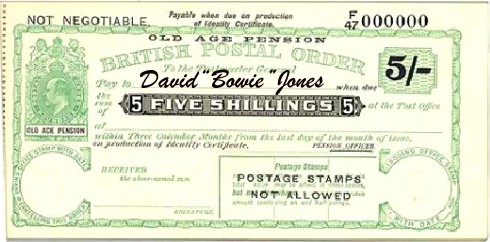
Were he still living in the UK, today’s birthday would designate him, in the idiom, “an old-age pensioner”, and the state would pay him slightly more than the five shillings a week handed over when the scheme began 100 years ago. He can’t be 65, you’re saying as you inspect the picture of him and his wife Iman [above] at a leukemia charity gala in New York last year. He looks too good for 65. “Waddayamean?” he’d be bound to snap, flinging back the old feminist line, “This is how 65 looks in the 21st century.”
True, if you start young, break the rules and push yourself to the max, as all geniuses do. While in short trousers, the little suburban Londoner David Jones was nothing if not prolific. At 11 he was playing a skiffle bass, buying and collecting the NME for future reference, learning the sax at 13 and soon moving up through a succession of bands: Konrads, Hookers, King Bees, Manish Boys, Lower Third, Buzz, and Riot Squad.
At school he fell under the spell of an art teacher, Owen Frampton, whose own son Peter went on to musical fame. Bowie has said: “I went to one of the first art-oriented high schools in England, where one could take an art course from the age of 12. Three-fourths of our class actually did go on to art school.”
Everybody knows how this liberal education shaped his outsider stance, how he redefined glam-rock, and how his incarnation as Ziggy Stardust made him an international star and one of the most iconoclastic forces in 70s music. How much more fun though to celebrate a grand milestone by looking back to the earliest expressions of that genius and to wonder aloud how else might the talents of the young David Jones have developed? Today, we find whole chapters of his formative experiments on video online, from mime artist and music-hall hoofer, to actor and fin-de-siècle soothsayer. In all the springboard moments pictured in the slideshow above, Bowie is no older than 24. At any moment the fickle finger of fate could as easily have pointed in any number of directions…
In 1969 Bowie’s manager Kenneth Pitt proposed to showcase his talents by producing a half-hour film called Love You Till Tuesday. The compilation showcased tracks from his 1967 debut album, plus a spanking new song, Space Oddity, which introduced Major Tom and became his first hit. Cleverly anticipating the first Nasa Moonwalk in 1969, the filming for this number pastiches Stanley Kubrick’s cine-epic premiered the previous year. It effectively proposed what today we call the promo video which, as Kevin Cann reveals in his exhaustive 2010 Bowie biographyAny Day Now, remained substantially unseen by the public until its release as a clip in 1984. The whole half-hour showreel went online for the first time only yesterday…
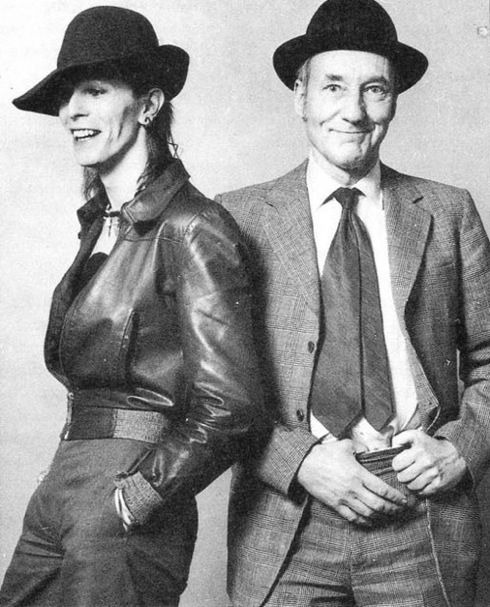
THEN HE MET WILLIAM BURROUGHS
1973: Bowie is interviewed for Rolling Stone with novelist Wiliam Burroughs and photographed by Terry O’Neill
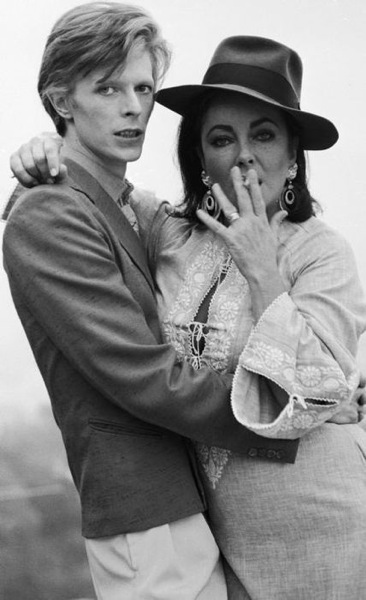
THEN HE MET LIZ TAYLOR
1975: Bowie meets Hollywood legend Liz Taylor. Photographed by Terry O’Neill
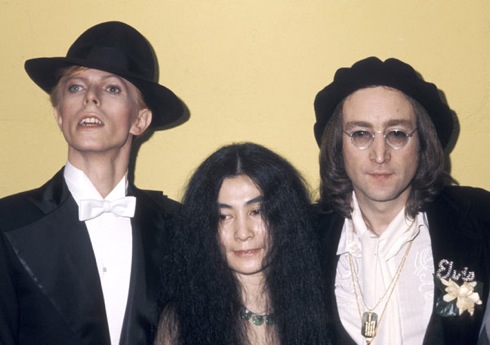
THEN HE WROTE A SONG WITH JOHN LENNON
1975: At the Grammys, Bowie upstages Yoko Ono and John Lennon — one day he gets jamming with David in a studio and turns a lick into the song Fame
➢ Choose “View full site” – then in the blue bar atop your mobile page, click the three horizontal lines linking to many blue themed pages with background article
MORE INTERESTING THAN MOST PEOPLE’S FANTASIES — THE SWINGING EIGHTIES 1978-1984
They didn’t call themselves New Romantics, or the Blitz Kids – but other people did.
“I’d find people at the Blitz who were possible only in my imagination. But they were real” — Stephen Jones, hatmaker, 1983. (Illustration courtesy Iain R Webb, 1983)
“The truth about those Blitz club people was more interesting than most people’s fantasies” — Steve Dagger, pop group manager, 1983
PRAISE INDEED!
“See David Johnson’s fabulously detailed website Shapers of the 80s to which I am hugely indebted” – Political historian Dominic Sandbrook, in his book Who Dares Wins, 2019
“The (velvet) goldmine that is Shapers of the 80s” – Verdict of Chris O’Leary, respected author and blogger who analyses Bowie song by song at Pushing Ahead of the Dame
“The rather brilliant Shapers of the 80s website” – Dylan Jones in his Sweet Dreams paperback, 2021
A UNIQUE HISTORY
➢ WELCOME to the Swinging 80s ➢ THE BLOG POSTS on this front page report topical updates ➢ ROLL OVER THE MENU at page top to go deeper into the past ➢ FOR NEWS & MONTH BY MONTH SEARCH scroll down this sidebar
❏ Header artwork by Kat Starchild shows Blitz Kids Darla Jane Gilroy, Elise Brazier, Judi Frankland and Steve Strange, with David Bowie at centre in his 1980 video for Ashes to Ashes
VINCENT ON AIR 2026
✱ Deejay legend Robbie Vincent has returned to JazzFM on Sundays 1-3pm… Catch up on Robbie’s JazzFM August Bank Holiday 2020 session thanks to AhhhhhSoul with four hours of “nothing but essential rhythms of soul, jazz and funk”.
TOLD FOR THE FIRST TIME
◆ Who was who in Spandau’s break-out year of 1980? The Invisible Hand of Shapersofthe80s draws a selective timeline for The unprecedented rise and rise of Spandau Ballet –– Turn to our inside page
SEARCH our 925 posts or ZOOM DOWN TO THE ARCHIVE INDEX
UNTOLD BLITZ STORIES
✱ If you thought there was no more to know about the birth of Blitz culture in 1980 then get your hands on a sensational book by an obsessive music fan called David Barrat. It is gripping, original and epic – a spooky tale of coincidence and parallel lives as mind-tingling as a Sherlock Holmes yarn. Titled both New Romantics Who Never Were and The Untold Story of Spandau Ballet! Sample this initial taster here at Shapers of the 80s
CHEWING THE FAT
✱ Jawing at Soho Radio on the 80s clubland revolution (from 32 mins) and on art (@55 mins) is probably the most influential shaper of the 80s, former Wag-club director Chris Sullivan (pictured) with editor of this website David Johnson
LANDMARK FAREWELLS. . . HIT THE INDEX TAB UP TOP FOR EVERYTHING ELSE














 ➢➢ Shapers of the 80s ➣➣