Category Archives: Media

2012 ➤ S’Express adds pizzazz to an alternative Pageant playlist for HM The Queen

River Thames ,Diamond Jubilee Pageant,

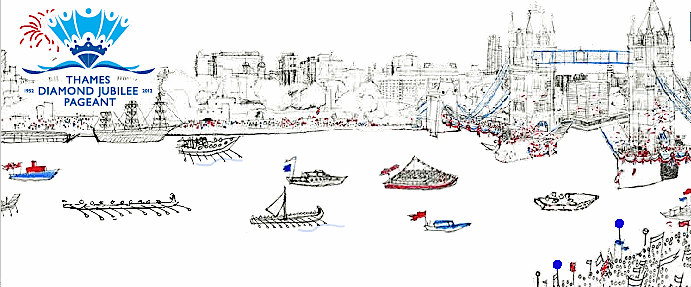
➢ 1,000 boats will muster on the River Thames — in case you hadn’t heard — on Sunday June 3, to accompany Her Majesty The Queen in the Thames Diamond Jubilee Pageant. The flotilla itself will be over seven miles long and will pass 25 miles of Thames river bank and under 14 bridges. It will take 90 minutes to pass any given point. A global TV audience is expected to number hundreds of millions… / continued online

London Philharmonic Orchestra ,Diamond Jubilee Pageant, Mark Moore, S’Express

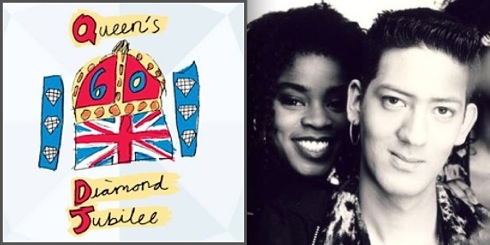
Official and unofficial Pageant soundtracks: the London Philharmonic Orchestra’s CD, and DJ Mark Moore of S’Express

➢ The Guardian offers an alternative playlist for
Her Majesty’s water music

According to Adrian Evans, the “pageant master” tasked with arranging a London Philharmonic Orchestra soundtrack for the Jubilee flotilla’s voyage down the river Thames, the Kinks’ Waterloo Sunset didn’t quite make the cut. Come June 3, the 86-year-old monarch will instead be serenaded with movie themes and century-old chestnuts. Today, though, The Guardian offers its own fantasy flotilla playlist of 14 tracks which start from Albert Bridge with The Clash’s London Calling — 1979. (London is drowning and I live by the river. The video for this Thameside apocalypse was shot beside the bridge)…

It nods to Southwark Bridge with S’Express: Theme from S’Express — 1988. (Shoom, in nearby Southwark Street, was ground zero for British acid house. Supercool DJ Mark Moore is suitably lowkey today on Facebook, “Most amusing”, and reminds us he was frontman in the 80s act)…

And reaches Tower Bridge with Blur’s This is a Low — 1994. (The flotilla turns around here, but the song follows the river eastwards. And into the sea/ Goes pretty England and me)… / continued at Guardian online

River Thames, Diamond Jubilee Pageant,

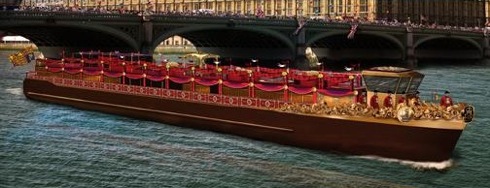
The Queen’s royal barge, 2012-style: a specially adapted Thames river boat dressed for the Diamond Jubilee Pageant

HERE’S THE OFFICIAL MUSICAL ACCOMPANIMENT

➢ An iPad app creates a multimedia journey in time-lapse videos shadowing the Thames Diamond Jubilee Pageant in which the London Philharmonic Orchestra will perform popular works by great British and Commonwealth composers on the glass-fronted herald music barge, Symphony.

SAMPLE the LPO performance now!

FRONT PAGE

➤ Sir Harold’s memories of Fleet Street: cut and thrust, or be cut dead

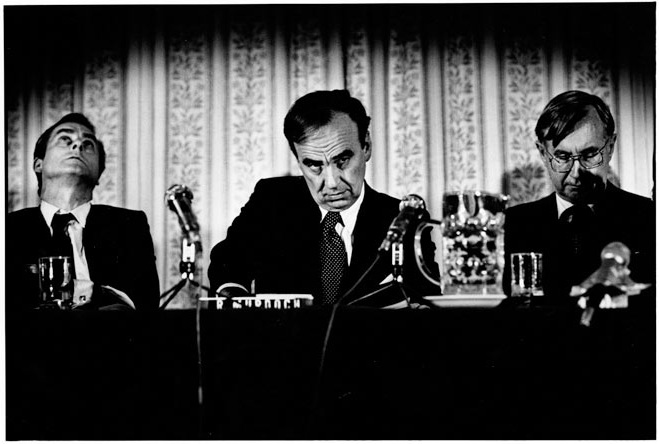
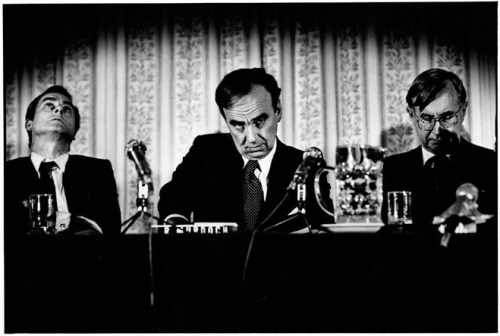
The media “sale of the century”: Rupert Murdoch announcing his purchase of Times Newspapers on Jan 22, 1981. He is flanked by Harold Evans, editor of The Sunday Times, and William Rees-Mogg, editor of The Times. Captured here in what the photographer © Sally Soames calls her “best shot”

❚ HOW EXCITING THAT HARRY EVANS can still recount his rows with Rupert Murdoch in 1982 were as if they were “the day before yesterday”. The legendary former editor of The Sunday Times yesterday regaled the Leveson inquiry into British press standards via a video link from New York where he lives. He described one row almost ending in “fisticuffs”.

Murdoch had transferred Evans from The Sunday Times to its daily stablemate, The Times, once he had purchased the UK’s two most important newspapers in 1981. Evans told the inquiry there followed a year of constant editorial interference from Murdoch. Under the headline “Harold Evans tells Leveson of conflict and ‘vindictive’ atmosphere at Times”, today’s Guardian was impressed, 30 years later, that the ex-editor seemed to be “replaying the events as if they had occurred the day before yesterday”.

An insight into why the memories remain so fresh is delivered in an irresistible report elsewhere, at The Daily Beast website, doubly spiced because its editor-in-chief is Sir Harold’s wife, Tina Brown. Amid a blizzard of other Murdoch coverage, we see this headline:

➢ Sir Harold Evans Fights Back Against Rupert Murdoch
At Leveson Inquiry:

Evans described how he and Murdoch “almost came to fisticuffs” when Murdoch disagreed with a story published in The Times by an anti-monetarist writer. Evans resigned after only a year, over what he has long described as disagreements with Murdoch’s editorial interference. “I was disgusted, dismayed, and demoralized,” he said today… The vitriol between the two men has festered ever since Evans’s departure from The Times.

Sir Harold might as well have been reading Chapter 15 from the rip-roaring book Good Times Bad Times that he wrote the moment after resigning in 1982 and exiling himself to America soon after. The fireworks turn to warfare in the chapter headed “Plots” when Murdoch is giving Evans a dressing-down at The Times:

Murdoch: “Whad d’ya stand for? Nothing! The Times has no convictions.”
Evans writes: I accepted the provocation. I was glad to have it out in the open. I outlined five policy lines…
Then [Murdoch] added acidly: “Of course, I’m not supposed to speak to you like this. I’m supposed to ask the national directors” … [Murdoch] was not looking for debate. He was looking for weapons.

Today’s digerati will seldom experience the adrenaline rush produced by such instinctive cut and thrust.† It was survival of the fittest on a daily basis which was the lifeblood of old Fleet Street — or Print as we used to call it.

➢ 1981, The day they sold The Times, both Timeses
— read more at Shapersofthe80s

❏++++++❏++++++❏

THE THREE BEST BOOKS FOR UNDERSTANDING
HOW BRITISH JOURNALISM WORKS

+++
books, journalism TOUGHING IT
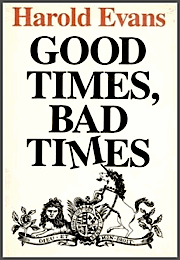
➢ Good Times Bad Times
by Harold Evans

The best account ever of the pitiless manners and mores of British newspaper executives and those they serve. The 525-page paperback is a thriller that starts with the Foreword: “Early in 1982, 10 months after he had taken over The Times and The Sunday Times, Rupert Murdoch went to see the prime minister Mrs Thatcher. They shared a problem: it was me.” The book is unputdownable. As my former editor Charles Wintour wrote in his review: “Enthralling… the narrative pace is tremendous… an immediacy and an excitement worthy of le Carré.”
Scoop , Evelyn Waugh, TV, films,Gavin Millar, DVD,Michael Maloney, books, journalism

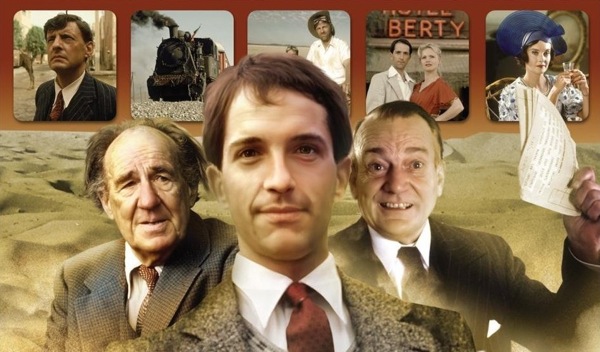
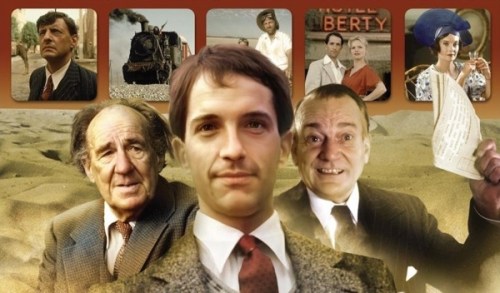
Gavin Millar’s TV film of Scoop, 1987, now on DVD: Michael Hordern as Uncle Theodore, Michael Maloney as William Boot, Denholm Elliott as Salter

THE HOLLOW LAUGH
➢ Scoop by Evelyn Waugh

A satire so lithely comic that it prompts tears of mirth on almost every page. Though published in 1938, every one of its sublime characters is alive and well and working on national newspapers today. More, the all-too-plausible gaffe on which the entire plot tilts — a dinner-party name-drop sends wrong reporter off to cover a war — is true to the serendipitous decision-making that lands journalists in the least suitable of jobs. The novel’s inspiration was the dynastic rivalry between the best-selling newspapers of their day, the Daily Mail (owned by Lord Northcliffe then his nephew Lord Rothermere) and the Daily Express (Lord Beaverbrook), all fictionalised in the megalomaniac universe of Lord Copper of The Beast and Lord Zinc of The Brute. Most famous line: When Lord Copper was right, [the foreign editor] said: “Definitely, Lord Copper”; when he was wrong: “Up to a point.”
books, journalismTOOTH AND CLAW
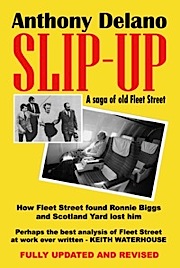
➢ Slip-up: How Fleet Street Found Ronnie Biggs and Scotland Yard Lost Him, by Anthony Delano

Verdict of playwright and columnist Keith Waterhouse: “Perhaps the best analysis of Fleet Street at work ever written.” Every word is true (allegedly) in this preposterous page-turner, starring Fleet Street’s finest, Scotland Yard’s finest, and the Great Train Robber. The sheer guile, grit and ratlike cunning displayed by newsroom hacks from the 14 rival national newspapers is breath-taking as they try to second-guess each other during the manhunt for Ronnie Biggs, the most infamous of the villains who had pulled off what was then the greatest robbery of all time. During his 30-year sentence he escaped from jail. Years later, in 1974, the Daily Express discovered the fugitive in Brazil.

This was the scoop of the century and the 4million-selling Express endeavoured to keep the scoop secret from everybody except Detective Chief Superintendent Jack Slipper, head of the legendary Flying Squad. He was invited to join the hacks in Rio to deliver his best line: “Hello Ronnie. Long time no see.” Then a bombshell exploded. The secrecy of the mission meant nobody had applied for Biggs’s extradition. Fact was: Brazil had no extradition treaty with Britain. Slipper’s humiliation was crowned by the picture stealthily snatched by Mike Brennan of the Daily Mail showing him flying back home asleep beside the empty seat that should have held Biggs. Still, the exclusive Express story had already scooped the world. And Delano’s book became a £1m BBC TV drama in 1988.
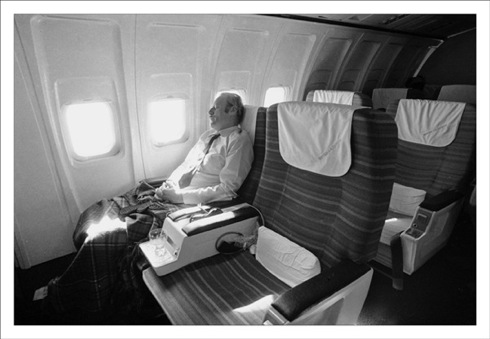
Detective Chief Superintendent Slipper flies home from Brazil: photographer Michael Brennan snapped him asleep in flight. The caption was “The Empty Seat”

➢ The story behind the story of Slip-Up — In a 2008 update, Anthony Delano spilled more beans: keep scrolling to find Revel Barker’s account, more by Delano himself and by Keith Waterhouse who scripted the 1986 TV version titled The Great Paper Chase.

➢ Ten of the best books about journalism — As Vincent Mulchrone said: “Journalism is the only human activity where the orgasm comes at the beginning.”

† HISTORICAL FOOTNOTE ON
THE CUT V THE THRUST
cut and thrust, swordplay,debate,conflict,competition

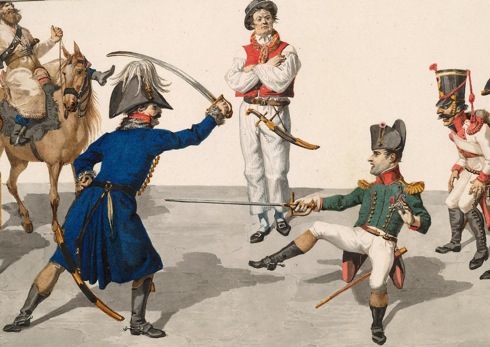
Point over edge in swordplay: attacks with the point rely more on speed and finesse while those with the edge rely more on strength and momentum. Different swords do one or the other better. The fact is that thrusting requires much less strength to make a lethal wound while an effective cut can require a powerful blow. Both demand skill. Both will kill. You decide which one suits Rupert and which suits Harold

➢ Napoleonic Flame War by Richard Marsden — During the late 18th and early 19th century the definition of a proper sword varied from nation to nation. Initially, nations sought to choose the “best” sword for their light and heavy cavalry units so that on the battlefield they would be more effective. Tests and studies were done, data collected and proposals put forth. Somewhere along the line, however, the matter of the cutting sword or thrusting sword became more than one of facts and figures — it became one of national pride.

FRONT PAGE

➤ The day Gary Kemp reduced hard-nosed Guardianistas to tears

+++
◼ AS WITH ANY ARTICLE AT THE GRAUNIAD about New Romantic cheerleaders Spandau Ballet, the resulting comments published online are always riotously entertaining. This is the one band that really winds up Guardianistas to a pitch of fury. When the 80s band announced their reunion tour in 2009, Michael Hann declared how much he’s always loathed them in a Graudina music blog which then provoked 342 comments — 342! — most of them apoplectic. How many other bands can claim such a following?

books, Lyrics of Gary Kemp,Lyric Book Company,

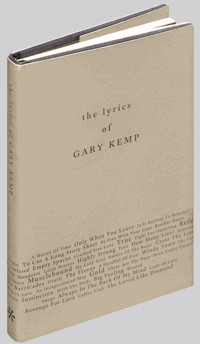
As it happens the Spandau songwriter has recently published an 88-page coffee-table book, titled The Lyrics of Gary Kemp from Lyric Book Company

Today for no apparent reason, the Guranaid runs an item about how Gary Kemp and Steve Norman made Spandau’s 1983 No1 hit True, in which lyricist Kemp admits: “I’m still berated for the line Take your seaside arms, but it’s straight out of Lolita by Vladimir Nabokov.”

Readers of Shapersofthe80s already know that the song was inspired by Kemp’s unrequited pash for poppette Clare Grogan — he was 22, she was 18 — who fronted an 80s band of Scottish cuties called Altered Images. On the same page, Steve Norman deconstructs his self-taught sax solo which has a key change in reply to Grover Washington’s Just The Two of Us.

All of which strangely prompts tearful blubbing at the Graun, rather than the usual explosion of acerbic outrage. Specimen comments follow after this gratuitous excuse to run a video…

VIDEO OF DARLING CLARE IN HER HEYDAY,
NOT TO MENTION SWIVEL-HIPS TICH

+++
➢ Meanwhile back to today’s Grauniad Online:
❏ Nietzsche39 (who else?) notes: “You don’t bastardise Nabokov. Seaside arms is absurd. Seaside limbs is genius.”

❏ Nepthsolem moans: “It always sounds to me like See side arms, as though referring to the service revolver I imagine was issued to all New Romantics, but sadly never used on TOTP.”

❏ DeeSawdeley says: “I always thought it was seaside aunt, which (for those of us with a seaside aunt, anyway) makes much more sense. Bet he wishes he’d written that now!”

❏ Stolencar comments: “Note also he says she gave him a copy of Lolita not that she had read it.”

❏ To which Vastariner responds: “There’s a picture of her reading it on the front of the Best Of Altered Images compilation released in 1991. Some might call me obsessed for knowing that, or because I have a username taken from one of her lyrics… etc etc.”

❏ From another planet, Golgafrinchan sobs: “I had unrequited love for Clare Grogan, still do to be fair. If you’re reading this Clare, get in touch, there’s still time.”

❏ DameHedwig adds: “I’ve often told my son that if things had worked out for me, Ms Grogan would be his Mum.”

❏ And Mccaugh: “As for the sublime Miss Grogan, well, just how many times did we go and see Gregory’s Girl? Helped, of course, by the fact that it ran at the Dominion Cinema in Edinburgh for three years non-stop.”

❏ Finally Bloodydoorsoff tells a despicable and blatant untruth about darling Clare, so you’ll just have to go to Grunadia Online to see it. And plenty more.

John Gordon Sinclair, Scott Neil), Clare Grogan, Glasgow Film Festival ,Gregory’s Girl

Glasgow Film Festival 2010: Darling Clare seen with Gregory’s Girl sidekick John Gordon Sinclair. In 1994 — sorry, lads — she married bandmate Stephen Lironi in Glasgow and today the couple live in Haringey, London, with their adopted daughter. (Photography by © Scott Neil)

FRONT PAGE

➤ Sukita-san’s eye view of the weird world according to Bowie

David Bowie, Masayoshi Sukita,Speed of Life, Genesis Publications,

Heroes-era Bowie in 1977 © by Masayoshi Sukita

David Bowie,Yamamoto Sukita, Kansai Yamamoto ,Speed of Life, Genesis Publications

Bowie as Ziggy in 1973 costumed by Kansai Yamamoto and photographed © by Masayoshi Sukita

❚ HERE WE SEE CLASSIC PIX of the early glam incarnations that broke the rules of rock and roll and put the gender-bending David Bowie into the headlines. Since 1972 Japanese photographer Masayoshi Sukita has gone on capturing the prolific flow of creations from the ever-inventive Bowie. This week in London his long-awaited book Speed of Life documenting their 40-year collaboration is launched by Genesis Publications in its 2,000-copy limited edition. Signed by both Bowie and Sukita, it is priced at £360 ($581) for 300 pages which they caption with their own recollections and memories. Bowie says: “It’s very hard for me to accept that Sukita-san has been snapping away at me since 1972 but that really is the case… May he click into eternity.”

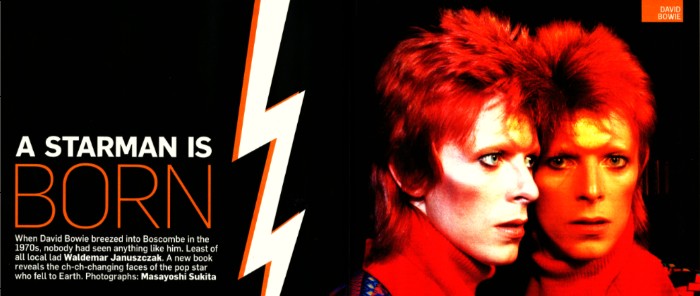
Meanwhile in today’s Sunday Times Magazine art critic Waldemar Januszczak recalls his teenage outing in 5-inch platforms when he paid 90p on the door of Starkers in Boscombe, Dorset, to discover the eye-popping mystique of Ziggy Stardust in August 1972 — minutes after Sukita the photographer arrived in Britain and caught Bowie’s shock show at London’s Royal Festival Hall. He described it as “like an astronomer finding a new planet”.

David Bowie, Masayoshi Sukita,Speed of Life, Genesis Publications,

Today’s Sunday Times Magazine: Bowie in 1972 © by Masayoshi Sukita

Januszczak writes: “It was Andy Warhol who invented the immensely attractive cultural idea that anyone could be whoever they wanted to be. It became Bowie’s big idea as well. And the tour he set out on in 1972 featured his most determined efforts yet to become lots of people at once: Ziggy Stardust, Aladdin Sane, Major Tom, The Man Who Saved the World. That was just the beginning. The bewildering multi-identitied career photographed for us so sympathtically by Sukita-san in Speed of Life features enough different David Bowies to constitute a football crowd…”

David Bowie, Masayoshi Sukita,Speed of Life, Genesis Publications,

Bowie in 1989 © by Masayoshi Sukita

Above images copyright Masayoshi Sukita, courtesy Genesis Publications

David Bowie, Masayoshi Sukita,Speed of Life, Genesis Publications,

Sukita then and now: left, with Bowie in the 70s

MAY 8: INVETERATE LIGGERS AT THE LONDON
BOOK LAUNCH PARTY

Paul Simper, Steve Norman, Bowie, Sukita, books, Speed of Life,Genesis Publications,Dover Street Arts Club,

Lads insane: The Spand sax-man also known as Spiny Norman ingratiates himself with Ballet biographer Paul “Scoop” Simper at tonight’s Speed of Life book launch. Spandau’s own official photo-book is promised for 2013 from Genesis Publications. Photograph by © Shapersofthe80s

➢ Condé Nast president Nick Coleridge tells book-launch party of his teen obsession with Bowie and his encounter with Angie — Evening Standard Diary, May 9

FRONT PAGE
➤ Shapersofthe80s is declared an “invaluable website” by British historian

“winter of discontent” ,  Leicester Square, strikes,

Britain’s infamous “winter of discontent” that brought down the Labour government in 1979: as public service workers went on strike, rubbish piled-up even in London’s Leicester Square

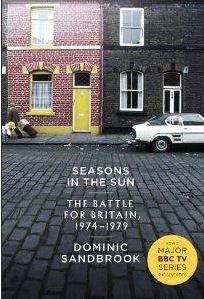
Seasons in the Sun,Battle for Britain, Dominic Sandbrook, books, history, Allen Lane,❚ AN “INVALUABLE WEBSITE” — this is the verdict on Shapersofthe80s by historian Dominic Sandbrook, author of the rich new cultural analysis, Seasons in the Sun: The Battle for Britain, 1974–1979. It’s a doorstep of a book, yet highly readable, which reveals numerous upbeat aspects to the chaotic decade many write off as worthless.

Chapter 31 is especially inspirational! Sandbrook gives generous credit to key characters who Shapersofthe80s has long maintained deserve recognition as movers and shapers pivotal to the energy of the 80s. And, having quoted chunks from our own texts, the historian gives due acknowledgement in his extensive bibliography. Indeed, the scope of his research is more impressive than for much other contemporary history, as Sandbrook not only cites political and economic mandarins, but also sifts fine detail from popular culture and eye-witness reportage across the whole social spectrum.

Sandbrook writes: “Behind the lurid news stories, the late 1970s were the decisive point in our recent history. Across the country, a profound argument about the future of the nation was being played out, not just in families and schools but in everything from episodes of Doctor Who to singles by the Clash. These years marked the peak of trade union power and the apogee of an old working-class Britain – but they also saw the birth of home computers, the rise of the ready meal and the triumph of a Grantham grocer’s daughter who would change our history for ever”

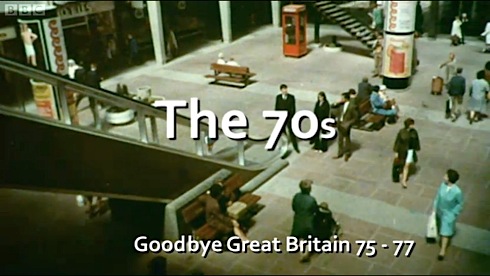
Seasons in the Sun is the fourth title in Sandbrook’s survey of postwar Britain. His unstuffy combination of high and low life is behind the BBC2 series The Seventies currently viewable live and on iPlayer.

BBC2 series The Seventies,Seasons in the Sun ,Dominic Sandbrook

Sandbrook’s Seasons in the Sun forms the basis of the current BBC2 TV series The Seventies

REVIEWS OF SEASONS IN THE SUN

❏ “The first three volumes of Dominic Sandbrook’s epic history of Britain between 1956 and 1979 were exceptionally good. The fourth, Seasons in the Sun, is magnificent … marked by its pace, style, wit, narrative and characterisation as by its exhaustive research.” — Roger Hutchinson, Scotsman

❏ “Sandbrook has created a specific style of narrative history, blending high politics, social change and popular culture … his books are always readable and assured, and Seasons in the Sun is no exception … Anyone who genuinely believes we have never been so badly governed should read this splendid book.” — Stephen Robinson, Sunday Times

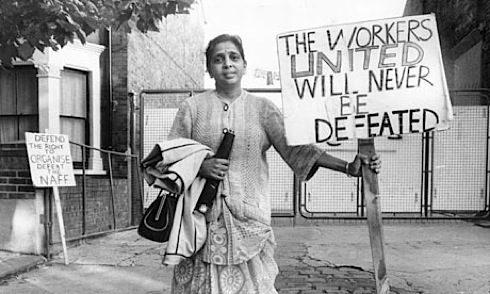
1977, Jayaben Desai, Grunwick, strike, picket

August 1977: Jayaben Desai, treasurer of the strike committee at the Grunwick photo-processing plant, had been picketing for a year, supported by white, male trade unionists while postmen blocked the company’s mail. (Photograph by Graham Wood/Getty)

EVEN WIDER PERSPECTIVE FROM LEADING PLAYWRIGHT

➢ Playwright David Edgar draws together the Sandbrook quartet in The Guardian, May 9, 2012: The 1970s was the moment when our century arrived… As Sandbrook insists, the women’s liberation movement was as much about Hull’s fishermen’s wives and female machinists at Ford Dagenham as feminist activists disrupting Miss World. In 1971, workers campaigning against the closure of Upper Clyde Shipbuilders borrowed the student tactic of the sit-in. As 1970s chronicler Andy Beckett argues, the gay groups who stood shoulder to shoulder with trade unionists outside Grunwick prefigured an alliance which “would become commonplace in the decade to come”. The identity politics that were to become such a satirised feature of the left of the 1970s arose not just out of campus and culture but class war… / continued at Guardian online

FRONT PAGE