Category Archives: London

➤ No flash, no mob, as Occupy Bowie proves a damp squib

Occupy Bowie , V&A, exhibitions, fans,flash mob,David Bowie

More like Freddie Starrdust: The Bowie Experience tribute act outside the V&A yesterday in shabby Earthling coat and filthy lace. Photograph by Andy Polaris
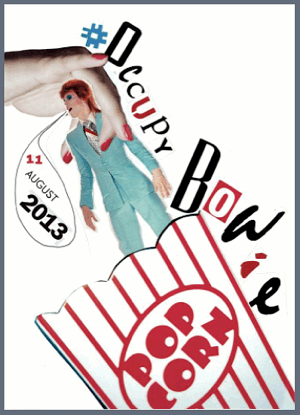
Occupy Bowie , V&A, exhibitions, fans,flash mob,David Bowie❚ “CALLING ALL MISFITS, ANDROGYNES, glam rockers, goblin kings, scary monsters and super creeps: you are invited to a gathering on the steps of the V&A on the last day of the Bowie exhibition, 11 August. Together we will create a tableau vivant.” This call to arms by an ad hoc faction calling itself Occupy Bowie posted a tortuous Tumblr page that dared to translate this difficult French phrase as a “living picture” and illustrated several examples from a long tradition blah blah of motionless, silent models in poses plastiques blah blah often theatrically lit blah blah.

Another page at Facebook declared: “In honour of music, art and David Bowie, it will be a spectacle. It is a participatory event for visual extremists of all stripes. Don’t call us a flash mob.”

As it happens, this tribal turnout by a few dozen fans yesterday afternoon proved to be less a flash mob, more a naff huddle. There was a singalong to Rebel Rebel, but no truly glam Bowie persona in sight, what with the low-rent mimes and the generally jumble-sale approach to costume topped with nylon wigs that could have come from Ridley Road Market. By midnight we could count only three photographs of this act of mass homage posted online, then a couple more today.

Click any pic to launch carousel

As it happens, Andy Polaris, who lives in East London, claims he was “passing by” the V&A in West London at 3pm and snapped the faithful engaged in their mystical rites. His verdict: “It looked more Freddie Starrdust than Ziggy Stardust.” This referred to the shabby Earthling playing guitar who is known as The Bowie Experience, a professional tribute impersonator wearing the least glam costume of any Bowie incarnation. Polaris said: “The women looked a lot better than the men and the girl with the dark hair and Aladdin streak was the best.” Funny, that. Even the apparent ringleaders themselves, University of the Arts types subtly disguised on Facebook as Occu PyBowie, let the side down in scruffy old jeans. They’d never have let each other get away with that in 1973, let alone the Blitz in 1980.

Brilliant sunshine put paid to any “theatrical lighting” to compare with the photographs of Ryan Schude or the Society of Beaux-Arts Architects Ball, 1931, that Occupy Bowie had cited as inspiration on that ambitious Tumblr page. Better luck at the exhibition’s Toronto opening in September, lads.

FRONT PAGE

➤ Bowie blockbuster goes abroad after 20 weeks wowing London

David Bowie is, exhibition, V&A, international tour, Bowie,

London landmarks: the V&A’s local tube station


➢ Bowie HQ on the V&A show’s last days:

Around 300,000 people have seen the V&A’s David Bowie is exhibition as it enters its closing week. The V&A has been running regular late-night openings to cope with demand and the exhibition has been open until 22.00 every night for the final two weeks. Tickets are still available for purchase every day at the Museum.

To give people one last chance to see the exhibition in the UK the V&A has also commissioned a special film to be transmitted live to over 200 cinemas across the UK on 13 August. David Bowie is happening now will be a cinematic, behind-the-scenes tour of the exhibition in the company of curators Victoria Broackes and Geoffrey Marsh and celebrity guests.

The exhibition will now commence an international tour. Confirmed venues are:

  • Art Gallery of Ontario, Toronto, Canada from 25 September to 27 November 2013
  • Museum of Image and Sound, Sao Paulo, Brazil from 28 January to 21 April 2014
  • Museum of Contemporary Art, Chicago, USA from September 2014 to January 2015
  • Philharmonie de Paris/ Cité de la Musique, Paris, France from 2 March to 31 May 2015
  • Groninger Museum, Groningen, The Netherlands from 15 December 2015 to 15 March 2016

Further international venues are under discussion… / Continued at Bowie.com

David Bowie is, exhibition, V&A, international tour, Bowie,

Fresh this week: a new Bowie portrait by Jimmy King, oozing maquillage

FRONT PAGE

1959 ➤ When beans defined bohos and cappuccino tasted of coffee

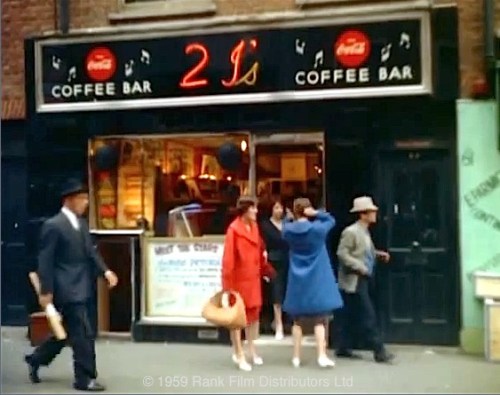
The Look at Life tour starts at the 2I’s in Old Compton Street: click to run video in a new window

The Look at Life tour starts at the 2I’s in Old Compton Street: click to run video in a new window

➢ Tour the bohemian coffee bars of London on film

❚ FROM SMALL COFFEE BEANS a mighty fad exploded. The documentary film clip, above, immaculately preserved in rich Eastmancolor, takes us on a tour of Soho in 1959. The distinctly arch voice-over tells us: The coffee bar boom in Britain began in 1952 when the first espresso machine arrived from Italy and set up in London’s Soho. They reckoned that a cup costing tuppence to make could be sold for ninepence to 1s 6d [about £3 in today’s money], according to the trimmings. But for every three coffee bars that opened up, two closed down… / Continued at YouTube

CLICK ANY PIC TO LAUNCH CAROUSEL:


With the arrival of ITV in the mid-50s, the UK’s two television channels competed to bring the day’s news into living rooms. In Britain’s cinemas the Rank Organisation responded in 1959 with the weekly magazine Look at Life, a series of light-hearted short films to precede the main feature on their Odeon and Gaumont circuit. This episode, titled Coffee Bar, takes us inside a few of Soho’s many haunts that took care to attract their own social segment: at the 2I’s in the basement of 59 Old Compton Street, live rock groups ensured a young clientele of jive cats, for example, while artists hung out at The French, intellectuals at the Macabre, politicos at Le Partisan, while writers and actors favoured Legrain.

Fifty years on, you’d be hard-pressed to distinguish one Soho bar’s customers from another’s – rather like the vile burnt cinders they all sell in the name of “coffee”. One sad consequence is to see the genuinely delicious stuff being edged off our supermarket shelves, presumably driven out by tastebuds destroyed in the high-street branded coffee shops.

FRONT PAGE

➤ The original Wag sets the scene for Club to Catwalk at the V&A

Wag club, Soho, clubbing , Swinging 80s, Chris Sullivan ,Ollie O’Donnell

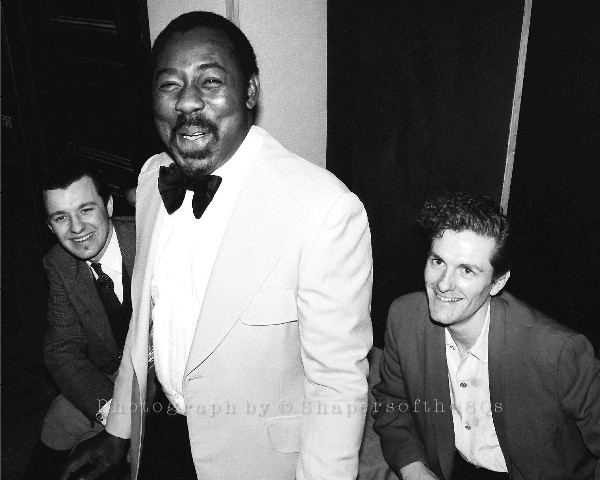
The Wag, for 19 years the coolest nightspot in Soho: its suave doorman Winston is flanked by co-hosts Chris Sullivan and Ollie O’Donnell. © Shapersofthe80s

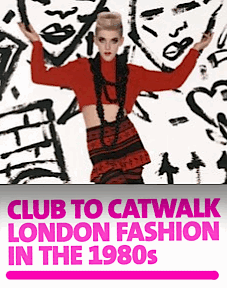
➢ The July issue of High Life magazine celebrates the launch next week of the Club to Catwalk exhibition in the V&A fashion gallery – Longtime Wag club host Chris Sullivan recalls the unbridled creativity, outrageous abandon and downright cheek of London in the 80s …

It was 27 April 1985 and the opening party for the second floor of the Wag Club – the nightspot I founded and ran in Soho – was in full, unrestrained swing. Fuelled by the unlimited free bar, the place was totally off the hook, the crowd dressed to the nines in their own inimitable fashion – pirates, preachers, punks and picture-postcard peaches – throwing themselves about with Bacchanalian abandon to a soundtrack as arcane and varied as they were.

Club to Catwalk, exhibition, London, Fashion,1980s, V&A High jinks indeed, yet looking around I realised that we as a group had come of age, were taken seriously and that this moment was ours. George Michael danced next to Siobhan of Bananarama overlooking Sade who nodded to the music in front of Suggs and Martin Kemp. Over the way, John Galliano camped it up alongside Leigh Bowery, Judy Blame, Boy George and one of the scene’s most innovative dressers and designers, Stephen Linard, while behind them stood Steve Strange and Princess Julia chatting to Vivienne Westwood… / Continued at High Life

➢ Club to Catwalk: London Fashion in the 1980s runs at the Victoria & Albert Museum, July 10–Feb 16, 2014. Featuring more than 85 outfits, it showcases new looks from the decade’s most experimental designers and some remarkable photography from back in the day

on video: five shapers still going strong

FRONT PAGE

1983 ➤ A turning point in David Hockney’s vision of the world

rel="nofollow"

Hockney wielding his Pentax in London, July 10, 1983: having devoted two years to photography, in this his second week on a trip to Britain, a further new canvas in the studio confirms a return to painting. Photograph © by Shapersofthe80s

❚ 30 YEARS AGO THIS WEEK the British painter David Hockney made a discovery so monumental that he called it “a truer way of seeing”. I’d gone to interview him about the education cuts Margaret Thatcher was inflicting on British art schools and found myself receiving an exhilarating tutorial while the artist tested his new ideas.

“Have you been to the cubism exhibition at the Tate?” Hockney enthused during a trip to London from his home in Los Angeles. “I’ve been seven times! Suddenly I see cubism differently, more clearly… That’s what I’m only starting to grasp. Cubism is about another way of seeing the world, a truer way. But the moment you grasp it, you can’t give it up.”

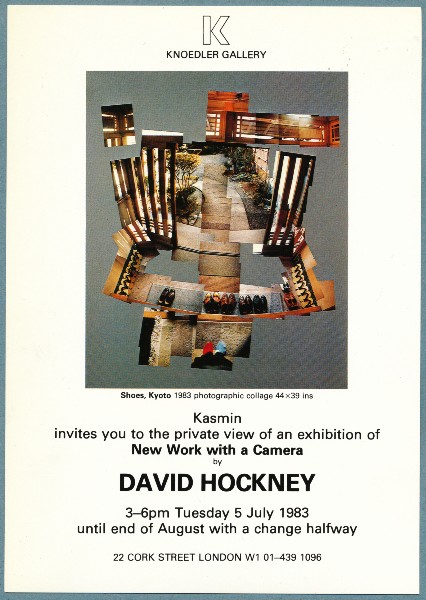
Photography had preoccupied Hockney for the previous couple of years and in the week of his 46th birthday, we’d met at a Cork Street gallery during the hanging of his show New Work With A Camera, fresh from its Los Angeles run. Yet on two visits to his Kensington studio that week, fresh canvases on the easel signalled that Hockney had returned to painting. He said: “I had to deal with the ideas that are bubbling away. Cubism is hard enough to grasp, but it’s even harder to do, which actually is why not many people have been able to do anything with it. Starting to paint again is very refreshing.”

Four days later when the resulting interview appeared in the London Evening Standard, he’d been again to the Tate and said on the telephone: “Your article is pretty much the first time I have talked about this – of course I’ve discussed these things with friends but the article does make it clear to people.”

rel="nofollow"

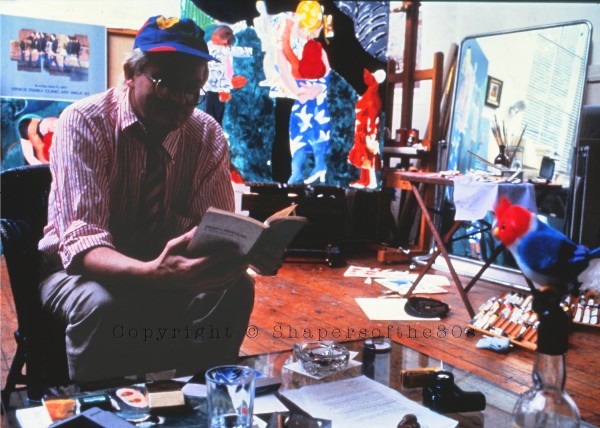
Hockney with fresh paintings in his London studio, July 3, 1983: so keen to deal with his new ideas, he reads aloud from a book about Marcel Proust’s theories of vision. Photographed © by Shapersofthe80s

He added: “You must go to the Tate retrospective [The Essential Cubism], it’s marvellous. You go from one cubist picture to another and another. In other galleries, like Moma, you might have one cubist room but go to the Tate show because you’ll never see so many cubist paintings together again. I found I began to develop this way of seeing them, it’s very rich. You do have to stand in front of the Picassos and spend time looking. When you’re physically in front of a cubist painting, once you start looking, especially the early analytical ones, it slowly reveals itself. It doesn’t pounce off the wall.”

The next day, when I returned to his studio with a camera, Hockney had begun yet another huge cubistic canvas which seriously took the breath away. It was a privilege to view the unfinished paintings with their images outlined in charcoal and he remarked that few people get to see inside the studio. I made sure to snap the 1,001 mementoes and influences scattered throughout the space suggestive of a restless imagination. The three substantial conversations I was fortunate to enjoy that week remain a turning point in my own appreciation of art. By a stroke of fate, my presence had provided the artist with a sounding board at the very moment when he urgently needed to kick around some bold new thoughts.

➢ Click through to read the full fascinating interview with Hockney, in an elision of two pieces first published in the Evening Standard, July 8, 1983, and The Face, Sept 1983

David Hockney,New Work With A Camera, photography, London, 1983

Fresh from its Los Angeles run: Invitation to Hockney’s latest show of three-dimensional photo collages in London, 1983

FRONT PAGE