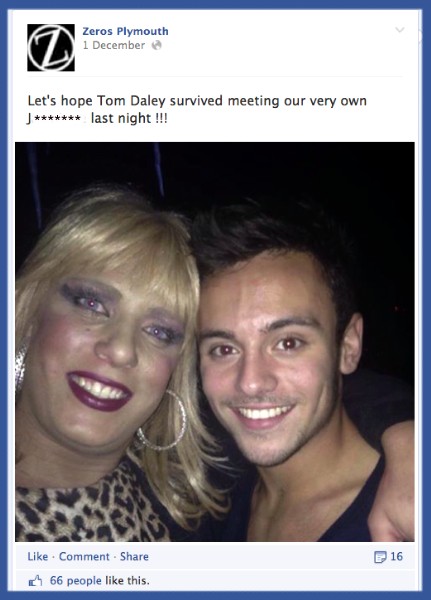
Saturday night out: the Facebook page of Plymouth’s Zeros gay club pictures Tom Daley with their shot girl
◼ QUIZ QUESTION OF THE WEEK: Which of these statements came first?
1 – “Hello, is that The Sun? Would you be interested in a photo of Tom Daley at our local gay club in Plymouth?”
2 – “Hello Tom, Sun newsdesk here. Do you want to tell us what you were doing in Zeros club Plymouth on Saturday night?”
3 – [via Twitter] “Got something I need to say…not been an easy decision to make, hope you can support me! :) ”
❏ On Monday morning at 11 o’clock Britain’s 19-year-old Olympics diver Tom Daley posted his confessional video on YouTube telling the world he was “dating a guy”. The global media coverage has been massive and the video has clocked 6 million views in two days. In it he said: “In an ideal world I wouldn’t be doing this video because it shouldn’t matter. But recently I was misquoted in an interview and it made me feel really angry… Now I feel ready to talk about my relationships.” Throughout the brave five-minute video message, recorded on his own phone, he was understandably nervous, and by the end seemed palpably relieved.
SCROLL DOWN FOR FURTHER UPDATES
+++
The interview that had angered him appeared in the Daily Mirror on September 8 when he was quoted denying the suggestion that he was gay.
EIGHT WEEKS PASS – THEN SUDDENLY…
At about 2am this Sunday, Dec 1, after the Sunday papers have gone to press, Tom Daley visits the gay club Zeros in his Devon hometown with some friends and is photographed at the club with a shot girl, also described as a “drag artist”. That morning the photograph is published by Zeros nightclub on its Facebook page with the message: “Let’s hope Tom Daley survived meeting our very own J******* last night !!!” (The shot girl later complained about her picture being published and her name was removed).
At 1pm Sunday the first of several Facebookers shares this picture.
At 3pm Sunday Daley tweets “So lucky to have such a supportive mum! I love you!” and – out of the blue – he posts a smashing picture of himself with Debbie Daley at Instagram.
Then at about 5pm Sunday Daley makes a special visit to his grandparents nearby in Devon to break his news to them, which they tell the Daily Mail the next day also came “out of the blue”.
Early on Monday morning he tells the rest of his family. “I can count the number of people I’ve told on my hand,” he says.
At 11am Monday, Daley goes public with his outing video on YouTube. It is immediately reported by BBC News and the rest of the media and Daley is soon trending on Twitter.
At 7pm Monday The Sun, Britain’s biggest selling tabloid newspaper, is going to press with its detailed “exclusive” report for Tuesday’s issue revealing the name of the “Pop hunk pal who helped dive star come out”. The new news here claims that Daley was inspired to do so after “developing a close friendship with gay former S Club Juniors idol Aaron Renfree”. Mike Spencer, the gay TV producer of the Only Way is Essex, is reported to be another of Daley’s “close friends”. And a Zeros barman reports that while in the nightclub Tom was “not surprisingly being quite flirty”. In this cloud of gay innuendo, nowhere does The Sun cite Daley as a source of information.
It would have taken some very nifty footwork to pull that lot together had the Sun’s exclusive research been a same-day response to the video as breaking news! As it is, the so-called exclusive is swamped by coverage in every other newspaper following up Monday’s outing video.
Eight weeks had passed since the Mirror interview angered Tom. Yet suddenly within a single day this weekend our hero decided that he not only felt ready to share his secret with the world, but first had to share it at high speed with his mother, his grandparents, his extended family. Then record and upload. All with immaculate timing. Here was a man with a plan – though it’s hard not to believe pressure was being brought to bear on the teenage sports star to spill the beans. The Sun generously placed an editorial beside its exclusive report hailing Tom for his guts as the “diver who broke the news”.
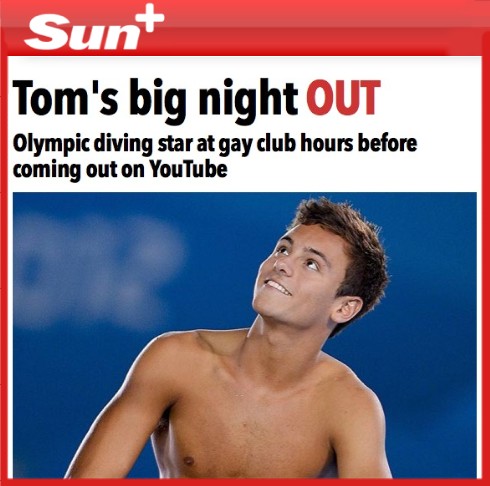
Tuesday’s Sun: inside story of his gay connections

Tuesday’s Sun, Dec 3: photographs from Zeros nightclub where Daley posed with a barman and a shot girl
JUST FANCY THAT !
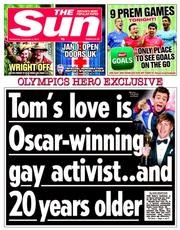 ❏ Wed Dec 4 update: The Sun follows through with a massive second chapter in the Daley outing saga by front-paging the name of Tom’s purported lover “who is almost 20 years his senior”, complete with pictures and quotes from “friends”. These are all the hallmarks of a well-prepared major investigation to steamroller a celeb into making a “He’s so brave” confession in advance of publication. What choice did our hero have at the weekend? What better strategy could his management have endorsed but to out himself first and wrong-foot The Sun?!
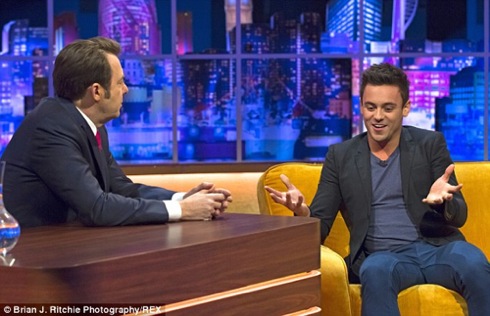
Daley tells Wossy: “I’ve never felt anything like it” (on ITV next Saturday)
WOSSY SCOOPS THE TV INTERVIEW
Tom tells Jonathan Ross: “It was love at first sight. I’ve never felt anything like it – and I made the first move. At the end of the night I wrote in his notes with my number and put ‘call me’ with a wink face and then I had a text in the morning.”
“To be honest, everything is all pretty new and I don’t see any point in putting a label on it – gay, bi or straight.”

Sweatshirt day, T-shirt day: budding boyfies Tom and Lance papped in Los Angeles
A MASTERPLAN FALLS INTO PLACE
❏ Thur Dec 5 update: BRILLIANT! The clockwork spins and the teen star sings – on TV, not in The Sun – confirming suspicions that a very sure-footed strategy to “protect the brand” has been executed by Team Daley. The Olympic Bronze medallist diver is said to be worth £2m and is tipped to double that sum through sponsorship deals in the near future. At 19 Tom faces many more years of earning potential which PSG, his Weybridge-based management company, is committed to capitalising on, not putting at risk.
The complete absence of further Sun exclusives today, plus the choice of an interview with the A-List Jonathan Ross Show where again Tom speaks for himself without misrepresentation, indicate astute Team intelligence at work. To cap it all, last night they leaked contents of the Ross interview exclusively to the Daily Mirror just as it was going to press.
The Team knew the TV cook Nigella Lawson was going into the witness-box mid-week to account for her troubled marriage and would commandeer all newspaper front pages. They knew Daley was booked in soon for Ross’s TV chatshow and got him bumped up the queue onto this week’s recording as a special guest. They have been nudged in recent weeks by The Sun to respond to rumours circulating about the boyfriend’s identity.
So in hindsight the Saturday night visit to a Plymouth gay club – accidentally on purpose lifting the lid on Tom’s private life – can be seen as the Brand Daley start-line for a three-day masterplan. He outs himself on Monday morning and comes out of it a smiling hero, while all The Sun could do in the wake of his statement is to package its unconfirmed rumours for Tuesday’s paper with papped pictures and quotes from unnamed “friends”. Ross’s show wins the trusted follow-up interview because on TV Tom can speak for himself. Inevitably, its content cannot remain secret until the Saturday transmission at 10.45pm on ITV so, as The Sun’s rival tabloid, Wednesday’s Mirror is exclusively gifted advance text of Tom’s Tigger-like romantic revelations on TV, leaving all other papers to rehash them the next day.
Yet a mystery remains. Most curious of all is that in both the UK and the USA neither Tom nor his supposed lover Lance Black have confirmed themselves as partners. Throughout the Ross interview Tom talks emotionally about his new lease of life yet does not mention Lance by name, while going into intimate detail of how he, Tom, made the first flirtatious move. At his home off Sunset Boulevard, Lance unceremoniously rebuffs a Mail reporter.
Why are both men staying schtum on this score when Tom is so out and proud? The LA gay grapevine is convinced the pair are lovers, so might there be personal reasons? Rumour suggests that 39-year-old gay activist Lance Black (nobody calls him Dustin in LA) was in a long-term romance with his heart set on marriage when bushy-tailed Tom bounded into his circle. Tom might well have worked powerful magic and who can guess at the repercussions?
Let’s assume the Brand Daley team will sensibly have reserved still more fire power, to be released under its own terms when the next chapter unfolds.

Transatlantic romance: “I didn’t know if he was gay,” says Tom
ROMANTIC 2014 UPDATE
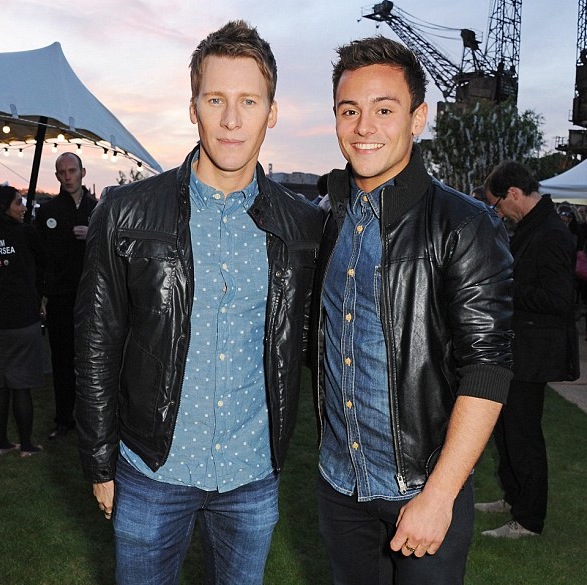
❏ FINALLY! Tom and Lance are officially papped together to mark the first time that the guys have stepped out as a couple at a public event. Here below we see them on April 30, 2014, attending the Battersea Power Station Annual Party. A few days later they announce they are setting up home together in London. Congratulations, boys.
➢ 5 May update: Tom Daley and Lance Black move in together near London’s Olympic Park
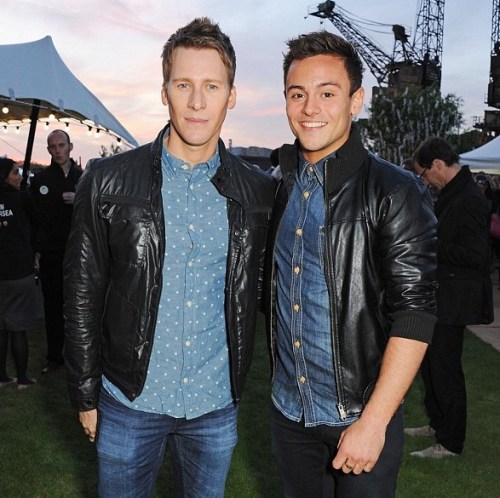
Officially a couple, April 30, 2014: papped at the Battersea Power Station Annual Party (Getty)
FRONT PAGE