Eighties singer Andy Polaris was knocked back this month
to hear one cool track after another play out in a Soho eaterie
and he quickly synthesised a playlist from the dozen best
– here’s a taste from his website Apolarisview. . .
“ What’s unique about my dozen best tracks? Obviously they all formed the backbone of the funk and soul soundtrack to my teen years in the 1970s when I would hear them on the dancefloors of the Lacy Lady, Croc’s, Racquel’s, Gold Mine, and on Radio London’s Robbie Vincent show and on Capital Radio’s Greg Edwards session. What’s amazing is that only this month I heard some of them playing out at the newish if retro-styled Old Compton Brasserie as the most credible playlist in Soho that night. It reminded me of the pre-disco cocktail bars in Covent Garden which became our favourite haunts at the time.
Seventies jazz-funk in a millennial eaterie for an audience of all ages? You wonder how many ears present during this evening knew that every tune was a gem from the golden age of club music. The Brasserie’s funky dozen kicked off with Rufus feat. Chaka KhanOnce You Get Started (1974) – The track that brought Chaka Khan to my attention in the UK. I was sent the vinyl import album Rufusized before its UK release. . . ” / Discover the whole playlist at Apolarisview>
Our local saxophone busker: turning heads on the high street
❚ WELL WORTH TWO MINUTES OF YOUR TIME to listen to this superb musician raising funds for his wife’s medical treatment. Let this old guy’s melancholy yet hopeful strains from his saxophone turn the windmills of your mind. . . He sits on the pavement in my local high street in London in those spots reserved for the patient stream of regular musicians whose turn comes every month or so. Here photographed outside Marks & Sparks.
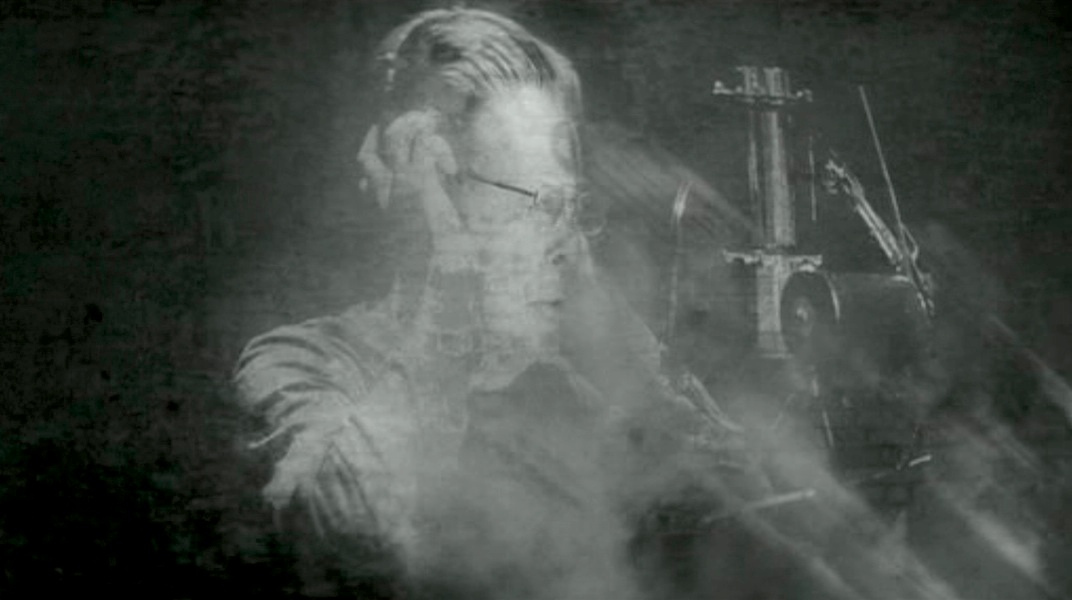
Bowie as a projected image in the video for Sue (Or in a Season of Crime)
“If you feel safe in the area that you’re working in, you’re not working in the right area. Always go a little further into the water than you feel capable of. Go a little bit out of your depth and when you don’t feel that your feet are quite touching the bottom, you’re just about in the right place to do something exciting” – David Bowie
◼ THE MOST GRIPPING SEQUENCES in the new TV documentary about Bowie’s final surge of creativity are those which assemble every musician in the bands he worked with from 2012 to the end. Each band re-enacts pivotal moments when they rehearsed the music, inspired by his lyrics, and laid down the tracks for the albums The Next Day and Blackstar. Particularly revealing is the session when pure jazz soloists created the nerve-tingling Sue (Or in a Season of Crime), which Bowie added to his 2014 “best-of” collection, Nothing Has Changed.
To mark the first anniversary of the star’s death, this weekend BBC2 screened David Bowie: The Last Five Years, Francis Whately’s sequel to his other superb documentary Five Years broadcast in 2013. The role of jazz in Bowie’s musical temperament seldom gets discussed, though his producer Tony Visconti says the jazz influence had always been there in the music but underneath the surface. As a small child Bowie heard a jazz band and right away said: “I’m going to learn the saxophone. When I grow up, I’m going to play in [this] band. So I persuaded my dad to get me a kind of a plastic saxophone on hire purchase.”
In 2013 in New York he met Maria Schneider, a jazz composer, handed her a demo disc and asked her to extemporise around a tune called Sue. In turn, she told him he had to listen to this sax player Donny McCaslin and without missing a beat Bowie went straight into the studio with his group and Maria and out came possibly the purest jazz number of his career, a discomfiting tale of infidelity. It won Schneider a Best Arrangement Grammy in 2016.
Donny McCaslin enthuses about Bowie during rehearsals
Maria Schneider’s proposed scoring for Sue
REVIEWS OF THE LAST FIVE YEARS TV DOC
➢ A thrilling portrait of a late-life renaissance
– Jasper Rees at the Arts Desk “ The opening yielded much joyful footage of Bowie goofing around on the Reality tour (2003), seeming much more like one of the boys than he ever managed with Tin Machine. The band still seemed spooked at the memory of his collapse, before he was carted off to retirement in an ambulance.
Maria Schneider was one of many musicians – three complete bands – who re-formed to walk through the creation of the music. Drummer Zachary Alford still looked shocked at the NDA handed him as he showed up to work on The Next Day. “If I said anything about it,” remembered bassist Gail Ann Dorsey, “I would be in big trouble legally.” Nobody was asked if Bowie really would have sued his collaborators for spilling the beans.
The recent collaborators reflected on the extent to which the new music was steeped in the past. But there was also good stuff from the old lags who worked (and sometimes slept) with Bowie in the feather-cut era: Ideally there would be a DVD with extras featuring much more from each of them. Chief keeper of the flame Tony Visconti sat at a console and played excerpts of Bowie’s unaccompanied vocal takes. On Blackstar came the haunting sound of Bowie wheezing like an ancient mariner fighting for every last scrap of breath. . . ” / Continued online
➢ A treat and a treatise on music’s departed genius
– by James Hall, Daily Telegraph “ The Last Five Years wove previously unheard Bowie interview material with on-screen contributions from collaborators including producer Tony Visconti. The access and insights were faultless. Whately’s programme was essentially a treatise on artistic rebirth. And it showed that although Bowie’s musical style constantly changed, the themes that preoccupied him — alienation, escape, the notion of fame — were there until the end.
During his final creative burst, Bowie gradually revealed to collaborators that he was ill. In the most poignant scene, we learned that Bowie only discovered his cancer was terminal three months before he died. This was in October 2015 when he was filming the video for Lazarus, in which he sings the line “Look up here, I’m in heaven”. Bowie worked and cared and joked until the end. Through tears, Visconti said that he was at ‘the top of his game’. . . ” / Continued online
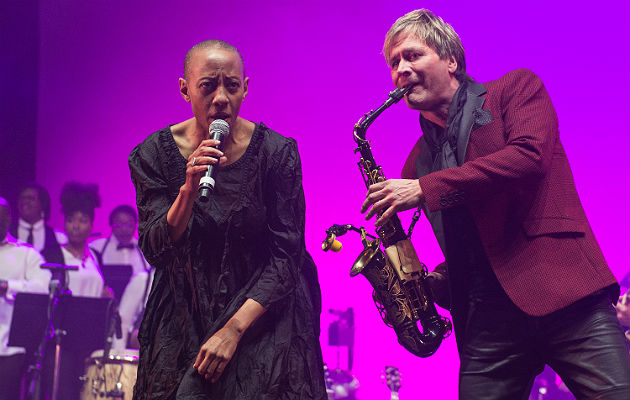
Brixton tribute concert for Bowie: Gail Ann Dorsey singing Young Americans with Spandau Ballet’s Steve Norman. (Photo: Getty)
❏ On what would have been Bowie’s 70th birthday his friend the actor Gary Oldman gathered at the Brixton Academy a 30-strong all-star lineup of musicians who had collaborated throughout his career, with some glorious orchestral and choral support. The show is the first in a run of gigs around the world taking place in cities that have a strong connection with Bowie and his work.
The London concert featured Mike Garson, Earl Slick, Adrian Belew, Mark Plati, Gerry Leonard, Sterling Campbell, Zachary Alford, Holly Palmer, Catherine Russell, plus such guests as Tony Hadley and Simon Lebon. Special highlights saw Gail Ann Dorsey singing Young Americans with Spandau’s Steve Norman on sax; and an audience singalong to Life on Mars? led by Adrian Belew and gifted vocals from Tom Chaplin from the band Keane. Plenty of live videos at YouTube.
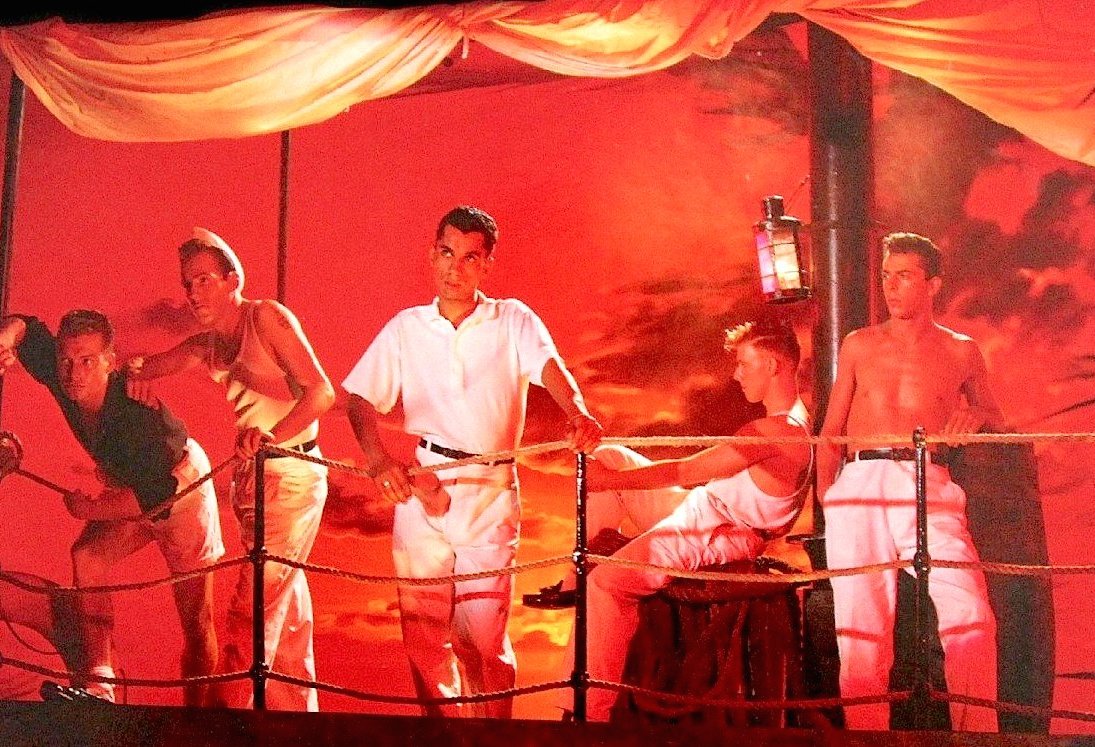
Cool-hunters 1985: the Animal Nightlife lineup who charted with their album Shangri-la. . . Billy Chapman, Paul Waller, Andy Polaris, Leonardo Chignoli and Steve Brown
❚ REMEMBER SNAKE-HIPPED ANDY POLARIS, frontman for Animal Nightlife, the soul/jazz/pop socialist collective who emerged from London’s cool clubbing scene and charted with Native Boy in 1983? This week their debut album Shangri-la is re-issued in a deluxe two-CD edition, having charted in summer 1985 only on vinyl.
Andy says: “It comes with a bonus disc of remixes and a great booklet with retro photos of the band in its two phases. Just in time for Christmas. The vinyl album has long been deleted and since then a very poor compilation of songs was released. The re-issue’s tracks consist of the album in its original form and a second CD containing other singles and extended remixes that were only available on 12-inch before.” Lois Wilson supplies some nicely informed sleeve notes identifying Animal Nightlife’s role as innovators when the UK’s thriving underground changed the face of nightclubbing.
“Just listen to the Pink Panther style
saxophone of instrumental Basic Ingredients
and try not to lose yourself momentarily
in another world, a better world even”
– First review (7/10) by Loz Etheridge
Managed by Steve Lewis, London’s coolest club deejay in the Beat Route’s heyday, Nightlife’s swing sound with an electronic twist enjoyed its moment as the hippest trend in music while Polaris penned his own brand of torch song and the band wore head-to-foot styles from Bolshevik bolshieness to Johnson’s jazz-age retro. Rabid clubbers must remember how Nightlife’s crazy animalettes and animalads went through about 35 line-up changes during their eight years on the scene, sadly scoring only four chart singles. For some band members, good times tended to take precedence over naked ambition in those highly competitive years when British acts were storming international pop charts.
“The must have re-issue CD of 2016.
A perfect Xmas stocking filler”
– deejay Mark Moore
By 1985 the band had slimmed down to the five-piece pictured on the CD cover. They consisted of Andy Polaris (vocals), Leonardo Chignoli (bass), Paul Waller (drums), Steve Brown (guitar) and Billy Chapman (playing a thrilling saxophone). After switching from the finger-snappy Innervision label to supercool Island Records, they were all packed off to Philadelphia where the first album was recorded at the legendary home of Philly World Records.
“The label wanted a bit more discipline from us,” Andy says, “and they sent us to America to get us out of our element and into the hands of those seasoned veterans who’d created the fabled Philly sound. We five working-class boys from London were wide-eyed and just did everything they told us. It paid off, because after our sojourn at Philly World our urban jazzy feel translated into a more sophisticated British club sound.”
❑ Standout trackon the second Shangri-la CD of lost mixes is reggae producer Dennis Bovell’s version of Native Boy. Whoever’s on vibes – “mm, nice”.
➢ Choose “View full site” – then in the blue bar atop your mobile page, click the three horizontal lines linking to many blue themed pages with background article
MORE INTERESTING THAN MOST PEOPLE’S FANTASIES — THE SWINGING EIGHTIES 1978-1984
They didn’t call themselves New Romantics, or the Blitz Kids – but other people did.
“I’d find people at the Blitz who were possible only in my imagination. But they were real” — Stephen Jones, hatmaker, 1983. (Illustration courtesy Iain R Webb, 1983)
“The truth about those Blitz club people was more interesting than most people’s fantasies” — Steve Dagger, pop group manager, 1983
PRAISE INDEED!
“See David Johnson’s fabulously detailed website Shapers of the 80s to which I am hugely indebted” – Political historian Dominic Sandbrook, in his book Who Dares Wins, 2019
“The (velvet) goldmine that is Shapers of the 80s” – Verdict of Chris O’Leary, respected author and blogger who analyses Bowie song by song at Pushing Ahead of the Dame
“The rather brilliant Shapers of the 80s website” – Dylan Jones in his Sweet Dreams paperback, 2021
A UNIQUE HISTORY
➢ WELCOME to the Swinging 80s ➢ THE BLOG POSTS on this front page report topical updates ➢ ROLL OVER THE MENU at page top to go deeper into the past ➢ FOR NEWS & MONTH BY MONTH SEARCH scroll down this sidebar
❏ Header artwork by Kat Starchild shows Blitz Kids Darla Jane Gilroy, Elise Brazier, Judi Frankland and Steve Strange, with David Bowie at centre in his 1980 video for Ashes to Ashes
VINCENT ON AIR 2026
✱ Deejay legend Robbie Vincent has returned to JazzFM on Sundays 1-3pm… Catch up on Robbie’s JazzFM August Bank Holiday 2020 session thanks to AhhhhhSoul with four hours of “nothing but essential rhythms of soul, jazz and funk”.
TOLD FOR THE FIRST TIME
◆ Who was who in Spandau’s break-out year of 1980? The Invisible Hand of Shapersofthe80s draws a selective timeline for The unprecedented rise and rise of Spandau Ballet –– Turn to our inside page
SEARCH our 925 posts or ZOOM DOWN TO THE ARCHIVE INDEX
UNTOLD BLITZ STORIES
✱ If you thought there was no more to know about the birth of Blitz culture in 1980 then get your hands on a sensational book by an obsessive music fan called David Barrat. It is gripping, original and epic – a spooky tale of coincidence and parallel lives as mind-tingling as a Sherlock Holmes yarn. Titled both New Romantics Who Never Were and The Untold Story of Spandau Ballet! Sample this initial taster here at Shapers of the 80s
CHEWING THE FAT
✱ Jawing at Soho Radio on the 80s clubland revolution (from 32 mins) and on art (@55 mins) is probably the most influential shaper of the 80s, former Wag-club director Chris Sullivan (pictured) with editor of this website David Johnson
LANDMARK FAREWELLS. . . HIT THE INDEX TAB UP TOP FOR EVERYTHING ELSE










 ➢➢ Shapers of the 80s ➣➣