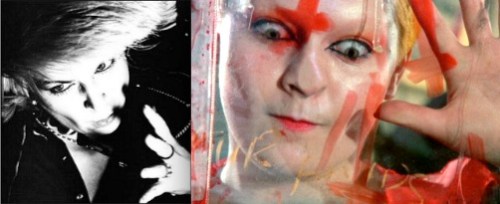
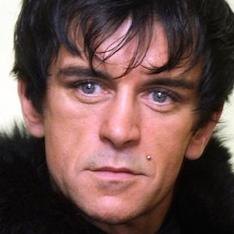
+++ ❚ AS TOYAH’S 30th ANNIVERSARY TOUR, From Sheep Farming To Anthem, comes to an end in London on Saturday after months on the road, let’s compare and contrast the manic bouncing Toyah from the Rainbow Theatre in 1981 (above) with the smiling mumsy Toyah 22 studio albums and a stage career later (having happily admitted to having had a facelift in 2008). Earlier this summer she seemed genuinely affected by the welcome War Boys received 30 years on (video below) … The hour-long Rainbow video is a brilliant reminder of what a force Toyah was in the singles charts of 1981 when her second album Anthem also went platinum — by year’s end she won the Smash Hits Reader’s Poll as both Best Female Singer and Most Fanciable Female. In 1982 she was voted the Best Female Singer at the Brits.
All of which had become a curious adventure following her lucky break aged 18 and fresh from drama school in Birmingham. In 1977 Toyah was cast in the role of Emma in Tales from the Vienna Woods at the National Theatre. The role required her to front a band they called Toyah wearing orange hair, and the rest is history. OK, a couple of edgy parts in Jubilee (video clip with Adam) and Quadrophenia helped too.
Toyah’s lucky year, 1977: playing Emma in Tales from the Vienna Woods, and a shaven-headed punkette in Derek Jarman’s film Jubilee
❏ Back in the present, Toyah can take only a short rest, however, before she’s back onstage, yeahhh! In panto, yeahhh! As the Wicked Queen in Snow White, boooo! Toyah says: “It’s a gift as an actress to play a baddie because you can be really nice and noone believes you, and you can be plain bad and noone loves you.” Panto comes to us all, darlings. Even Cliff Richard. Eventually.
❚ ONLY ABOUT 400 “LOOKERS-IN” were able to view the world’s first scheduled television service in high-definition (240+ lines) at 3pm on November 2, 1936. The engineers wore white dust-coats and the star wore a cocktail dress. With immaculate middle-class enunciation, she sang a song full of amazement at the newest technology of its day:
♫ A mighty maze of mystic, magic rays Is all about us in the blu-u-u-u-e, And in sight and sound they trace Living pictures out of space To bring our new wonder to you-u-u-u-u ♫
Everyone knew the musical comedy star Adele Dixon, though not yet the BBC Television Orchestra conducted by Hyam Greenbaum, also glimpsed in the clip above. The opening show was called Variety, and the song was called simply Television — known universally today as The Television Song. It had been specially written for the occasion, with lyrics by James Dyrenforth and music by Kenneth Leslie-Smith. Its innocence still wows us for six.
The broadcast was being beamed from what became a landmark transmitter tower atop customised studios 350ft over North London at Alexandra Palace, the original “people’s palace of entertainment”. Two different black-and-white television systems were being tested in quick succession on that first afternoon, and then on alternate weeks for six months: in the 70 x 30 feet Studio A the Marconi-EMI 405-line electronic system; and in Studio B, John Logie Baird’s 240-line mechanical system.
Baird the tenacious Scot is usually claimed to be the inventor of television and between 1923–1925 he demonstrated his clunky apparatus with a spiral of revolving lenses in the Soho building which became Bianchi’s restaurant soon after, refurbished today as Little Italy. The Times reported in 1926: “The image was often blurred. But it substantiated a claim that it is possible to transmit and reproduce instantly such things as the play of expression on the human face.”
Baird’s televisor in Frith Street, 1925: before transmission, the received image at left has been scanned by a spiral of revolving lenses, shown at right with inventor Logie Baird. Photo: Hulton/Getty
The flaw lay in Baird’s underlying technology being mechanical. In the end, Marconi’s electronic rival proved to be the future and it endured until the 1960s. Cecil Madden, the BBC’s fledgling TV Programme Organiser, says the differences were all too apparent: “Working in the Baird studio was a bit like using Morse code when you knew that next door you could telephone.”
A kick-start to the novice TV industry had come two months earlier. At very short notice the rival systems had been demonstrated at Radiolympia, the annual exhibition mounted by the Radio Manufacturers’ Association. The radio industry couldn’t sell the stands for the 1936 show (Aug 24-Sep 3) and a desperate call for help went out: could television save the day? (All the more desperate considering that TV sets in 1936 cost a princely £150, which is equivalent to £8,300 in today’s money.) Given only nine days’ warning, Cecil Madden appointed himself producer of its first broadcast.
❏ On August 26 at 11:45 a piece of Duke Ellington was heard, accompanied by a caption card reading, BBC Demonstration to Radiolympia by the Baird System, transmitted from its tiny one-camera studio. This was followed by another ten minutes of music. The highlight of the demonstration was to be a variety show someone had the bright idea of calling Here’s Looking At You, featuring a song with the same title by Ronnie Hill, performed by Helen McKay.
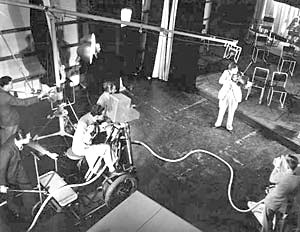
Alexandra Palace: Studio A with an Emitron camera
It was not until the next day, when everything was repeated using the Marconi-EMI system, that the show was seen in its full glory: with three cameras, two mobile and one fixed. This was the version filmed by British Movietone news cameras and featured above. “Hello Radiolympia,” said announcer Leslie Mitchell, standing in front of the first set of curtains. “Ladies and gentlemen, Here’s Looking at You.” And Miss McKay sang:
♫ Here’s looking at you From out of the blue Don’t make a fuss Just settle down and look at us ♫
The 30-minute show that followed went out twice a day. Cecil Madden says: “It’s still unique because noone has ever done 20 programmes live, twice a day for ten days, from Alexandra Palace to the radio show at Olympia.”
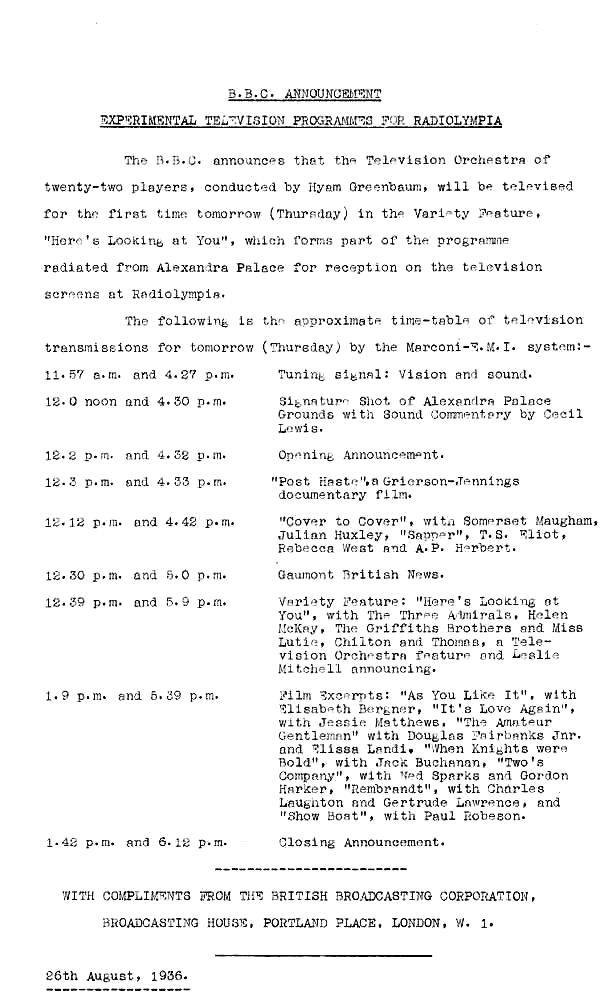
The BBC’s twice-daily running order for Radiolympia 1936. Click for the full document where eagle eyes will note readings by T S Eliot, Aldous Huxley and Rebecca West, and film appearances by Charles Laughton, Gertrude Lawrence and Paul Robeson. Source: Terra Media
The programme was received as far away as Bournemouth and Nottingham, and the Marconi-EMI team, with their mobile camera, were able to include some exterior shots from Ally Pally. All of which resulted in the official inauguration of the BBC Television Service being brought forward to early November. Regular programmes were broadcast twice a day from 3pm to 4pm and from 9pm to 10pm, except on Sundays. One of the early fears was that television would cause eye strain — even after only two hours a day.
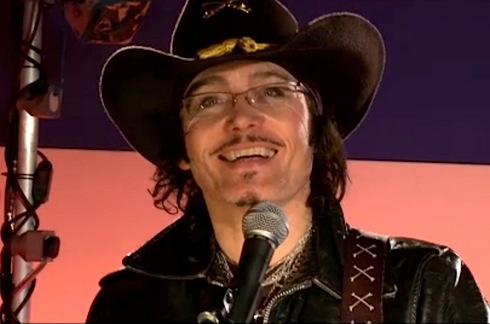
➢ Click picture to run video in new window — Today at Guardian online Adam Ant gives a video interview in the strand: How I wrote … Stand and Deliver, his chart-topping hit from May 1981. When he starts strumming the tune, why not try cueing up the video below by Marco Pirroni, his onetime lead guitarist in the Ants and songwriting partner, then compare the results? Adam and Marco shared an Ivor Novello Award for this number
❏ Adam explains the song’s mix of images… “I very much like the 18th century, and the traditional sayings that everyone knows like ‘Stand and deliver’ and ‘Drop your drawers and ten bob’s yours’.” Adam says he wove together various other themes in the song: a touch of Tommy Steele’s Where’s Jack? based loosely on DickTurpin, plus Native American Indians and a bit of piracy. Result: “The lyric wrote itself. It was really a manifesto of what was to come… I knew I’d cracked it when the window cleaner round my house was singing it and changing the lyrics and didn’t know it was my flat… I was very flattered by that.”
❏ As Adam’s songwriting partner in the Ants, Marco co-wrote five number-one singles, a further four top tens with him, their two number-one albums, plus many more songs during 20 years together. When Marcella Puppini asked about his songwriting with Adam, Marco said: “I don’t think it’s something I really want to talk about at the present time.” Of his input into the music, he said: “I don’t write lyrics generally. I work with riffs and you keep playing. You have a moment when you think I really like playing this and the person you’re working goes: ‘It’s really good’. There are no rules. John Lennon’s tragic death kept us off No 1 [in Dec 1980], then I remember doing Stand and Deliver and thinking that’s going to happen. We weren’t going to be No 1 with just anything. I thought that’s catchy, that’s going to work.”
THE ANTS Mk3 ‘WON’T INCLUDE MARCO’
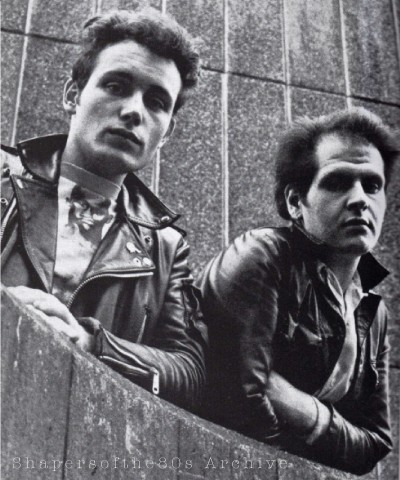
Early 80s: Adam and Marco in happier days
➢ Adam Ant: back from the brink— in today’s Daily Telegraph Andrew Perry listens to Adam like a respectful fan while interviewing Stuart Goddard with the care of a concerned parent…
“ After numerous tribulations, he’s to make a dramatic comeback to music next month, with his first full tour in more than 15 years. A couple of years ago, Goddard gradually withdrew from antidepressants, and the songwriting came back… He’s recorded a double album, which he plans to release himself in January 2012, entitled ‘Adam Ant is the Blueblack Hussar in: Marrying the Gunner’s Daughter’.
Goddard, now 56… talks of fronting an association for misdiagnosed bipolar sufferers, and of an album he’s writing for a third version of Adam and the Ants, which won’t include Pirroni. (“He did something to me which I won’t forgive him for. I’ll never go on stage with him again in my life.”) It’s equally difficult not to worry that all this hare-brained scheming is merely a manifestation of the old “manic” self. Now he’s off the medication, can he cope with those desperate mood swings? … He says: “You’ve got to be crazy to be a rock-and-roll singer”. ”
➢ Tour dates for Adam Ant & the Good, the Mad and the Lovely Posse — 25 stages in a stately, historic progress from Nov 10 at the 850-capacity Cheese & Grain (the 19th-century Market Hall) in Frome, Somerset… to Jan 22 at the 900-capacity former Art Deco cinema, “The Tiv” nightclub in Buckley (once famed for its brickmaking), Flintshire… while taking in on Nov 20 the 2,661-capacity Grade II listed Troxy (view online the virtual tour of this fabulously renovated Art Deco cinema, designed by George Coles) in East London… Somebody has been thinking about these things.
‘ZIGGY PAVED THE WAY FOR JOHNNY ROTTEN’
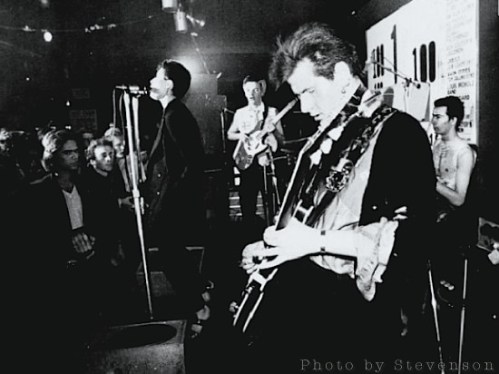
Siouxsie and the Banshees debut at the 100 Club punk festival, 1976: with Steven Severin, Marco Pirroni and John Ritchie (later Sid Vicious) on drums. Photograph by Ray Stevenson
❏ A lynchpin of the UK punk scene, Marco Pirroni became an integral part of Adam and the Ants in 1980 as lead guitarist and co-songwriter, until they went their own ways 20 years later. Today he is a songwriter, producer and guitarist in a rock-and-roll garage band called The Wolfmen, along with another ex-Ant, Chris Constantinou, making a sound described by Mojo magazine as “exuberant filth — Chris and Marco do growing old disgracefully with style”.
“ Q: So it would have been stuff like Roxy Music that inspired you to play guitar?
A: Yeah, Roxy and Mick Ronson. Aladdin Sane made me want to play. Q: How important would you say glam-rock was to the advent of punk?
A: It was really really important. The glam thing laid the ground rules and maybe the foundations. I know there are lots of punk fans out there that say it’s nothing to do with it, but you can see direct parallels between Ziggy Stardust and Johnny Rotten. ”
❚ MELBOURNE’S DEEPLY GEEKY Bedroom Philosopher, noted for his ode to absurdity, I’m So Post Modern, famously rode the No 86 tram last year in the video (above) for his cross-over hit single Northcote (So Hungover). Why? Melbourne boasts the world’s largest tramway system (249 km) and within that, Route 86 is not only the busiest but universally regarded as THE hippest in the universe. Because it connects RMIT University campus to Waterfront City, it carries All Human Life.
The Bedroom Philosopher has graduated from broadcasting with JJJ’s Morning Show to the crucial role blogging as one of Australia’s spokesmen for confused youth. His third studio album, Songs From The 86 Tram, recorded with his dynamic backing band The Awkwardstra, was nominated for an ARIA award. The album drew on the multi-award winning show of the same name (Directors Choice, Melbourne International Comedy Festival 2009), which showcased the BP’s “astonishing range as an impersonator of suburban characters with depth and empathy, all backed with lively, genre-hopping soundtracks – think Chris Lilley meets Beck” (his own words).
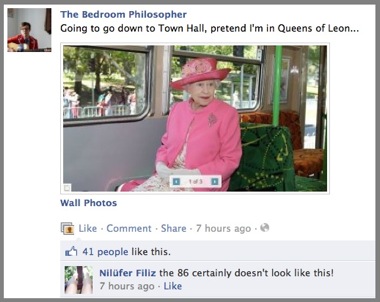
Facebook earlier today
The video for its single Northcote is directed by Craig Melville (Chaser, John Safran) and featuring cameos by rock royalty Tim Rogers, Kram and Angie Hart. It has won more awards than we have time to count.
And yet the Lord Mayor still put Her Majesty QE2 on the wrong tram during her 16th state visit to Australia this week. The video below, specially commissioned by Shapersofthe80s, seeks to redress this diplomatic howler.
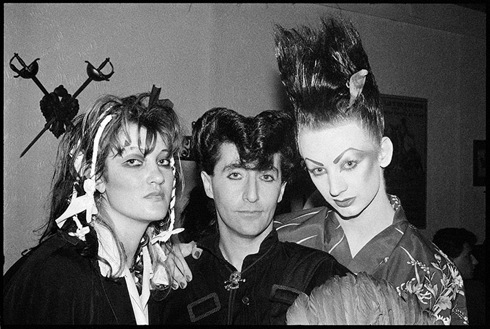
1980: Clare Thom, Philip Sallon and George O’Dowd on a coach trip to Margate. Photograph by Graham Smith/grsmith@mac.com.jpg from his book We Can Be Heroes
WE CAN BE HEROES
must be funded by November 12 17 [update]
❚ NOBODY IS BETTER QUALIFIED to chronicle the whirlwind six years between punk and the death of the New Romantics than Graham Smith through his eye-witness photography, and the writer Chris Sullivan, one of the core movers-and-shapers of his generation. UK music and style evolved out of all recognition in a mighty resurgence of youth subcultures that directly triggered a rejuvenation of mainstream media for the rest of the decade. Shapersofthe80s was on hand as an observer. But these two wags were in the thick of the action — major players in a spontaneous youthful collaboration to regenerate the UK’s ailing music and style scenes as 1980 dawned. With contributions by a galaxy of stars, who include Gary Kemp and Boy George, this will become the definitive story of one of the great explosions of creativity in British youth culture.
The authors aim to get their large-format 320-page coffee-table photobook We Can Be Heroes to you in time for Christmas. Their “crowd-funding” venture requires them to raise the cash first by asking YOU to buy your copy in advance, before 6pm GMT on November 12 17. Your reward is to see your name printed as a Supporter in the limited first edition. The clock is ticking.
View Graham’s video today at Unbound Publishing, a new company under the patronage of Faber, the most prestigious publisher in Britain. Here you can purchase your book and enjoy other perks such as an invitation to the launch party. Join the clubbers at Facebook who are submitting their own photos and tales of merriment.
READ WHAT HAS ALREADY BEEN SAID
ABOUT WE CAN BE HEROES
+++
➢ Unbound aims for 40 books in year one … Supported by Faber, the platform was created by QI writers John Mitchinson and John Pollard, and Crap Towns author Dan Kieran — The Bookseller
➢ Funded by the people — Channel 4 News video on “crowdfunding”, the process that decides when and how Graham’s book gets published
➢ Choose “View full site” – then in the blue bar atop your mobile page, click the three horizontal lines linking to many blue themed pages with background article
MORE INTERESTING THAN MOST PEOPLE’S FANTASIES — THE SWINGING EIGHTIES 1978-1984
They didn’t call themselves New Romantics, or the Blitz Kids – but other people did.
“I’d find people at the Blitz who were possible only in my imagination. But they were real” — Stephen Jones, hatmaker, 1983. (Illustration courtesy Iain R Webb, 1983)
“The truth about those Blitz club people was more interesting than most people’s fantasies” — Steve Dagger, pop group manager, 1983
PRAISE INDEED!
“See David Johnson’s fabulously detailed website Shapers of the 80s to which I am hugely indebted” – Political historian Dominic Sandbrook, in his book Who Dares Wins, 2019
“The (velvet) goldmine that is Shapers of the 80s” – Verdict of Chris O’Leary, respected author and blogger who analyses Bowie song by song at Pushing Ahead of the Dame
“The rather brilliant Shapers of the 80s website” – Dylan Jones in his Sweet Dreams paperback, 2021
A UNIQUE HISTORY
➢ WELCOME to the Swinging 80s ➢ THE BLOG POSTS on this front page report topical updates ➢ ROLL OVER THE MENU at page top to go deeper into the past ➢ FOR NEWS & MONTH BY MONTH SEARCH scroll down this sidebar
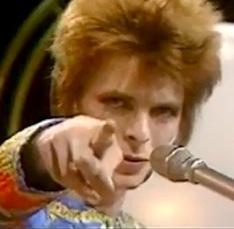
❏ Header artwork by Kat Starchild shows Blitz Kids Darla Jane Gilroy, Elise Brazier, Judi Frankland and Steve Strange, with David Bowie at centre in his 1980 video for Ashes to Ashes
VINCENT ON AIR 2026
✱ Deejay legend Robbie Vincent has returned to JazzFM on Sundays 1-3pm… Catch up on Robbie’s JazzFM August Bank Holiday 2020 session thanks to AhhhhhSoul with four hours of “nothing but essential rhythms of soul, jazz and funk”.
TOLD FOR THE FIRST TIME
◆ Who was who in Spandau’s break-out year of 1980? The Invisible Hand of Shapersofthe80s draws a selective timeline for The unprecedented rise and rise of Spandau Ballet –– Turn to our inside page
SEARCH our 925 posts or ZOOM DOWN TO THE ARCHIVE INDEX
UNTOLD BLITZ STORIES
✱ If you thought there was no more to know about the birth of Blitz culture in 1980 then get your hands on a sensational book by an obsessive music fan called David Barrat. It is gripping, original and epic – a spooky tale of coincidence and parallel lives as mind-tingling as a Sherlock Holmes yarn. Titled both New Romantics Who Never Were and The Untold Story of Spandau Ballet! Sample this initial taster here at Shapers of the 80s
CHEWING THE FAT
✱ Jawing at Soho Radio on the 80s clubland revolution (from 32 mins) and on art (@55 mins) is probably the most influential shaper of the 80s, former Wag-club director Chris Sullivan (pictured) with editor of this website David Johnson
LANDMARK FAREWELLS. . . HIT THE INDEX TAB UP TOP FOR EVERYTHING ELSE







 ➢➢ Shapers of the 80s ➣➣