Tag Archives: Tributes

2010 ➤ Duffy, the man who shot Aladdin Sane

❚ BRIAN DUFFY, THE PHOTOGRAPHER who helped to capture the spirit of the Swinging 60s, has died. Among the many showbiz stars he shot was David Bowie, and if any images deserve to be called iconic, these do. Known to friends and colleagues by his surname alone, Duffy was a rival of David Bailey and Terence Donovan throughout the 1960s. Film producer Lord Puttnam said Duffy helped push the stultifying conservatism of the 1950s into permanent retreat. Duffy is also famed for once burning part of his work in a bin in 1979.

➢➢ Read the full BBC News report
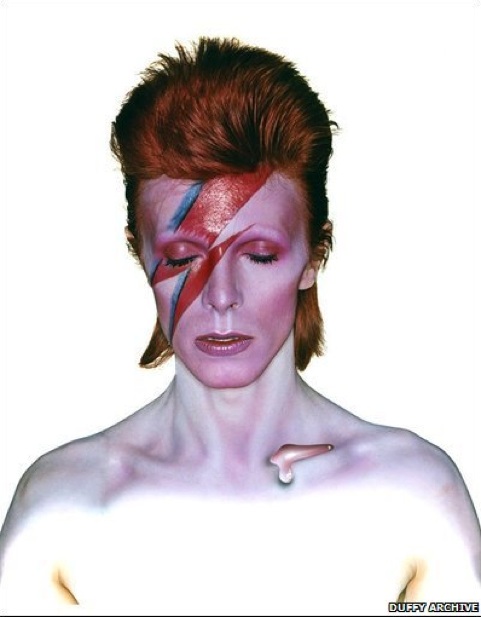
David Bowie, Aladdin Sane, Brian Duffy

Duffy shot three album covers for Bowie, here Aladdin Sane, 1973, artfully created long before Photoshop had been invented. © The Duffy Archive Limited

Vogue, Brian Duffy, photographer

In May 2003, Vogue magazine paid tribute to Bowie by dressing up Kate Moss in some of his original costumes. A nod to the 1973 Duffy photo graced its cover, which Vogue’s editor Alexandra Shulman said was his favourite cover of all time (see Iconic Photos, below). Right, the photographer Duffy at his lightbox
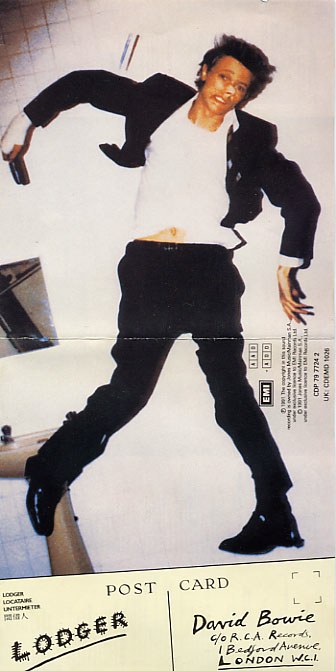
David Bowie, Lodger, Brian Duffy, Derek Boshier

Bowie’s Lodger album, 1979, photograph © The Duffy Archive Limited. Artist Derek Boshier wrote: “The cover for Lodger was a collaboration between David, the photographer Duffy, and myself. I loved the resolution to the problem of David being photographed falling. Shooting him from above, on a specially made table built to match the falling form. The table was designed to be completely obscured by David’s body”

Brian Duffy, David Bowie, Scary Monsters

Duffy’s shoot for Bowie’s Scary Monsters album, 1980 © The Duffy Archive Limited
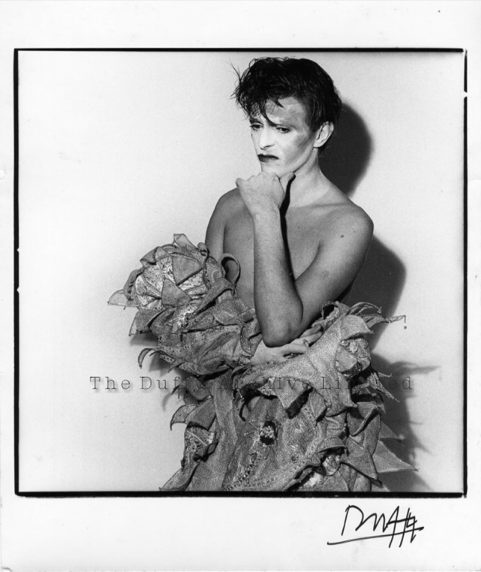
David Bowie, Brian Duffy

Bowie by Duffy, 1980: not chosen for Scary Monsters and published only once, in a blog last September. © The Duffy Archive Limited

➢➢ Sara Wiseman, Duffy’s archive assistant, wrote last September in her blog:

“Whereas Duffy’s more iconic images such as his Aladdin Sane cover, have been retouched, consciously selected and then admired by many to achieve such status, I love the fact that this one [shot but not chosen for Scary Monsters and never before been published] was forgotten for thirty years and for that reason I loved discovering it. I could perhaps align the thrill to that of finding buried treasure. There is something about Bowie’s unperfected facial expression that gets me every time. In a way I find the photograph to be extremely revealing in that it humanizes Bowie. This scornful look which, was not included in his contrived and manufactured public image, lowers him from the elevated, almost superhuman level of the pop/rock star. What we have before us here, is a man in a ridiculous costume looking pretty indifferent.

“I asked Duffy what his thoughts on the photograph were: ‘You like it? Yes me too. You may have noticed that in many of my male portraits my subjects look as if they’re on the verge of smacking me … ha! (Duffy acquired a reputation, of which he is proud, for being a bit of an anarchist.) That was my technique, I would say something to rile them or wind them up. It won me some great photographs – full of genuine male aggression. You may also notice that the same can not be said for my female portraits!’ ”

☐ ☐ ☐


➢➢ Visit Duffy’s website

➢➢ Surviving contact sheets from the Aladdin Sane session
➢➢ Famous, Infamous and Iconic Photos
➢➢ Derek Boshier Art

THE TRIBUTES

➢➢ Fearlessly innovative photographer who in countless striking images helped to define the mood and style of the Swinging Sixties – The Times, June 5, 2010
❏ Duffy, Bailey and Donovan invented a new documentary style of fashion photography, and fed off each other’s creativity. Duffy produced a body of work that spanned everything from portraits and reportage to advertising — he was one of the few photographers to have shot two Pirelli calendars, and successfully undertook campaigns for brands including Smirnoff, Aquascutum and Benson & Hedges, for whom he created a series of surreal advertisements in 1977.

➢➢ Central figure in the visual revolution that echoed the wider changes in British society during the 1960s – The Daily Telegraph, June 6, 2010
❏ With David Bailey and Terence Donovan, he formed what was dubbed the “Black Trinity” by Norman Parkinson, the photographer whose pastoral style seemed to embody all that the young trio wanted to challenge. If Bailey was the most creative of them, and Donovan the most amusing, the art school-trained Duffy was the most provocative and intellectual. “Before 1960 the fashion photographer was tall, thin and camp,” he reflected. “But we three were different: short, fat and heterosexual.”

➢➢ One of the “terrible trio” with David Bailey and Terence Donovan who broke the mould of fashion photography – The Guardian, June 6, 2010
❏ The three men became far more famous than many of the models with whom they worked, and were – for a while – bigger than the glossy magazines that published their pictures. The photographer Norman Parkinson called Duffy, Bailey and Donovan the “black trinity”. There was some merit in the label. The cravat-wearing old guard felt threatened by these freewheeling young men in leather jackets, who took their models on to the streets and snapped them with newfangled, small 35mm cameras.

➢➢ Brian Duffy: The Man Who Shot The 60s by George’s Journal

FRONT PAGE

2010 ➤ Spider-woman Bourgeois created her art as meditations on sexuality

◼ LOUISE BOURGEOIS, THE FRENCH-BORN SCULPTOR, who lived in a 15-foot-wide town house on West 20th Street, Manhattan, died today at the age of 98 following a heart attack. She was largely unknown until 1982, aged 71, when she became the first woman to have a retrospective at the Museum of Modern Art. Time art critic Robert Hughes has called her “the mother of American feminist identity art” and declared that “[Louise’s] influence on young artists has been enormous”.

Raimon Ramis, sculpture, Louise Bourgeois

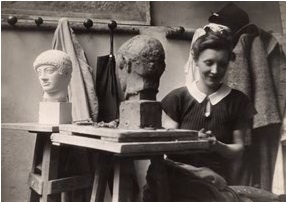
Louise Bourgeois in 1990, behind her marble sculpture Eye to Eye (1970). Photographed © by Raimon Ramis

On the occasion of her 1982 retrospective, Bourgeois published a photo essay in Artforum magazine that revealed the impact of childhood trauma on her art. “Everything I do,” she exclaimed, “was inspired by my early life.” Born in 1911, Bourgeois grew up in provincial France, and aged eleven, she witnessed her father’s betrayal of his wife and three children when he initiated a ten-year affair with their live-in English tutor. Bourgeois also attended to her mother, who had succumbed to the Spanish Flu after the First World War.

Louise Bourgeois, Brassai, 1937

Bourgeois photographed by Brassaï in Paris, 1937, where she studied under Fernand Léger. (Louise Bourgeois Archive)

This familial triangle of sexual infidelity and illness cast the young artist in the most inappropriate of roles — as voyeur, accomplice, and nurturer — the combination of which left her with life-long psychological scars, including insomnia. Bourgeois’s diaries, which she has kept assiduously since 1923, indicate the tensions between rage, fear of abandonment, and guilt that she has suffered since childhood. It is through her art, however, that she has been able to channel and release these tensions.

Many of her works are today instantly recognisable, especially the giant spiders created for the opening of Tate Modern in London in 2000. Only last month she shared the following thoughts with Jonathan Jones for The Guardian on the 10th anniversary of that commission…

From The Guardian, Tuesday May 4, 2010:
“ Bourgeois no longer gives interviews, so the fact she’s even speaking to me proves how much the first Turbine Hall commission meant to her. The twisted steel legs of her giant spider Maman, alongside a sequence of fabulous, hellish towers, gave the brand-new Tate Modern an instant visual signature, and made the then 89-year-old French-born New York artist a household name. Until then, Bourgeois had been revered by a small world of contemporary art fans; did this sudden popularity surprise her? “No,” she says modestly. “The space is so beautiful – anything placed inside it would cause a strong reaction.”

Louise Bourgeois, sculpture, Spider, Maman

Bourgeois’s sculptures: Maman in the turbine hall at Tate Modern in 2000, photographed by Ray Tang. Spider and Maman in the Large Courtyard of the Winter Palace, St Petersburg, 2001

As an artist, Bourgeois dwells on the strange and darkly remembered interiors of her childhood; the intensity of her meditations on sexuality and power easily filled the colossal space. Maman turned the surrealist obsession with the male psyche on its head, creating a haunting image of motherhood — a spider carrying her eggs.

Before this, Bourgeois says, “I made a series of small sculptures with mirrors and chairs. They were about looking and being looked at. To continue these concepts on a large scale was an opportunity I could not pass up.” What mattered to her most about this installation was the audience’s engagement with it. Her towers were designed to be ascended, paving the way for subsequent participatory installations. “The towers were meant to be an experience. If you did not experience all three towers in sequence, then you did not get the piece.”

Did Maman affect future work? She says not, beyond the opportunities afforded by scale. As she points out, her work is relatively immune to outside influences: “It has an internal logic all its own”.

➢ “Need for nurture in a frightening world” – The New York Times obituary
➢ “Known for her primitive, female forms” – The Guardian obituary
➢ “A tension between quintessentially male and female forms” – All you need to know about Louise Bourgeois at Artsy, the website with a mission to make all art accessible

FRONT PAGE

2010 ➤ Rich Kid Steve New (aka Stella Nova) dies at 50

❚ Ex-RICH KIDS GUITARS/VOCALIST MIDGE URE:

“Another one of the good ones gone. My thoughts are with Steve’s family and close friends”

❚ Ex-RICH KIDS DRUMMER RUSTY EGAN, TONIGHT:

“Steve New R.I.P. – Loved by so many. It was a real pleasure to play with you again in 2010. You are now 12 miles high but always in our hearts”

❚ PHOTOGRAPHER STEVE CURRID:

“Steve was always one of the coolest kids in my school… was somehow allowed to bring his cherished acoustic guitar into school in St John’s Wood, and would walk from lesson to lesson strumming along. In later years we had lots of fun together”

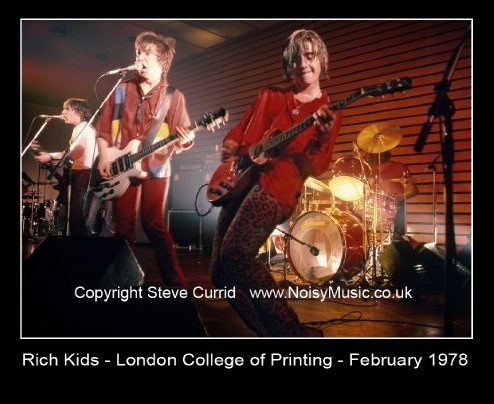
Rich Kids, Steve New, 1978, Steve Currid, pink trousers

➢➢ READ ON: Why the Rich Kids were the “missing link” between 70s and 80s – “So what was the missing link during the post-punk vacuum? The tell-tale signs are all over the early photos of Rich Kids and especially in their very Mod-flavoured 1978 debut on Top of the Pops that epitomised power pop …”

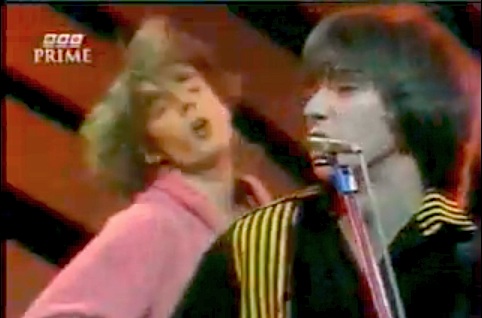
➢➢ VIEW ♫ ♫ Rich Kids debut on Top of the Pops, 1978: Glen Matlock, Midge Ure, Steve New and Rusty Egan

Rich Kids, Top Of The Pops, Glen Matlock, Midge Ure, Steve New , Rusty Egan

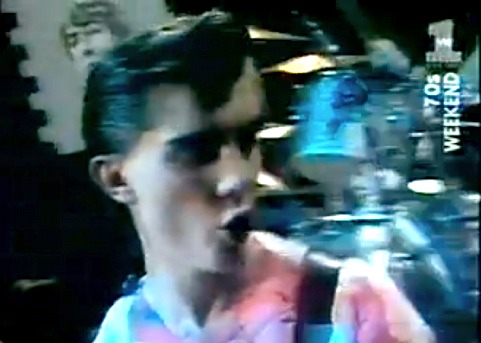
➢➢ VIEW ♫ ♫ Ghosts of Princes in Towers, 1978: Rich Kids on Revolver, introduced by legendary 60s satirist, Peter Cook (Steve New pictured below)

Rich Kids, Ghosts of Princes in Towers, Revolver, Peter Cook

FRONT PAGE

2010 ➤ Index of posts for March-April

McLaren, O'Dowd,Shapersofthe80s,Index March April 2010

McLaren departs this world ... O’Dowd demands a place in the spotlight

➢ Kemp sets a new standard for rock memoirs

➢ Grace Jones turns her back on London ;-)

➢ Rich List puts George Michael top of the popstars from the un-lucrative 80s

➢ In Australia, Spandau make Jason feel like a kid again: one true pop fan reviews their show

➢ What a tear-jerker! McLaren mashes up his own musical ‘Requiem to Myself’

➢ Punk glitterati see McLaren noisily to his grave

➢ Nnnnn-na-na-na, nnnnn-na-na, Nineteen

➢ Midge stakes his claim as the weathervane of synth-pop who helped shape the British New Wave

➢ Sci-fi’s coolest Number 6 finds Gandalf in charge and relocated to 93-6-2-oh!

➢ McLaren — Svengali of Pistols and punk remembered by those who knew him

++++++

➢ Uh-oh, A2A is back and we’re about to be Quattroed in HD!

➢ Ex-jailbird George takes his first trancey steps on the path to sainthood

➢ A giant dies: Charlie Gillett, the man who defined rock’n’roll and world music

➢ Barcelona: Spandau wow lifelong fans in their other spiritual home

➢ Albums that defined the new 80s funk

FRONT PAGE

2010 ➤ What a tear-jerker! McLaren mashes up his own musical ‘Requiem to Myself’

LISTEN TO MCLAREN’S REQUIEM
EXCLUSIVELY AT SHAPERS OF THE 80S

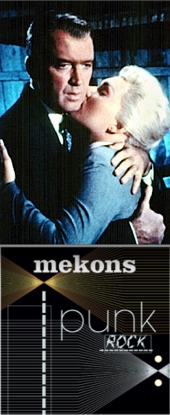
Hitchcock , Vertigo, The Mekons,

Romance and anguish: James Stewart and Kim Novak in the psycho-drama Vertigo (top), and the post-punk Mekons

◼︎ TWO UNEXPECTED RECENT VIDEOS have acquired poignant new life in the wake of Malcolm McLaren’s death, Svengali of punk that he was. Few people could have guessed that the soundtrack to one of last month’s Paris ready-to-wear fashion shows [in the video above] would be McLaren’s final creative achievement.

It was completed after his diagnosis of cancer and possibly in acceptance of his own mortality.

What seduces the listener is the overwhelming melancholy McLaren evokes, in what suddenly amounts to a Requiem to Myself. It was commissioned by Dries Van Noten – to set a deliberately discomfiting mood for his runway show amid the gilded opulence of the Hôtel de Ville in Paris on March 3.

After McLaren’s funeral, his partner Young Kim described the piece to Shapers of the 80s as “quintessential Malcolm McLaren – an entirely original and powerful, elegant but punk collage”. She gave us permission to run the full 13-minute mash-up in clean mp3 format, featuring the Vertigo theme, Mekons, Roxy, Raincoats and Burundi Beat.

➢ CLICK HERE for the full McLaren/Dries Van Noten soundtrack and background report on its creation on our inside page

➢ The Raincoats perform The Raincoats for Don’t Look Back in London, May 20, 2010, at The Scala in London

➢ More at Shapersofthe80s: Svengali of Pistols and punk remembered by those who knew him

++++++++++++

McLaren on how to fail brilliantly
in this ‘karaoke world’

◼︎ “THIS WORLD WE LIVE IN TODAY is no more than a karaoke world, an ersatz society, which provides us with only the opportunity to revel in our stupidity… A karaoke world is one in which life is lived by proxy.” So said Malcolm McLaren last October, only days before he discovered he was unwell. He was presenting a keynote speech to 1,000 delegates in London at the Handheld Learning Conference 2009 about the future of learning and education.

➢ Details from the Learning Conference also on our inside page

FRONT PAGE