Tag Archives: Gary Kemp

➤ The Kemp Brothers cook up a mystical morsel

Karma Magnet, Gary Kemp, Martin Kemp, Raj Ghatak

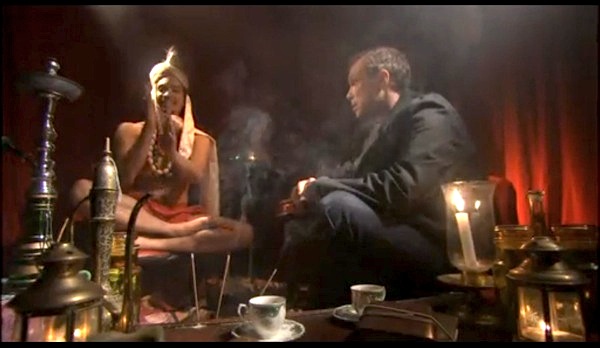
Fatal consultation over a nice cup of tea: celebrity chef Joel Manners (Gary Kemp) meets his guru (Raj Ghatak) in Karma Magnet

➢ Click to view Karma Magnet at Daily Motion

❚ HERE’S A 17-MINUTE SHORT FILM called Karma Magnet, directed by Martin Kemp of Black and Blue Films (also Spandau Ballet bass player) and featuring his brother Gary and Adele Silva. It tells why the luckiest man in the world wants to kill himself for the good of humanity.

No prizes for seeing how many other members of the Kemp family you can spot in this low-budget thriller.

FRONT PAGE

1980s ➤ So many shapers shaped the decade that people think was all down to Margaret Thatcher

A handful of key books this year have added to our estimations of that much demonised decade, the 1980s, and to our understanding of its cultural shifts. Shapersofthe80s has of course always drawn a distinction between the youthful creativity of the earlier Swinging 80s, and the ethos that finally took hold in Britain and earned the name of “Thatcherism”

Loadsamoney, Harry Enfield, Thatcherism1980s

Emblem of the 80s: Harry Enfield’s yob character, Loadsamoney. © Rex features

➢ Rejoice, Rejoice!: Britain in the 1980s,
by Alwyn W Turner (Aurum Press, 426 pages)

Alwyn Taylor, Rejoice!,1980s,book❏ A SHARP AND WITTY ANALYSIS of the 80s came this year from cultural historian, Alwyn Turner. Its savage title Rejoice! Rejoice! echoes the triumphal cry that burst from the lips of prime-minister-turned-warrior-queen Margaret Thatcher in 1982 when victory was declared over Argentina in the Falklands War (910 dead, 1,965 casualties). Reviewing the book in The Sunday Times, Dominic Sandbrook wrote: “One of the pleasures of Alwyn Turner’s breathless romp through the 1980s is that it overflows with unusual juxtapositions and surprising insights. Who knew, for example, that not only Alan McGee’s Creation Records but the bawdy magazine Viz were set up with money from Thatcher’s Enterprise Allowance Scheme, dismissed at the time as a feeble attempt to disguise the horrors of mass unemployment?

“Where this book really shines is on the intersections between politics and popular culture… For Turner, the defining characteristic of the 1980s was its obsession with size: big money, big hair, big issues, big politics. But what also emerges from his account is the sheer, unashamed nastiness of public life during the Thatcher years. This was a time, after all, when Thatcher’s cheerleader [disc-jockey] Kenny Everett publicly joked about kicking [the elderly opposition leader] ‘Michael Foot’s stick away’, while thousands chanted ‘Ditch the bitch’ at anti-government demonstrations.

“It is a refreshing surprise, however, to read a book on the 1980s in which Thatcher, while naturally dominant, does not entirely drive out all other voices. As Turner admits, the Iron Lady cast a larger shadow over national life than any other prime minister since Churchill: the style magazine i-D, a quintessential product of the decade, called her ‘almost a fact of nature’. But the results of her revolution were mixed at best, and the irony is that in many ways her policies had the opposite effect from what she hoped.”

Turner is not alone in presenting Harry Enfield’s comic character Loadsamoney as the emblematic figurehead for Thatcherism, a swaggering slob waving a fistful of banknotes while yelling, “Look at my wad!”. In the Financial Times Francis Wheen follows through: “Even if many Britons eventually accepted [Thatcher’s] economic remedies, Turner infers in his history of the 1980s, Rejoice! Rejoice!, ‘culturally the country was unconvinced’. Ideals of enterprise were all very well but winning at all costs, with no thought for the loser and no care for the way one played the game, ‘seemed somehow wrong’. The British still sided with heroic failures and doomed underdogs such as the hopeless ski-jumper Eddie (the Eagle) Edwards.”

30-UP FOR A CLUBBING TREASURE

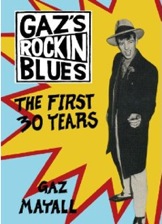
➢ Gaz’s Rockin’ Blues: The First 30 Years,
by Gaz Mayall (direct from Trolley, 280pp)

Gaz Mayall, Jarvis Cocker, Radio 2,

Gaz Mayall on 6Music: celebrating his 30th clubbing anniversary talking with Jarvis Cocker on The Sunday Service in October. © BBC

❏ GAZ MAYALL IS one of UK clubbing’s national treasures, and the paperback Gaz’s Rockin’ Blues is a nostalgic first-person collection of great club photos and comic-strip flyers that tell their own tale of London’s oldest continuous club-night, where Tracey Emin was once the cloakroom girl. The lad in the hat, who has kept his tiny nightspot jumping since July 3, 1980, supplies a brief but breathless string of anecdotes about live guests such as Prince Buster, Desmond Dekker and Joe Strummer. Gaz was one of the pathfinders who perfected the then brilliant notion of throwing a party every Thursday and playing his favourite rebel dance-tunes. As the 22-year-old Gaz told Shapersofthe80s that year: “People come here for good music”, which essentially meant his own heritage as a kid raised amid rock royalty and steeped in ska, reggae, rockabilly, rock and R’n’B.

Gaz's Rockin Blues, book, 1980sOn his club’s 30th anniversary, Kate Hutchinson wrote in Time Out: “It’s still going strong: you’ll find throngs of people swinging to guest live bands and DJs every Thursday night at the Soho basement dive St Moritz. It’s also the kind of hangout that keeps new generations coming, so the crowd always stays fresh. Those who aren’t old enough to go yet can mingle with everyone else at Gaz’s sound-system at Notting Hill Carnival, where he’s been causing a roadblock since 1982, or at his stage at Glastonbury, which he has run for the past three years.”

SHUFFLING BETWEEN STRAVINSKY AND ARMSTRONG

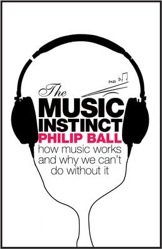
➢ The Music Instinct : How Music Works and Why We Can’t Do Without It, by Philip Ball (Bodley Head, 464pp)
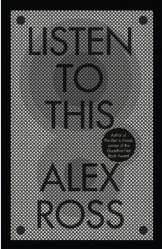
➢ Listen to This, by Alex Ross (Fourth Estate, 400pp)

The Music Instinct, Philip Ball, books❏ TWO IMPRESSIVE BOOKS THIS YEAR have dissected how music works its magic. They are not posited on the 80s at all, though they may well be emergent phenomena of our era of musical diversity. Critics heaped praise on Philip Ball’s The Music Instinct, an engaging survey by a popular science writer. Bee Wilson in The Sunday Times called it a “wonderful account of why music matters, why it wrenches our souls and satisfies our minds and sometimes drives us crazy”. In The Guardian Steven Poole praised Ball’s “deft analyses of the limitations of attributing ‘emotion’ to music, or considering it as a ‘language’ (Lévi-Strauss: if music is a language, it is an ‘untranslatable’ one)”. And the Amazon reviewer Steve Mansfield liked the author’s scope “by drawing his examples from across the spectrum of music, equally comfortable discussing and occasionally comparing music as diverse as J.S. Bach, John Coltrane, Eliza Carthy, gamelan orchestras, ragas, Schoenberg, and the Sex Pistols”.

Alex Ross, Listen to This, books❏ IN 2008 ALEX ROSS, music critic for The New Yorker, landed an unlikely bestseller with his gripping survey of 20th-century music, The Rest is Noise, plus a torrent of highbrow praise. This year he packages some choice essays under the title Listen To This, which David Smyth in the London Evening Standard said “ranges even more widely, making century-spanning, triple-jumping connections in the same way his shuffling iPod leaps from Stravinsky to Louis Armstrong. Coming from a background of listening to nothing but classical music in his teens and discovering rock’n’roll in adulthood, Ross can explain the brute appeal of, say, Radiohead’s Creep in a way that makes you feel your mind enlarging as you read”.

TWO WHO CHANGED THE CHARTS

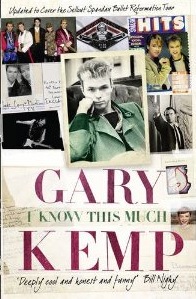
➢ I Know This Much: From Soho to Spandau,
by Gary Kemp (Fourth Estate, 320pp)

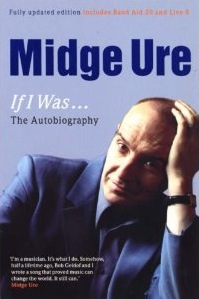
➢ If I Was, by Midge Ure with Robin Eggar
(Virgin Books, 288pp)

Gary Kemp, I Know This Much❏ FOR A MUSICIAN, the music really tells the life story. It’s rare for many of them to try to flesh out the story in prose, let alone as autobiography. Two who starred centre stage in 1980 were Ultravox’s Midge Ure and Spandau Ballet’s Gary Kemp, and though their accounts of the early transformative years of the decade weren’t actually first published this year, their paperback reprints continue to act as intelligent correctives to the hyperbole that accompanies some of the 30th-anniversary air-punching.

Songwriter Gary Kemp surprised many when last year’s autobiography, I Know This Much, proved so eloquent, encouraging rock writer Paul Du Noyer
to claim that it “sets a new standard for rock memoirs”. One of Amazon’s top reviewers, Mr Steve Jansen, believed that Kemp’s perceptive memories of a London now transformed make a “a touching testament to spiritual growth”. He wrote: “Kemp is able to reflect with great poignancy on a young man’s journey into, and through the shining city of dreams. In Kemp’s case that city, metaphorically, but more often literally — and literary in its evocation — is unmistakably London, and the metropolis is ever present like a ghost, framing his actions and attitude.”

The prominent journalist Robert Sandall of The Sunday Times, who died in July, had made Kemp’s his book of the year: “A sharply observed account by a quintessential London musician. Kemp exudes confidence, candour and a keen appreciation of the capital’s club culture.” This year’s paperback edition brought the story up to date with a postscript on his band’s reunion.

Midge Ure, If I Was❏ MIDGE URE IS THE OTHER eye-witness to the birth of Blitz culture, and his memoir, If I Was, hasn’t been out of print since published in 2004, and a revised edition is slated for next summer. Here, the musician tells with exceptional vigour a no-holds-barred story of his own journey from impoverished Glasgow childhood to new-wave superstar .

Amazon reviewer Lisby writes: “Ure writes fluidly and conversationally, imparting the kind of tactile detail that takes readers to the place and time of which he speaks. Ure is astonishingly honest, yet never vindictive. He is, in his prose, much as he is in his lyrics, a good person trying to be a better one while hoping the same for us all.” Another Amazon regular called thedouses adds: “Midge’s autobiography is a very well written, frank and honest book, which offers a fascinating insight into his own career and life but also other notable musical figures of the 80s and 90s music scenes in Britain, as well as providing background to the Band Aid and Live Aid events. He doesn’t use the opportunity to settle scores as so many of his contemporaries have done.”

Apart from being a busy wizard stirring the magic cauldron from which emerged many musical innovations in the 80s, Ure here establishes his central role in the production of Band Aid’s charity single, Do They Know It’s Christmas?, which led to Live Aid, the globally televised rock concert in 1985 which raised millions for famine relief.

NOT FORGETTING…

David Bowie, 1975 ➢ Any Day Now: David Bowie The London Years (1947-1974), by Kevin Cann (Adelita, 336 pages) was reviewed here on Dec 11. “Being a Bowie fan for almost 40 years I am flabbergasted. Many, many never before seen pictures” — Amazon reviewer Peter Gooren

FRONT PAGE

1984 ➤ Band Aid, when pop made its noblest gesture but the 80s ceased to swing

Band Aid , Do They Know It’s Christmas?

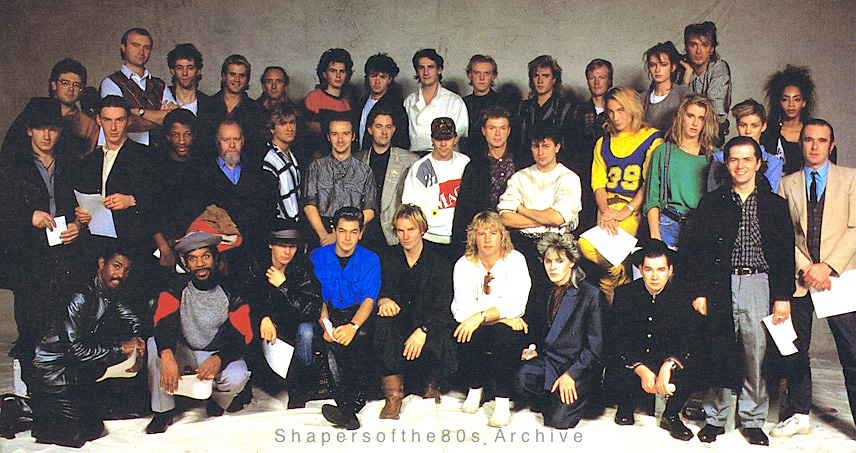
The Band Aid band, Nov 25, 1984: most of the pop stars who performed, plus artist Peter Blake who created the record sleeve for Do They Know It’s Christmas?

◼︎ TODAY WAS THE DAY IN 1984 THEY RECORDED the song that became, for 13 years, the biggest selling UK single of all time. Do They Know It’s Christmas was released four days later, stayed at No 1 for five weeks, sold over three million copies and raised significant funds for famine relief in Africa. The project lead naturally the next year to Live Aid, the biggest globally televised rock concerts ever, viewed by two billion people in 60 countries, who coughed up still more dollars. It is estimated that Live Aid raised £150m (about $283m). Last year a poll of 5,000 people, who were surveyed across Europe, named Live Aid as the most important music event of the past 30 years. The hit single sold for £1.35, of which 96 pence went to the fund. Rerecordings of the song charted again in 1985 and 1989.

The idea for Band Aid was proposed by one man, Bob Geldof, since granted an honorary knighthood but in 1984 a musician down on his luck, who enlisted the much more successful go-getter, Ultravox’s Midge Ure (who remains unknighted for no good reason), to bring the dream to fruition as its producer. They created a megagroup from 45 of the biggest hitters in British music, who included the supergroups dominating world charts at the time — Culture Club, Duran Duran, Spandau Ballet, Wham! — plus AOR giants Sting, Genesis and U2, plus Kool and the Gang from the States. In a sea of mullets and bleached highlights, rival musicians united under the name Band Aid in a daring act of charity that was unprecedented in the competitive commercial arena.

Band Aid,Bob Geldof ,Midge Ure,SARM

Leaders of the Band Aid pack in 1984: Bob Geldof and Midge Ure outside SARM Studios in London. © Pictorial Press

The enterprise marked the end of an era, as this website documents. The Band Aid collaboration signalled the final chapter of the innovation which Shapersofthe80s believes defined the Swinging 80s as six dynamic years of subcultural initiative between 1978 and 1984. Britain’s visual kaleidoscope of cults was exactly what fed MTV from its launch in 1982 and loosened the stranglehold that music radio had previously enjoyed in the USA. The unlikely Band Aid scrum of Britain’s rival image bands who had risen on the same new wave  substantially defined a new show-business elite who had come to epitomise mainstream tastes.

 Michael Buerk , Ethiopia

Michael Buerk in his BBC report from Ethiopia

Nobody can doubt the uniqueness of the pop fraternity’s gasp of altruism through Band Aid. Geldof had been genuinely distressed by the now landmark teatime TV report broadcast on October 23, 1984, by Michael Buerk, a popular BBC journalist. It still makes for grim viewing. In Ethiopia 7m people were threatened by famine, and 40,000 refugees had converged on the town of Korem in the hope of finding food and medical aid.

The film footage shocked the world and Buerk’s opening words still resonate today: “Dawn, and as the sun breaks through the piercing chill of night on the plain outside Korem, it lights up a Biblical famine, now, in the 20th century. This place, say workers here, is the closest thing to hell on earth…”

CONTRARY VERDICTS ON BAND AID

Morrissey, 1985 — “I’m not afraid to say that I think Band Aid was diabolical. Or to say that I think Bob Geldof is a nauseating character. Many people find that very unsettling, but I’ll say it as loud as anyone wants me to. In the first instance the record itself was absolutely tuneless. One can have great concern for the people of Ethiopia, but it’s another thing to inflict daily torture on the people of England. It was an awful record considering the mass of talent involved. And it wasn’t done shyly, it was the most self-righteous platform ever in the history of popular music.”

The World Development Movement described the Band Aid lyrics in 2004 as “patronising, false and out of date” and regretted it did not “provide a more accurate reflection of Africa and its problems”.


❏ IN THEIR RESPECTIVE AUTOBIOGRAPHIES, Ultravox’s Midge Ure and Spandau Ballet’s Gary Kemp provide entertaining and detailed accounts of the Band Aid venture, spiced with the frankness that comes from hindsight . . .

➢ Ure and Kemp on the shenanigans
that led up to Band Aid

FRONT PAGE

1980 ➤ The day Spandau signed on the line and changed the sound of British pop

Spandau Ballet, Virginia Turbett,Chrysalis,Steve Dagger, New Romantics

The way they wore: Spandau Ballet minutes before signing their record record deal in October 1980. Photographed at London’s Waldorf Hotel © by Virginia Turbett

◼ AS THE COOLEST CULT LEADERS OF 1980, Spandau Ballet’s songwriter Gary Kemp claimed: “We want the band to be at all times the most contemporary statement we could possibly make on modern London.” In the face of the post-punk new wave, it took courage to decide to play fresh sexy dance music in a corporate landscape dominated by adult-oriented rock supergroups. In the event, the five boys from the Angel, Islington, quickly assumed the role of houseband to the Blitz club and by placing the bass guitar and the bass drum at the front of the sound made it hip once more to play pop.

Spandau Ballet were being managed by their onetime schoolmate Steve Dagger, aged only 23, while three record labels competed to secure them. On this day 30 years ago they signed a deal with Chrysalis Records and walked into the future clutching an advance cheque for £85,000 — at the time, a record sum for an untried band that had played all of eight bookings and had refused to cut demo discs.

“We were strong, it was a real gang, a real team mentality. It was: We’re Spandau Ballet, who the f*** are you?” — John Keeble, Spandau drummer

By breaking all the industry rules, Spandau triggered a fashion and dance music movement that had been evolving in the nightclubs of Britain. At the very moment that the Blitz closed its doors, the press dubbed their followers the New Romantics, and a slipstream of more than 100 new image bands was born. The new sounds and new styles of this, the last of the Babyboomer generation, went on to dominate the international landscape of pop and over the next three years put more British acts in the US Billboard charts than the 1960s ever achieved.

ELSEWHERE ON SHAPERS OF THE 80s

➢ Oct 16, 1980: One week in the private worlds of the new young
➢ Birth of the New Romantics and the band who made it hip to play pop
➢ How the rhythm of the pop charts changed

Spandau Ballet, The Makers,The Cut,Roots, Dame Alice Owens

Tony Hadley fronts The Makers: Spandau as a school band playing to the fourth form at Dame Alice Owens — grabbed from video

➢ VIEW ♫ Early footage of Spandau Ballet in the Young Guns documentary from 2000
➢ New Romantics: I Was There — ex-Sounds hackette Betty Page’s recollections for Record Collector, written with the benefit of hindsight in 2004

FRONT PAGE

1970 ➤ Where to draw a line between glitter and glam – naff blokes in Bacofoil versus starmen with pretensions

David Bowie, Starman, 1972, Top of the Pops, tipping point, BBC

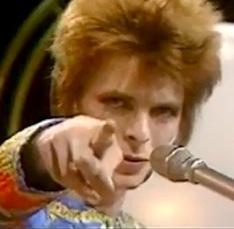
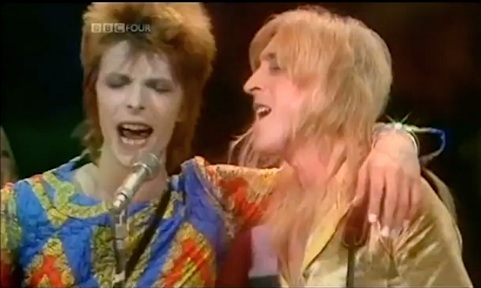
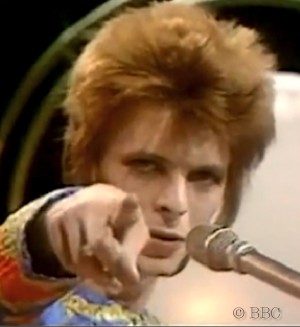
The moment the earth tilted July 6, 1972: During Starman on Top of the Pops, David Bowie drapes his arm around the shoulder of Mick Ronson. Video © BBC

❚ WHO DARES DEFINE GLAM ROCK? Almost nobody agrees what it means, even as we celebrate the 40th anniversary of glam’s birth, but that isn’t going to stop many of its prime movers lighting a few squibs in a thrilling and meticulous Ten Alps documentary titled The Glory of Glam†† across two hours on BBC Radio 2 tonight and tomorrow (iPlayer for a further week). This thorough analysis has been badly needed since the term glam became a rubbish-bin into which gets thrown anything brash, theatrical and shiny – such as shock-rock, metal and goth. The problem glam suffers is that the tat needs to be accounted for, then set aside, especially after you’ve waded through yards of tosh at Wikipedia penned by American sociologists out of their depth in this entirely British phenomenon.

Glam rock came cloaked in sequins, satin and unmasculine flamboyance. Its touchstones – alienation, decadence, self-invention and sexual transgression – most certainly went on to shape the UK’s fashion pop of the 80s, and glam’s pioneers were pillars of inspiration to the New Romantics. Even though glam banished the guitar solo and the drum break, it fuelled as much a fashion revolution as a musical one, if not more so, which many of its own practitioners didn’t get a handle on by merely pulling on their platform boots and zany top hats. Glam had deeper resonances than a sprinkling of glitter, and reached back into the traditions of theatre and Hollywood.
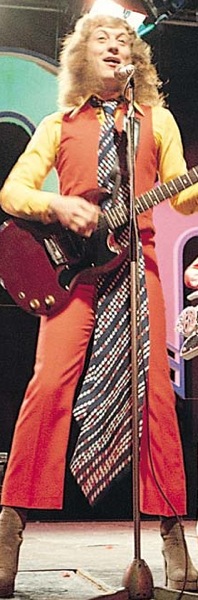
Noddy Holder, Slade

The pantomime version: mutton-chopped Noddy Holder of Slade

The Blitz Kids see no confusion. They draw a firm line between the distinctly fashion-driven imperatives of their own New Romantic style and the grotesque pantomime of the worst 70s glam-rockers. Certainly the Blitz Kids of 1980 admitted no connection with the chart-storming excess confected that year by Queen, whose origins lay in 60s psychedelia and heavy metal, still less make mention of Noddy Holder of Slade in the same breath as Ultravox, Visage, Depeche Mode or Spandau Ballet.

The 80s musician Gary Kemp, who narrates tonight’s documentary, writes in today’s Guardian: “I could spot the uncomfortable look on the face of a hefty northern bass player bursting from a turkey-foil jumpsuit worn simply to sell records. With Bowie, it was different: he had integrity. An effeminate, pale young man in eye shadow had somehow connected with working-class flash.”

Blitz fashion god Stephen Linard dismisses Slade’s avalanche of chart hits: “Even at 12, you knew Bolan and Bowie were special. Slade were just for fun, like Sweet and Gary Glitter – theirs was party music. The only reason I’d bought the first Gary Glitter album was because it was covered in glitter. Come on! Slade were hairy oiks from Birmingham, hideous sideburns, going bald on top. I plastered Roxy Music all over my bedroom because they were glamour. They had real transsexuals on the cover of their album. Everybody assumed Bryan Ferry’s girlfriend Amanda Lear was one!”

The indispensable Allmusic hits the mark when discussing Hunky Dory: “a kaleidoscopic array of pop styles, tied together only by Bowie’s sense of vision: a sweeping, cinematic mélange of high and low art, ambiguous sexuality, kitsch, and class . . . A touchstone for reinterpreting pop’s traditions.” There’s the nub of it: artsy pretension is out there a length ahead of beer-swilling mayhem. Any innovator at the Blitz club never loses sight of the origins of glam, whether in Bowie’s training with performance artist Lindsay Kemp, Eno’s experiments with electronica, Ferry as a walking ad for Antony Price’s luminous suits, and even Bolan’s obsessive eye for style instilled as a mod. To cap it all, in photographer Mick Rock’s opinion: “Bowie was good at being provocative, but the beauty was his lightness of touch.”

We are of course bang in the middle of the hoary old music-industry debate about art versus profits, innovation versus pomp.

Fortunately clarity is at hand. The next week boasts two landmarks on the timeline of pop that signal the dawn of glam and celebrate its immortals. July 1 is the 40th anniversary – the day in 1970 when Marc Bolan recorded the first glam-rock single, Ride a White Swan, though it took till year’s end and Top of the Pops to boost it to No 2 on the chart in January. A youthquake then erupted.
rel="nofollow"

Ziggy sings: “So I picked on you-oo-oo”

By popular vote, however, the more resonant date is July 6, 1972. This Thursday is burnt into the souls of the specific generation who were to make good as popstars in the 1980s.

Songwriter and Spandau Ballet guitarist Gary Kemp speaks for many when he writes of the creation of Ziggy Stardust: “David Bowie’s seminal performance of Starman on Top of the Pops in 1972 became the benchmark by which we would for ever judge pop and youth culture. It was a cocksure swagger of pouting androgyny that appealed to pubescent working-class youth across Britain – a Britain still dominated by postwar austerity and weed-filled bomb sites. For us, the Swinging 60s had never happened; we were too busy watching telly.”

Kemp goes on: “The object of my passion had dyed orange hair and white nail varnish. Looking out from a tiny TV screen was a Mephistophelean messenger from the space age, a tinselled troubadour to give voice to my burgeoning sexuality. Pointing a manicured finger down the barrel of a BBC lens, he spoke to me: ‘I had to phone someone, so I picked on you.’ I had been chosen. Next to him, in superhero boots, his flaxen-haired buddy rode shotgun with a golden guitar. As my singing Starman draped his arm around him, I felt a frisson of desire and wanted to go to their planet. I had witnessed a visitation from a world of glitter. That night, I planned my future. After all, ‘If we can sparkle,’ he’d told me, ‘he may land tonight’.”

Bear in mind that at the time of White Swan, in 1970, our two pop idols had both been aged 23, and our pubescent audience of future Blitz Kids, typically born around 1959, were then 11. So they were rising to 13 by 1972 — detonation year for the glam explosion. That was when the careers of Roxy Music, Iggy Pop, Elton John and Alice Cooper all went critical in the UK, when Andrew Logan threw his first Alternative Miss World Contest, paving the way for the stage musical The Rocky Horror Show the following year [currently touring the UK till Dec 2010].

The Starman’s earth landing is the most influential song of Bowie’s many influential songs because it is seared on the memory of that generation of TV viewers. From Morrissey and Marr to Ian McCulloch, Neil Tennant and Siouxsie Sioux — all say this day changed their lives. For Michael Clark, who went on to lead an all-male dance company, it was a revelation because he’d only seen men touch each other when they were fighting, and suddenly he realised that there might be “kindred spirits” out there . . .
Bowie, Man Who Sold the World, Hunky Dory, Glam rock

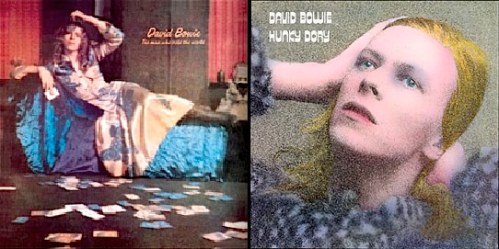
Bowie confronts camp: album sleeves for The Man Who Sold the World, and Hunky Dory

❚ MARC BOLAN AND DAVID BOWIE ARE INDISPUTABLY the progenitors of this flamboyant art-rock musical style at the dawn of the 70s, along with the Svengali who can claim much credit, Tony Visconti, the Brooklyn-born musician and producer who worked with the young Bolan and Bowie in London, with honourable mentions for Bryan Ferry and Brian Eno for the early Roxy Music. These voices are heard in the Radio 2 doc.

Angie Bowie says: “David and Marc liked each other very much and at certain times were great friends, but they were also bitter rivals.” As teenagers in the mid-60s they were both image-conscious suburban mods, then hippies, who experimented with styles from blues to psychedelia in search of their own pop moment. They first met while painting their shared manager’s office, and their paths constantly crossed at Bowie’s Beckenham Arts Lab and especially at Visconti’s flat in Earl’s Court, west London.

Bowie himself rather revelled in the rivalry, in May 1970 spoofing Bolan’s vocal style on Black Country Rock, a track on his album The Man Who Sold the World, recorded a couple of months before Bolan’s pivotal Swan. On the sleeve notes to Sound+Vision, Bowie recalls the day Bolan provided musical support while recording his Prettiest Star single at Trident Studios that January: “We had a sparring relationship… I don’t think we were talking to each other that day. I remember a very strange attitude in the studio. We were never in the same room at the same time. You could have cut the atmosphere with a knife.”

Both singers toyed with sexual ambiguity. While Bolan prettified himself into T.Rex, Bowie’s new wife Angie encouraged experiments in androgyny that led to the UK album cover where he wears what he called a “man dress” (though this image was replaced for the earlier US release in 1970).
T.Rex, Marc Bolan, Mickey Finn, David Sanders,

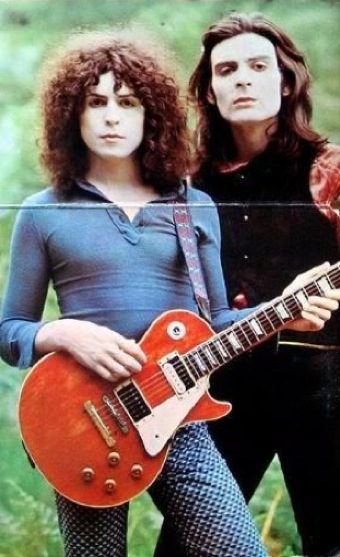
Transformed into T.Rex for the 1970 album: Bolan sports his new electric guitar, square-jawed and white-faced with Mickey Finn, in the Sussex garden of the photographer David Sanders’ mum

In their day, these were shock tactics – which still trigger fireworks in the art-versus-profits argument. So-called glam-rockers such as Slade and Sweet and Glitter weren’t into sexual role-play so much as pantomime and clowning, despite their figure-hugging satin.

What puts the music of Roxy Music, David Bowie and T.Rex in a different league? The elephant in the room is sex or, rather, sexual subversion. What is rock and roll if not almost entirely about that vertical expression of the famous horizontal desire? What is adolescence if it’s not at least partly about curiosity, confusion and the testing of boundaries? There’s no point in discussing glam rock without mentioning its implicit androgyny and the dangerous allure of unthreatening, feminine young men to adolescent audiences.

Kemp declares boldly in today’s Guardian of his Starman moment: “The first time I fell in love it was with a man.” And he notes: “Gender-bending was suddenly far more rebellious than drugs and violence.”

Brave words from any popstar in any era. Suzi Quatro observes in the radio doc: “All those men in eye shadow – you have to be very comfortable with your sexuality to play with it.” Even so, when a grown-up family man admits to an adolescent pash for a fey young man, it doesn’t necessarily make him gay, but it does take courage to admit.

❚ DESPITE THE CLIMATE OF PERMISSIVENESS the 60s had beqeathed, the word gay was taboo in public in 1970, even though the iconography was pretty blatant. As T.Rex, Bolan shed his folksy heritage for white-faced androgyny when twinned with Mickey Finn on their first album cover. Bowie adopted a Greta Garboesque pose for his portrait on Hunky Dory, and wore the “man-dress” by the Mayfair tailor Michael Fish on The Man Who Sold the World.

Bowie’s later admissions of “bisexuality” are well documented. In 2002 he told the American music magazine Blender: “I had no problem with people knowing I was bisexual.” In David Buckley’s 1999 book Strange Fascination, Bowie said that when he met his first wife, Angela Bowie, in 1969 they were “fucking the same bloke” and Buckley claimed the marriage had been cited as one of convenience for both.
Marc Bolan, T.Rex, boa

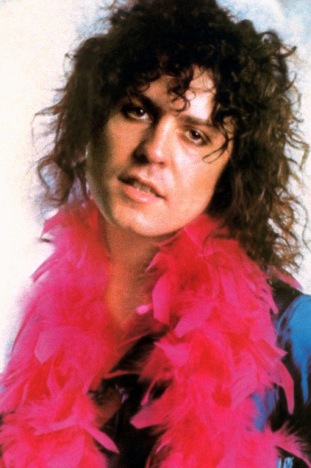
Sexual ambiguity: Bolan adopts the boa for T.Rex

There’s little or no contemporary evidence of Bolan’s now known bisexuality, except the eye witnesses. His manager during the late 60s, Simon Napier-Bell lays it out in the biog, The Rise and Fall of a 20th Century Superstar by Mark Paytress (1992, revised 2006).

“Marc was more gay than straight. He had no hangups about sex,” says Napier-Bell, who lived in Lexham Gardens in west London at the time. “[Bolan] used to come round on the early-morning bus from his parents’ prefab in Wimbledon and get in bed with me in the morning. How can you manage anybody and not have a relationship with them? The sexual borders had completely collapsed by that time. Straight people thought they shouldn’t be straight. In fact, in the 60s, it was pretty difficult to have any sort of relationship with someone without it being sexual.”

An extreme perspective, perhaps, but “anything goes” was the motto for the coterie who subscribed to the Swinging London melting pot of hallucinatory drugs and louche morals.

In addition, bisexuality was growing in fashionability in the wake of the historic changes brought about by the Sexual Offences Act of 1967. Before then in the UK, gay activity was a jailable offence and hence highly blackmailable. It’s no coincidence that in 1971, a couple of years after New York’s Stonewall riots, the Campaign for Homosexual Equality emerged as the leading English gay rights organisation by staging its first march ending in a Trafalgar Square rally. By 1972 the explosion of glam-rock coincided with very visible expressions of gay liberation in the UK.

None of which implies that massed ranks of gay popstars leapt into the charts, though the totally closeted record business did ease the door open by a chink, whereas previously any hint of gay would spell death to a band’s career. The English star Dusty Springfield was extraordinarily brave at the age of 31 to entrust her coming out in 1970 to Ray Connolly in the Evening Standard, in an intense interview that remains a compelling read. (Ray told Shapersofthe80s: “I was a big fan and I actually didn’t want to ask her. She pushed me into it, saying, ‘There’s something else you should ask now… about the rumours’.”) It took Elton John till he was 41 to come out, first getting married in 1984 and divorcing four years later.

In the Radio 2 doc, Gene Simmons from Kiss sums up the social change that characterised the early 70s: “The great thing about glam was whether people thought you were gay or not didn’t matter. More was done to further different sexual preferences onstage in a rock band than all the commentaries from serious people, because there onstage, the way the old court jesters used to do in silly outfits, they were actually doing something serious, which in essence was saying, Be tolerant. The cool thing was that it was all cool.”

As for our immortals . . . Sadly we lost Bolan to a car crash when he was only 29. Had he been alive today he’d be the same age as Bowie, 63, give or take a few months. It’s challenging to speculate which of them might be shining the more brightly today as our totem of pop culture.

†† FOOTNOTE – This website has no connection with the makers of The Glory of Glam, and has since discovered the credit goes to producer Des Shaw and editor Chris O’Shaughnessy. If this documentary doesn’t win a Sony radio award, there’s no justice.

➢ 2013 update: Glam! The Performance of Style runs at Tate Liverpool Feb 8–May 12, 2013 – Well worth a day trip to Liverpool, this superbly curated exhibition explores 70s glam style and sensibility across the whole spectrum of painting, sculpture, installation art, film, photography and performance. The in-depth survey comes in two halves, drawing a clear distinction between the playful subversion of pop culture that characterised the British glam wave, and the American, which was driven much more profoundly by gender politics.

FRONT PAGE