Tag Archives: 2011

➤ Will the magical blasts from the past follow St Martin’s out of Soho?

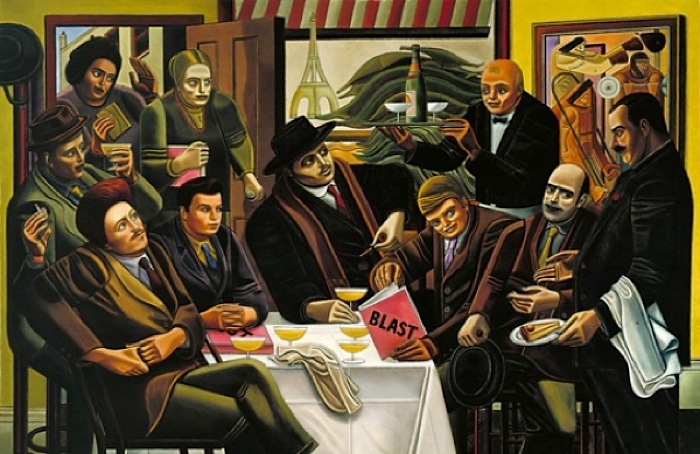
William Roberts ,Vorticists at the Restaurant de la Tour Eiffel ,Tate Britain

BLAST! Hackney-born William Roberts was an apprentice poster designer, who at the age of 14 attended evening classes at St Martin’s School of Art in London. Within four years he was taken up by Wyndham Lewis, who was forming a British version of the avant-garde Futurist movement. Ezra Pound suggested the name Vorticism, and 19-year-old Roberts’s work was featured in the radical Vorticist magazine BLAST in 1914, a seminal text of 20th-century modernism. A lifetime later, Roberts painted the group (he is seated third from left) in one of the defining images in European art — The Vorticists at the Restaurant de la Tour Eiffel, Spring 1915 (detail) — currently showing in The Vorticists: Manifesto for the Modern World at Tate Britain until September. (Courtesy of the Estate of William Roberts/Tate)

London’s grooviest art school is leaving the bright lights for the wide open spaces two miles north of their historic manor, where the impoverished Marx wrote Das Kapital and Hazlitt the finest essays in English, and the painter Francis Bacon was a founding member of the Colony Room, a notorious watering hole for misfits. Can our savviest creative spirits really thrive once uprooted from Soho’s 300-year heritage, its dissenters, eccentrics, streetlife and dens of inquity?
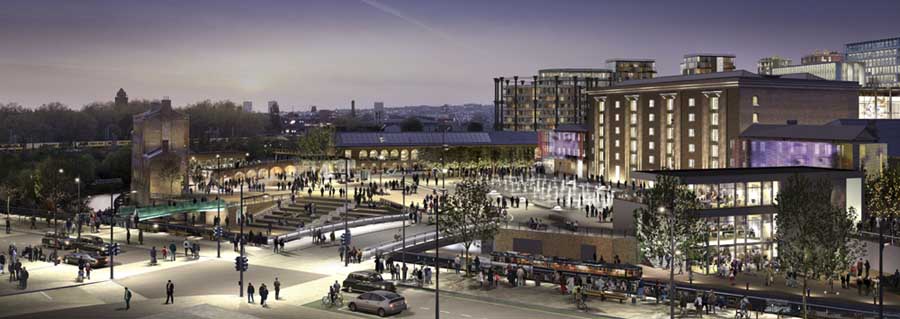
King’s Cross Central,Central Saint Martins ,University of the Arts, London

King’s Cross Central: the University of the Arts at Granary Square will form the hub of a new cultural quarter, a 67-acre development that is the largest in London for 150 years. (Courtesy of Anderson-Terzic)

❚ AT MIDNIGHT LAST NIGHT, before an artsy audience spanning many generations, Jarvis Cocker and Pulp were bashing out their hit song Common People in the heart of his ramshackle old college, St Martin’s School of Art, as it was still called in 1988 when he met that girl made famous by its lyrics. While he studied film-making, she seemingly “studied sculpture”. The song says she came from Greece and her Dad was loaded, yet she wanted to slum it by going to live in down-at-heel Hackney. Jarvis explained years later: “It stuck in my mind what she was saying — that she wanted to sleep with common people like me.”

Jarvis Cocker, Pulp, popCommon People has become much more than an anthem for Jarvis’s generation. Everybody knows the words and the 800 former St Martin’s graduates — gathered to bid farewell to their alma mater as it leaves Soho for King’s Cross — erupted into a riotous sing-along, because those lyrics are stiff with truths that aren’t entirely universal, but they are, or were, peculiarly British. What we now know is that, in real life, Jarvis hardly knew the girl and in the end they didn’t get it together, but what the encounter had triggered in him was an awareness about class differences in our society that, as a lad from Oop North, even at age 25, he’d been oblivious to: that she would always have Daddy to help her “never fail”.

The definitive song of the Britpop era begins as satire but ends in anger. In deeply felt rage. As with the socially mobile 60s, this was the edginess in the 80s that divided British society and in our art schools sparked tangible creative tension, when talented working-class lads came up against genteel gals from the moneyed middle-classes, especially those on the smartest degree course for fashion in the land. Many posh parents saw this as an alternative kind of finishing school, yet the sloganeering designer Katharine Hamnett tells fashion historian Judith Watt in a forthcoming film documentary about St Martin’s, directed by Oleg Mitrofanov: “I actually had to change the way I spoke because I’d come from public school and nobody would take me seriously.”
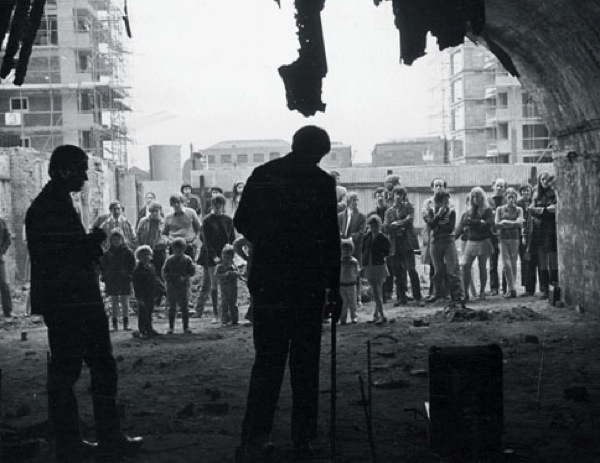
Gilbert & George  Singing Sculpture, St Martin's, performance art,

♫ Underneath the Arches ♫ Gilbert & George perform Singing Sculpture in Cable Street, London, 1969 © Courtesy the artists
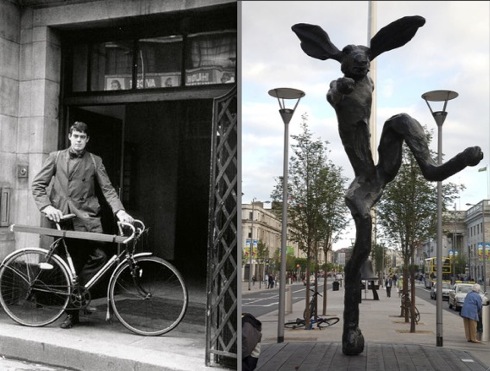
St Martin’s ,art school, Richard Long, Barry Flanagan

Radical sculptors of the 60s: Richard Long outside St Martin’s in 1967 (Alammy) . . . One of Barry Flanagan’s giant bronze hares in O’Connell Street, Dublin, in 2006

Why the Blitz Club became the potent subcultural melting pot that it did in 1979 was down to its geography — located midway between St Martin’s on Charing Cross Road, and Central School of Art & Design in Holborn, in the no-man’s land between the then trendily refurbished market area of Covent Garden and the sleazy, yet always cool red-light district of Soho. As one early 80s fashion graduate reminds us: “Essentially, the Blitz was an art students’ club.” Then into their midst, lured by new music, came the working-class soulboys and girls who were themselves several sharp steps ahead of their own class for style. Naked one-up-manship inflamed ambitions all round.
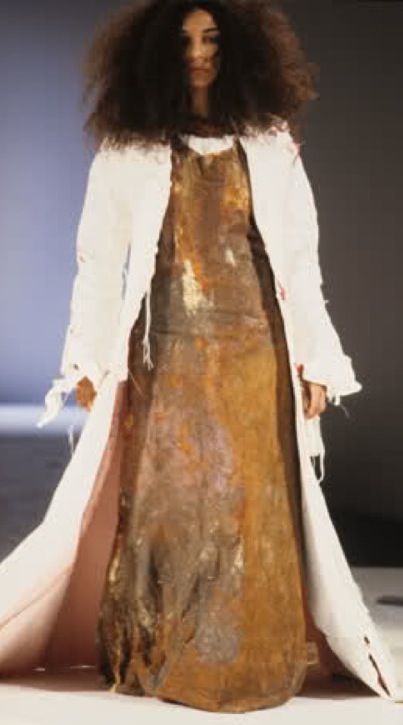
Hussein Chalayan, collection,1993, Tangent Flows

Graduation 1993: for his collection, The Tangent Flows, Hussein Chalayan buried silk garments in his back garden, then exhumed them. Joan Burstein of Browns put the entire collection on show in her windows

The pole position of St Martin’s has been reconfirmed with each generation of graduates who become household names: from Frank Auerbach and Joe Tilson, Lucian Freud and James Dyson, Terence Conran and his son Sebastian, Isaac Julien and Belinda Eaton, Bruce Oldfield and John Galliano, to Stella McCartney and Sarah Burton who stepped into Alexander McQueen’s shoes following his sudden death.

Through the 60s and 70s, both under Anthony Caro’s tutorship then in revolt against it, abstract sculpture had been St Martin’s strength, but with the 80s the fashion department responded to the force of Britain’s subversive street style which was exciting the international media. The impact of alumni such as Jacques Azagury with his New Romantics collection made London Fashion Week an essential stop-over for the fashion world’s globetrotting commentariat.
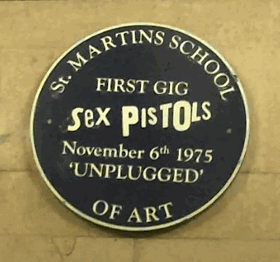
Sex Pistols, debut, plaque, anniversary, St Martin’s,

30 years on: Pistols bassist and St Martin’s painter Glen Matlock unveiled this plaque at his old college. It was designed and made by potter Douglas Fitch and graphic designer Mike Endicott

Is the old Soho alchemy about to lose its magic? Last night’s party  for alumni was organised by one of them, Birmingham-reared Katie Grand, stylist and editor of Love magazine and coincidentally partner of Pulp’s bass player, Steve Mackey. It was a generous and fitting farewell to the shabby seven-storey building on Charing Cross Road that has blazed as the beacon among London’s half-dozen undergrad art schools for the past 50 years. Though technically St Martin’s School of Art (founded 1854) merged with Central School of Art and Design (founded 1896) two decades ago, only now does the resultant Central Saint Martins College of Art and Design have a purpose-built new home to house its 3,800 staff and students — two miles away from the life of spice that energises Soho.
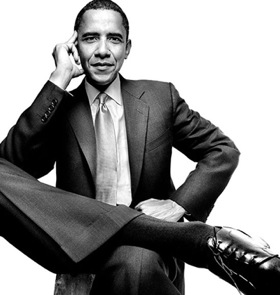
Platon Antoniou, Barack Obama,photography, St Martin’s

President Obama by photographer and St Martin’s alumnus Platon Antoniou: he succeeded to Richard Avedon’s job at the New Yorker magazine

Not for nothing did the anarchic Sex Pistols choose to play their first gig at St Martin’s in November 1975. GQ editor Dylan Jones, who graduated in 1980, told The Independent a while back: “We were 400 yards from the 100 Club, 200 yards from the Marquee, and a mere spit from the Cambridge, which is the pub everyone used to congregate in before they went onstage — the Pistols, the Clash, Adam and the Ants… St Martin’s at the time felt like the most exciting place on earth, not just because of all the wonderful painters, designers and boulevardiers who had studied there, but also because it was central to the whole punk explosion.”

So will the renegade artistic heritage that evolved with the growth of Soho over 300 years become somehow dissipated? Britain’s most visible sculptor Antony Gormley, another St Martin’s graduate, made a case more detached from bricks and mortar in Wednesday’s Guardian: “The place stands for a certain anarchic idea of permanent revolution – of every generation overturning the orthodoxies of the previous one.” Indeed, from the stage in the old St Martin’s studio last night, Jarvis Cocker capped his anthemic song by criticising the government’s introduction of £9,000 annual student fees that are bound to deter new generations of common people from even considering art school. He then indicated the walls of the buliding, and said, “It’s not about THIS … It’s about THAT”, pointing at the heaving dance-floor.

Which seems to suggest that the spirit of the age will ultimately trump any spirit of place. Aha! Germanic Zeitgeist versus the classical genius loci. Discuss.
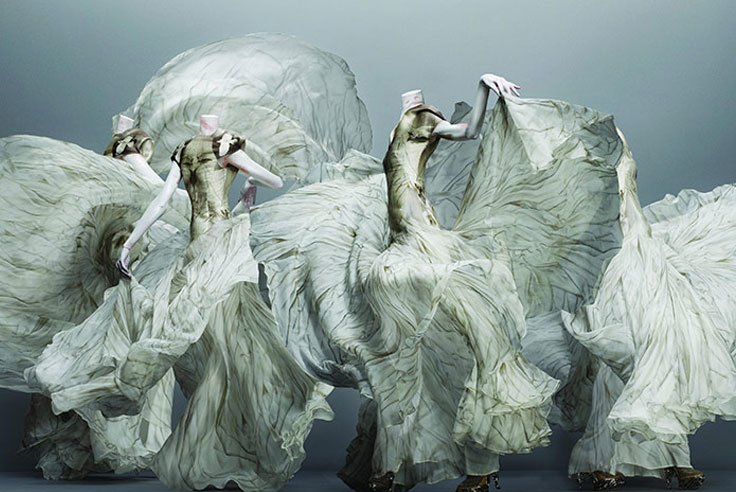
Alexander McQueen , fashion,Savage Beauty,Metropolitan Museum of Art ,New York,

McQueen lives on: The 2011 Costume Institute Met Gala, held in New York on May 2, honoured the life of the British fashion designer Alexander McQueen who died in February 2010 at the age of 40. His Savage Beauty exhibition is running at the Metropolitan Museum of Art until July 31

➢ Oleg Mitrofanov’s blog, I Hate My Collection, follows
his progress in making a film documentary about
the exodus of St Martin’s from Soho

HOW TO TEACH THE UNTEACHABLE

Peter Kardia, Christopher Burstall, The Locked Room,Richard Deaconm,St Martin’s

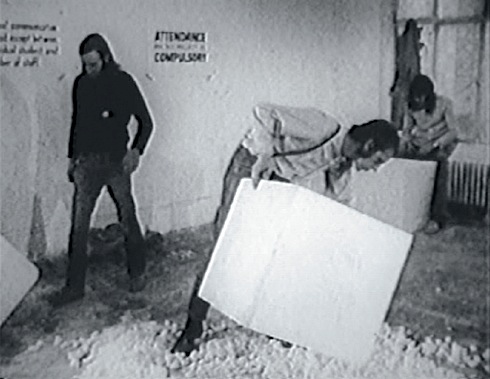
“The Locked Room”, a radical teaching experiment at St Martin’s from 1969: a dozen first-year students, including Richard Deacon, were locked in a room and observed in silence. What were they to make of it? From Christopher Burstall’s BBC documentary A Question of Feeling. Photograph © Garth Evans

❏ SOME OF US WHO were later required to recruit new talent in our workplaces learnt a novel lesson in 1970 by watching a compelling BBC documentary shot at St Martin’s. How do you assess somebody for a creative job which has few boundaries and rests heavily on self-reliance? Invite them to an interview, don’t say a word and see how they react! Such was the inspiration yielded by Christopher Burstall’s documentary A Question of Feeling, which observed a dozen first-year sculpture students including Richard Deacon who were locked in an empty studio and not allowed to speak. Each was given one particular material — a block of polystyrene, say, or a bag of plaster. They were left to deduce for themselves that these were raw materials with which to work, without critical feedback, despite their tutors’ constant surveillance.

The experiment known as “The Locked Room” came in response to the prevailing trend towards non-objective art, itself a reaction to Anthony Caro’s giant abstract works in steel, all of which posed the problem of how you set about teaching conceptual art. This was a bold attempt to erase tradition. Tutor Peter Kardia said: “I wanted to put them in an experiential situation where they couldn’t grasp what they were doing. What I wanted was ‘existence before essence’.”

➢ More about Richard Deacon’s work at the Tate

+++

ELEGIES ON LAST NIGHT’S EXODUS

Judith Watt, St Martin’s, fashion, historian, Twentieth-Century Fashion Writing,

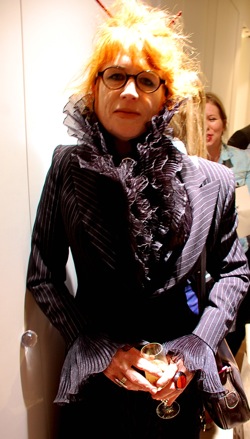
Judith Watt photographed by The Clothes Whisperer

❏ JUDITH WATT, fashion historian who has taught the history of fashion and writing to Fashion Communication and Promotion BAs since 1998, reports:
“Most current students were not invited to the party; so it was helpers — many my lovely students — and those who graduated this June. It was a shame, as students are so much of what makes up St Martin’s unique character (with the added magic dust of some staff). There was a mix in terms of the alumni, but so many of the youngsters have no idea about those important days of the late 70s to the mid-1980s, when St Martin’s was the beating heart of British fashion and style; who the people were, or the magic uniqueness of it. Stephen Linard was there, and I thought of how many of my students have xeroxed pictures of him and his work from The Face, i-D and Blitz but didn’t know he was in their midst. Which spoke volumes about them, and the hideous metamorphosis of fashion, not him.

“John Galliano (obviously) was not there but homages of all kinds to him were graffiteed on the walls. I saw Dean Bright, Jacques Azagury, Ninevah Khomo, Claire Angel, Paddy Whitaker and Keir Malem, Christopher Brown, Andrew Groves, David Kappo, Tristan Webber, the lovely Christopher Kane. Sadly not there were Fiona Dealey, Rifat Ozbek, John McKitterick, Ike Rust, John Maybury, Simon Ungless, and, of course, Amanda Lear. Great line up really … Most asked-about former tutor was Bobby Hillson, who set up the MA Fashion course and was the person who arranged for Lee McQueen to enroll as a student and who supported him in those early days. She was sadly not there … and was sorely missed.

“Jarvis Cocker hit just the right note … it’s a long time since St Martin’s has felt like an art college to me — and last night it did again. Pulp playing Common People was particularly apt, as of course it’s the thread that binds so many of the people who make up the subversive British music and style underground. With the fees now at around £9,000 a year, that may be a lot more difficult to find.”
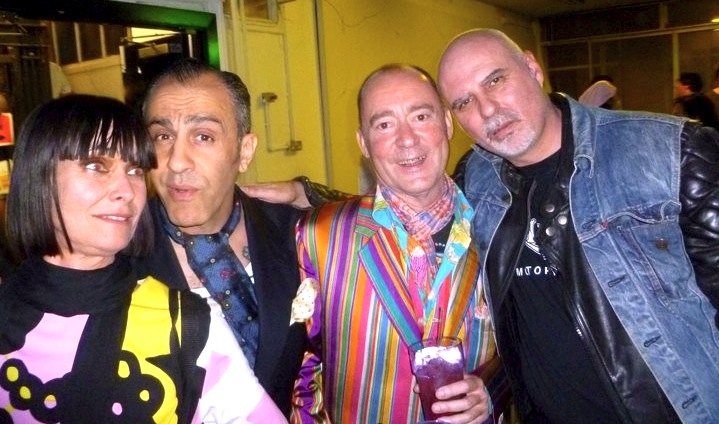
Corinne Drewery, Christos Tolera, Stephen Linard, Robert Leach, London,St Martin's, farewell, party

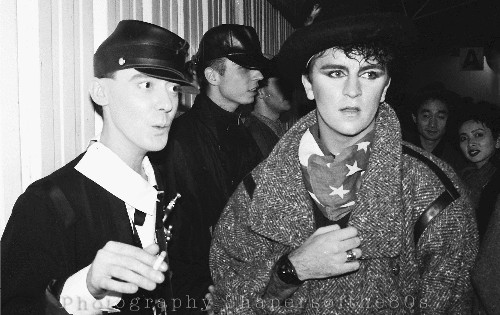
Two alumni, two gatecrashers, four ex-Blitz Kids: At St Martin’s farewell to CXR party, Corinne Drewery (fashion, Swing-Out Sister), Christos Tolera (ex-college cafe customer), Stephen Linard (fashion, own silk suit), Robert Leach (ex-Kingston — photo from his Facebook album, Goodbye Charing Cross Road, June 24, 2011)

❏ HOW TO DRESS FOR A ONCE-IN-A-LIFETIME PARTY — Fashion note by Stephen Linard (class of ’81, pictured above):
“That suit is a one off from 1990, silk rep candy stripes, to my own design. I was the belle of the ball. Etro print shirt, Drake’s linen madras check scarf, printed pastel paisley hank, lime-green suede Paul Smith Hush Puppies.”
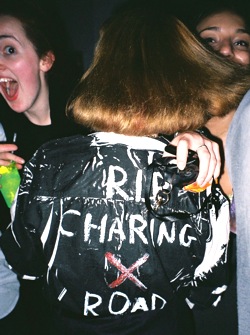
Willie Walters,St Martin’s, farewell party

Partying with her stars: Willie Walters, BA fashion course director, in a shirt by Lucie Sutton. Photographed by Alexandra Gordienko

❏ Kay Barron, FCP/CSM graduate, reports at Grazia Daily:
“Everyone regressed to their student selves. In fact some (sorry) became even younger when Pulp took to the stage. I would like to apologise for pushing, screaming and bouncing on people’s feet like a 16-year-old as Jarvis (an ex-student himself) wiggled his way through Disco 2000, Sorted for Es and Whizz, Misfits and Common People (natch). They have never sounded better.

“This party was as legendary as the college. Beyond any fashion party, as no-one was putting on airs and graces, everyone was relaxed and felt bloody lucky to be there.

“St Martin’s is bigger than a building. Give it a year or two and the spanking new building in King’s Cross will be as rough around the edges as CXR, and another 72 years of creative genius will be shaped there. And there will be 800 new alumni enjoying Absolut cocktails, and drawing obscenities on the wall — really, all that talent, and penises are still the illustration of choice!”
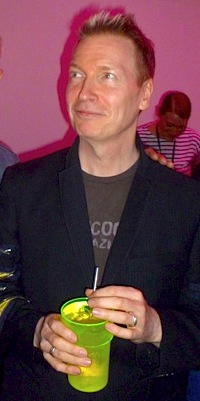
St Martin’s, farewell party, Iain R Webb

Iain R Webb Absolutly aglow. Photographed by Robert Leach

❏ Iain R Webb, CSM professor of fashion, reveals all about his 1970s soulmates at the Harper’s Bazaar blog, and puts Friday’s bash in perspective:
“The Farewell to Fashion at Charing Cross Road party was a strange cocktail (fuelled by lashings of Absolut vodka) of nostalgic sad tidings and glittering ecstasies. Past generations of graduates, from Swing Out Sister’s Corinne Drewery (who DJ’d in the Illustration studio) to Katie’s ex-classmate Giles Deacon, rubbed shoulder pads with the current cohort and a Sex Pistol — Glen Matlock, who along with the original Pistols line-up played their first gig at St Martin’s. Dressed up to the nines (and tens in some cases — the boy in the gold knitted dress that unravelled as the evening wore on), the colourful crowd (who says fashion folk only wear black?) displayed a flagrantly flamboyant individuality that is the very lifeblood of the college and has played no mean part in the success of its alumni who have over the decades become big players on both sides of the catwalk.

“The St Martin’s media mafia still fills the international front rows, Twitter on about trends and play dress-up with popstars and supermodels. The party on Friday night was an appropriately loud, glittering and bumptious, sexy and downright messy affair. Confirmation of the enduring talent born out of St Martin’s School of Art.”

London,St Martin's, farewell, party, Chi He

Farewell CXR<3 thanks for the amazing memories: fashion print-maker Chi He from Shanghai (second right) and friends at the St Martin’s party. From her Facebook album

➢ Farewell CXR<3 — happy snaps from Chi He’s party album

❏ CHRISTOS TOLERA, painter, musician and not a former student, who nevertheless idled many away teenage hours in the St Martin’s cafe, reports:
“Pulp started with Misfit and ended with Common People which I listened to in the rain from Charing X Rd as I left. If I was 22 I think I would have thought it was one of the best gigs ever. Jarvis was charming in between songs and had presence but was drowned out during the enthusiastic performance.

“However the energy in the room was palpable and reminded me of the olden days, of gigs in warehouse spaces and a certain abandon rarely seen in these overly organised and calculated times. I left because I wasn’t drunk and had seen enough. It made me feel old. I didn’t really have anyone with me who was looking through the same eyes, seeing what I was seeing. There was something quite romantic about listening to the last song from under an umbrella on the street, with no one really aware that the very audible racket coming from the first-floor window was actually Pulp and not a dodgy covers band.

“All in all I found it sad. Not the band but the memory of me as a 17-year-old hanging out in the cafe at St Martin’s thinking I’d arrived only to find out I was just passing through like the rest of us. My night was summed up when the girls in the cloakroom asked why I was there and I told them I’d modelled in a seminal show (Stephen Linard’s) there in 1980. ‘Oh, that was nine years before I was born’…”

HELLO TO THE SPECTACULAR NEW UNIVERSITY CAMPUS BESIDE THE CANAL AT KING’S CROSS

King’s Cross Central, CSM, Central Saint Martins, Granary Building

King’s Cross Central: The focus for CSM’s new home will be the Grade II listed Granary Building of 1851, built to a design by Lewis Cubitt

➢ Wednesday’s Guardian G2 cover story laid out the arguments for the move — Alex Needham writes:

❏ THIS WEEK marks the end of an era, as CSM leaves its two buildings in central London and moves to a new premises in King’s Cross, just across the road from The Guardian. The move won’t be welcomed by Professor Louise Wilson, legendary course director of MA fashion, who believes that the very grottiness of the Charing Cross Road building has helped drive her students – from McQueen to Christopher Kane – to succeed. “You feel that you’re better than this corridor,” she says. “In the new building you want to hide…”
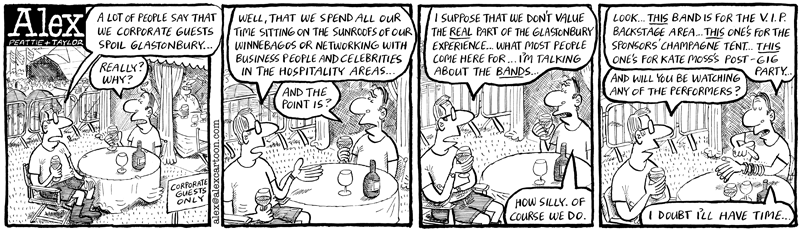
Charles Peattie, alexcartoon,

Yesterday’s topical Alex cartoon strip: created by another St Martin’s painter, Charles Peattie, together with Russell Taylor. © alexcartoon.com

FRONT PAGE

➤ The Blitz Kids WATN? No 28, Stephen Linard

drakes-london,Stephen Linard,British tailoring, haberdashery,Drake’s,Michael Hill,luxury shops, Clifford Street , London

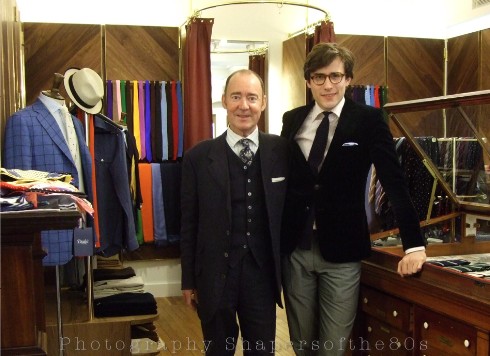
Former Blitz Kid and St Martin’s fashion graduate Stephen Linard: today he is a designer with Drake’s, the gentlemen’s haberdasher, seen here at a staff preview for the opening of its first shop just off Savile Row. Photographed © by Shapersofthe80s

❚ WACKIEST AMONG THE 80s BLITZ KID RACERS was Stephen Linard, the Essex boy who nevertheless graduated from St Martin’s art school with a first-class degree in menswear 30 years ago this summer. Modelled by six of his hunky clubland pals, his collection titled Reluctant Emigrés featured swishy draped greatcoats, pinstripe trousers and city shirts that all evinced an Edwardian air of immaculate tailoring while declaring edgy details with organza and contrast patches. Amid the women’s outfits shown by most of the other fashion graduates, Linard’s chic street-savvy lads had a gasp-out-loud impact, as commentator Suzy Menkes noted after the show. The influential South Molton Street shop Browns immediately wanted to develop the range, but Stephen decided instead to sell his original garments to a short-lived synthpop band called Animal Magnet. “I needed the money,” he says now in a shocking confession of short-termism.

A hugely original and resourceful talent, Stephen was feted by the fashion press upon graduation. His high-visibility fashion leads were key among the 15 sharpest Blitz Kids who shaped the New Romantics silhouette from Covent Garden’s Blitz club — Stephen Jones, Kim Bowen, Lee Sheldrick, Helen Robinson, Melissa Caplan, Fiona Dealey, Judi Frankland, Michele Clapton, David Holah, Stevie Stewart, Julia Fodor, Dinny Hall, Simon Withers and über-wag Chris Sullivan were the others. Most significantly, Linard advertised his bizarre imagination by changing his appearance on an almost daily basis, from his foppish Fauntleroy dandy, to the Endangered Species outfit made from animal skins, to the Bonnie Prince Charlie tartans copied for his character in Worried About the Boy, last year’s TV biodrama on Boy George, who became a soulmate the moment Stephen walked into Billy’s club, where the Swinging 80s were hatched in 1978.

Click any pic below to enlarge Linard’s degree collection 1981:


So… where is he now, the dignified Stephen Linard pictured this month sporting a three-button, three-piece linen suit in a faded shade of indigo, and handmade in Venice? Well, since 1989 Stephen has been on the design team at Drake’s, the respected men’s haberdasher which has just opened its first shop at No 3 Clifford Street, just off Savile Row, the global epicentre of serious tailoring. Those with fond memories of Bowring Arundel & Co — for whom Stephen’s late father once supplied handmade leather goods — have welcomed the arrival of the new shop.  Though Drake’s was founded in 1977, the firm has never had its own retail outlet.

Michael Drake, a former head of design at Aquascutum, was its co-founder (and incidentally, “my grandmother’s nephew,” Stephen said). He began making the finest accessories, from cashmere scarves and printed silk handkerchiefs to knitwear, shirts and the elegant neckwear that has made Drake’s the largest independent producer of handmade ties in England. It enjoys a prodigious export market, by designing collections for international luxury shops and collaborating with such style-leaders as the Japanese fashion label Commes des Garçons.

drakes-london,British tailoring, Clifford Street,London, Michael Drake, handmade ties, haberdashery,Adam Dant

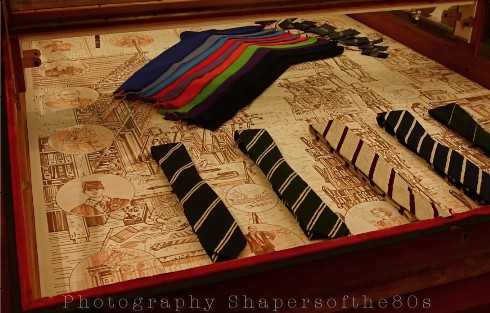
The young Linard by artist Adam Dant: lining this antique vitrine at Drake’s new shop is a busy tableau of life at the firm’s Clerkenwell factory. At lower left we see a youthful portrait of the designer alongside some of the handmade ties in fine Shantung silk Drake’s is renowned for. Photographed © by Shapersofthe80s

Today the creative director Michael Hill encourages his designers to refresh the seasonal ranges with new textiles, both for readymade production and for bespoke handcrafting at Drake’s workrooms in the artisan quarter of Georgian Clerkenwell. A revival of bespoke suit-making has seen a new appetite for accessories in raw shantung and Indian tussah silk — its slubbed texture playing well with both formal suits and casual jackets — as well as traditional madder silk from Macclesfield in Cheshire, where Stephen is a frequent visitor ensuring that exacting standards are met.

A stylish touch to Drake’s new strategy has been to recruit the impish graphic artist Adam Dant, whose witty drawings adorn the shop and the stylishly written Drake’s website. In particular it commissioned him to create one of the Hogarthian “mockuments” which won him the Jerwood Prize. Rather like flowcharts, these reveal the inner workings of an institution and its people, and Dant’s depiction of Drake’s Clerkenwell factory provides the lining to one antique vitrine, formerly property of the Victoria and Albert museum and now in Clifford Street, displaying shantung ties and enormously long (in the Italian style) knee-socks.

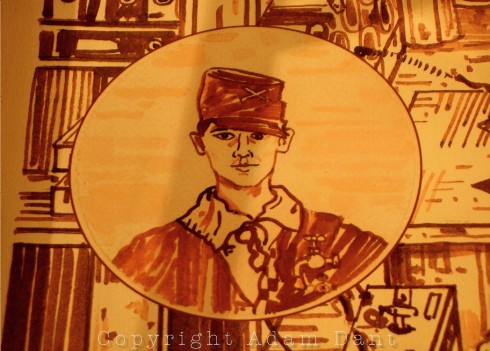
Included among Dant’s portraits of colleagues who are said to have influenced Michael Drake is Stephen Linard’s and it echoes an emblematic photograph published in i-D magazine in which he wears a Yohji jacket and jaunty Confederate Army leather cap, “bought in Anchorage airport in the days when I was rich — bathtubs filled with champagne”. This is a reminder of the period 1983–86 when he lived in Tokyo designing for Jun Co, the fashion giant, on a salary which, he liked to boast, exceeded the prime minister Margaret Thatcher’s. In the mid-80s, to be an English designer brought you popstar status in Japan, as those fellow Blitz Kids Stephen Jones and Lee Sheldrick also discovered.

drakes-london,British tailoring, Clifford Street,London, Michael Drake, handmade ties, haberdashery,Adam Dant

Close-up of the portrait: Linard is one of many talents associated with Drake’s who have been captured by the artist Adam Dant. His reference was a photograph dating from 1983 — note the ornamental bath tap. Courtesy of Adam Dant and Drake’s

The 1983 look that inspired the portrait: Stephen Linard sports a leather Confederate Army cap $15 from Alaska, and Yohji Yamamoto jacket £250, over giant-collared Yohji shirt £120. Artfully placed on his left lapel is a silvered bathroom tap £60 and faucet brooch £40, both from a jewellery collection for Chloe, Paris. Seen here with Lee Sheldrick (rear) and Steve Strange at the Worlds End fashion show in Paris that October. Photographed © by Shapersofthe80s

Long before he joined the “Japanese invasion” effected by Britain’s emergent new wave of streetwise fashionistas, Stephen had gained the admiration of the international fashion glossies. With 1983 came his collection Angels With Dirty Faces, inspired by the Bogart-Cagney gangster movie set in the 30s depression. It was both pretty and poignant and it sold worldwide. That year, the snappiest magazine of the day, New York, headlined a special fashion section The British Are Here, and selected as the UK’s five leading lights Jean Muir, Zandra Rhodes, Katharine Hamnett, Vivienne Westwood — and Stephen Linard, “one of the most creative of the young designers”.

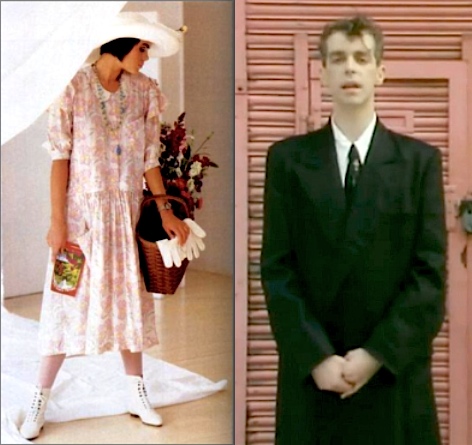
Linard designs from his heyday: bias-cut tea dress, $100 in Bloomingdale’s, from his 1983 Angels With Dirty Faces collection, here photographed by Tony McGee for New York magazine. Right, Neil Tennant wears a Reluctant Emigrés topcoat by Linard in the Pet Shop Boys video for West End Girls (Parlophone 1984)

Stephen’s clothes had always been sought after by his popstar contemporaries from Spandau Ballet, Boy George and The Slits, to U2, Womack & Womack, even Cliff Richard and Johnny Mathis, and ultimately to the great god David Bowie himself. (Stephen had to turn down the invitation to go on location to appear in the Ashes to Ashes video in 1980 “because I was on a disciplinary warning at St Martin’s over attendance”!) His Reluctant Emigrés collection enjoyed a curiously long life and in 1984 we see Neil Tennant lording it in one of the black linen topcoats in the Pet Shop Boys video for West End Girls, their first single which went to No 1 in the UK and US.

Many Linard looks have been coveted by the fashionistas but, as with so many gifted designers, let’s say a head for business came second to his eye for fashion. The timing of funds hit the rocks in more than one of Stephen’s creatively successful ventures, and decades ago he complained loudly that the St Martin’s fashion department didn’t do enough to equip graduates with basic business skills. (This, we are assured, has since been addressed by the college.) In the end it wasn’t surprising that he accepted the offer to join the Drake’s family, which seems to have dealt him a lucky hand.

One tip for wearing the perfect handmade tie? “Never tuck the smaller blade through the ‘keeper’— the loop on the back of the large blade. Much more stylish to let it flap free. Like undoing the button-cuff on your jacket, to show you don’t care.”

drakes-london,British tailoring, Clifford Street,London,Augustin Vidor, Michael Drake, handmade ties, haberdashery,Stephen Linard

The new shop in Clifford Street: Linard joined the Drake’s design team in 1989 whereas sales assistant Augustin Vidor is currently an intern. Photographed © by Shapersofthe80s

FRONT PAGE

2011 ➤ When Shirl asked Peps if she fancied an arena tour, Peps said to Shirl, Why not?

❚ ON THE EVE OF THE HERE & NOW TOUR, Shirlie Kemp from 80s pop duo, Pepsi & Shirlie, talks to Vanessa about reuniting with Helen “Pepsi” DeMacque after 20 years — and why the reunion took so long. Answer: “Because when I had my daughter I realised that was all I wanted. I had a beautiful husband, Martin Kemp, a beautiful baby, and I wasn’t going to risk losing that.” Shirlie (née Holliman) also recalls how she joined Wham! as a backing singer to two of her former schoolmates, Andrew Ridgeley and George Michael. When Pepsi & Shirlie went their own way in 1986 their debut single Heartache went to No 2 in the UK singles chart and the American dance chart.

➢ The Here and Now 10th anniversary seven-city tour runs June 24–July 2, 2011, taking in Birmingham’s LG and London’s O2. Starring Boy George, Jason Donovan, Jimmy Somerville, Belinda Carlisle, Midge Ure, Pepsi & Shirlie and A Flock of Seagulls

FRONT PAGE

2011 ➤ EPIC forecasts for the 2015 media landscape loom closer than we think

Robin Sloan , Matt Thompson, Poynter Institute, EPIC 2014, EPIC 2015, new media

A decade from now, it has never been easier for people to make their lives part of the media landscape . . . The press, as you know it, has ceased to exist. After the News Wars of 2010, The New York Times loses a supreme-court battle with Google and eventually goes offline as a print-only newsletter for the elite . . . 20th-century news organisations are a remnant of a not too distant past.
— EPIC predictions made in 2004

❚ SUCH UNWELCOME FORECASTS of global media convergence were made in 2004 by two young Americans, Robin Sloan and Matt Thompson, alumni of the Poynter Institute. EPIC 2014 was the title of a flash slideshow made by Sloan and Thompson for the fictitious Museum of Media History. Set in 2014, it charted the history of the internet from 1989, and envisaged an evolving mediascape and the impact of online technologies on print and on daily life. It coined the word “Googlezon” from a putative merger of Google and Amazon to form the “Google Grid”, and predicted “news wars” after which the online New York Times reverted to being a print-only paper for a literate, elderly elite.

EPIC 2015, GooglezonThe emergent media mechanism was dubbed EPIC — the Evolving Personalised Information Construct — which spookily anticipated Google Maps and GPS matched to personalised data capture, all too familiar to us today through Google, Facebook and mobile phone apps.
Epic 2014 was prescient and unnerving in 2004. As superfast broadband was rolled out many of its prophecies came into existence, and a year later MySpace was being bought by Rupert Murdoch’s News Corporation. Epic 2015 was an updated sequel in 2005 only marginally less dystopian than the original. Its vision will certainly rattle the confidence of all affected by the latest concerns at Guardian News Media (GNM) in the UK.

➢ View Epic 2015 — an eight-minute vision of a media landscape that is almost upon us

THE GUARDIAN “LOOKS TO AMERICA”
FOR ITS ONLINE FUTURE

➢ Guardian News and Media is to axe dozens of staff after it lost £33m in the last financial year — Daily Telegraph report June 17

Alan Rusbridger, Guardian News Media, GMG,

Alan Rusbridger: only the tenth Guardian editor in the newspaper’s 190-year history

“Andrew Miller, chief executive of GNM’s parent company, Guardian Media Group (GMG), told staff in a series of briefings yesterday that the group could run out of cash in three to five years unless it underwent a ‘major transformation’ . . . The Guardian will continue to publish in the morning, but will focus on analysis and opinion instead of reporting widely available news.”

➢ The Guardian faces going out of print after warning of a cash crisis — Daily Telegraph report June 18

“Alan Rusbridger, the editor of The Guardian, has repeatedly had to dispel rumours that the title might stop producing printed papers altogether and become an internet-only business . . . Andrew Miller’s commitment to a ‘digital first’ strategy relies partly on launching an online-only New York office later this year, which he hopes will help take The Guardian’s website into the top 10 most read in the US, where advertisers would automatically include it in major national campaigns.”

➢ Update June 27 from Media Guardian: Media guru Jeff Jarvis on what Digital First means for journalism

“News mimics the architecture of the internet: end-to-end, witness-to-world, without a central gatekeeper… Reporting is our highest journalistic priority. Telling stories will always have a role. But journalists have more roles to play today. When working in collaboration with the public — which can help news become at once more expansive and less expensive — it may be useful to help collaborators improve what they do: journalist as community organiser, journalism teacher, support system. At every turn, the question must be where can I add the greatest value? Is that necessarily in writing articles?”

➢ “We’ll all have voices in our heads by 2040” — View video of Ray Hammond, the futurologist who coined the term “online” back in 1984, discussing eight key drivers of the future as seen from June 2011. Download his latest book free

FRONT PAGE

➤ Aside from the freaks, George, who else came to your 50th birthday party?

❚ YES, OF COURSE SHAPERSOFTHE80s was at the fruit-cakiest party of the summer, and we can offer a selection of pix not widely seen in the tabloids.

Boy George, 50th birthday,Jon Moss, Barbara Moss,

That Man in the Middle: George O’Dowd celebrates his 50th birthday with former Culture Club drummer and father of three children, Jon Moss and his wife Barbara at Tuesday’s party. © Dave Benett/Getty

Boy George, 50th birthday, Dinah O'Dowd

That Boy with his doughty mum: Dublin-born Dinah O’Dowd is still up for a party at 71 even after bringing up George and five other children! She spilt the beans in her own book Cry Salty Tears (Arrow Books 2007). Spot the marzipan chameleon. © Dave Benett/Getty

➢ The Daily Mirror said it was “camper than Christmas at Louie Spence’s house”
➢ The Sun dubbed it a “bonkers bash” in print and “wacky” online
➢ Holy Moly called it “a terrifyingly horrid looking party”

❚ BRITAIN’S BIGGEST-SELLING PAPER, The Sun, couldn’t have been more shocked by Boy George’s 50th birthday party when 1,500 guests crowded into two of the largest nightclubs — Lightbox and Fire — set in railway arches at the heart of London’s gay village, across the River Thames and upstream. The area became infamous for 200 years as the Vauxhall Gardens, a fabled pleasure-seekers’ amusement park which opened in the 17th century and closed only in the 19th. It was deliberately sited outside London’s city limits and also its by-laws, so that Fielding’s novel Tom Jones immortalised the gardens as a place “where people come to undo others — and others come to be undone”.

This morning’s Sun spluttered: “As well as a host of transvestites, George, sporting a black top hat, was joined by a selection of PVC-clad ghouls and other creepy-looking creatures, some clad in bondage gear. One man even had his head fixed inside a bird cage.” A “source at the party” — with this phrase The Sun was distancing itself from the unimaginable goings-on — reported : “It wasn’t for the faint-hearted. Some of the outfits were a little weird.”

Shapersofthe80s can’t compete with the selection of frenzied ghouls pictured in The Sun and other tabloids, largely because we were idling in the quiet outdoor tents and feeling our age with some of the original Blitz Kids a couple of years older than George, the baby of his clubbing generation. We had a good dinner first and arrived when the weirdness was in full swing, genuinely surprised that, despite the ravages of 30 years, a sizeable contingent of ex-Blitz Kids had turned up out of loyalty to Britain’s chief genderbender. The keener ones showed up on time to get their faces into the early-edition pap pix, though a lot of cool people didn’t. For many, the prospect of a free bar 8–10pm didn’t provide the bait it once would have done.

Boy George, 50th birthday,Holly Johnson

That Boy with Holly Johnson: the vocalist with 80s shock-band Frankie Goes to Hollywood is today a painter whose work has been exhibited at the Tate Liverpool. © Chris Jepson

Boy George, 50th birthday,Emma Woollard , Jeremy Healy

Among George’s guests: artist Emma Woollard and Jeremy Healy, formerly half of 80s pop duo Haysi Fantayzee, today a prominent club deejay who also provides music for fashion shows — until recently John Galliano’s. © Dave Benett/Getty

Cameron Jones, Roman Kemp, Boy George, 50th birthday, Paradise Point

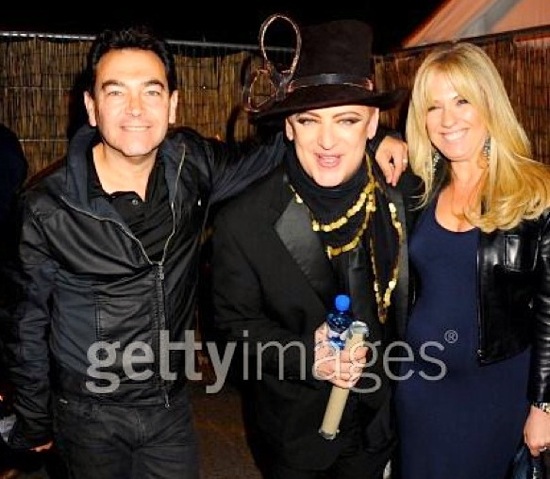
That Man in the Middle: his two gorgeous companions are budding stars from London’s new livepop band Paradise Point, singer Cameron Jones with bass player and former schoolmate Roman (son of Martin) Kemp. © Getty Images

Relaxing at last into middle age, the very Blitz Kids who perfected the idea of “Your Look” while shaping the Swinging 80s left the showing off to the kids at the party who thrill to dress as an inflatable rubber sex doll, or to attach to their naked vital parts every toy and fruit that drag acts have been dangling before all-male audiences at the nearby Royal Vauxhall Tavern since World War Two.

The notion of originality seems strangely lost on today’s drag queens and seven-foot tall trannies whose platform boots clomp through every poser nightclub in town as they push their way, as if by right, to the front of every bar queue. (And manage not to catch the barman’s eye. How does that work?) Back in the mists of New Romance, in 1979, the oldtimers each established their own Look not only to gain them admission to the Blitz Club but to personify their individual attitude. And after “the party that lasted four years”, dressing up as a nightly competition lost its novelty. By the mid-80s each Blitz Kid had arrived at a visual brand statement that had or would launch their careers and more or less last them for life… a personalised image that declared self-evidently I am a Serious Professional and This Is What I Do: I am Urban Deejay, I am Pop Stylist, I am Comic Relief Wannabe, I am Wideboy Producer, I am Dior’s Next Choice, I am Westwood Trainwreck, Pop Art Object, Rock Idol, Mockney Wag, or Sex on a Stick (for eternity, I hope).

The brightest and the most single-minded Blitz Kids always will embody Essence of Glamour — subtle, immaculate, witty, first. (Just look at the picture of Julia below!) They still populate the two core tribes, the Exquisites or the Peculiars. By their Themness shall they be identified. All respect to Peter York, whose definitive essay on Them appeared in Harpers & Queen as long ago as 1976, and should be required reading for anybody who isn’t, well, Homer Simpson.

Boy George, 50th birthday,Pepsi DeMacque,Martin Kemp, Steve Strange, Shirlie Holliman

Among George’s guests: Pepsi (DeMacque) & Shirlie (Holliman, today Mrs Kemp) flank actor and Spandau Ballet bassist Martin Kemp, and Steve Strange, former Blitz Club host who made his reputation in the 80s by changing his clothes daily. © Dave Benett/Getty

Boy George, 50th birthday, Princess Julia, Julia Fodor, Jeffrey Hinton

Among George’s guests: former Blitz Kids (and indeed Blitz coatcheck girl) the immaculate Princess Julia and the ever-scruffy Jeffrey Hinton, both today leading club deejays in the UK and abroad. © Shapersofthe80s

The arch-poser Christos Tolera facebooked after George’s party: “Well that was fun… It was like being in the 80s but without the carnage… Never have I seen so many old people looking so good.” And indeed it did seem that even Steve Strange — especially Steve Strange — had applied five times the Essex-Girl minimum of bronzer to create this season’s visage.

What was mildly heart-warming on Tuesday was to realise that who turned up was itself confirmation of the bonds of friendship within the Blitz camp. Yet the apprehension in the air was palpable as pleasantries were shared. One or two did cut the others dead. Over three decades, there have been fallings-in-love and fallings-out… recriminations and insults and envy as people stumbled through life’s great obstacle course… Many have succumbed to temptations that only will-power and time can heal. Some discovered that dreadful experiences can enrich the soul, others that to scratch a lover is to find a foe… Peter Ustinov believed: “Friends are not necessarily the people you like best. They are merely the people who got there first.” We are where we are. Would old romantics really want it any other way?

Boy George, 50th birthday,Sue Tilley,Stephen Linard, Les Child

Among George’s guests: designer and former Blitz Kid Stephen Linard, the biographer of Leigh Bowery and Lucian Freud model Sue Tilley, with dancer Les Child who has choreographed countless pop promos and tours since the 80s. © Shapersofthe80s

Boy George, 50th birthday,Stephen Jones, Judith Frankland

Among George’s guests: celebrated milliner Stephen Jones with his tie being worn on an unusually rakish tilt, meets up for the first time in decades with Judith "Ashes to Ashes" Frankland whose pink crimped hair seems inspired by Bette Davis as Baby Jane. © Alice Shaw

❏ NAMECHECKS — Amid the trannies at the party (deciphering genders proved quite a challenge at times) were a few genuine female celebs such as designers Pam Hogg, Judith Frankland, Stevie Stewart, singers Beth Ditto, Sonique Clarke, Pepsi & Shirlie, author Sue Tilley, artist Emma Woollard, heiress Daphne Guinness, promoter Rose Turner, deejay Princess Julia and broadcaster Janet Street Porter, whose landmark TV documentary 20th-Century Box put the Blitz Club obsessives on the media map in 1980…

Non-transvestite males included ex-Culture Club members Jon Moss, Mikey Craig, musicians Holly Johnson, Martin Kemp and son Roman, singer Cameron Jones, choreographer Les Child, milliners Stephen Jones and Philip Treacy, stylist Judy Blame, model Luke Worrall, restaurateur Paul Murashe, deejays Fat Tony, Rusty Egan, Jeremy Healy, Jeffrey Hinton, Mark Moore, Brandon Block, designers Rifat Ozbek, David Holah, Stephen Linard, impresario Phil Polecat… Who didn’t we see in the crowd?

Boy George, 50th birthday, Stevie Stewart, David Holah

Among George’s guests: ex-Blitz Kids Stevie Stewart and David Holah, the clubland designers behind the funkiest, trippiest label of the 80s, Bodymap. © Shapersofthe80s

Boy George, 50th birthday,Alice Shaw, Eve Ferret

Among George’s guests: Alice (fromthepalace) Shaw, lifelong pal of George who campaigned to find witnesses to this year’s assault on nightowl Philip Sallon, seen with Blitz Club cabaret star Eve Ferret, who recently returned to the boards in London’s West End. © Alice Shaw

Boy George, 50th birthday,Slippry Feet,Jody and Bayo

Among George’s guests: Emma, Jody and Bayo, the dancing feet behind the Most Promising Cabaret Act of 1989, Slippry Feet, and still bringing laughter to, er, millions. © Shapersofthe80s

Boy George, 50th birthday,Christos Tolera ,Judith Frankland

Among George’s guests: former Blitz Kids, painter Christos Tolera, who once sang with Blue Rondo à la Turk, and fashion designer Judith Frankland, who appears in Bowie’s Ashes To Ashes video and in the header to this website. © Shapersofthe80s

➢ Interview: Boy George hits the big Five-0 and says, yes, he has ‘lots of regrets’

FRONT PAGE