➤ Fassbender is the new man inside Big Frank’s papier-mâché head

Maggie Gyllenhaal, Michael Fassbender ,Domhnall Gleeson,Frank Sidebottom,movies, Film4,Lenny Abrahamson

Filming Frank: Maggie Gyllenhaal, Michael Fassbender and Domhnall Gleeson in the New Mexico desert. (Picture: Artificial Eye)

❚ WITH TIMPERLEY COMEDY LEGEND, Frank Sidebottom, cremated barely 18 months ago, a biopic titled simply Frank started shooting this week in New Mexico. Making his feature debut as a screenwriter is Jon Ronson, former member of Frank’s Oh Blimey Big Band in the 80s and investigator into
The Men Who Stare At Goats. The comedy about a young wannabe musician is a fictionalised account of the life of Lancastrian cult comic Chris Sievey, who was revealed finally in death as the creator of Frank Sidebottom, a character recognised across the North by his outsize papier-mâché head.

Ronson is co-writing the script with the Oscar-nominated Peter Straughan (Tinker Tailor Soldier Spy), while Film4, the BFI, the Irish Film Board are signing the cheques. The Irish director Lenny Abrahamson has marshalled an exceptional cast led by Michael Fassbender, Domhnall Gleeson, Maggie Gyllenhaal, and Scoot McNairy …

➢ Read more news of Frank-the-movie online at Heyuguys

➢ RIP Big Frank and Little Frank – Comprehensive coverage of Frank Sidebottom’s 2010 funeral and tributes at Shapersofthe80s

➢ I was the keyboard player with the Frank Sidebottom Oh Blimey Big Band – Jon Ronson in The Guardian, 2006

FRONT PAGE

➤ Webb lays bare the subversive story of British fashion in the 80s

Scarlett Cannon ,Iain R Webb, books,As Seen In Blitz, Fashion, 1980s,Style,Blitz Kids

80s club host Scarlett Cannon wears Hermes on the cover of Iain R Webb’s new book: “One of the things I love most about this photograph is that David just drew around Scarlett and darkened the background with a pencil to make her stand out more.” (Photograph by David Hiscock. Make-up, William Faulkner)

❚ FINALLY A BOOK ABOUT THE 80s without George O’Dowd’s face on the cover! Here comes the other version of the Swinging London of 30 years ago, created by the fashionistas, rather than the music entrepreneurs, and the face of Cha-Cha club host Scarlett on the cover defines another version of events exactly. It comes just in time to chime with the V&A’s second landmark exhibition this year. From July 10, following the Bowie extravaganza, comes Club to Catwalk: London Fashion in the 1980s, which includes a display of denim jackets commissioned in 1986 by Blitz magazine from key London-based designers. Who better to sort the Who’s from the Who Nots than one of the seminal clubland Blitz Kids, Iain R Webb.

During those fertile years in the re-energising of the capital’s youth culture through nightlife, when he shared a flat with fellow St Martin’s design students Fiona Dealey and Stephen Jones, Webb says his peers were “cultured clubbers – our aim was to push the parameters and explore the ideals of glamour, imagery, sexuality and taste. We were determined to challenge the status quo and maybe even change the world, even if ‘just for one day’.”

Iain R Webb,Blitz Kid, fashion, journalism

Webb: from Blitz Club to The Times

Having studied fashion at St Martin’s, Webb says he “fell into writing” and went on to become fashion editor of Blitz magazine, the Evening Standard, Harpers & Queen, The Times and Elle.

This week his new book, As Seen In Blitz: Fashioning 80s Style, went off to the printers, to be published in April by ACC (272 pages, £27.30 pre-order price). With previously-unseen archive content and much oral history from key designers, it chronicles the fashion pages Webb created for Blitz magazine 1982–87, after the New Romantics fad had died the death. Webb’s subversive images gave free rein to the imagination and involved a global cast of designers including Comme Des Garcons, Jasper Conran, John Galliano, Jean Paul Gaultier, Katharine Hamnett, Hermes, Pam Hogg, Marc Jacobs.

Blitz magazine,fashion,style,1980s, London, pop music

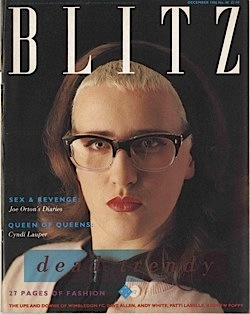
Blitz December 1986: Dead Trendy fashion special. Martine Houghton photographed by Gill Campbell. Make-up, Gregory Davis. Hair, Rick Haylor

Webb says: “The book has over 100 contributors – designers and photographers from the Bodymappers to Nick Knight, and loads of models, make-up and hair peoploids in between.”

At its launch in 1980, Blitz magazine posed little threat to the fondly remembered Face magazine, which majored on music and style. Blitz wandered a disparate social world of its own well to the west of the Soho trendsetters – but eventually, under the influence of Webb, photographer Knight and other cool arbiters of taste, it gradually clicked into the Swinging London groove that saw the UK capital become a crucial stopover for the world’s media and buyers during the biannual round of international fashion shows.

Webb himself went on to win the Fashion Journalist of The Year Award in 1995 and 1996. Today he consults for the Fashion Museum in Bath and is a visiting professor at Central Saint Martins, LCF and the RCA.

FRONT PAGE

➤ Stomping like the 70s but with Nutter style

Nutters of Savile Row, Peter Werth, London Collections Men,fashion,Cafe de Paris,

Dance-off Wigan fashion: The finale to the Nutter-Werth men’s collection at the Café de Paris. (Videograb from milavictoria)

❚ EXTRAVAGANT AND OVERSTATED could readily describe both the whole-body dance moves of Northern Soul fanatics, and the rock-and-roll men’s tailor Tommy Nutter, the Savile Row rebel who favoured gigantic hand-rolled lapels and Oxford bags. Last week the fashionistas attending a Café de Paris “runway” show during the London Collections for men certainly caught the uninhibited exuberance of the 1970s, as the videos here show.

An unexpected collaboration between high-street retailer Peter Werth and Nutters of Savile Row produced a show of two halves. It opened with regular jackety models in skinny pants who were upstaged by an explosion of casual soulboys in knitwear and baggies. The Café’s dancefloor suddenly became the fabled Wigan Casino, about 1975, climaxing with a jack-in-the-box dance-off to the stomping beats of Luther Ingram’s If It’s All The Same To You Babe.

+++
All very sporty for AW13 with classy fabrics and jaunty tailoring bringing a gentlemanly vibe to the look, described by designer David Mason as “Studio 54 meets Wigan Casino” (which closed in 1981). The dancers in fact turned out to be from the cast of a debut feature film titled Northern Soul, written and directed by Elaine Constantine, about two lads swept up in the subculture when they discovered uptempo American soul music. Creating a wardrobe for the film forged the alliance between the two London design houses. The current incarnation of Nutters decided it had to reach out to a ready-to-wear audience, and Peter Werth, today owned by JD Sports, is strong on working-class savvy.

+++
➢ Northern Soul, the film due for release this summer
➢ Britain’s got talcum – Guardian backgrounder on training up a generation to dance in the film
➢ Soulboy, the 2010 film directed by Shimmy Marcus

THE MAN WHO GLAMORISED SAVILE ROW

❏ Tommy Nutter, the charmer and dandy whose father ran a North London caff, would no doubt have voiced some self-deprecating witticism at today’s move to widen his market. The young Nutter wanted to work for the 60s designer Michael Fish and when he bumped into him said, “Can I do something with you?” Fish said, “Don’t be silly. You’ve got your own style. Do something yourself.” Nutter died in 1992 aged 49, having designed for Elton John, David Hockney, both the Jaggers, the Rolling Stones, David Bowie (Pinups), and for three of the Beatles who wear his outfits on the Abbey Road record sleeve, likewise Jack Nicholson as The Joker in Batman, the 1989 film. Nutter shook up Savile Row by injecting softer cuts and bold fabrics into the bespoke man’s suit while respecting classic tailoring. His was the first shop on the prestigious Row to design for women such as his backer, the pop singer Cilla Black.

Tailor Timothy Everest concludes: “Tommy’s was a brand that people wanted to buy into but within that you could be an individual and I think that’s a very modern approach. That’s what bespoke is all about.”

FRONT PAGE

➤ The Bowiesconti proxy has spoken: only second-hand interviews from here to eternity

interview, David Bowie,Tony Visconti, Where Are We Now?, Next Day

The Bowiesconti proxy: silent pop star plays puppet in the hands of his ventriloquist producer Visconti

❚ SHOCK HORROR REVELATION in today’s Times. David Bowie has been a member of Alcoholics Anonymous though seems to have abstained from drink 23 years ago. This is the bonus ball among many truths we’ve been getting closer to since the star’s 66th birthday comeback bombshell on Tuesday. Another is that he will “never do another interview again” and this itself comes from the mouth of his lifelong 68-year-old friend and producer Tony Visconti who is giving this interview to The Times. Visconti has become Bowie’s Voice on Earth, we’re told. And by the end of the two-page read, we’re so far into Smash Hits territory – Bowie’s fave TV shows are The Office and The Shield – that you’re gritting your teeth at the prospect of another 30 years of interview-by-proxy.

➢ Meanwhile here are five revelations we gleaned from today’s Times interview with the Bowiesconti proxy:

1 – A second Bowie single may be issued before the album The Next Day is released on March 11. And a second album is almost inevitable. “What he wants to do is make records. He does not want to tour,” says his Voice on Earth.

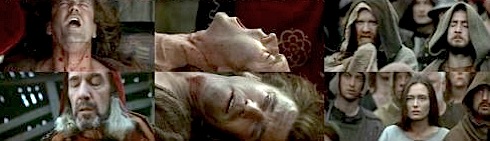
2 – An exclusive list of the 14 album tracks shows all-original material embracing adult themes of “tyrants, spies and soldiers” to reflect Bowie’s recent reading matter, as well as “love in the internet age”. Titles include Dirty Boys (about glam-rockers), Valentine’s Day (about a mass murderer), Set the World on Fire (about an unnamed female nightclub singer) while the track The Next Day is itself a gruesome number in which a man is hung, drawn and quartered in stereo (remember the final scene in Braveheart?) so you might have to look away now and have a lie-down.

Braveheart, movie, Mel Gibson

HDQ in Braveheart 1995: Mel Gibson takes it like a man

3 – During Bowie’s cocaine-fuelled Berlin years recalled on the new single, Where Are We Now?, his Voice says: “We’d have both been dead if we’d carried on.” Visconti stopped taking coke in 1984. Both men went to AA and we’re invited to deduce that Bowie has passed his 23rd anniversary without a drink, placing his temperance decision at 1989, year of the Tin Machine album, itself an expression of musical regeneration.

4 – Since his heart op in 2004 rumours have circulated that Bowie also has cancer. “They’re categorically not true,” says the Voice. “He is incredibly fit because he takes care of himself. He looks rosy cheeked.”

5 – Big letdown for the gayers: while living in Berlin David and Iggy had separate bedrooms in their seven-room Hauptstrasse apartment. Did their relationship go beyond friendship? “No, absolutely not.” Aw, c’mon. What about the Ziggy years? “I never witnessed him with a boyfriend,” Bowiesconti declares. “He said Ziggy stardust was a persona.”

After slapping us with this big wet fish, perhaps Tony Visconti can rehearse a few laughs for his next major interview as the proxy David Bowie, otherwise Jonathan “The Joker” Ross will hog the limelight as usual.

JAN 13 UPDATE

➢ New from the Sunday Telegraph interview with the Voice on Earth:
Despite all reports to the contrary, Visconti reveals that Bowie may actually perform these songs live. “He doesn’t want to tour any more. He’s had enough of it. But he hasn’t ruled out that he might do a show.”

Will there be another record? “We recorded 29 titles. We have at least four finished songs that could start the next album,” says Visconti. “If all goes well, we will be back in the studio by the end of the year. He’s back. Bowie has found out what he wants to do: he wants to make records. Nothing else.”

➢ Jan 13: David Bowie secures first Official Top 10 Chart single in two decades – Arriving at Number 6, Where Are We Now? becomes his highest charting hit since Absolute Beginners reached Number 2 in 1986.
➢ Shock and awe verdicts on Bowie’s born-again masterpiece
➢ Riddle of the train Bowie could not have taken in
Where Are We Now?

FRONT PAGE

➤ Riddle of the train Bowie could not have taken in Where Are We Now?

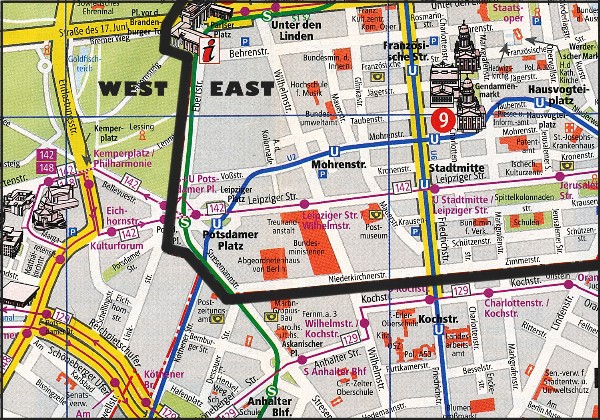
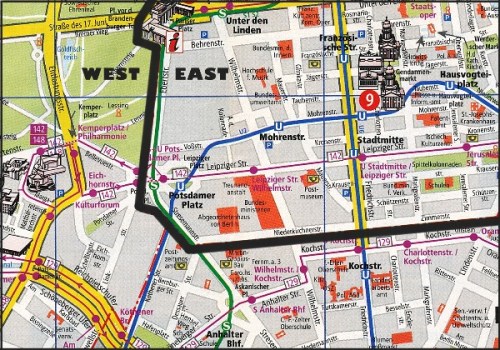
Divided Berlin: the wall shown in black places the U-Bahn station (blue) at Potsdamer Platz inside the Soviet sector, along with the S-Bahn station (green)

Divided Berlin: the wall shown in black places the U-Bahn station (blue) at Potsdamer Platz inside the Soviet sector, along with the S-Bahn station (green)

❚ THE NEW MUSIC VIDEO for Where Are We Now? raises challenges during David Bowie’s nostalgic Berlin city tour that his fans expect to decipher. Lesser mysteries were quickly cracked this week:
1 – The woman’s face on the cuddly toy is the video director’s wife Jacqueline Humphries.
2 – The T-shirt slogan “m/s Song of Norway” refers to both a retired and renamed cruise ship (Royal Caribbean has used Iggy Pop’s Lust for Life in its commercials), and an operetta that was made into a film starring Bowie’s onetime girlfriend Hermione Farthingale who inspired a song.
3 – The closing shots of the Siegessäule (Victory Column) resonate also as the title of Berlin’s gay community magazine.
4 – The lyric’s curious non-idiomatic phrase “walking the dead” coincidentally references the title of an American drama about a transgendered person.

But the real Poirot Puzzler raised by the opening line of the song is this: *How* did Bowie “get the train from Potsdamer Platz” (incidentally, or deliberately, misspelt on screen) to reach his Berlin haunts in the 70s? Today any of us can easily take the U2 towards Nürnberger Strasse, the lyric’s next destination, where once, he sings, he would sit in the cool Dschungel nightclub frequented by assorted popstars (his favourite seat was on a balcony overlooking the bar). We can also take the S1 line south from PP to the trendy Schöneberg district where Bowie used to share rooms with Iggy Pop.

But not when Bowie lived in Berlin, during the years now identified with his Berlin Trilogy of albums, 1976-79. Why not? Because of the 12-ft high Wall, fortified with minefields, anti-tank defences and ruthlessly guarded, the symbol of communism which had divided the city since 1961. As we see from the map (above) both the stations for the S-Bahn surface train line and the U-Bahn underground line lay on the East side of the wall within the Soviet sector.

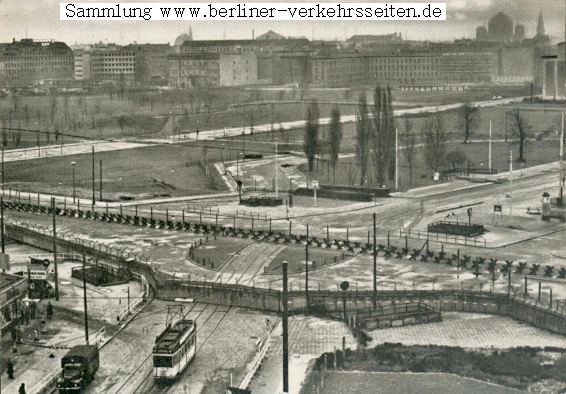
In the late 70s the site of Potsdamer Platz was a wide-open wasteland on the East of the Wall, a No Man’s Land chillingly known as the Kill Zone, where guards could gun down the continuing stream of desperate East Berliners courageous enough to make a dash for the West.
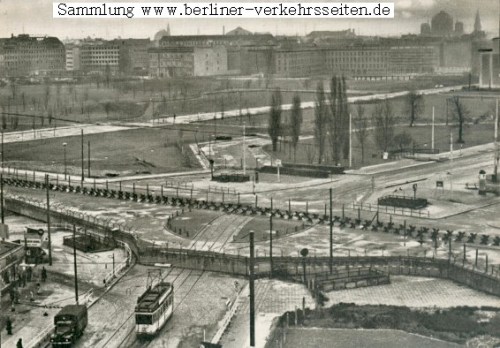
Potsdamer Platz in 1961: the postwar wasteland is divided by the Wall and was to become known as the Kill Zone

Potsdamer Platz in 1961: the postwar wasteland is divided by the first low-rise Wall and was to become known as the Kill Zone

Bowie’s workplace, the Hansa Studios where he recorded Low and Heroes, actually overlooked the Wall from the American sector, in Köthener Strasse a few yards south of Potsdamer Platz. Catching sight of two lovers near the Wall inspired the theme for the number, Heroes, in 1977, one of his most creative song-writing periods.

But Bowie could not have taken his train from either of those stations because they had been closed and barricaded when the Wall was built. Western trains continued to cross East Berlin along lines which emerged in the West but they passed through without stopping at many such stations which became known as Geisterbahnhöfe (ghost stations). Concrete collars at tunnel entrances scraped the sides of the trains to deter escapees from clinging to them. Half a lifetime later, on March 3, 1992, the S1 stop in Potsdamer Platz was the last ghost station to reopen after the reunification of Germany.

➢ Elsewhere at Shapersofthe80s:
Shock and awe verdicts on
Bowie’s born-again masterpiece

Perhaps Bowie departed from some other station? What about the 19th-century regional railway terminus called Potsdamer Bahnhof, you say? It fed ritziness into the heart of the metropolis and Potsdamer Platz became one of Berlin’s busiest traffic intersections where famously Europe’s first traffic lights were installed in 1924. The whole area was, however, laid waste during World War Two and the last trains you could have taken from this station ran in 1945.

Ah, yes but what about the innovative M-Bahn, the Magnetic Levitation line which powered south from the Philharmonie, skirting the Wall by Potsdamer Platz as it headed down to the river? Sorry, this didn’t open until 1989.

So how on earth did David Bowie take his train from Potsdamer Platz?

Is our hero indulging some romantic fantasy on behalf of an East Berliner during the 70s, making a wistful trip to the freewheeling delights of Schöneberg and the KaDeWe department store that became an attainable dream only after the fall of the Wall – as he sings, by crossing the Bösebrücke on November 9, 1989?

And why the first word of the song? Why *had* he to get this train at all? He was well-known for cycling everywhere in Berlin, such was the personal freedom he enjoyed there. And why from Potsdamer Platz?
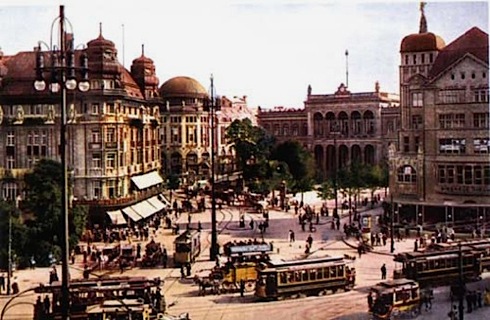
Potsdamer Platz in 1910: looking south towards the Potsdamer Bahnhof

Potsdamer Platz in 1910: looking south towards the Potsdamer Bahnhof

JAN 16 INSIGHT FROM THE NME

❏ Bowie producer Tony Visconti says of Where Are We Now?: “To me, it’s not about the three-years he spent in Berlin in the 70s. It feels like just one day he had an epiphany walking in the street.” So there we have it. A walk in the street. Puts our post above out with the trash. Still, it painted a picture of an era that is probably unimaginable for anybody who hadn’t visited the divided city between 1961 and 1989.

When Bonn became the capital of West Germany in 1949, the war-ravaged city of Berlin grew ever more desolate, despite the handful of nightclubs where hedonism was very much defined as the antidote to the privations of daily life. The Western sectors felt like a minor provincial city with a population of 2 million, mostly consisting of the elderly, because everybody else had left to make new lives elsewhere. Just turning 30, Bowie and Iggy were among the city’s youngest inhabitants and their work as musicians was one of the few productive industries in an enfeebled economy.
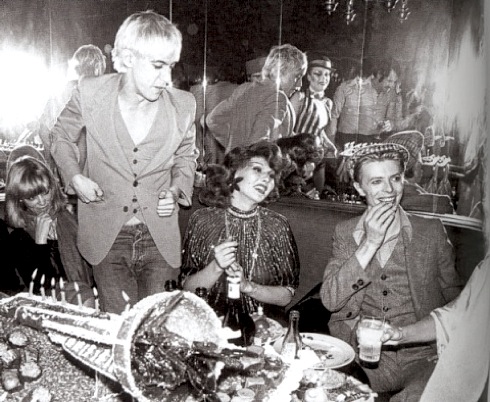
Iggy Pop, David Bowie, Berlin

Nightclubbing 1977: Bowie and Iggy enjoy the Berlin nightlife

The Soviet sector, which we Westerners were privileged to visit, unlike its citizens wishing to make the opposite journey, felt tragic: rundown beyond the point of dilapidation, with high-rise Tower blocks in the brutalist Soviet style built to ease the pressure on a crowded population and signal the “modernity” of the East. As with visits to the Soviet Union, tourists were usually conscious of being followed or at least monitored by East German security personnel, and woe betide any local who behaved in an inappropriately friendly manner toward visitors! With the Stasi (state security service) relying on family members to inform on each other, the East became a society of subterfuge, with a black economy built less on cash than barter and influence at all levels of daily life.

➢ Take The Guardian’s complete tour of Bowie’s Berlin

➢ Jan 13 update: The Observer recounts his “unrepeatable time of Sturm und Drang in the shadow of the Wall”

FRONT PAGE