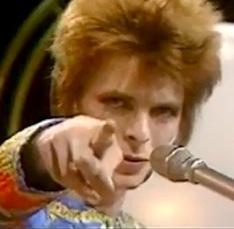
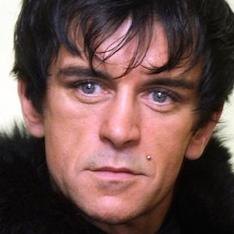
1982 ➤ How Spandau put Capaldi on the road to play the new Doctor Who

Peter Capaldi, Doctor Who, Spandau Ballet, stand-up comedy

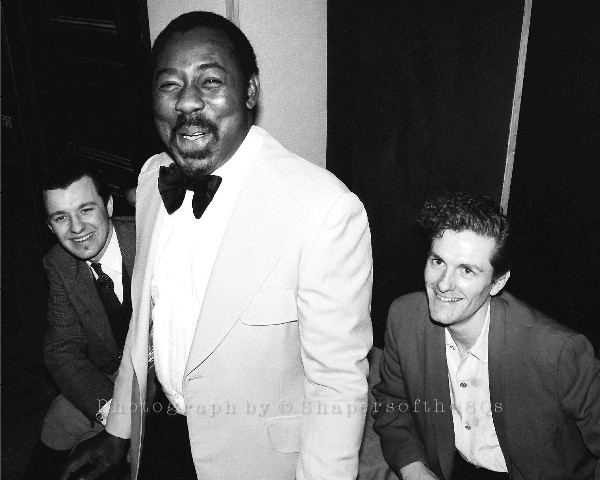
Capaldi the stand-up in 1982: onstage supporting Spandau Ballet at Bournemouth, days after Bill Forsyth saw the Glasgow show. Photographed © by Shapersofthe80s

❚ WHAT’S THE CULTIEST ROLE in all of television, the one that’s just been given to the cultiest madman in all of TV comedy? Yes the new Doctor Who is announced as Peter Capaldi, aka Malcolm Tucker, foul-mouthed spin-doctor from the multi-award-winning political satire, The Thick of It. The part won him the 2010 BAFTA Award for Best Performance in a Comedy Role.

The 55-year-old Scot will be the 12th actor to play the Doctor, a new hero for a new generation. It is not the first time Capaldi has appeared on the show – he played a Roman merchant in the 2008 Doctor Who adventure The Fires of Pompeii.

But few people seem to know how he got his big acting break in Bill Forsyth’s 1983 movie Local Hero. As a student at the Glasgow School of Art, Capaldi had been the vocalist in a post-punk band called The Dreamboys. He also took to stand-up comedy and was invited to support Spandau Ballet on their first UK tour in 1982. The famously anti-rock clubland band did not want the usual rock support act and decided a comedian would add piquancy to the uniqueness of their own approach to new music.

Spandau songwriter Gary Kemp is reluctant to take any credit as talent scout, but it just so happened that he spent quite some time in Scotland that year romantically smitten by Clare Grogan, the cute 20-year-old singer in the Glasgow pop group Altered Images.

WHAT’S ALL THE FUSS ABOUT?

➢ Doctor Who explained in 25 GIFs at Mashable – “Let’s assume you have no idea what TARDIS stands for”

Kemp, himself then 22, recalls vaguely how Capaldi came to his attention at the age of 23: “It was through Gerry McElhone who managed Altered Images. Maybe he played me a tape, or something.” Clearly he had other more important things on his mind at the time. Gig archives tell us that in May 1981 The Dreamboys played on the same bill as Altered Images at Edinburgh’s Nite Club, and in September Capaldi gave his stand-up routine, so there’s every chance Kemp met him at the bar.

The point was Grogan had starred in Forsyth’s 1981 cinema smash, Gregory’s Girl, and Spandau’s Diamond tour launched in March 1982 with three dates in Scotland and Capaldi live onstage as the warm-up.

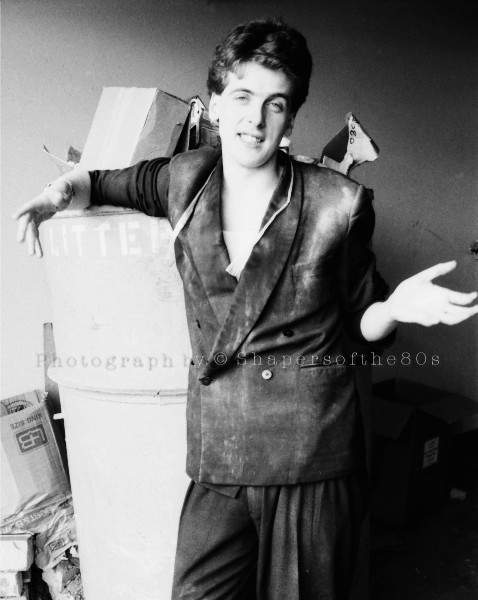
Spandau’s brief tour ended at the Winter Gardens Bournemouth [my pix are previously unpublished] but a year later, when Local Hero was released, Capaldi told me that he got the part only because Bill Forsyth had seen him at the Spandau show in Glasgow. The rest is history: a brilliantly versatile career as an actor of comedy and drama has included a cameo dad in the 2007 series of Skins, and the repressed head of news in last year’s electric BBC series, The Hour.
Peter Capaldi, Doctor Who, Spandau Ballet, stand-up comedy

Capaldi relaxing offstage in Bournemouth 1982. Photographed © by Shapersofthe80s

Steven Moffat, executive producer of Doctor Who, described casting Capaldi as an incendiary combination: “One of the most talented actors of his generation is about to play the best part on television.”

Capaldi said yesterday: “Being asked to play the Doctor is an amazing privilege. Like the Doctor himself I find myself in a state of utter terror and delight. I can’t wait to get started.” Filming begins in the autumn.

The Thick of It writer Armando Ianucci tweeted: “There can’t be a funnier, wiser, more exciting Time Lord than Peter Capaldi. The universe is in great hands.”

➢ Peter Capaldi revealed as 12th Doctor – BBC News

REVISIT DOCTOR WHO’S 13 REGENERATIONS
video, regeneration,Doctor Who, William Hartnell , Peter Capaldi

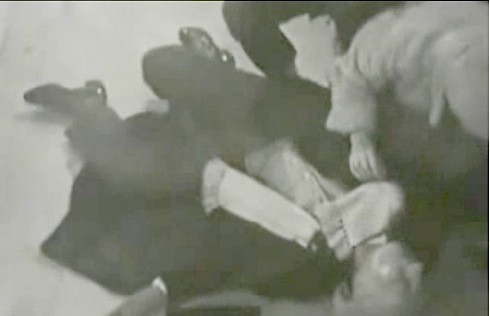
1966: The first Doctor William Hartnell becomes the second, Patrick Troughton © BBC

➢ All 13 of the Doctor’s regeneration scenes on video at Wired

➢ Update 2020: Peter Capaldi has been voted third in a TV viewer’s poll of favourite Doctor Who actors … David Tennant topped the poll organised by the programme guide, RadioTimes, with the current Doctor Jodie Whittaker (the first female to play the Time Lord) in second place. Since its launch in 1963, 13 actors have played the intergalactic traveller.

LISTEN TO THE WOULD-BE BAUHAUS VOCALIST
+++

Peter Capaldi

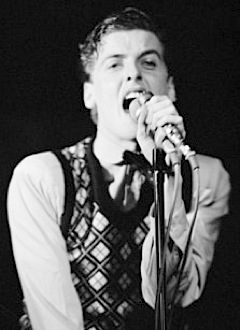
Capaldi as Dreamboys vocalist

❏ PETER CAPALDI DELIVERS Bela Lugosi’s Birthday, the A-side song from the 7-inch single by Scottish rockers, The Dreamboys, on the St Vitus label about 1980 – before Craig Ferguson joined as drummer. YouTuber Ashley Harrison writes: “A little post-punk, goth and power pop, it is reminiscent at times of Bauhaus, Joy Division, Wire, The Fall, The Damned.” Scotland had a fierce underground music scene in the early 80s and I’ve often said a weekend in Glasgow felt as if you were in the trendiest city in the UK, and at least on a par with London.
Peter Capaldi

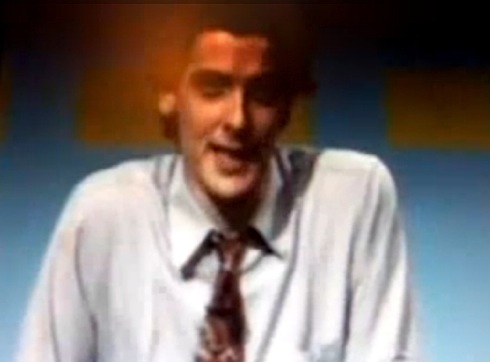
Capaldi in 1983: introducing Sade’s TV debut on Loose Talk
➢ View video of Capaldi introducing Sade’s TV debut

FRONT PAGE

1959 ➤ When beans defined bohos and cappuccino tasted of coffee

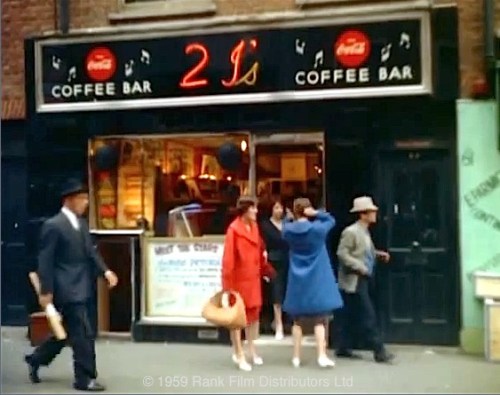
The Look at Life tour starts at the 2I’s in Old Compton Street: click to run video in a new window

The Look at Life tour starts at the 2I’s in Old Compton Street: click to run video in a new window

➢ Tour the bohemian coffee bars of London on film

❚ FROM SMALL COFFEE BEANS a mighty fad exploded. The documentary film clip, above, immaculately preserved in rich Eastmancolor, takes us on a tour of Soho in 1959. The distinctly arch voice-over tells us: The coffee bar boom in Britain began in 1952 when the first espresso machine arrived from Italy and set up in London’s Soho. They reckoned that a cup costing tuppence to make could be sold for ninepence to 1s 6d [about £3 in today’s money], according to the trimmings. But for every three coffee bars that opened up, two closed down… / Continued at YouTube

CLICK ANY PIC TO LAUNCH CAROUSEL:


With the arrival of ITV in the mid-50s, the UK’s two television channels competed to bring the day’s news into living rooms. In Britain’s cinemas the Rank Organisation responded in 1959 with the weekly magazine Look at Life, a series of light-hearted short films to precede the main feature on their Odeon and Gaumont circuit. This episode, titled Coffee Bar, takes us inside a few of Soho’s many haunts that took care to attract their own social segment: at the 2I’s in the basement of 59 Old Compton Street, live rock groups ensured a young clientele of jive cats, for example, while artists hung out at The French, intellectuals at the Macabre, politicos at Le Partisan, while writers and actors favoured Legrain.

Fifty years on, you’d be hard-pressed to distinguish one Soho bar’s customers from another’s – rather like the vile burnt cinders they all sell in the name of “coffee”. One sad consequence is to see the genuinely delicious stuff being edged off our supermarket shelves, presumably driven out by tastebuds destroyed in the high-street branded coffee shops.

FRONT PAGE

➤ The original Wag sets the scene for Club to Catwalk at the V&A

Wag club, Soho, clubbing , Swinging 80s, Chris Sullivan ,Ollie O’Donnell

The Wag, for 19 years the coolest nightspot in Soho: its suave doorman Winston is flanked by co-hosts Chris Sullivan and Ollie O’Donnell. © Shapersofthe80s

➢ The July issue of High Life magazine celebrates the launch next week of the Club to Catwalk exhibition in the V&A fashion gallery – Longtime Wag club host Chris Sullivan recalls the unbridled creativity, outrageous abandon and downright cheek of London in the 80s …

It was 27 April 1985 and the opening party for the second floor of the Wag Club – the nightspot I founded and ran in Soho – was in full, unrestrained swing. Fuelled by the unlimited free bar, the place was totally off the hook, the crowd dressed to the nines in their own inimitable fashion – pirates, preachers, punks and picture-postcard peaches – throwing themselves about with Bacchanalian abandon to a soundtrack as arcane and varied as they were.

Club to Catwalk, exhibition, London, Fashion,1980s, V&A High jinks indeed, yet looking around I realised that we as a group had come of age, were taken seriously and that this moment was ours. George Michael danced next to Siobhan of Bananarama overlooking Sade who nodded to the music in front of Suggs and Martin Kemp. Over the way, John Galliano camped it up alongside Leigh Bowery, Judy Blame, Boy George and one of the scene’s most innovative dressers and designers, Stephen Linard, while behind them stood Steve Strange and Princess Julia chatting to Vivienne Westwood… / Continued at High Life

➢ Club to Catwalk: London Fashion in the 1980s runs at the Victoria & Albert Museum, July 10–Feb 16, 2014. Featuring more than 85 outfits, it showcases new looks from the decade’s most experimental designers and some remarkable photography from back in the day

on video: five shapers still going strong

FRONT PAGE

1983 ➤ A turning point in David Hockney’s vision of the world

rel="nofollow"

Hockney wielding his Pentax in London, July 10, 1983: having devoted two years to photography, in this his second week on a trip to Britain, a further new canvas in the studio confirms a return to painting. Photograph © by Shapersofthe80s

❚ 30 YEARS AGO THIS WEEK the British painter David Hockney made a discovery so monumental that he called it “a truer way of seeing”. I’d gone to interview him about the education cuts Margaret Thatcher was inflicting on British art schools and found myself receiving an exhilarating tutorial while the artist tested his new ideas.

“Have you been to the cubism exhibition at the Tate?” Hockney enthused during a trip to London from his home in Los Angeles. “I’ve been seven times! Suddenly I see cubism differently, more clearly… That’s what I’m only starting to grasp. Cubism is about another way of seeing the world, a truer way. But the moment you grasp it, you can’t give it up.”

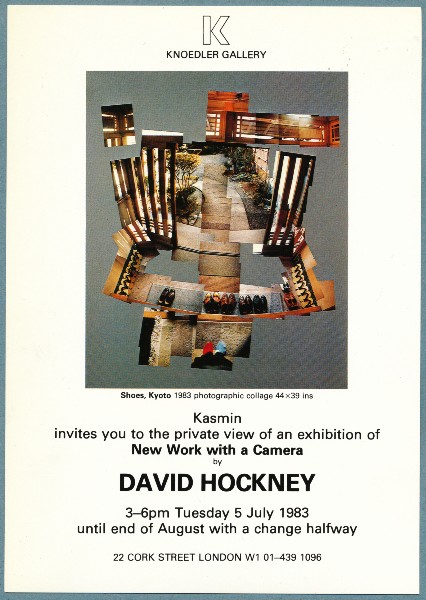
Photography had preoccupied Hockney for the previous couple of years and in the week of his 46th birthday, we’d met at a Cork Street gallery during the hanging of his show New Work With A Camera, fresh from its Los Angeles run. Yet on two visits to his Kensington studio that week, fresh canvases on the easel signalled that Hockney had returned to painting. He said: “I had to deal with the ideas that are bubbling away. Cubism is hard enough to grasp, but it’s even harder to do, which actually is why not many people have been able to do anything with it. Starting to paint again is very refreshing.”

Four days later when the resulting interview appeared in the London Evening Standard, he’d been again to the Tate and said on the telephone: “Your article is pretty much the first time I have talked about this – of course I’ve discussed these things with friends but the article does make it clear to people.”

rel="nofollow"

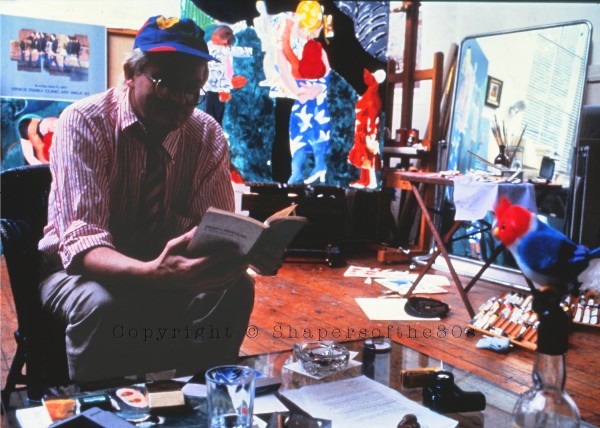
Hockney with fresh paintings in his London studio, July 3, 1983: so keen to deal with his new ideas, he reads aloud from a book about Marcel Proust’s theories of vision. Photographed © by Shapersofthe80s

He added: “You must go to the Tate retrospective [The Essential Cubism], it’s marvellous. You go from one cubist picture to another and another. In other galleries, like Moma, you might have one cubist room but go to the Tate show because you’ll never see so many cubist paintings together again. I found I began to develop this way of seeing them, it’s very rich. You do have to stand in front of the Picassos and spend time looking. When you’re physically in front of a cubist painting, once you start looking, especially the early analytical ones, it slowly reveals itself. It doesn’t pounce off the wall.”

The next day, when I returned to his studio with a camera, Hockney had begun yet another huge cubistic canvas which seriously took the breath away. It was a privilege to view the unfinished paintings with their images outlined in charcoal and he remarked that few people get to see inside the studio. I made sure to snap the 1,001 mementoes and influences scattered throughout the space suggestive of a restless imagination. The three substantial conversations I was fortunate to enjoy that week remain a turning point in my own appreciation of art. By a stroke of fate, my presence had provided the artist with a sounding board at the very moment when he urgently needed to kick around some bold new thoughts.

➢ Click through to read the full fascinating interview with Hockney, in an elision of two pieces first published in the Evening Standard, July 8, 1983, and The Face, Sept 1983

David Hockney,New Work With A Camera, photography, London, 1983

Fresh from its Los Angeles run: Invitation to Hockney’s latest show of three-dimensional photo collages in London, 1983

FRONT PAGE

➤ Babyboomers at war with their kids: sad fact of recession or generational theft?

generation gap, guilt, citizenship, babyboomers, Moral Maze,

“It’s war!” – Babyboomers v. their kids

➢ Moral Maze, June 26 – catch up on iPlayer:

They’ve been called the Dick Turpin generation but time could be up for the babyboomers this week as the Chancellor announces spending cuts and universal benefits, like free bus passes and winter fuel payments for rich pensioners, start to look tempting targets. But for some this is more than just an argument about balancing the books – it’s about inter-generational equity. Instead of being custodians of future generations the babyboomers are accused of busily raiding their kids’ piggy-banks, saddling them with a vast and increasing national debt to fund for their own generous pensions and welfare payouts.

❏ The knives were out in last night’s combative episode of Radio 4’s Moral Maze, the weekly debate chaired by Michael Buerk. With Anne McElvoy, Giles Fraser, Matthew Taylor and Melanie Phillips. Witnesses: Ros Altmann, Former Director-General of Saga; Angus Hanton, co-founder of the Intergenerational Foundation; Ed Howker, co-author of Jilted Generation: how Britain has bankrupted its youth; and Stuart Prebble, producer of Grumpy Old Men TV series and books.

VOCABULARY FOR THE ZEITGEIST

“grumpy babyboomer”… “generational theft”… “generational guilt”… “generationally selfish”… “inter-generational equity”… “income imbalance”… “politics of envy”… “power of the grey vote”… “transfer of reserves”… “stewardship”… “compact of citizenship”… “human sustainability”

A REMINDER OF HOW EASILY WARS BEGIN

FRONT PAGE