Category Archives: Youth culture

1984 ➤ 2010, RIP Big Frank and Little Frank. You’ll be missed. You know you will, you really will

Frank Sidebottom, comedian, Little Frank, Timperley, Manchester
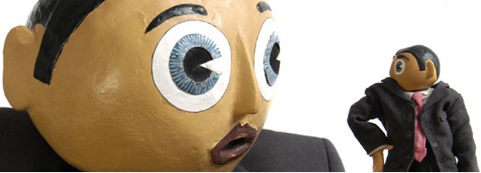
❚ TIMPERLEY COMEDY LEGEND FRANK SIDEBOTTOM IS NO MORE. The man in the papier-mâché head like a Max Fleischer cartoon has been revealed only in death to have been aka Chris Sievey. Almost entirely unknown to the effete south of England, Lancastrian icon Frank was unleashed on the world through a record given away with the video game The Biz, presciently created by Sievey for the pioneering ZX Spectrum computer in 1984.

Only last week, he launched a comedy song for the World Cup, titled Three Shirts on My Line. Campaigns to Make Frank No 1 in the pop charts have begun at twitter.com/MakeFrank1 and at the Facebook group Let’s get Frank Sidebottom in the charts, which is bursting with tribute images. The Manchester Evening News reports that Frank is facing a pauper’s funeral after dying virtually penniless, so visitors to this impromptu Facebook page have already established a fund, being helped by Guardian writer and former bandmate Jon Ronson who asks for donations to go via this Paypal account: jonelle1929@gmail.com. [Appeal now closed, see update below]

Frank Sidebottom, Three Shirts On My Line, World Cup, Nick Hilditch, tributes

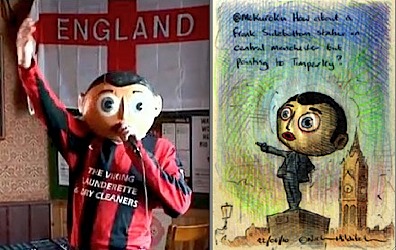
Official unofficial World Cup song launch: Frank at The Salutation pub in Manchester last month. Right, Nick Hilditch’s concept for a statue in Albert Square, pointing to Timperley

Frank Sidebottom zoomed to cult status through comedy records on the Regal Zonophone label and his broadcasts on Radio Timperley for Manchester Radio Online. Within minutes his stand-up routine rocketed him to 80s superstardom, accompanied by Little Frank, a puppet who was his deadringer. From 1986 he had his own comic strip in an anarchic children’s comic called Oink! which was top-shelved by many newsagents. He regularly reported for the regional TV news programme, Granada Reports, graduating to his own ITV showcase, Frank Sidebottom’s Fantastic Shed Show.

Sidebottom, whose fame was greatest during the late 1980s, can truly claim to have put on the map such names as Timperley, St Helen’s, Altrincham FC, Mrs Merton, Mark Radcliffe and most notoriously Chris Evans. Among the final appearances of Big Frank and Little Frank was the living test card shown on late-night television in Greater Manchester on Channel M.

Sievey left a daughter, Asher, 31 and two sons, Stirling, 31, and Harry, 18, who still lives with Sievey’s ex-wife Paula. Frank’s catchphrase was “The Robins aren’t Bobbins”. Another one was “You know it is, it really is”.

Frank Sidebottom, Edwina Currie, Cheshire FM

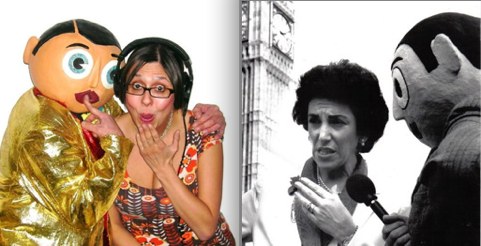
Sidebottom the broadcaster: Frank meets Vicky at Cheshire FM . . . and interviews MP Edwina Currie for Granada TV

➢➢ Genuinely a genius – Manchester’s showbusiness stars lead the tributes
➢➢ Longtime friend Mick Middles recalls Frank’s creator, first encountered as frontman of The Freshies, an off-kilter power pop band
➢➢ “A curious line in daft Bontempi songs” – The Guardian obit, June 22
➢➢ VIEW ♫ ♫ Frank Sidebottom explaining Three Shirts on my Line, his unofficial World Cup 2010 song, at the Monarch in Camden Town last December

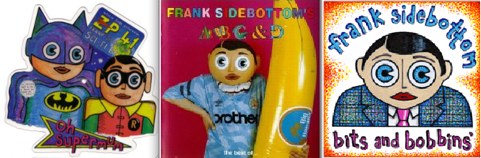
Frank Sidebottom, discography

Find the complete Sidebottom discography at Frank’s interweb site

➢➢ Frank’s World, the official official site
➢➢ Complete Sidebottom discography at Frank’s interweb fan site run by Russ
➢➢ Frank Sidebottom at MySpace
➢➢ VIEW ♫ ♫ Chris Sievey and the Freshies in the studio recording Bouncing Babies – a poptastic treasure from 1981
➢➢ VIEW The Magical Timperley Tour – Frank Sidebottom takes a load of people on an amazing bus tour through his home village of Timperley . . .

➤ Update: fan fund totals £21,240
for Frank’s send-off

Chris Sievey, Frank Sidebottom, funeral

Chris, aka Frank

❚ FRIDAY JULY 2 IS THE DATE for Chris Sievey’s funeral. A private service for family and friends will be held at Altrincham Crematorium to celebrate the life of the man who created the cult hero Frank Sidebottom. It is being funded by donations from an internet campaign. Within six days of his death from cancer, donations to the funeral fund saved Sidebottom’s creator from a pauper’s funeral. More than 2,500 supporters signed up to the Facebook group Frank’s Fantastic Funeral, with Twitter claiming 3,400 followers. The appeal fund closed on Sunday June 27 at £21,240.

His son Stirling, 31, said the private funeral would give those who knew his dad the chance to mourn the man behind the mask. “The funeral is for friends and family of Chris. We want to hold a celebration of Frank within the next couple of weeks. We are looking at venues, including Manchester town hall.” [More at the Manchester Evening News]

➢➢ UPDATE: A fresh assessment of Chris Sievey, the little-known creator of Frank Sidebottom

❚ IGNORED BY THE MAINSTREAM ALL HIS LIFE, the cult comedian cum cod pop star finally made headline news in death. Plenty of people didn’t get Sidebottom. The first time he appeared at Liverpool University, he bombed. “Did Sievey like being Frank? Yes. Would he prefer to have been a Beatle? Yes.” – Simon Hattenstone in The Guardian, June 26, 2010

➢➢ Radio Presenter Mark Radcliffe describes the “real affection” evident at the funeral of his close friend Chris Sievey

❚ THE END OF THE SERVICE for Sievey at Altrincham Crematorium, July 2, was marked by the Beach Boys hit God Only Knows. A celebration of his life, titled Frank’s Fantastic Farewell, is being held in Castlefield Arena on July 8, 7-10pm, admission free.

➢➢ UPDATE: 5,000 people pack into Castlefield Arena for a tribute evening of laughter and song – MEN July 9

FRONT PAGE

2010 ➤ Ure rallies support for Japan’s bassist Karn

Mick Karn, ex-Japan, bass player

Mick Karn: former 80s popstar today struggling to make ends meet

❚ BITTER-SWEET NEWS TO HEAR THAT MIDGE URE has leapt straight into the breach to organise a benefit concert [See update at foot of this post] for Mick Karn, the former bass-player with 80s hit group Japan. Karn’s website has announced that he has been diagnosed with “advanced stages of cancer” and is struggling to pay his medical bills in Cyprus where he lives with wife and child.

One aspect of this sad news is to be reminded that not all chart-topping “popstars” become millionaires, especially the drummers and sax-players and guitarists who don’t get a chance to write lyrics, which is what generate the big money in royalties. The typical pop group makes two albums in as many years. As hugely influential pathfinders for the glam-into-synth-pop era, Japan had a very good run: over eight years, six studio albums and one live, plus umpteen compilations. Yet the pop industry is not noted for its pension schemes.
Midge Ure, Mick Karn, After a Fashion

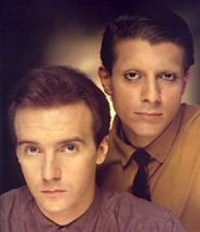
Ure and Kahn: Fashion single in 1983

Another aspect of this week’s news is to be starkly reminded of our own mortality. Mick Karn will be “only” 52 on his birthday next month. When Michael Jackson died last June, he was “only” 50 and more than a few among our pop pals from the Swinging 80s generation said they suddenly felt the hairs prickle on the backs of their necks. Jacko was exactly their age. So was Steve (Stella) New when he died last month, at “only” 50.

What seems to chill us is the threat of the Big C. For most of the past three decades various forms of heart disease have been the most common cause of death in the UK. But whether as a result of dietary change or gym culture, circulatory diseases have shown the greatest decline, while life expectancy at birth has increased by six years on average to 79. It’s often said that if the heart doesn’t get you in the end, cancer will, but what’s little appreciated is that cancer is the prime cause of death among men when they’re younger – in their thirties. From there on, cardiovascular causes and, curiously, geography become more decisive. So, given a man’s susceptibility, perhaps we ought not to be surprised when cancer claims him earlier in life than a woman.

“We understand death for the first time when he puts his hand upon one whom we love,” it is said. “Only” 50, if we’ve come this far, brings ever more frequent intimations of our own mortality, that tilt us from the Wordsworthian vision towards a more pragmatic view of our role as a toiler in the scheme of things. The hot-blooded proclamations of Jimmy Dean, Pete Townshend and Roger McGough starts sounding like romantic indulgence: “Live fast, die young”? You have to be kidding! “Hope I die before I get old”? Oh no, you don’t really! “Let me die a young man’s death”? Absolutely not! As the grand old man of British sculpture, Henry Moore, told The Face shortly before he died at 88: “The work is what’s important, and I haven’t got much time left.”
Japan, pop group,

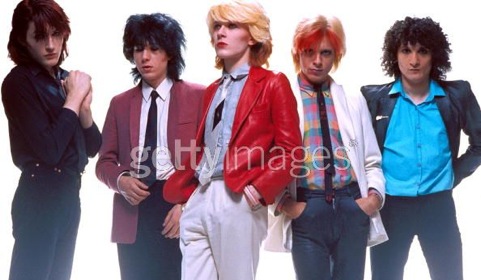
Japan in May 1979: Steve Jansen, Richard Barbieri, David Sylvian, Mick Karn, Rob Dean. Photographed © by Fin Costello

So all power to Midge Ure for grasping the nettle and planning to celebrate a life not yet fully run. He has urged fans to give Karn both “financial help and emotional help”. In addition, Ure, as the joint-founder of Band Aid, 1984’s fund-raising supergroup, is well versed in how to organise a benefit for Karn. BBC 6Music reports: “While no acts are confirmed yet for the concert, which is to take place some time this year, Ure has his sights on reuniting Japan for the show.” (Karn’s website later said these had not been Midge’s words.)

Ure said of Karn’s diagnosis: “The situation is not very good. The cancer has spread, he is going through chemo right now — but surrounded by family and friends, he has a positive attitude.”

❚ IN 1982 WHEN PETE TOWNSHEND WAS PUTTING TOGETHER a supergroup to launch the first Prince’s Trust Gala, he chose Karn for the line-up and described him as by far the best bassist in the UK. This event was the showcase that led to his collaborations with Kate Bush, Joan Armatrading, Pete Murphy (Dalis Car, 1984), Midge (the chart single After a Fashion, 1983) and many more. The intervening years have yielded 13 solo albums, among which The Tooth Mother (1995) is a standout for its juzz-funky innovation.

Of Karn’s musicianship, Ure said: “Until I heard Japan, I had never heard a bass guitar played like that. It was almost like playing a lead instrument, incredibly percussive and melodic, something that inspired me.”
Prometeus Guitars, Italy, Armando Pugliese, auction

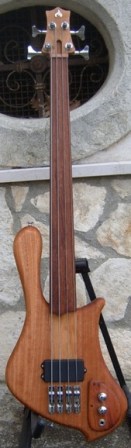
Mick Karn Appeal – This Fretless
Bass could be yours

Armando Pugliese from Prometeus Guitars in Italy has kindly agreed to donate the proceeds from the auction of a fretless bass guitar to Karn’s appeal – either the bass pictured here, which he lovingly made for himself, or one built to your spec. This a serious instrument worth a high three-figure sum. Auction ends Friday June 25.
[Update: Auction now ended. Winning bid, 1502 Euros.]

O

Karn’s unusual fretless bass technique is at once surreal, exotic and sinuous, practised in the early days on an aluminum-necked Travis Bean instrument. His best friend guitarist David Torn once said: “It’s like if Bootsy was Moroccan.”

Motown’s James Jamerson insisted that the bass can actually drive a melody, and Karn agrees. It was one of the hallmarks of Japan’s music. The group was founded in 1974 (when Karn was 15) with schoolmates in south London: David Sylvian, David’s younger brother Steve Jansen, and Richard Barbieri. They decided to play Roxy-ish art-rock, both pre-punk and despite punk. By 1979 and the release of their pivotal third album, the synth-driven Quiet Life, Japan’s long hair, glam make-up and progressive melodies saw them branded as New Romantics in all but club membership. In reality they presaged the UK’s edgy new pure pop by going off on their own musical tangent with Sylvian’s sardonic crooning, quirky Eastern influences and saxophone arrangements.

Talk of a reunion might just be a bridge too far, given the deep personal tensions that drove Karn and Sylvian apart in 1982. In 2006, Karn told Beatmag: “For all four of us to agree would be nigh-on impossible. But there’s something I’d really, really enjoy about being on stage with them again, and I’d enjoy playing the old Japan songs again, with my fellow bandmates. That was an enjoyable period of my life, and I’d like to experience it again.”

➢ Extract from Mick Karn’s response on his website, June 14:

“Your comments and well wishes have left me speechless, in the same way that our news had affected you. The support and love you give me is felt by all of us here, every day . . .

“At the time of first posting my news I was striving to obtain a medical card that would pay for treatment here in Cyprus and I am pleased to say that in recent days, since becoming officially diagnosed through a series of specific tests, the state will now take care of my basic medical costs . . . Donations that have been received will remain in a fund which will be used to augment the state care  . . .

“Words cannot truly express the full scope of my gratitude and feeling of good fortune to have so many friends, both near and far.”

➢ Another response on his website, Sept 3:

“Thanks to the appeal fund, Mick and his family were able to move to London where he is currently being treated. This really wouldn’t have possible without the support of Mick’s friends and all of you who have raised money for the fund. When it’s appropriate, there will be further updates. Mick also hopes to work with Peter Murphy on a follow up to their Dali’s Car album, The Waking Hour, towards the end of September.”
Mick Karn, Japan, bass player, re:VOX, interview, autobiography, album

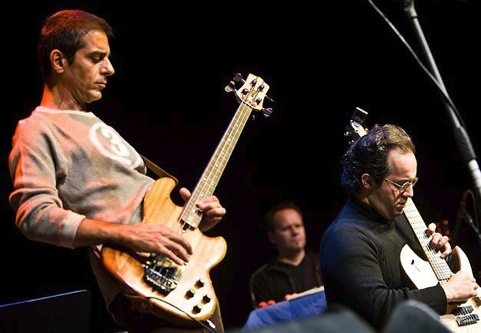
Karn at home: searching music, candid memories

➤ Latest reflections by the restless Karn on a road well travelled

O

❚ MICK KARN GIVES AN INTERVIEW to Rob Kirby in the next issue of re:VOX, a pocket magazine dedicated to 80s electronica. The guitarist says of the restless and searching quality in much of his latest album, The Concrete Twin, which was released in January: “My recordings are always a way of dealing with unresolved issues, most of them mentioned in the book [his autobiography] . . . It’s impossible not to hear music wherever you go. Everything I hear will eventually turn into an influence on some level, subconsciously.”
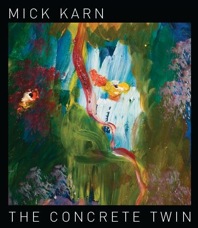
Mick Karn, album, The Concrete Twin,download, CDWho, or what, is The Concrete Twin of the album’s title (£7.99 as a download, £17.49 as CD from Karn’s site)? It brings to mind the self-sculpture of Antony Gormley. Karn, who has been admired as a sculptor for 30 years alongside riding the music industry rollercoaster, says: “I guess it’s the closest I’ll come to mixing music with sculpture. The concrete twin is another self we all have. The ‘hard’ side of us that can withstand all the trials and tribulations that life has to offer.”

What prompted you to commit your thoughts on your past life so candidly to the book, Japan and Self Existence (£16.96 from Lulu), which has roused strong reactions? Was it the relocation to Cyprus? “Just tired of meeting so many people that have the wrong idea, and that well-known people can have the same human flaws as anyone else. I feel glad that people know the truth due to the book, but contented, no. I’m never contented. It’s my motivation for carrying on. Self-publishing was the last option. Debi spent three years on my behalf, approaching every publisher that we could think of. The reaction was always positive, but the explanation the same: too many biographies by musicians on the market.”

❏ Extracts from Musique Concrete, an interview with Mick Karn in re:VOX #9, on sale in late June at £1.50 from Rob Kirby, 2 Bramshott Close, London Road, Hitchin, Herts SG4 9EP.

➢ Mick Karn’s own website – Download his latest album The Concrete Twin, order his autobiography, view his sculpture online (“amazingly accomplished” – John Russell-Taylor)

➢ Honorable tension: Karn gives a substantial interview to music journalist Anil Prasad in 1996 for Innerviews, the web’s longest-running music magazine. Extract here . . .

On the line-up for Japan’s 1989 reunion as Rain Tree Crow: “We really wanted a soloist and a guitarist. David Torn was my first choice. I recommended him to everyone. It looked as if it was going to happen for a while. But the David Sylvian we’d always known was one of complete control. That made it very difficult for us to work with him. And that was another reason why the band just couldn’t work. We found that as more time went by, the more and more control David [Sylvian] wanted to take — to the point of not wanting David Torn to come into the picture, because he decided to take care of the guitar himself . . .”

➢ VIEW ♫ ♫ Japan on Top Ten New Romantics – Paul Morley: “There was a wonderful moment when it happened for Japan with the album Ghosts, when us serious NME people embraced them, because they seem to have left behind the weird clothing and the makeup” !!! Oh yes.

FRONT PAGE

1980 ➤ Can birthday-boy George tell his Boudica from his Britannia?

Jayne Chilkes , George O'Dowd, Blitz Kids

George-before-the-Boy: posing as Queen Boadicea with Jayne Chilkes at Steve Strange’s 1980 party on the Circle Line. Photographed © by Andy Rosen

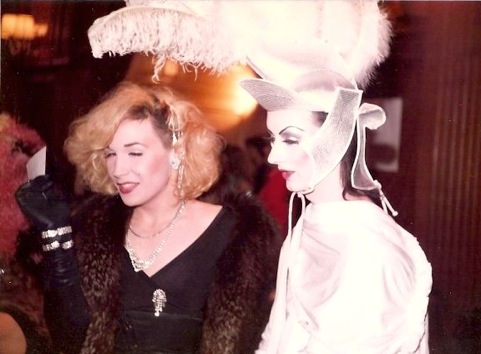
❚ WHO’S A NATIONAL ICON THEN? On this day 30 years ago not only was it George O’Dowd’s birthday, as it would be every year. But in 1980, at the age of 19, he was prancing around the Mall dressed so he claimed, as Boadicea, Queen of an ancient tribe of Britons, wielding union-jack shield and trident. While our current Queen ERII processed down the road to Trooping the Colour, this was his “quest for publicity” as the Blitz Kids competed at getting their pictures in smart magazines. He was livid the next day to find not one mention of him in the tabloids to boost his own growing scrapbook of cuttings.

The look had been unveiled a couple of weeks earlier on the 21st birthday of his pal (ha!) Steve Strange, host at the Blitz, who had decided to throw a party on the Circle Line. About 50 ornamental clubbers piled into the bar on the platform at Sloane Square station aiming to pub-crawl their way by train to the other subterranean bars at Paddington, Baker Street and stations beyond (all now long gone) while armed with ghettoblasters, booze and fags. Prevailing fashion priorities prompted an unholy alliance between ecclesiastical drapery and Norton biker jackets.

Quiffs were being worn very high that summer – Strange’s rose a foot above his head, while below he had opted for a cowled satin surplice that might have appealed to a decadent monk. True to their competitive spirit, George had gone for an all-out pagan toga topped with a warrior’s silver helmet and monumental feathered plume (a gifted work of metallurgy in silver lamé by Stephen Jones). The big picture shows George modelling the outfit onboard the train in the arms of Jayne Chilkes (the elder of the two sisters, who claimed to receive ghostly messages from Oscar Wilde and then scribbled them all over his books).

Boudica, Britannia

Celtic battleaxe Boudica or Roman goddess Britannia: which would you rather be?

Actually, the origins of the Boadicea who was turning heads in 1980 lay in a madcap jaunt to the south of France (ultimately abandoned) with his squat-mate Marilyn who’d arranged a cabaret booking for them – Marilyn playing, well, Marilyn, and George playing some alien rock star as well as this toga’d character Boadicea. Well, the outfits had proved “too amazing to give back”, so George had walked off with them. In 30 years, I don’t think anybody has had the nerve to tell him he was really dressed as Britannia, the Roman goddess who became an emblem of the British Empire which at its height ruled a third of the world’s population. With her Corinthian helmet and the sea-god Poseidon’s three-pronged trident, Britannia has been pictured on our coins since Emperor Hadrian’s day.

Boadicea (or Boudica as smart people call her these days) was the one who led a barbaric revolt against the Roman occupation under Suetonius in about AD60, burnt London to the ground and today sits on Westminster Bridge still shaking her single-headed spear at Parliament. Did you ever see Boudica toting a trident? I don’t think so. Or shaded by a Grecian visor against dazzling British sunshine? I don’t think so. Nasty scythes projecting from her chariot wheels, yes. Her daunting right breast exposed, yes. Woad from head to toe, yes. So. If we’re in need of icons, let’s get them right.

Talking of which . . . How does an icon live? George was last month greeted as a “chalk-faced convicted thug” by the Asia News Nework on his visit to strife-torn Bangkok. Today he’s en route to Cape Town for a gig tomorrow, returning for the Glastonbury festival diary date on the 24th. A 16-track album Extraordinary Alien is promised for, er, “very soon”. And to celebrate his 49th birthday, his Twitter account has been turned off. Scythed wheels of steel are a’spinning.

Marilyn, George O'Dowd,Blitz Kids

Another day, another premiere: Marilyn and George as Boadicea on the town in 1980. Pictured © by Robert Gordon

FRONT PAGE

2010 ➤ Duffy, the man who shot Aladdin Sane

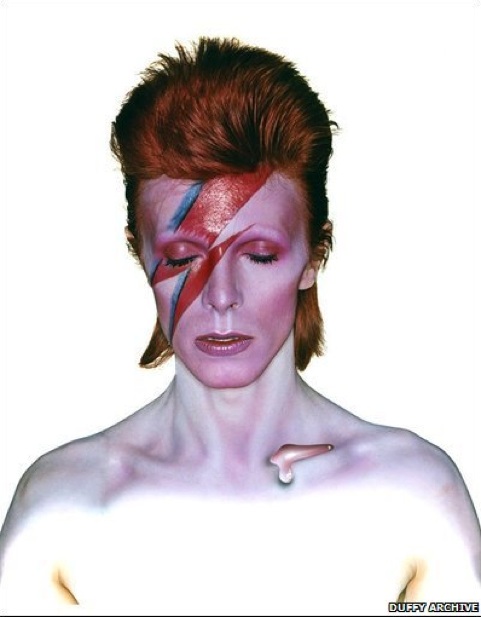
❚ BRIAN DUFFY, THE PHOTOGRAPHER who helped to capture the spirit of the Swinging 60s, has died. Among the many showbiz stars he shot was David Bowie, and if any images deserve to be called iconic, these do. Known to friends and colleagues by his surname alone, Duffy was a rival of David Bailey and Terence Donovan throughout the 1960s. Film producer Lord Puttnam said Duffy helped push the stultifying conservatism of the 1950s into permanent retreat. Duffy is also famed for once burning part of his work in a bin in 1979.

➢➢ Read the full BBC News report

David Bowie, Aladdin Sane, Brian Duffy

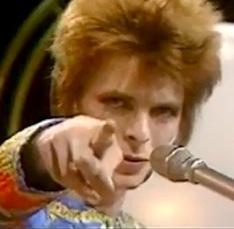
Duffy shot three album covers for Bowie, here Aladdin Sane, 1973, artfully created long before Photoshop had been invented. © The Duffy Archive Limited

Vogue, Brian Duffy, photographer

In May 2003, Vogue magazine paid tribute to Bowie by dressing up Kate Moss in some of his original costumes. A nod to the 1973 Duffy photo graced its cover, which Vogue’s editor Alexandra Shulman said was his favourite cover of all time (see Iconic Photos, below). Right, the photographer Duffy at his lightbox

David Bowie, Lodger, Brian Duffy, Derek Boshier

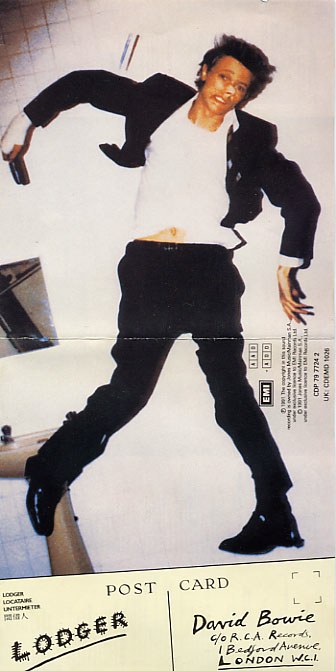
Bowie’s Lodger album, 1979, photograph © The Duffy Archive Limited. Artist Derek Boshier wrote: “The cover for Lodger was a collaboration between David, the photographer Duffy, and myself. I loved the resolution to the problem of David being photographed falling. Shooting him from above, on a specially made table built to match the falling form. The table was designed to be completely obscured by David’s body”

Brian Duffy, David Bowie, Scary Monsters

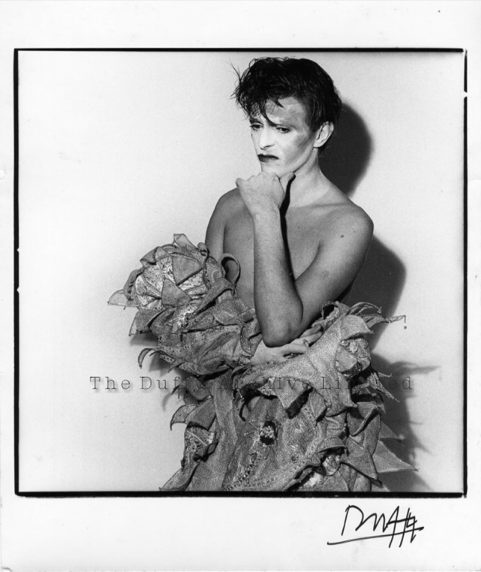
Duffy’s shoot for Bowie’s Scary Monsters album, 1980 © The Duffy Archive Limited

David Bowie, Brian Duffy

Bowie by Duffy, 1980: not chosen for Scary Monsters and published only once, in a blog last September. © The Duffy Archive Limited

➢➢ Sara Wiseman, Duffy’s archive assistant, wrote last September in her blog:

“Whereas Duffy’s more iconic images such as his Aladdin Sane cover, have been retouched, consciously selected and then admired by many to achieve such status, I love the fact that this one [shot but not chosen for Scary Monsters and never before been published] was forgotten for thirty years and for that reason I loved discovering it. I could perhaps align the thrill to that of finding buried treasure. There is something about Bowie’s unperfected facial expression that gets me every time. In a way I find the photograph to be extremely revealing in that it humanizes Bowie. This scornful look which, was not included in his contrived and manufactured public image, lowers him from the elevated, almost superhuman level of the pop/rock star. What we have before us here, is a man in a ridiculous costume looking pretty indifferent.

“I asked Duffy what his thoughts on the photograph were: ‘You like it? Yes me too. You may have noticed that in many of my male portraits my subjects look as if they’re on the verge of smacking me … ha! (Duffy acquired a reputation, of which he is proud, for being a bit of an anarchist.) That was my technique, I would say something to rile them or wind them up. It won me some great photographs – full of genuine male aggression. You may also notice that the same can not be said for my female portraits!’ ”

☐ ☐ ☐


➢➢ Visit Duffy’s website

➢➢ Surviving contact sheets from the Aladdin Sane session
➢➢ Famous, Infamous and Iconic Photos
➢➢ Derek Boshier Art

THE TRIBUTES

➢➢ Fearlessly innovative photographer who in countless striking images helped to define the mood and style of the Swinging Sixties – The Times, June 5, 2010
❏ Duffy, Bailey and Donovan invented a new documentary style of fashion photography, and fed off each other’s creativity. Duffy produced a body of work that spanned everything from portraits and reportage to advertising — he was one of the few photographers to have shot two Pirelli calendars, and successfully undertook campaigns for brands including Smirnoff, Aquascutum and Benson & Hedges, for whom he created a series of surreal advertisements in 1977.

➢➢ Central figure in the visual revolution that echoed the wider changes in British society during the 1960s – The Daily Telegraph, June 6, 2010
❏ With David Bailey and Terence Donovan, he formed what was dubbed the “Black Trinity” by Norman Parkinson, the photographer whose pastoral style seemed to embody all that the young trio wanted to challenge. If Bailey was the most creative of them, and Donovan the most amusing, the art school-trained Duffy was the most provocative and intellectual. “Before 1960 the fashion photographer was tall, thin and camp,” he reflected. “But we three were different: short, fat and heterosexual.”

➢➢ One of the “terrible trio” with David Bailey and Terence Donovan who broke the mould of fashion photography – The Guardian, June 6, 2010
❏ The three men became far more famous than many of the models with whom they worked, and were – for a while – bigger than the glossy magazines that published their pictures. The photographer Norman Parkinson called Duffy, Bailey and Donovan the “black trinity”. There was some merit in the label. The cravat-wearing old guard felt threatened by these freewheeling young men in leather jackets, who took their models on to the streets and snapped them with newfangled, small 35mm cameras.

➢➢ Brian Duffy: The Man Who Shot The 60s by George’s Journal

FRONT PAGE

2010 ➤ Manc agog at Gaga’s Monster Ball tour

Gary Ryan’s eyes were out on stalks last night for Lady Gaga’s concert in Manchester’s MEN Arena – here’s a taste of his review for City Life

Lady Gaga, Monster Ball, tour,

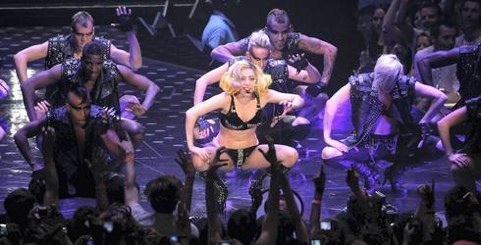
Gaga on tour with her merry men: Has she just killed Madonna?

❚ THOSE WHO MIGHT DOUBT THE LIBERATING FORCE for good Lady Gaga represents need have only glanced around the audience of her Monster Ball tour. Everywhere you look, there are women with their faces painted in the singer’s lightning flash make-up, and men wearing so much kohl, they resemble the Hamburgler.

At its core, the concept of the show is that she’s a Pied Piper for the misfits and the freaks; and has created the show as a place where “you can be free”. It’s heartening when you remember that ten years ago, the same audience would have been watching S-Club…

“You know what I hate more than money?”, says the woman who is charging £70 per ticket. “The truth.” It shows: she works harder to maintain a smoke-and-full-length-mirrors aura than any other act around. And, with an ambition and confidence that suggests she’s just killed Madonna and is wearing her skin as a tribal pelt, this night proves she’s the first true pop icon of the 21st century.

➢➢ READ Gary Ryan’s full review for City Life

FRONT PAGE