Category Archives: Youth culture

1928–2012 ➤ Sassoon’s revolution: No teasing. No hair spray. Just the cut.

Vidal Sassoon,the bob, Mary Quant, hairstyles

1963: Sassoon creates the “bob” on designer Mary Quant. (Photo: Getty)

“He revolutionised not just hair but fashion” — model-turned-Vogue fashion editor Grace Coddington

Vidal Sassoon , Albert Hall,

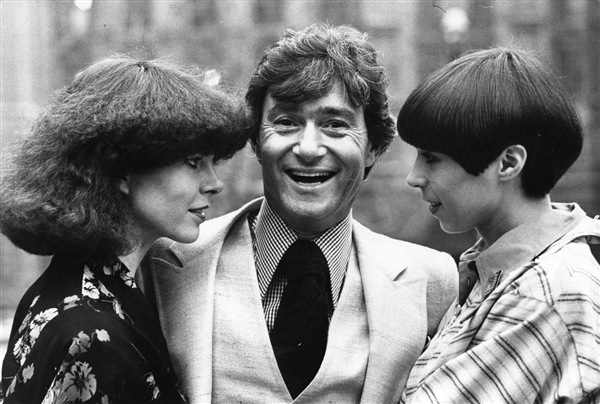
Comeback 1975: Vidal Sassoon between two contrasting examples of his hairdressing for a teach-in at the Albert Hall, where he returned to hairdressing after a five-year break. (Photograph by Tim Graham / Getty)

➢ The Daily Telegraph reports the death at 84 of celebrity hairstylist Vidal Sassoon, whose 1960s wash-and-wear cuts freed women from the tyranny of hairspray…

Vidal Sassoon, who was found dead at home on Wednesday, was at the cutting edge – literally and metaphorically – of hairdressing. His sharp, geometric, low-maintenance 1960s hairstyles revolutionised his craft, sounding the death knell for the stiff, set hairdos of the 1950s. An astute businessman, he made a fortune from his salons and products, and became a household name. “I wanted to eliminate the superfluous and get to the basic angles of cut and shape,” he said… / continued online

+++
❏ Craig Teper’s 2010 documentary Vidal Sassoon: The Movie follows the true rags-to-riches tale of how a boy from a London orphanage went on to open his own Bond Street salon in 1958 and — influenced by the Bauhaus designs he had studied — he create the “shape” that became his signature cut, the five-point bob. It revolutionised hairdressing. His geometric wash-and-wear cuts marked the end of the beehive and the bouffant hair styles of the 50s. Admirers included the Duchess of Bedford, model Jean Shrimpton, actor Terence Stamp, and film star Mia Farrow. In 1963 he devised the classic “bob” for fashion designer Mary Quant, who called him the “Chanel of hair”. By 1964 he’d gone international by opening his first salon in New York.

Vidal Sassoon, Movie

Sassoon The Movie: the London crimper freed women from 50s bouffants by pioneering the low-maintenance hairstyles that defined the 60s

FRONT PAGE

➤ Sukita-san’s eye view of the weird world according to Bowie

David Bowie, Masayoshi Sukita,Speed of Life, Genesis Publications,

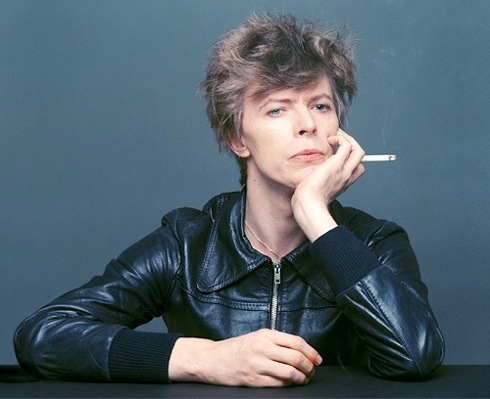
Heroes-era Bowie in 1977 © by Masayoshi Sukita

David Bowie,Yamamoto Sukita, Kansai Yamamoto ,Speed of Life, Genesis Publications

Bowie as Ziggy in 1973 costumed by Kansai Yamamoto and photographed © by Masayoshi Sukita

❚ HERE WE SEE CLASSIC PIX of the early glam incarnations that broke the rules of rock and roll and put the gender-bending David Bowie into the headlines. Since 1972 Japanese photographer Masayoshi Sukita has gone on capturing the prolific flow of creations from the ever-inventive Bowie. This week in London his long-awaited book Speed of Life documenting their 40-year collaboration is launched by Genesis Publications in its 2,000-copy limited edition. Signed by both Bowie and Sukita, it is priced at £360 ($581) for 300 pages which they caption with their own recollections and memories. Bowie says: “It’s very hard for me to accept that Sukita-san has been snapping away at me since 1972 but that really is the case… May he click into eternity.”

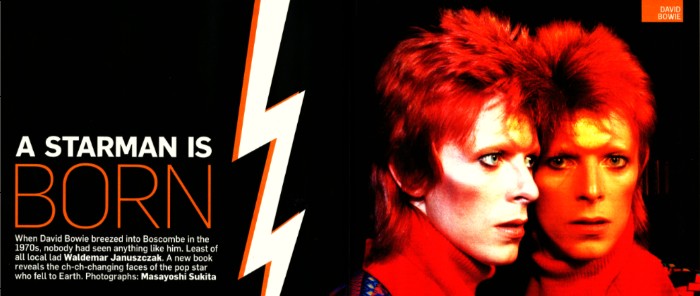
Meanwhile in today’s Sunday Times Magazine art critic Waldemar Januszczak recalls his teenage outing in 5-inch platforms when he paid 90p on the door of Starkers in Boscombe, Dorset, to discover the eye-popping mystique of Ziggy Stardust in August 1972 — minutes after Sukita the photographer arrived in Britain and caught Bowie’s shock show at London’s Royal Festival Hall. He described it as “like an astronomer finding a new planet”.

David Bowie, Masayoshi Sukita,Speed of Life, Genesis Publications,

Today’s Sunday Times Magazine: Bowie in 1972 © by Masayoshi Sukita

Januszczak writes: “It was Andy Warhol who invented the immensely attractive cultural idea that anyone could be whoever they wanted to be. It became Bowie’s big idea as well. And the tour he set out on in 1972 featured his most determined efforts yet to become lots of people at once: Ziggy Stardust, Aladdin Sane, Major Tom, The Man Who Saved the World. That was just the beginning. The bewildering multi-identitied career photographed for us so sympathtically by Sukita-san in Speed of Life features enough different David Bowies to constitute a football crowd…”

David Bowie, Masayoshi Sukita,Speed of Life, Genesis Publications,

Bowie in 1989 © by Masayoshi Sukita

Above images copyright Masayoshi Sukita, courtesy Genesis Publications

David Bowie, Masayoshi Sukita,Speed of Life, Genesis Publications,

Sukita then and now: left, with Bowie in the 70s

MAY 8: INVETERATE LIGGERS AT THE LONDON
BOOK LAUNCH PARTY

Paul Simper, Steve Norman, Bowie, Sukita, books, Speed of Life,Genesis Publications,Dover Street Arts Club,

Lads insane: The Spand sax-man also known as Spiny Norman ingratiates himself with Ballet biographer Paul “Scoop” Simper at tonight’s Speed of Life book launch. Spandau’s own official photo-book is promised for 2013 from Genesis Publications. Photograph by © Shapersofthe80s

➢ Condé Nast president Nick Coleridge tells book-launch party of his teen obsession with Bowie and his encounter with Angie — Evening Standard Diary, May 9

FRONT PAGE

➤ Shapersofthe80s is declared an “invaluable website” by British historian

“winter of discontent” ,  Leicester Square, strikes,

Britain’s infamous “winter of discontent” that brought down the Labour government in 1979: as public service workers went on strike, rubbish piled-up even in London’s Leicester Square

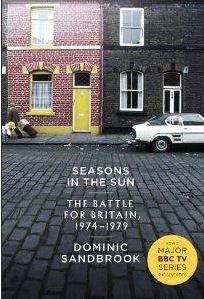
Seasons in the Sun,Battle for Britain, Dominic Sandbrook, books, history, Allen Lane,❚ AN “INVALUABLE WEBSITE” — this is the verdict on Shapersofthe80s by historian Dominic Sandbrook, author of the rich new cultural analysis, Seasons in the Sun: The Battle for Britain, 1974–1979. It’s a doorstep of a book, yet highly readable, which reveals numerous upbeat aspects to the chaotic decade many write off as worthless.

Chapter 31 is especially inspirational! Sandbrook gives generous credit to key characters who Shapersofthe80s has long maintained deserve recognition as movers and shapers pivotal to the energy of the 80s. And, having quoted chunks from our own texts, the historian gives due acknowledgement in his extensive bibliography. Indeed, the scope of his research is more impressive than for much other contemporary history, as Sandbrook not only cites political and economic mandarins, but also sifts fine detail from popular culture and eye-witness reportage across the whole social spectrum.

Sandbrook writes: “Behind the lurid news stories, the late 1970s were the decisive point in our recent history. Across the country, a profound argument about the future of the nation was being played out, not just in families and schools but in everything from episodes of Doctor Who to singles by the Clash. These years marked the peak of trade union power and the apogee of an old working-class Britain – but they also saw the birth of home computers, the rise of the ready meal and the triumph of a Grantham grocer’s daughter who would change our history for ever”

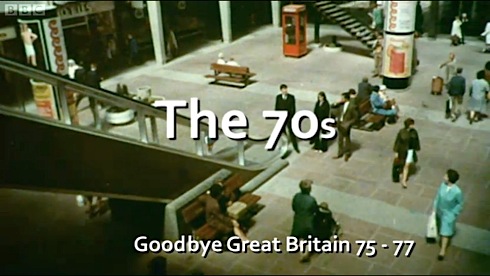
Seasons in the Sun is the fourth title in Sandbrook’s survey of postwar Britain. His unstuffy combination of high and low life is behind the BBC2 series The Seventies currently viewable live and on iPlayer.

BBC2 series The Seventies,Seasons in the Sun ,Dominic Sandbrook

Sandbrook’s Seasons in the Sun forms the basis of the current BBC2 TV series The Seventies

REVIEWS OF SEASONS IN THE SUN

❏ “The first three volumes of Dominic Sandbrook’s epic history of Britain between 1956 and 1979 were exceptionally good. The fourth, Seasons in the Sun, is magnificent … marked by its pace, style, wit, narrative and characterisation as by its exhaustive research.” — Roger Hutchinson, Scotsman

❏ “Sandbrook has created a specific style of narrative history, blending high politics, social change and popular culture … his books are always readable and assured, and Seasons in the Sun is no exception … Anyone who genuinely believes we have never been so badly governed should read this splendid book.” — Stephen Robinson, Sunday Times

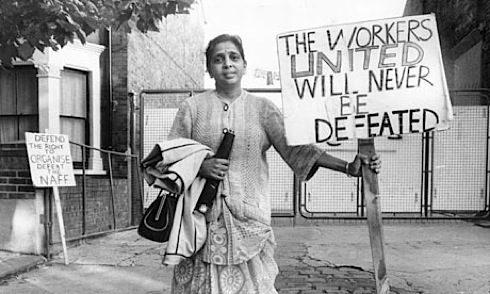
1977, Jayaben Desai, Grunwick, strike, picket

August 1977: Jayaben Desai, treasurer of the strike committee at the Grunwick photo-processing plant, had been picketing for a year, supported by white, male trade unionists while postmen blocked the company’s mail. (Photograph by Graham Wood/Getty)

EVEN WIDER PERSPECTIVE FROM LEADING PLAYWRIGHT

➢ Playwright David Edgar draws together the Sandbrook quartet in The Guardian, May 9, 2012: The 1970s was the moment when our century arrived… As Sandbrook insists, the women’s liberation movement was as much about Hull’s fishermen’s wives and female machinists at Ford Dagenham as feminist activists disrupting Miss World. In 1971, workers campaigning against the closure of Upper Clyde Shipbuilders borrowed the student tactic of the sit-in. As 1970s chronicler Andy Beckett argues, the gay groups who stood shoulder to shoulder with trade unionists outside Grunwick prefigured an alliance which “would become commonplace in the decade to come”. The identity politics that were to become such a satirised feature of the left of the 1970s arose not just out of campus and culture but class war… / continued at Guardian online

FRONT PAGE

➤ Proustian frissons aplenty as Derek Ridgers’ photographs revisit three decades

Derek Ridgers, photography, exhibition, Society Club,Morrissey

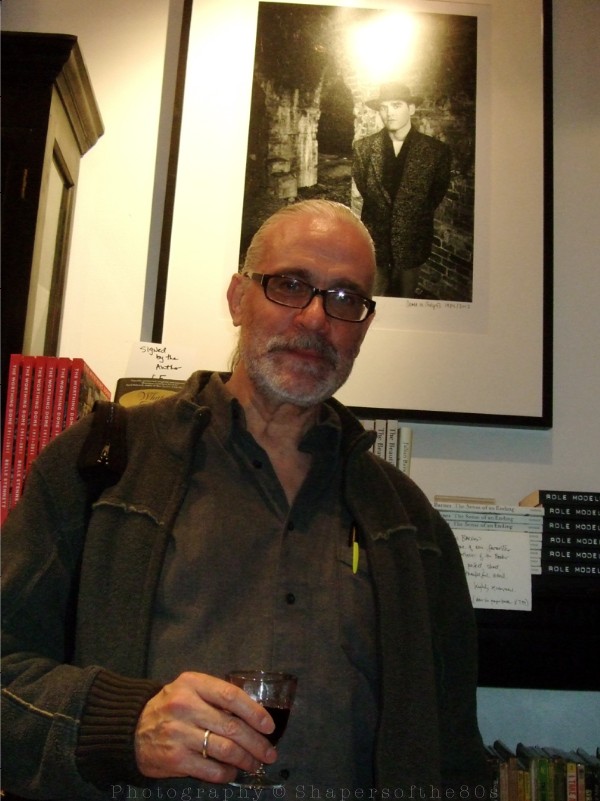
Derek Ridgers in Soho last night: his portrait of Morrissey a bridge between two eras. Photographed by Shapersofthe80s

❚ SOME PHOTOGRAPHERS ARE as extrovert as their famous sitters, but Derek Ridgers has captured the essence of British street style and achieved a uniquely influential status by tip-toeing through the margins of life, feather-footed as the questing vole. Anyone who has followed the Punk and New Romantic scenes recognises the Ridgers types — “transient beings moving across an urban landscape, experimenters, flamboyant souls who cared more than anything about how they looked and whose greatest fear was of being ordinary”, as writer Val Williams noted in the Ridgers photobook of 2004, When We Were Young: Club and Street Portraits. His straight-up photographic style pinned those clubbing butterflies like curios into the display case labelled Swinging 80s. They trigger the involuntary remembrance of the texture of an era as readily as cake did for Marcel Proust: each image has the potential to become the “vase filled with perfumes, sounds, places and climates”.

Throughout April and May we may relish the Ridgers back catalogue in a new exhibition titled Unseen at Soho’s Society Club. The selection documents celebrities and street stylists from 35 years of commissions by music mags and national press. Here is an engaging mix of concert shots and powerfully intimate portraits in which eye-contact is key: Nick Cave, David Lynch, J G Ballard, Boy George, Tom Waits, The Cramps, Mick Jagger, plus the image of Keith Richards which is currently touring in the Sunday Times Magazine 50th anniversary show.

Another exceptionally striking portrait has the singer Morrissey eyeballing the Ridgers lens with an intense gaze that definitely says misunderstood but could just as easily be saying cussed. It was shot in London in 1985, year of The Smiths’ second album, Meat Is Murder, when Moz began raising the temperature with political views about the Thatcher government and the monarchy.
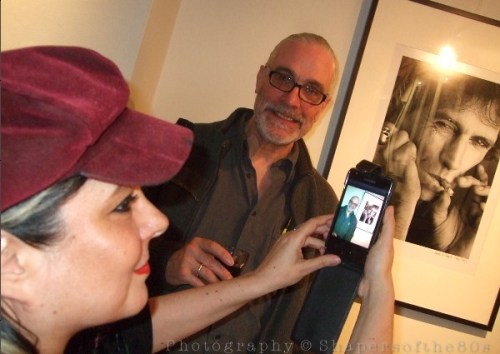
Derek Ridgers, photography, exhibition, Society Club, Keith Richards

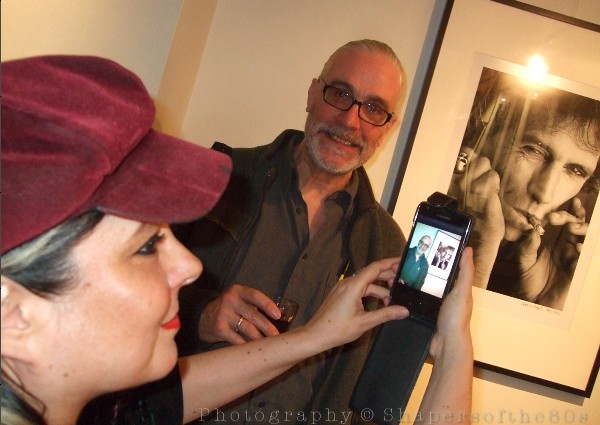
Soho last night: Ridgers, Richards and a new snapper called Tracy Jenkins. Photographed by Shapersothe80s

Ridgers said: “He’s a bit of a strain to photograph in the sense that there is so little of his personality coming back at you. Or at least there wasn’t in those days. Maybe he was very shy but he seemed taciturn in the extreme. The two times we met, he gave the impression of not wanting to say boo to a goose. He honestly hardly said a word to me. Nothing at all like the extremely opinionated personality that comes across in interviews these days.”

The two characteristic Morrisseys of then and now — the one taciturn, the other curmudgeonly — bestride three decades which completely reinvented British notions of youth culture, music, sexuality and success, yet at last night’s preview it was salutory to be pulled up by a 26-year-old illustrator among the guests who had to ask: Who was Morrissey?

All the more reason to buy ourselves a cool black-and-white print as a Proustian trigger, either directly from the Ridgers Archive or from an earlier catalogue viewable at the Society Club. Titled Previously Unpublished, this takes us from an iconic 1982 lineup of the ever-evolving band The Fall, through Culture Club, John Galliano, Roddy Frame, Tim Roth, into the 90s of the Charlatans, Ray Winstone, Lee Scratch Perry and a pensive Kylie Minogue to a raunchy Boo Delicious and more in the new century.

Ridgers has published three books of photographs, has exhibited frequently, and was a judge in How We Are Now, an online photography project launched by Tate Britain in 2007.

➢ Derek Ridgers Unseen runs until May 31 at the Society Club, 12 Ingestre Place, London W1F 0JF

➢ Previously Unpublished can be bought in various formats from Blurb, “a creative publishing service”

➢ 50 Years of The Sunday Times Magazine is viewable in Bristol, Manchester and Birmingham until June

FRONT PAGE

➤ Uh-oh! Vice lifts the lid on the untold dramality of Dalston Superstars

Dalston Superstars, #Exposed , Vicedotcom,dramality, web TV,hipsters
➢ Click the pic to view the new #Exposed video

➢ Vicedotcom exhumes its hipster tragicomedy — and just look at the tags: Mark Ronson, Grace Dent, billie jd porter, Paul Morley

Dalston Superstars #Exposed is the untold story of the web series that changed everything. Back in 2011, Dalston Superstars was launched on an unsuspecting internet, clocking up a record three million Facebook likes.

At first glance the show appeared to be just another dramality show in the vein of TOWIE or Jersey Shore, but, on closer inspection, was Dalston Superstars more than that? Was it in fact a searing satire, not only of reality television, but also of the mindless young hipsters who populate East London’s streets? / Er, discuss at Vice online

❏ Top Commenter and bad speller Guy Turner declares at Vicedotcom: “I think you started it as a reality TV spin-off with your cool hipster freinds [sic] then realised they were nobs [sic] so pretended it was satire as the abuse came in from all quarters.”

➢ Catch up on the whole darn dramality of the original Dalston Superstars as it unfolded — only at Shapersofthe80s

FRONT PAGE