Category Archives: Youth culture

➤ Smash Hits and other mould-breakers of the 80s

Neil Tennant ,Smash Hits, Radio 4, documentary

1983: Neil Tennant as Smash Hits writer. (Photo by Virginia Turbett)

❚ ANOTHER NICELY PACKAGED Radio 4 documentary today celebrated the crucial years 1982–85 which Neil Tennant describes as “the golden age of 80s pop”. They luckily coincided with his tenure as a writer on Smash Hits magazine before stepping into the pop charts himself as half of the Pet Shop Boys. Obviously in a prog titled Neil Tennant’s Smash Hits Christmas Tennant and his cronies were full of back-slapping at the moulds they broke with the mass-selling fan mag, driven initially by two selling points – song lyrics and pull-out pinup posters.

Smash Hits, Radio 4, documentary,Pete Murphy

1982: Peter Murphy of Bauhaus (you really don’t want to see its Christmas cover star)

Launched in Nov 1978 as a monthly title, Smash Hits trailed “The words to 18 top singles” as its key feature. The mag was the invention of former NME editor (and later founder of The Face) Nick Logan who conceived it on the kitchen table and initially toyed with the title Disco Fever, presumably in homage to that year’s horror movie Saturday Night Fever. He chose the Belgian new-wave joker Plastic Bertrand for the cover of a pilot issue in the post-punk vacuum when any new direction seemed significant, but actually launched with Blondie. Smash Hits soon went fortnightly, ran for 28 years, and died with Celebrity Big Brother’s Preston gracing its last cover in 2006. In his Guardian obituary for the mag, Alexis Petridis wrote: “The period between the rise of Adam and the Ants and the collapse of Stock, Aitken and Waterman’s ‘Hit Factory’ empire may prove to be the last truly great pop era, in that it produced not just great pop music, but great pop stars.”

Tennant ignores the fact that 80s classic pop began with the music of Spandau Ballet and Adam Ant a couple of years earlier than his joining the mag. Also unmentioned in today’s doc was that the mould-breaking writing of this era was actually led by The Face and the subcultural flagship magazine New Sounds New Styles, which gently parodied the posers of the New Romantics movement and closed in 1982 through lack of promotion by its publisher Emap, who also happened to publish Smash Hits. The fresh rebel writers of NSNS had adopted a tongue-in-cheek tone which kickstarted a shift of power away from stars and their publicists into the hands of writers themselves. Once the 80s had revived the long-dead credibility of pop music – dubbed “pure pop” in vigorous public debates – Smash Hits took its cue by adopting a knowing approach to pop journalism and providing a cheeky foil to Britain’s four seriously po-faced weekly rock-music newspapers. We cannot underestimate how its humour helped sophisticate the Smash Hits reader, pragmatically described by Tennant as “the 12-year-old girl in Grantham”. Which was a neat way of deflating his own pomposity.

Spookiest quote today came from Toyah, after remarking that the pop scene has lost the airy optimism of the 80s: “We now view fame as something dark and faintly abusive.” Oo-er.

Neil Tennant ,Smash Hits, Radio 4, documentary, Pet Shop Boys

April 1985: Tennant as cover star and Pet Shop Boy with Chris Lowe

FRONT PAGE

2012 ➤ A brighter Bluer Rondo for the 20-tweens

Chewing the Fat, vinyl, Blue Rondo à la Turk, 1982, albums,pop music, Latin funk,Wag club, Chris Sullivan, Change, Club Mix,

Picture sleeve painted by vocalist Chris Sullivan, 1982

❚ TWO VINTAGE MUSICAL GEMS appeared online this week, casting a fresh magic spell. They are two tracks from Chewing the Fat, the debut album by the image dance-band of 80s clubland, Blue Rondo à la Turk. In the view of Shapersofthe80s, the 9-track stereo vinyl LP was then and remains now the standout pop album of 1982 for sheer verve and originality. Chris Sullivan, the band’s driving force who went on to run Soho’s Wag club for 19 years, has been remixing the Diable Noir masters which became available only a few months ago.
++++++
This week we heard the sparkling Change Club Mix 2, an original Poncioni-Sullivan composition tagged as “Afro-Latino funk”, and only released previously on the album. Sullivan says we can download the remix as a 58MB Wav file from Soundcloud so it plays right away through iTunes. “We’ll leave it up for downloads for a week,” he said. “Blue Rondo recorded this over 30 years ago and remixed it this year… Still shakes it.” At Facebook, Rondo fan Michael Feasey agrees: “Good stuff Chris – love that samba percussion coming up to 4:00 and the gritty sax. Hell, it’s all good.”
vinyl, Blue Rondo à la Turk, 1982, albums,pop music, Latin funk,Wag club, Chris Sullivan, Klacto Vee Sedstein,Oxford Road Show,TV,

Picture sleeve painted by vocalist Chris Sullivan,1982

The band’s second chart single was the witty Klacto Vee Sedstein. (“It’s got to mean something, it can’t be a dream” – Well, the title was inspired by Charlie Parker’s 1947 number, if not the tune itself.) Rondo’s track enlivened the top 100 for nearly six months, and its “mutant funk” has now emerged from the glitz of Godley & Creme’s 80s production. As Sullivan says: “This is how we’d have liked to have done the song initially but all we’ve done is clean it up a bit and take it back to the original idea… This was recorded 31 years ago.” Verdict at Mixcloud from Mark Huxley: “Lovely stripped down mix!”

Best revelation from Sullivan also came this week: “Expect a digital re-release of our album Chewing The Fat in the spring. I’m quite shocked by how well it’s aged.” He’s not wrong there.

♫ Listen to Klacto Vee Sedstein 2012, as it was meant to sound

Live Performance on Oxford Road Show

+++
➢ 2012, Blue Rondo breathe fresh life into Mr Sanchez – “Mark Reilly did the lion’s share,” says Sullivan, referring to Rondo’s guitarist

New Sounds New Styles, 1981

First published in New Sounds New Styles, August 1981

➢ 1981, Blue Rondo create a new buzz with Latin sounds – unveiled in New Sounds New Styles by Shapersofthe80s

DEC 3: MUTANT DISCO UPDATE

Michel Esteban, Michael Zilkha, ZE Records,

Michael Zilkha and Michel Esteban: label founders combined their initials into ZE

♫ Sullivan also offered an hour-long Mutant Disco mix for a recent Mark Jones show on BBC 6Music – The party kicks off with Contort Yourself (August Darnell remix from the 1979 US 12-incher) by No Wave pioneer James White & The Blacks on ZE Records, the boutique label based in Paris and New York which recharged the disco genre with edge and credibility while Manhattanites pursued dance-oriented rock and Euro-disco wandered its own byways, both folkloric and electronic.

No Wave, Mutant Disco, dance music, James White & The Blacks, ZE Records
Launched in 1978 by British-born old Oxonian and Mothercare heir Michael Zilkha, and French graphic artist Michel Esteban, ZE selected style-leading eccentrics of the day to redefine upfront New York disco. The Sullivan mix includes ZE artists such as Lizzy Mercier Descloux, Kid Creole & The Coconuts, Was (Not Was), Coati Mundi, Material, though alas no Cristina. The title of ZE’s witty vinyl cocktail of acts tagged “A Subtle Discolation of the Norm” put the term Mutant Disco into the language in 1981, and acted as soundtrack to the first Blitz invasion of the US that spring.

Sullivan explains, Dec 3: “Here’s a live mix straight off the decks I did for Mark Jones Back to the Phuture show on BBC 6Music. Kinda all that early 80s electro Ze records stuff we loved and still do … They’ve edited some of the mixes but still it’s a bit of a gas … With a few exceptions this is what I played at Hell” [the Blitz crowd’s breakaway club of 1980].

FRONT PAGE

2012 ➤ Soho’s nightowls revisit the club that sifted the Artex monkeys from Bowie’s Heroes

Cultural observer Peter York: eager for the Sullivan autograph on the new edition

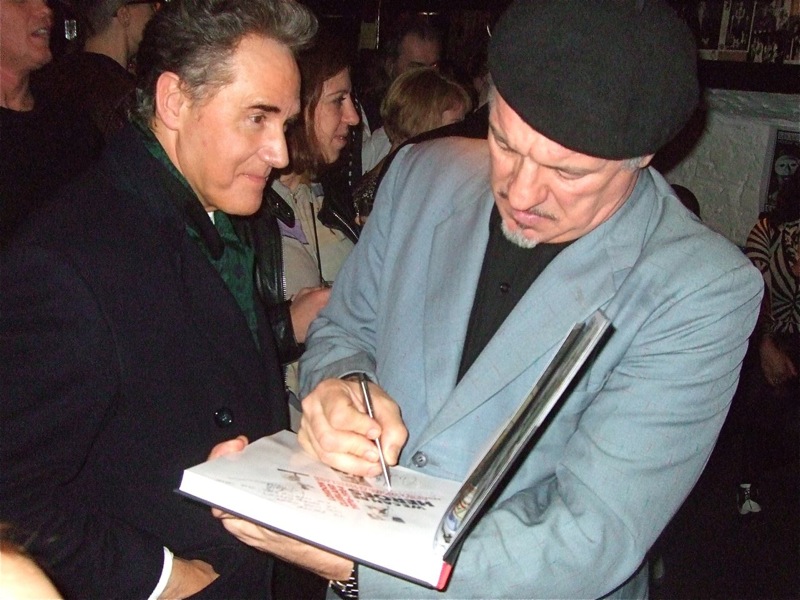
❚ THE 80s BLITZ KIDS turned out in force last night. As Kitten Kouturist Franceska Luther King remarks today: “an elegant crowd, older, but still the same spirit.” Those clubbing compulsives who defined the sounds and styles of Soho 30 years ago, swarmed into the tiny steaming Artex-lined cellars of the St Moritz restaurant, the fit all the tighter thanks to a fair few middle-aged paunches. For three months in 1980 this was the site of their milestone one-nighter which signalled the first faction to break away from the futurists at Steve Strange and Rusty Egan’s pioneering electro-diskow, The Blitz. In host Chris Sullivan’s words, this was “the more alert end of the Blitz crowd” – in other words, the hardcore fashionistas.

Initially St Moritz’s music evoked interwar Berlin cabaret but the effect of Charles Fox, the theatrical costumiers, staging its closing-down sale in Covent Garden injected a huge Hollywood movie wardrobe. Sullivan notes:  “You could be a gangster, a geisha, or Geronimo.” The New Romantics had been born – just like that!

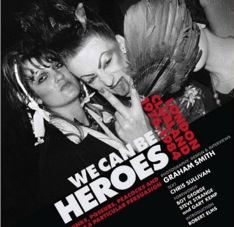
“No single shop sale ever had such an influence on street fashion before or since,” Sullivan writes in the fabulous photo-book, We Can Be Heroes. This ribald account of the dawn of UK clubbing in the 80s, led by the eye-popping photographs of Graham Smith, was the reason for last night’s beano. Soul-music diehards Smith and Sullivan graduated from The Blitz to become two of the St Moritz deejays (along with Robert Elms and Steve Mahoney) and half a lifetime on they were hosting yet another launch party. The book’s revised and amended second edition of 2,500 copies is released this week through regular retail outlets. Copies of last year’s limited edition are still available from the fund-it-yourself publisher Unbound.

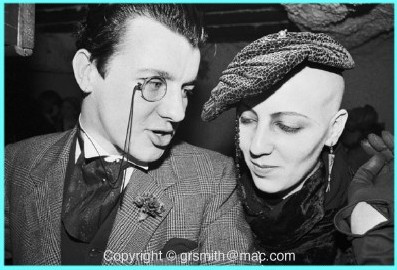
St Moritz 1980: Chris Sullivan and Michele Clapton – from Smith’s book We Can Be Heroes

Back in the day, the St Moritz posse distinguished themselves from The Blitz by playing retro lounge-lizard tunes from Lotte Lenya or Nat King Cole. In today’s arts pages of The Times Sullivan recaps how, in their efforts to avoid the present, he and his cohort helped create the future: “We decided to oppose Blitz futurism and turn the clock back with music from Marlene Dietrich, Monroe, Sinatra and soundtracks from A Clockwork Orange, Last Tango in Paris and Cabaret. It was an alarming success.”

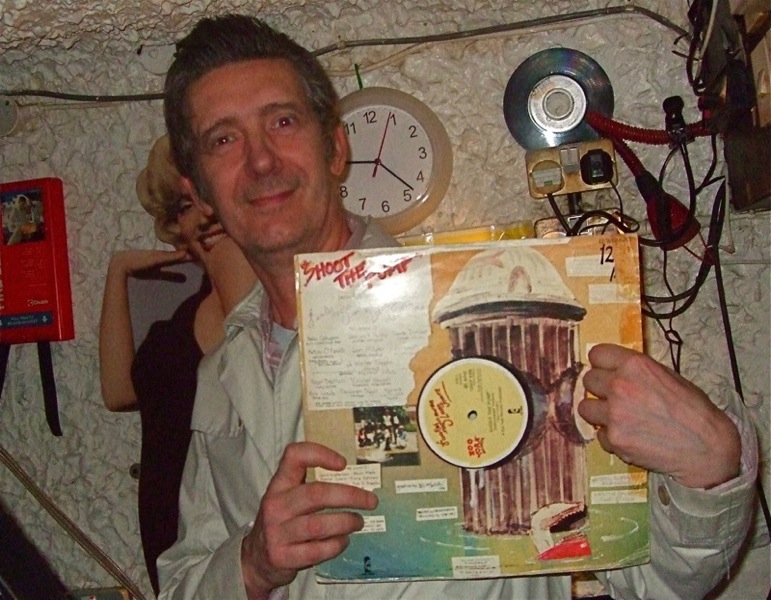
Rob Milton: Shooting the Pump in the deejay booth

♫ Click to hear Shoot the Pump in a new window

Fashions in music moved apace. Within a year successive London club-nights at Hell, Le Kilt and Le Beat Route were stirring into the club mix not only familiar 70s soul but the edgy new urban sounds of North America.

Choosing the soundtrack last night at St Moritz were the were the astute ears of David Hawkes, Christos Tolera and Sullivan himself, plus Dirt Box co-founder Rob Milton, who raked the dancefloor early in the evening with the crazed beats of Shoot the Pump. This intoxicating debut single from 1981 was a state-of-the-art fusion of emergent street sounds – rap, hip-hop and funk with a hint of mutant disco – from the “playin’ brown rapper” and graffiti artist J Walter Negro & the Loose Jointz (on Zoo York Records via Island). J Walter is urging his crew of Zoo Yorkers to spray docile citizens with the water from a fire hydrant: “You make like a monkey with monkey wrench, cos you feel a little funky, got a thirst to quench.” In 1980–81, something similar was pumping the adrenalin in London.

CLICK ANY PIC TO LAUNCH CAROUSEL:

FRONT PAGE

➤ Another knees-up while Amazon discounts We Can Be Heroes second edition

The reviewers said: “A gorgeous history of 80s London clubland” (Alex Petredis, Guardian) … “fascinating and definitive” (Robert Spellman, Sunday Express)

Graham Smith,Chris Sullivan, books,photography, youth culture, We Can Be Heroes , Swinging 80s, clubbing❚ TOMORROW SEES ANOTHER launch party, this time at 1980’s breakaway New Romantics nightspot St Moritz in Soho to celebrate publication of the second (unlimited) edition of the 320-page coffee-table photobook that chronicles the creation of 80s clubbing through Graham Smith’s eye-witness photography, and racy commentary from Wag club host Chris Sullivan. Read the full background to the characters behind the book We Can Be Heroes at Shapersofthe80s. On sale for £35 from its publisher Unbound, or discounted to £25.50 at Amazon (an even cheaper pre-publication offer has finished).

➢ View Shapersofthe80s’ videos of Chris Sullivan telling his “Ribald tales of excess” from the Blitz era

➢ More 80s yarns on video from Robert Elms

➢ Catch-up list of links to all last year’s publicity shenanigans

Making up the rules of 80s clubbing: Robert Elms, Phil Dirtbox and Chris Sullivan at last year’s exhibition of Graham Smith’s nightlife pictures. Photograph by Shapersofthe80s

FRONT PAGE

➤ K West sign ‘possibly’ for sale in Bowie memorabilia show

Ziggy Stardust ,K West, Brian Ward,David Bowie,memorabilia ,Movie Poster Art Gallery,Paul Burston,Alex Hopkins

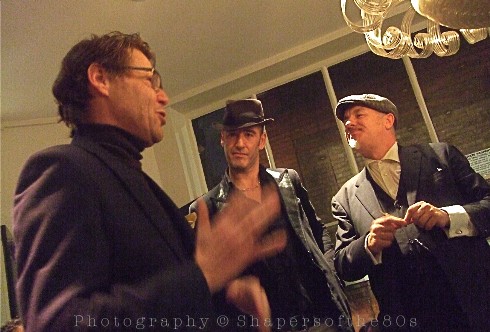
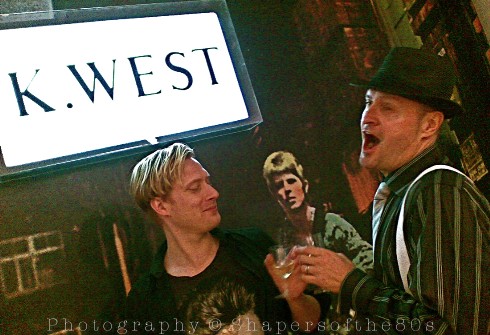
The long-lost K West sign in all its magical luminescence: the restored emblem of the Ziggy Stardust album sleeve is on display at MPAG, London. Captured in its mystic rays (above), writer Alex Hopkins of the quarterly Lifestyle magazine beigeuk.com with the always-on Paul Burston of Time Out London. (Nokia snap © Shapersofthe80s)

❚ AFTER ZIGGY’S 40TH ANNIVERSARY HULLABALOO comes a unique selling exhibition of Bowie graphic art and memorabilia from his golden years 1969–1981. On display this week in London for the first time in 30 years is the original K. West sign that featured in Brian Ward’s covershot for Bowie’s springboard 1972 album, The Rise and Fall of Ziggy Stardust and the Spiders From Mars. The record sleeve itself has long been as iconic a London image as Abbey Road’s zebra crossing. At last, the illuminated sign from 23 Heddon Street has been rescued by a music industry veteran and restored, and is on show at the Movie Poster Art Gallery, run by 80s Mud Club regular, Tim Maddison. He revealed to Shapersofthe80s that it may be for sale “at the right price”.

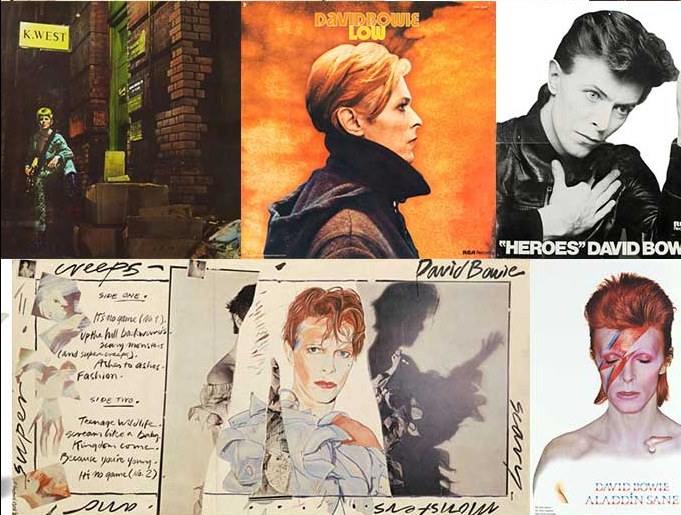
The exhibition highlights celebrated images created for Bowie by talents such as Brian Duffy, Edward Bell, Masayoshi Sukita, Guy Peellaert, Steve Shapiro and Eric Stephen Jacobs. Original posters and large-format promotional displays on Bowie in the 70s are hard to come by, let alone buy, so this show is a treat. At the preview, a 3-ft wide original RCA in-store display for Diamond Dogs was snapped up at £1,250. A fab Scary Monsters in-store stand was still for sale today at £950.

Bowie graphics: five of the images for sale this week

➢ David Bowie: Sound and Vision at the The Movie Poster Art Gallery, London (Nov 17–Dec 1)

➢ View more classic Bowie images for sale this week

This slideshow requires JavaScript.

A MORE PAINTERLY TAKE ON BOWIE

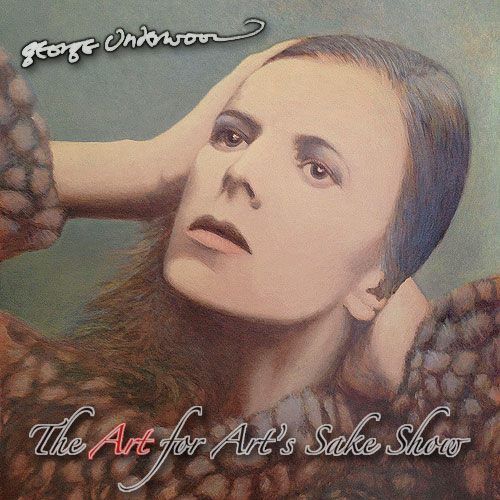
❚ KNOWN AS THE MAN WHO changed the colour of Bowie’s left eye, painter George Underwood is showing his recently discovered 1975 oil painting of the Hunky Dory cover shoot [below] in London next month. He stumbled upon the 32 x 38-inch original while sorting through some old artworks and now it’s on sale for £16,000.

Bowie’s schoolfriend and former musician, Underwood as a painter adopted an imaginative style that refers to Bosch, Bruegel and mannerism. He is among an eclectic mix of ten contemporary artists selling direct through The Art for Art’s Sake Show at The Gallery in Cork Street next month. Rather more affordable Bowie mementoes are his limited edition giclée prints which include Width of a Circle (1969, £500), seen on the back cover of the UK David Bowie LP on Philips… Stardust Memories (1972, £350), a Ziggy era painting that was reproduced as a poster… The Man Who Fell to Earth (1975, £650), seen on the cover of the Pan Books film tie-in.

George Underwood , Hunky Dory,David Bowie,Cork Street, artwork

Rediscovered: George Underwood’s 1975 painting of the Hunky Dory cover

➢ The Art for Art’s Sake Show: the New Kids on the Block (Dec 3–8)

➢ At Underwood’s own online gallery, collectable enamel brooches of Ziggy Stardust cartoons

FRONT PAGE