Fireworks in Firework: British TV viewers see only a pixelated version
❚ YESTERDAY KATY PERRY’S SINGLE FIREWORK finally fell out of the UK singles chart after 58 weeks, having left the US Billboard Hot 100 last July after 39 weeks, and selling 4.7m copies in the US. To date, the video has been viewed 253m times on YouTube, and picked up MTV’s video of the year award.
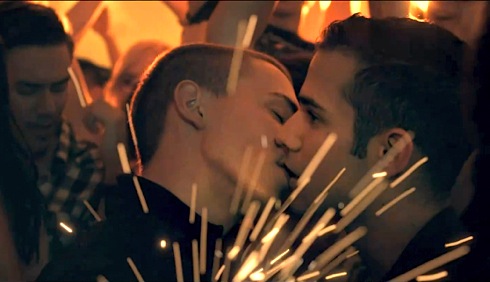
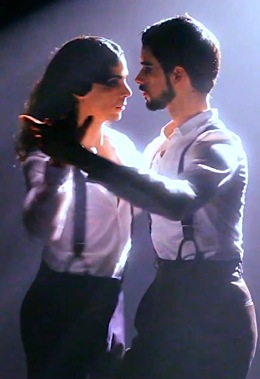
Despite depicting fireworks shooting from Perry’s chest, this daft yet lavish and cinematic promo video shot in Hungary was censored for British television because it captured the fleeting kiss shown above between two young men. Yet many another video has failed to raise such outrage. A year ago when Firework had reached No 4 in the UK chart, Shapersofthe80s went in search of 20 gay kisses in pop that did make it past the censor.
❏ iPAD, TABLET & MOBILE USERS PLEASE NOTE — You may see only a tiny selection of items from this wide-ranging website about the 1980s, not chosen by the author. To access fuller background features and site index either click on “Standard view” or visit Shapersofthe80s.com on a desktop computer. ➢ Click here to visit a different random item every time you click
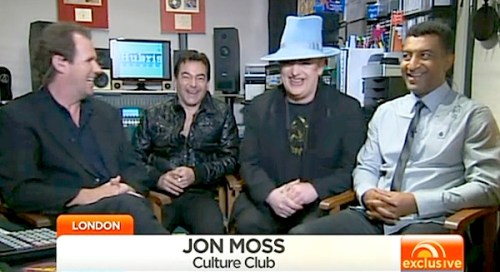
❚ HERE’S A PICTURE MANY SAID would never be taken: all four members of 80s supergroup Culture Club reunited. And a live concert imminent. In 1983 the New Romantic band with its gender-bending singer and unique reggae-based rhythms were prominent among the 18 new-wave bands who mounted the Second British Invasion of the US charts. In 1984 the band won the Grammy Award as Best New Artist and along with Princess Diana, Boy George became an international fashion emblem for the new Swinging London.
This week Boy George’s official website announces that the four original members of Culture Club have reunited for the first time since 2002 for a one-off concert in Australia on Jan 1. Before an audience of 30,000 at Sydney’s Glebe Island, overlooking the harbour, the band will play after the New Year’s Eve midnight fireworks on a bill with The Pet Shop Boys, Jamiroquai and other Australian acts.
More surprising is that the photo shows Roy, Jon, George and Mikey in a London recording studio where George said “we’re in the middle of writing for a new album” with their original producer Steve Levine. This first pic of the reunited Culture Club is grabbed from Sydney’s Seven Television in an interview on Tuesday when George said they’d include a couple of new songs in the “hit-packed” Sydney show. When Jon was asked why a reunion has taken so long, an agonisingly long silence followed until he managed to answer “I don’t know!” This did raise the laugh we see above, then he added “I think we have a ten-year cycle. It takes that long to recover from the last time we worked with each other.” Not a flicker of a smile from anyone. The six-minute exchange contained so many sidelong glances between the four and generally awkward body language that you might wonder whether they would survive the flight to Australia together.
Culture Club’s initial five-year career was blown apart after clocking ten Top 40 hits in the US, which included Karma Chameleon and Do You Really Want to Hurt Me. By 1986, however, George’s addiction to drugs was making tabloid headlines and his secret four-year romance with Jon was growing ever more explosive. A sanitised TV dramatisation titled Worried About The Boy provided an extremely one-sided version of events when aired last year. From 1998 a band reunion over four years yielded two chart hits and a platinum compilation album in the UK.
❚ ONLY ABOUT 400 “LOOKERS-IN” were able to view the world’s first scheduled television service in high-definition (240+ lines) at 3pm on November 2, 1936. The engineers wore white dust-coats and the star wore a cocktail dress. With immaculate middle-class enunciation, she sang a song full of amazement at the newest technology of its day:
♫ A mighty maze of mystic, magic rays Is all about us in the blu-u-u-u-e, And in sight and sound they trace Living pictures out of space To bring our new wonder to you-u-u-u-u ♫
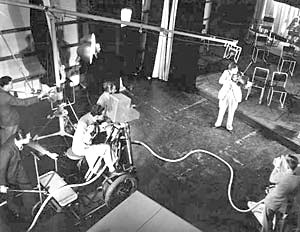
Everyone knew the musical comedy star Adele Dixon, though not yet the BBC Television Orchestra conducted by Hyam Greenbaum, also glimpsed in the clip above. The opening show was called Variety, and the song was called simply Television — known universally today as The Television Song. It had been specially written for the occasion, with lyrics by James Dyrenforth and music by Kenneth Leslie-Smith. Its innocence still wows us for six.
The broadcast was being beamed from what became a landmark transmitter tower atop customised studios 350ft over North London at Alexandra Palace, the original “people’s palace of entertainment”. Two different black-and-white television systems were being tested in quick succession on that first afternoon, and then on alternate weeks for six months: in the 70 x 30 feet Studio A the Marconi-EMI 405-line electronic system; and in Studio B, John Logie Baird’s 240-line mechanical system.
Baird the tenacious Scot is usually claimed to be the inventor of television and between 1923–1925 he demonstrated his clunky apparatus with a spiral of revolving lenses in the Soho building which became Bianchi’s restaurant soon after, refurbished today as Little Italy. The Times reported in 1926: “The image was often blurred. But it substantiated a claim that it is possible to transmit and reproduce instantly such things as the play of expression on the human face.”
Baird’s televisor in Frith Street, 1925: before transmission, the received image at left has been scanned by a spiral of revolving lenses, shown at right with inventor Logie Baird. Photo: Hulton/Getty
The flaw lay in Baird’s underlying technology being mechanical. In the end, Marconi’s electronic rival proved to be the future and it endured until the 1960s. Cecil Madden, the BBC’s fledgling TV Programme Organiser, says the differences were all too apparent: “Working in the Baird studio was a bit like using Morse code when you knew that next door you could telephone.”
A kick-start to the novice TV industry had come two months earlier. At very short notice the rival systems had been demonstrated at Radiolympia, the annual exhibition mounted by the Radio Manufacturers’ Association. The radio industry couldn’t sell the stands for the 1936 show (Aug 24-Sep 3) and a desperate call for help went out: could television save the day? (All the more desperate considering that TV sets in 1936 cost a princely £150, which is equivalent to £8,300 in today’s money.) Given only nine days’ warning, Cecil Madden appointed himself producer of its first broadcast.
❏ On August 26 at 11:45 a piece of Duke Ellington was heard, accompanied by a caption card reading, BBC Demonstration to Radiolympia by the Baird System, transmitted from its tiny one-camera studio. This was followed by another ten minutes of music. The highlight of the demonstration was to be a variety show someone had the bright idea of calling Here’s Looking At You, featuring a song with the same title by Ronnie Hill, performed by Helen McKay.
Alexandra Palace: Studio A with an Emitron camera
It was not until the next day, when everything was repeated using the Marconi-EMI system, that the show was seen in its full glory: with three cameras, two mobile and one fixed. This was the version filmed by British Movietone news cameras and featured above. “Hello Radiolympia,” said announcer Leslie Mitchell, standing in front of the first set of curtains. “Ladies and gentlemen, Here’s Looking at You.” And Miss McKay sang:
♫ Here’s looking at you From out of the blue Don’t make a fuss Just settle down and look at us ♫
The 30-minute show that followed went out twice a day. Cecil Madden says: “It’s still unique because noone has ever done 20 programmes live, twice a day for ten days, from Alexandra Palace to the radio show at Olympia.”
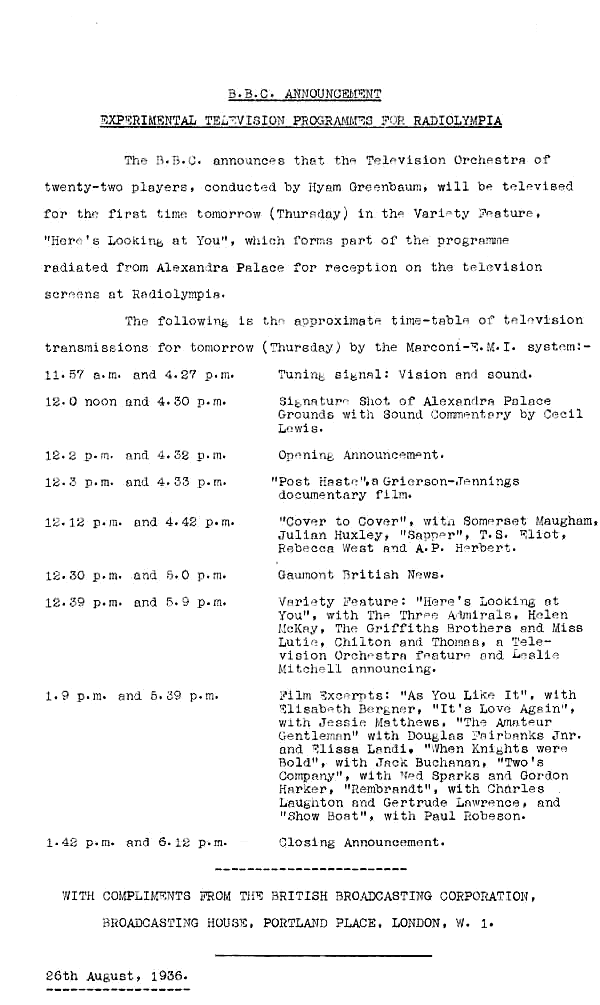
The BBC’s twice-daily running order for Radiolympia 1936. Click for the full document where eagle eyes will note readings by T S Eliot, Aldous Huxley and Rebecca West, and film appearances by Charles Laughton, Gertrude Lawrence and Paul Robeson. Source: Terra Media
The programme was received as far away as Bournemouth and Nottingham, and the Marconi-EMI team, with their mobile camera, were able to include some exterior shots from Ally Pally. All of which resulted in the official inauguration of the BBC Television Service being brought forward to early November. Regular programmes were broadcast twice a day from 3pm to 4pm and from 9pm to 10pm, except on Sundays. One of the early fears was that television would cause eye strain — even after only two hours a day.
NUMBER CRUNCHER
❚ Last year sales of UK programmes and format ideas generated revenues of £1.4bn, up from £1.3bn in 2009
❚ North America represented 42% of total UK export revenue in 2010, with Europe 31% and the rest of the world 27%
❚ Sales to Canada rose from £61m to £73m in the year to 2010, a 20% increase
❚ Revenue from ready-to-screen TV sold abroad in 2010 raised £657m, up 15% [UK Television Exports Survey]
“ THE CATCHPHRASE ‘Fire up the Lada’ could soon be sweeping Russia. The BBC has licensed the hit TV series Life on Mars, which turned actor Philip Glenister’s politically incorrect DCI Gene Hunt into one of the nation’s best loved characters, to be set in the former Soviet Union and the action relocated from 1970s Manchester to communist Moscow.
“ The BBC’s announcement comes as figures from the UK Television Exports Survey show that the world’s appetite for British television is booming. The success of formats such as Strictly Come Dancing and The X Factor, as well as the dramas Downton Abbey and Sherlock, have led to a 13% rise in export revenues to more than £1.4bn in the past year…”/continued at Guardian online
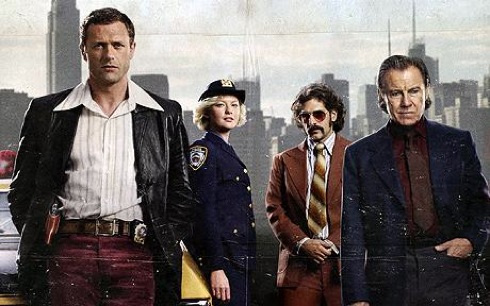
Next stop, Moscow: The US version of Life on Mars, starred Jason O’Mara as Sam Tyler and Harvey Keitel as a quieter Gene Hunt (photography: FX)
❏ iPAD & TABLET USERS PLEASE NOTE — You are viewing only a very small selection of content from this wide-ranging website on the 1980s, not chosen by the author. To access fuller background features and topical updates please view Shapersofthe80s.com on a desktop computer
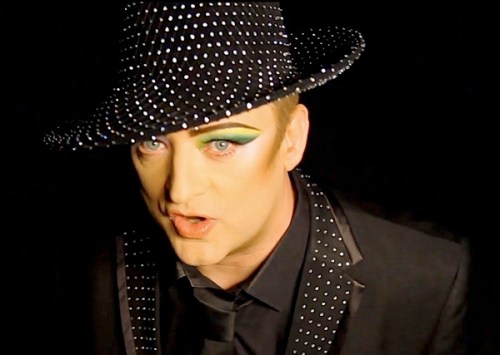
❚ GET AN EYEFUL OF THOSE long-lost cheekbones! Hello! We haven’t seen you since the late 90s. Well, Boy George has been Twittering away for months about his fad diets, his gym routine and doing 100 squats at a time, and this week he unveiled the result — at least from the neck up. And yes, this studio video for Turn 2 Dust does suggest that a few pounds seem to have been shed.
Turn 2 Dust: two dancers among many turns in Boy George’s video
OK the camera is angled from above looking down throughout the three-and-a-half slickly edited minutes. OK he’s shot wearing black and artfully lit in a black void. OK somebody has been paid a fortune to get the maquillage just so. But hey. It’s a start. Welcome to the muscle marys club, George.
This reggaefied version of the highly danceable Turn 2 Dust derives from the track on his MP3 album Ordinary Alien released in March. It’s one of those heartfelt, political George numbers about the outsider “with only truth as my defence” and it pleads for tolerance: “All hatred must turn to dust.” And there’s a break, just for a moment, where you could swear the voice is Bowie’s, oh yes. This very cool video is shot in a no less cool London nightspot, the Lightbox, where George threw his 50th birthday party last June.
The vid is promoting an MP3 package of 11 remixes released this month. To underscore the song’s message, the video features a provocatively camp cast of comic clubbing characters, so it is no surprise that George can scarcely keep a straight face. Cheekbones and all.
MENTION OF LADY GAGA’S NAME
SETS GEORGE OFF, KERPOW!
+++ ❏ Yesterday Boy George was in Macau, the administrative region of China famed for its casinos, to present a deejay session at Club Lotus, preceded by this live videoed press conference. When a journalist asked whether his current musical collaborations might include Lady Gaga, the question seemed to trigger a good-humoured but impassioned rant [scroll forward to the 4-minute mark]. Here’s just a part of it…
“ I’m more interested in working with people in the dance field. I’m talking about house music, not pop. I’m not really involved in pop music — I haven’t been for a long long time. I don’t have anything to do with the modern pop scene. It’s not for me. It’s an alien thing to me. I just don’t get it, don’t feel part of it, don’t understand it. The dance world is more fun — you have more freedom… Pop music is very restricted. Everybody is making the same record, everybody is using same vocal sound, nobody’s singing about anything any more, it’s all crap…
“ That’s a very extreme statement but that’s how I feel. There’s nobody speaking to me in pop music. Everybody just wants to wear the fur coat and drink champagne and talk rubbish. Where’s the David Bowies? Where’s the Boy Georges? Where’s the passion? There isn’t really any. ”
QUIZZED ON THE PRICE OF HIS £499 PHOTOBOOK
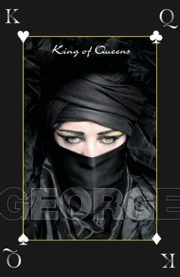
❏ Boy George has a chunky 18×12-inch coffee-table picture book titled King of Queens coming out on Dec 12 in a limited edition of 999 signed copies, which includes a 10-inch vinyl anthology of unreleased music, all in a clamshell clothbound case, from Kitchen Sink Publishing, price £499. At the Macau press conference a journalist thought this was very expensive. George replied:
“ It’s 90 pages of photographs, very personal things from my collection, things people have never seen, a beautifully bound collectors’ book. It’s very expensive. But you don’t have to have it. It’s like saying you should put down the price of a Porsche because I want to have it. You know, some things in life, you can’t have. ”
➢ Choose “View full site” – then in the blue bar atop your mobile page, click the three horizontal lines linking to many blue themed pages with background article
MORE INTERESTING THAN MOST PEOPLE’S FANTASIES — THE SWINGING EIGHTIES 1978-1984
They didn’t call themselves New Romantics, or the Blitz Kids – but other people did.
“I’d find people at the Blitz who were possible only in my imagination. But they were real” — Stephen Jones, hatmaker, 1983. (Illustration courtesy Iain R Webb, 1983)
“The truth about those Blitz club people was more interesting than most people’s fantasies” — Steve Dagger, pop group manager, 1983
PRAISE INDEED!
“See David Johnson’s fabulously detailed website Shapers of the 80s to which I am hugely indebted” – Political historian Dominic Sandbrook, in his book Who Dares Wins, 2019
“The (velvet) goldmine that is Shapers of the 80s” – Verdict of Chris O’Leary, respected author and blogger who analyses Bowie song by song at Pushing Ahead of the Dame
“The rather brilliant Shapers of the 80s website” – Dylan Jones in his Sweet Dreams paperback, 2021
A UNIQUE HISTORY
➢ WELCOME to the Swinging 80s ➢ THE BLOG POSTS on this front page report topical updates ➢ ROLL OVER THE MENU at page top to go deeper into the past ➢ FOR NEWS & MONTH BY MONTH SEARCH scroll down this sidebar
❏ Header artwork by Kat Starchild shows Blitz Kids Darla Jane Gilroy, Elise Brazier, Judi Frankland and Steve Strange, with David Bowie at centre in his 1980 video for Ashes to Ashes
VINCENT ON AIR 2026
✱ Deejay legend Robbie Vincent has returned to JazzFM on Sundays 1-3pm… Catch up on Robbie’s JazzFM August Bank Holiday 2020 session thanks to AhhhhhSoul with four hours of “nothing but essential rhythms of soul, jazz and funk”.
TOLD FOR THE FIRST TIME
◆ Who was who in Spandau’s break-out year of 1980? The Invisible Hand of Shapersofthe80s draws a selective timeline for The unprecedented rise and rise of Spandau Ballet –– Turn to our inside page
SEARCH our 925 posts or ZOOM DOWN TO THE ARCHIVE INDEX
UNTOLD BLITZ STORIES
✱ If you thought there was no more to know about the birth of Blitz culture in 1980 then get your hands on a sensational book by an obsessive music fan called David Barrat. It is gripping, original and epic – a spooky tale of coincidence and parallel lives as mind-tingling as a Sherlock Holmes yarn. Titled both New Romantics Who Never Were and The Untold Story of Spandau Ballet! Sample this initial taster here at Shapers of the 80s
CHEWING THE FAT
✱ Jawing at Soho Radio on the 80s clubland revolution (from 32 mins) and on art (@55 mins) is probably the most influential shaper of the 80s, former Wag-club director Chris Sullivan (pictured) with editor of this website David Johnson
LANDMARK FAREWELLS. . . HIT THE INDEX TAB UP TOP FOR EVERYTHING ELSE








 ➢➢ Shapers of the 80s ➣➣