London riots, Saturday: Fire rages through the Carpet Right store in Tottenham, north London, after an arson attack
London riots, Saturday: three text messages sent via the BlackBerry BBM service by some organising hand to rally looters. (BBC)
❏ Tottenham Hale retail park, Saturday-Sunday: One looter asks the cameraman to look after his bike so it didn’t get nicked while he went inside the shops (by viceuk1)
❏ Fires over north London: Time lapse filming as Tottenham buildings burned into early Sunday morning (by itdrewitself).
❏ Update Aug 10: The photographer Amy Weston took this dramatic shot on Monday night in what she called a “war-zone”, meaning the outer London borough of Croydon where the House of Reeves furniture store was ablaze [below]. It was published on the front page of Tuesday’s final editions of the Guardian, Times, Sun, Daily Mirror and Daily Telegraph and in many other papers. Weston says: “In front of me was this fire with six or seven riot police and this lady falling from a window, but directly behind me was Surrey Street market where the larger stores sell electrical products… As I turned around it was like a war-zone… People were turning on each other and beating each other up, and mugging and robbing each other. That’s when I took my cardigan off and wrapped it round my camera so nobody could see what I had and I ran as fast as I could through that crowd back to my car.” Listen to the full four-minute interview for BBC Radio 4’s Media Show here:
London riots, Monday: the 144-year-old House of Reeves furniture store ablaze in Croydon, south London. A 33-year-old man was later charged with arson. (BBC)
❏ Driving through London riots: Video of looters ruling in Clapham about 21:30 Monday before police took control of the situation (by RussiaToday).
The Soho House dress-code paradox: shirt-sleeved founder Nick Jones and his suited boss, multi-millionaire Richard Caring. (Jones pictured by Christopher Morris)
❚ “TOO SCHOOL FOR COOL”!!! This is the Soho House’s newly enforced verdict on the wearing of suits and ties by its 15,000 members at its achingly hipster hangouts across the world. One London member has now been banned from entering the Greek Street club and a second warned via text message that he was dressing too formally.
A year ago The Daily Telegraph reported New York’s Soho House purging members to regain its cool, and over the past two years about 1,000 of its 4,500 members have not had their annual $1,800 memberships renewed, mainly bankers, lawyers and anyone considered “too corporate”. Being aged over 27 didn’t go down too well either.
The paradox is that the 80% owner of the Soho House Group, the immaculately groomed restaurant tycoon Richard Caring (worth £700m on The Sunday Times Rich List) is never seen out of a suit and seldom without a tie. On the other hand, his open-collared Soho House chief executive Nick Jones, who founded the careerist club in 1995, favours the dress-down style of the creative industries, judging by most of his Google images. In 2005 he told the Independent: “Yes, I get Basil Fawlty moments. They usually revolve around suits. I don’t like packs of people in suits. I feel like giving these people some jeans and a T-shirt and saying, ‘Can you go and put these on, please?’ ”
Does this mean Basil would turn away his boss Richard Caring at the door?
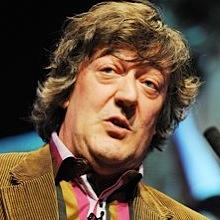
Groucho Club style: the corduroyed Stephen Fry
Style guru Peter York identifies what he calls Soho House’s implicit dress code as “knowing casual, rather than the smart casual people bang on about — Tod’s, dark linen, soft shirts with teeny open collars and all that expensively sub-fusc kit”. So loosen up, Mr Caring, if you expect to gain admission.
At the other end of London’s Old Compton Street, peels of laughter were tonight ricocheting round the distinctly more artsy and proudly louche Groucho Club (founded 1985) where broadcaster Stephen Fry has been known to murmur: “Ties are tolerated but not encouraged.” Matthew Hobbs, managing director of the Groucho, gave today’s Evening Standard the official line: “We have no dress code whatsoever.”
❏ Soho House members include: Kirsty Young, Michael Hill, Ashley Highfield, Spencer Matthews, Ollie Locke, Geri Halliwell, Nigella Lawson, Scarlett Johansson, Uma Thurman, Ed Westwick, Ellie Goulding, Davina McCall.
❏ Groucho Club members include: Stephen Fry, Sienna Miller, Damien Hirst, Tracey Emin, Sarah Lucas, Sam Taylor-Wood, Jonathan Yeo, Alex James, Janet Street-Porter, Melvyn Bragg, Julie Burchill, Gary Kemp, Robert Elms, Liam Gallagher, Peter Saville.
“ A leading London businessman has attacked “Stalinist” rules that led to him being banned from Soho House for wearing a suit and tie. Peter Bingle, 51, has been told he is not welcome at the West End members’ club or any of its offshoots after “clearly disregarding” its casual dress code. The sanction comes after another member was told that his suit was “too school for cool”.
Mr Bingle, chairman of Bell Pottinger Public Affairs, said he had received a “yellow card” e-mail two weeks ago. It warned him Soho House “openly discourages the wearing of suits at the clubs as we are a club for the creating industries and like being a relaxed environment”. Yesterday he was given his marching orders in a letter from UK membership manager Tom Russell. ”
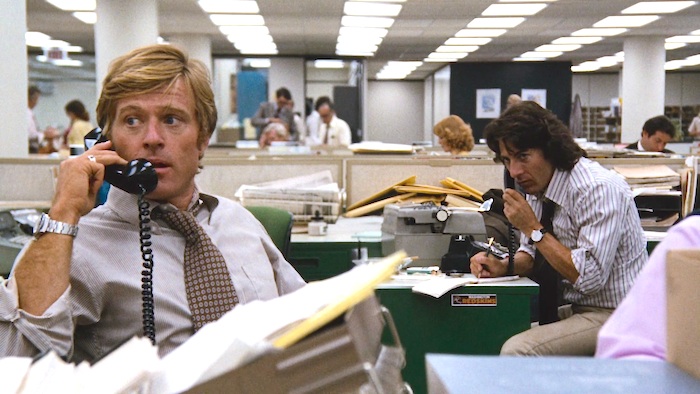
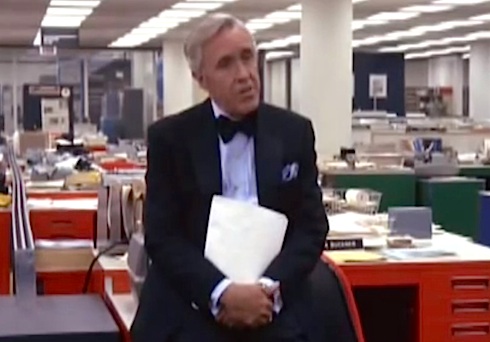
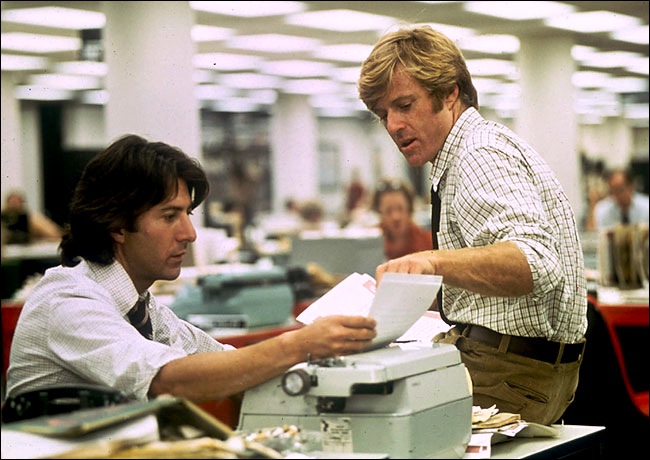
“Woodstein” the investigating double act: Robert Redford cast as Bob Woodward and Dustin Hoffman as Carl Bernstein in the colour-coded Washington Post newsroom built in Hollywood for the 1976 movie All the President’s Men
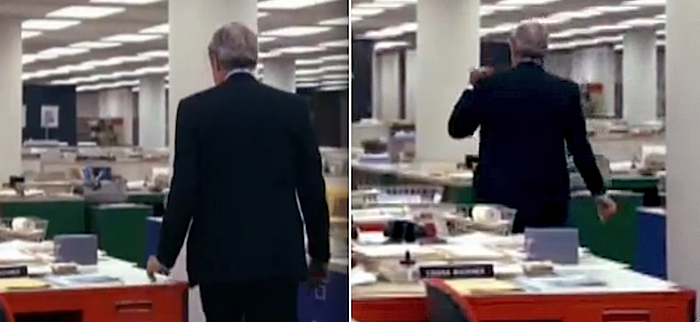
Fingertap. Clap hands. — Jason Robards as Ben Bradlee expressing his elation in All the President’s Men, after finally approving Woodward and Bernstein’s story of the century: “Run that baby!” [Exactly the same gesture that Charles Wintour would give at the London Evening Standard when elated]
◼ ALL THE PRESIDENT’S MEN should be compulsive viewing for everybody in public life in the UK right now. This, Robert Redford’s greatest achievement as producer, is also the greatest movie about how good journalism works. It examined the greatest crime in the history of American politics: the Watergate conspiracy that disgraced the White House in 1973. The scandal gave to our language the all-purpose suffix “-gate” for any corrupt activity in public life.
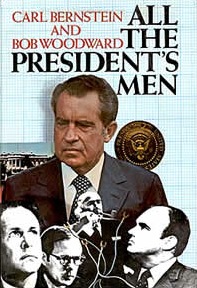
The film showed American journalism at the height of its power, and gave the language the team nickname “Woodstein”, derived from the two 30-year-old reporters who scooped the world, Bob Woodward and Carl Bernstein. Their investigations would lead in 1975 to the takedown of the highest office in the land: the presidency of Richard Nixon.
In 2006 a thorough and thrilling half-hour TV doc appeared titled Telling the Truth About Lies, reporting on the making of the 1976 feature film, All the President’s Men, directed by Alan J. Pakula and written by William Goldman. The doc directed by Gary Leva is as steeped in the integrity of the screenwriters and film-makers as much as the feature movie itself faithfully tries to honour the diligence and persistence and courage of everybody at the Washington Post, under the editorship of Ben Bradlee and the enlightened direction of its publisher Katharine Graham. Leva was of course finally able to report the identity of Deep Throat, Woodstein’s anonymous senior source in the FBI, which had remained a mystery for three decades.
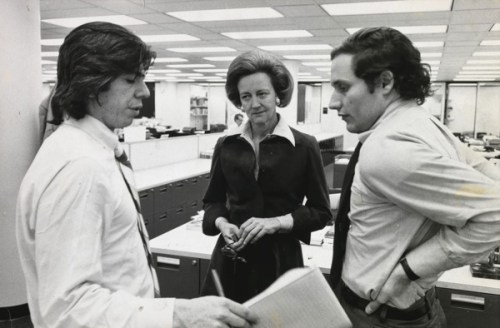
Katharine Graham, publisher of the Washington Post for three decades: here with reporters Carl Bernstein, left, and Bob Woodward in 1972. She put Ben Bradlee in charge and gave him “remarkable freedom in the newsroom”. (Copyright Mark Godfrey. Estate of Katharine Graham)
It was ATPM that inspired Nick Davies, the Guardian’s key reporter who has dug deep into the News of the World phone-hacking scandal, to become an investigative journalist. Given the current climate of ineffectuality and guilt spreading through Britain’s parliament, police and press — as documented in this week’s Spectator under the claim that “The omertà of Britain’s press and politicians on phone-hacking amounts to complicity in crime” — All the President’s Men should be a reminder to everybody in the British press today of the campaigning John Pilger’s famous charge that the first duty of journalists is to be “tribunes of the people”.
Jason Robards as Ben Bradlee in All the President’s Men: click on image to run video clip
❏ Jason Robards as Ben Bradlee: “You guys are about to write a story that says the former attorney general, the highest ranking law enforcement officer in this country, is a crook. Just be sure you’re right.”
❏ ATPM on video — “We haven’t had any luck yet” — “Get some.”
❏ Producer and star Robert Redford who played reporter Bob Woodward: “I had to be extra diligent on being authentic. I spent so much time focussing on detail — the tiniest, tiniest details were important.”
❏ Bob Woodward on writing the book on which the film was based: “Carl Bernstein and I were going to do a standard narrative about Watergate from the perspective of the Nixon White House” . . . Redford: “I said my interest is different, my interest is you guys and how you worked” . . . Bernstein: “Woodward came up to me one day and said he’d gotten a call from Robert Redford, and I said what the hell about? And he said, well, he thinks the story is really us. At the time we were still reporting the story and we sure didn’t think the story was really us.”
❏ Redford on the Woodstein team: “One guy was a Wasp, the other guy was a Jew. One was a Republican, the other guy was a radical liberal. They didn’t really care for each other but they had to work together. Now, that dynamic is character driven.” It is also so often the truth about working relationships in a newspaper office. You don’t have to like each other to produce first-class journalism.
❏ The Washington Post was sceptical about cooperating, Redford said, because the film could turn out to be “Hollywood crap”. Screenwriter William Goldman: “I was terrified because you knew that everybody who was going to talk about this film had at one time or another been in a newsroom. We knew if we Hollywooded it up we would be in terrible trouble.” The film nevertheless won four Oscars in 1976.
EPIC FINAL SCENE: 9 AUG 1974, NIXON RESIGNS
❏ ATPM on video — Ben Bradlee: “Nothing’s riding on this except the first amendment of the constitution, freedom of the press and maybe the future of the country.”
BEN BRADLEE INTERVIEWED IN 1996
Allan Gregg In Conversation (above):Did you see a change in behaviour of politicians post-Watergate?
Ben Bradlee: “I thought I did for a few years afterwards. 1974 brought in a whole new young idealistic breed of congressman. For a while their ethics cast a shadow on the American political scene. It’s taken some years for them to work their way out of the system.
“But I don’t think I saw a fundamental change. I saw an increase in the fear of getting caught. I saw an increase in the quality of journalists joining the business – it attracted a lot of good young energetic people who were bright and dedicated. But, in long haul, I’m quite discouraged about the ethical content of American political life… Lying has become second nature to people; to fib first, and then lie.”
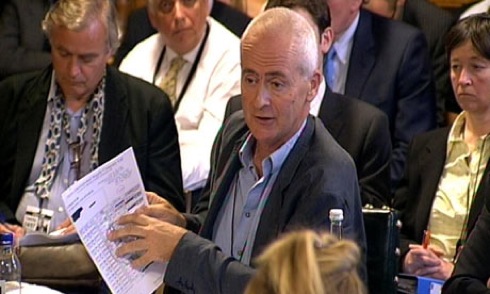
The Guardian’s Nick Davies: giving evidence to the Commons media committee in 2009. Photograph by PA
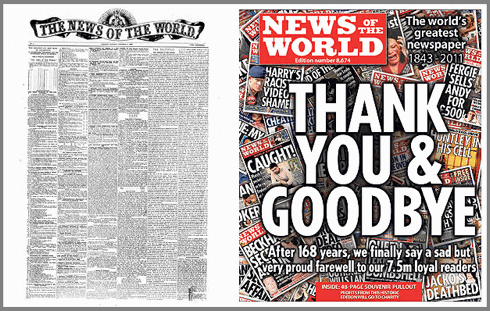
◼ BRITAIN’S BIGGEST-SELLING NEWSPAPER, the tabloid News of the World, closes tomorrow, a victim of its own phone-hacking scandal. First published 168 years ago, this hugely powerful title became the most toxic media brand in the land, all within the week. And much of the cause was down to the work of one investigative journalist, Nick Davies of The Guardian newspaper.
“ I have no doubt at all that Nick Davies is the greatest living British journalist ” — Peter Oborne, chief political commentator on the rival newspaper, The Daily Telegraph, speaking on Radio 4 tonight
Nick Davies is considered one of Britain’s leading investigative journalists. He has broken numerous stories, mostly for The Guardian. His scoops include the story about the nurse turned serial child murderer, Beverley Allitt, and the recent WikiLeaks revelations in classified US military and diplomatic documents. He it was who tracked down Julian Assange and persuaded him not to post his latest secrets on the WikiLeaks website but to hand them over to The Guardian. Among his published books, Flat Earth News accuses British newspapers of what he calls “churnalism”, churning out stories based entirely on PR, press releases or wire copy, without further fact-checking.
One irony is that in this year’s Society of Editors awards, Davies lost the award for News Reporter of the Year to Mazher Mahmood (the “Fake sheikh”) of the News of the World, whose winning submissions included exposing the Pakistan cricket match-fixing ring, and the claim that Fergie “sells” Andy for £500k. [Update July 10: In the NoW’s final issue, “crimebuster” Mahmood reminds us of the 250 successful prosecutions his investigations have achieved over 20 years, from paedophiles, arms dealers, drug peddlers and people traffickers to bent doctors and lawyers.]
Among the awards listed in his Debrett’s People of Today profile, Davies is cited as Feature Writer of the Year 1997, Journalist of the Year 1998, Reporter of the Year 1999, Martha Gellhorn Award 1999, European Journalism Prize 2003.
“ The Milly Dowler story changed the politics of the whole saga and made it impossible for anybody to defend the News of the World and that included the prime minister and the Tory leadership… And so they’ve switched sides, specifically on the question of whether there should be a public inquiry. ” ➢ Davies on pursuing the phone hacking investigation — on video at Guardian online
Davies decided to become an investigative journalist after seeing the brilliant film All the President’s Men, about the US journalists who cracked the Watergate conspiracy that brought down president Richard Nixon in 1973 and helped indict and jail numerous Nixon aides…
All the President’s Men, 1976: Dustin Hoffman and Robert Redford playing the Woodstein investigative team in a film studio
◼ OF ALL THE MOVIES ABOUT JOURNALISM the best by far is All the President’s Men. It tells the real-life story of how two young reporters on the Washington Post saw the corrupt American president Richard Nixon out of office. Robert Redford and Dustin Hoffman play the “Woodstein” team of Bob Woodward and Carl Bernstein, both hitting 30 when they pulled off their scoops about conspiracy in the White House. The Oscar-winning film is a gripping thriller that also gives the most authentic view of newspaper life yet, shot in an exact replica of the colour-coded Washington Post newsroom, built by knocking together two Warner soundstages in Burbank and ensuring all the coffee-cups and paperwork came from the real office 2,000 miles away.
Jason Robards won the 1976 Oscar as Best Supporting Actor for his charismatic depiction of the executive editor Ben Bradlee. “WOODSTEIN!!! Get in here!” At the press screening this writer attended, he raised repeated cheers for his oh-so-true-to-life rigour as he harried the young reporters again and again when they failed to convince him they had the scoop of the century. Our hearts sank, along with theirs, as Bradlee took his pen to their report and deleted line after line after line. We’ve all had bosses like him. “Get some harder information.” – “We haven’t had any luck yet.” – “Get some.” This film excels for showing how good newspapers work.
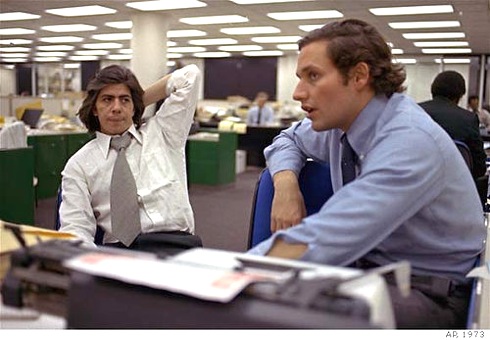
The real thing: Bob Woodward and Carl Bernstein in the Washington Post offices at the height of the Watergate investigation. (Associated Press)
◼ TODAY ON NEWSWEEK’S WEBSITE Pulitzer Prize-winning Carl Bernstein draws a comparison between Nixon’s downfall and the anything-goes approach of News of the World owner Rupert Murdoch and how it threatens to undermine the influence he so covets…
“ The hacking scandal currently shaking Rupert Murdoch’s empire will surprise only those who have wilfully blinded themselves to that empire’s pernicious influence on journalism in the English-speaking world. Too many of us have winked in amusement at the salaciousness without considering the larger corruption of journalism and politics promulgated by Murdoch Culture on both sides of the Atlantic.
“ The facts of the case are astonishing in their scope. Thousands of private phone messages hacked, presumably by people affiliated with the Murdoch-owned News of the World newspaper, with the violated parties ranging from Prince William and actor Hugh Grant to murder victims and families of soldiers killed in Iraq and Afghanistan. ”
48-page freebie: today’s News Of The World includes a souvenir of famous pages since the paper was first published on Sunday October 1, 1843, including “Crippen’s life at sea” as the killer doctor fled abroad in 1910 and “Prince Harry’s racist video shame” in 2009. During the 1950s — under its slogan Henry James’s phrase “All human life is there” — sales averaged 8.4m copies weekly. Its latest average sale was 2.6m copies
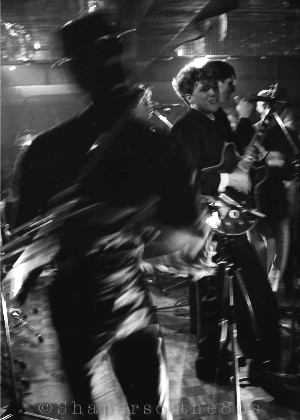
❚ ON THIS DAY IN 1981 Spandau Ballet, spearhead band of the New Romantic movement, were flying off to Spain and Portugal by way of a working holiday with sun and sand — a brief tour of principal cities to establish their first European fan base, which remains strong today. Most significantly, on Ibiza, the island which young British sunseekers were starting to make their own, Spandau played at the then spanking new Ku club, as one of the first fashion bands whose visits were to make Ku one of the Mediterranean’s destination nightspots.
Spandau Ballet in 1981: a quick sprint to the Iberian peninsular as well as a hot date at Ibiza’s Ku club
But the day before their departure, Spandau had lit the fuse to a musical bombshell. They changed their sound to outflank the emergent slipstream of new image bands invading the British charts with synth-pop.
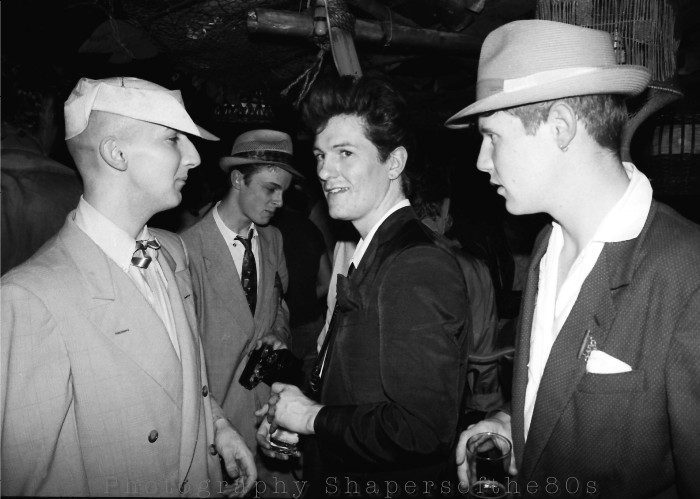
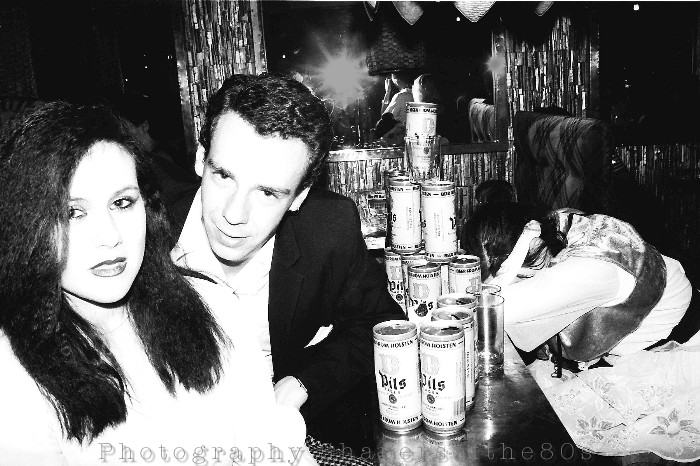
That Thursday they had taken over Le Beat Route in Soho, a mythical Mod club during the 60s, now fronted by Ollie O’Donnell, a suited but laid-back young crimper from Keith-at-Smile’s cool salon in Knightsbridge. The downstairs hideaway in Soho was the current Friday-night HQ of London’s nightlife leaders whose jackets and printed ties were hastily shaking off the New Romantic tag even as Duran Duran’s second single revelled in it. The bamboo decor helped: hints of a tropical holiday-camp with baskets for lampshades. South Seas tongue-in-cheek, maybe. Glamorous it was not. The ethos for new one-nighters was never to be smart, always gently ironic.
Here before an invited audience of Friday regulars the innovative Russell Mulcahy directed Spandau’s promotional video for their fourth single, Chant No 1. The bombshell was a surprise change of direction, announced by rat-a-tat congas and a burst of brass. The new tune, Gary Kemp said, had been inspired directly by the dissonant brass on the disco-funk track Wheel Me Out, the debut 12-inch dance single on Ze from US new-wave group Was (Not Was). The eerie sound had been introduced to keen Brit ears during the Axiom fashion show that had preceeded Spandau’s set in New York that May, during the first Blitz Invasion.
Chant No 1 was a blue-eyed funk mover that echoed the band’s teen years on the soul circuit, musically fresh while the lyrics seeped a certain seedy paranoia. There on-camera was a black trio of brass instrumentalists, Beggar & Co, who were the horn section for the British funksters Light of the World, and who’d already had their own hit with Somebody Help me Out.
Gone were the artsy settings and OTT costumes of Spandau’s early videos. This razor-sharp musical documentary intercuts Soho streetlife with a live club performance by Spandau. “Down, down, down, pass the Talk of the Town” urges the deejay’s Chandleresque rap as Tony Hadley sweeps past The Talk, the cobwebbed Mecca of international cabaret from the Judy Garland era. Inside the steamy Beat Route itself we take in the stylish ambience where the “mobile knives” now live to dance, as well as dress up in a distinctly more boy-meets-girl way than the incessant camperie of the Blitz, the long-gone poser-paradise. We glimpse the deejay Steve Lewis before his portrait of Lenin, in a season when Soviet button badges are also de rigueur, and it’s evident that, yes, things are different here.
The video emphatically makes the point that clubland rules. Spandau drummer John Keeble spoke with only slight exaggeration when he said: “For the next couple of years, no new band played live on a stage.” What he meant was that rock venues as the source for original music had been superseded by nightclubs. White socks and hedonism were the key: girls in swirling party frocks with hair cropped like chives, and boys wearing braces and rolled-up sleeves soon walked the streets of every town. Ha! Why, even the NME finally conceded by introducing a “Dance Chart” alongside their lists of Indie garage bands.
Chant No 1: Gary Kemp with one of Beggar & Co’s brass section at front
Once released on July 6, Chant No 1 rocketed straight up the charts to reach No 3 on August 1 (the NME chart actually placed it at No 1). Simultaneously remixed by Richard Burgess as a B-side and as an extended twelve-incher for clubs, the track immediately became an upbeat dance anthem for the school-leavers who were discovering what economic “hard times” were going to mean.
“I Don’t Need This Pressure On” ran Spandau’s chorus as a timely slogan for that summer when Britain went into shellshock from the rare experience of repeated race riots on the streets of London, Manchester and Liverpool. The fashion-conscious band who had been dismissed by the rockist press as fascists and dandies hit back with supreme optimism. This vibrant tune pressed the pop button with fans as well as rival bands who envied the chemistry of Spandau plus Beat Route. It announced a new brand: Team Soho. For ten weeks in the charts, Chant No 1 confirmed its rhythm as the sound of the new pop: once-and-for-all the dominance of the rock guitar was shifting to the supremacy of bass and drum for pop generations to come.
Ironies were everywhere. Not only did the crepe-shoed rocker Shakin’ Stevens occupy the No 1 spot for four consecutive weeks with Green Door, a comforting throwback to 50s nostalgia. By contrast, the cool young band who also held Chant off the top spot for another three consecutive weeks were The Specials, whose haunting single Ghost Town (where “all the clubs have been closed down”) became a poignant epitaph for the inner-city angst starting to erupt among the ranks of the hard-pressed in Margaret Thatcher’s Britain. The times were changing, not entirely for the better.
➢ Choose “View full site” – then in the blue bar atop your mobile page, click the three horizontal lines linking to many blue themed pages with background article
MORE INTERESTING THAN MOST PEOPLE’S FANTASIES — THE SWINGING EIGHTIES 1978-1984
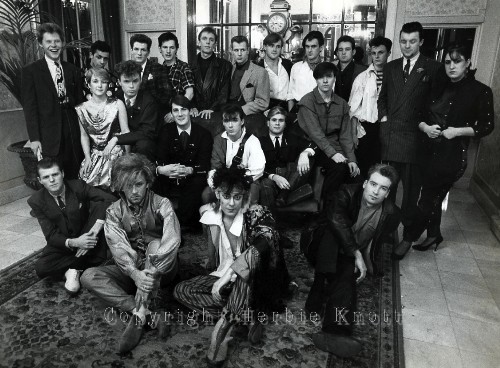
They didn’t call themselves New Romantics, or the Blitz Kids – but other people did.
“I’d find people at the Blitz who were possible only in my imagination. But they were real” — Stephen Jones, hatmaker, 1983. (Illustration courtesy Iain R Webb, 1983)
“The truth about those Blitz club people was more interesting than most people’s fantasies” — Steve Dagger, pop group manager, 1983
PRAISE INDEED!
“See David Johnson’s fabulously detailed website Shapers of the 80s to which I am hugely indebted” – Political historian Dominic Sandbrook, in his book Who Dares Wins, 2019
“The (velvet) goldmine that is Shapers of the 80s” – Verdict of Chris O’Leary, respected author and blogger who analyses Bowie song by song at Pushing Ahead of the Dame
“The rather brilliant Shapers of the 80s website” – Dylan Jones in his Sweet Dreams paperback, 2021
A UNIQUE HISTORY
➢ WELCOME to the Swinging 80s ➢ THE BLOG POSTS on this front page report topical updates ➢ ROLL OVER THE MENU at page top to go deeper into the past ➢ FOR NEWS & MONTH BY MONTH SEARCH scroll down this sidebar
❏ Header artwork by Kat Starchild shows Blitz Kids Darla Jane Gilroy, Elise Brazier, Judi Frankland and Steve Strange, with David Bowie at centre in his 1980 video for Ashes to Ashes
VINCENT ON AIR 2026
✱ Deejay legend Robbie Vincent has returned to JazzFM on Sundays 1-3pm… Catch up on Robbie’s JazzFM August Bank Holiday 2020 session thanks to AhhhhhSoul with four hours of “nothing but essential rhythms of soul, jazz and funk”.
TOLD FOR THE FIRST TIME
◆ Who was who in Spandau’s break-out year of 1980? The Invisible Hand of Shapersofthe80s draws a selective timeline for The unprecedented rise and rise of Spandau Ballet –– Turn to our inside page
SEARCH our 925 posts or ZOOM DOWN TO THE ARCHIVE INDEX
UNTOLD BLITZ STORIES
✱ If you thought there was no more to know about the birth of Blitz culture in 1980 then get your hands on a sensational book by an obsessive music fan called David Barrat. It is gripping, original and epic – a spooky tale of coincidence and parallel lives as mind-tingling as a Sherlock Holmes yarn. Titled both New Romantics Who Never Were and The Untold Story of Spandau Ballet! Sample this initial taster here at Shapers of the 80s
CHEWING THE FAT
✱ Jawing at Soho Radio on the 80s clubland revolution (from 32 mins) and on art (@55 mins) is probably the most influential shaper of the 80s, former Wag-club director Chris Sullivan (pictured) with editor of this website David Johnson
LANDMARK FAREWELLS. . . HIT THE INDEX TAB UP TOP FOR EVERYTHING ELSE