Category Archives: Fashion

2012 ➤ Central Saint Martins fashionistas graduate with street vibes, fantasy and outlandish colours

Central Saint Martins, fashion,BA,fashion, catwalk

First BA fashion show at CSM’s new King’s Cross campus, 2012: Designs by Natalija Mencek, Ruoxin Jin and Erin Hawkes who won the L’Oréal Professionnel Award award

➢ Central Saint Martins fashion design graduates presented an optimistic and upbeat offering at their swish new headquarters last night — Daily Telegraph report:

136 design students are graduating from the BA course this year, and the ultra modern postindustrial building they moved to last September has undoubtedly had an influence. The work was brighter, more optimistic and upbeat than it has been for years. Models actually smiled! Prof Jane Rapley, OBE, retired after 25 years at St Martin’s, six as Head of College … / Continued at Telegraph online

All 41 graduate collections for 2012
on the catwalk

➢ Will the magical blasts from the past follow
St Martin’s out of Soho?

FRONT PAGE

1928–2012 ➤ Sassoon’s revolution: No teasing. No hair spray. Just the cut.

Vidal Sassoon,the bob, Mary Quant, hairstyles

1963: Sassoon creates the “bob” on designer Mary Quant. (Photo: Getty)

“He revolutionised not just hair but fashion” — model-turned-Vogue fashion editor Grace Coddington

Vidal Sassoon , Albert Hall,

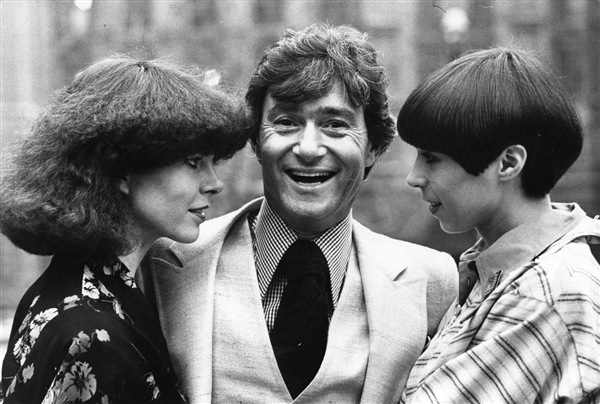
Comeback 1975: Vidal Sassoon between two contrasting examples of his hairdressing for a teach-in at the Albert Hall, where he returned to hairdressing after a five-year break. (Photograph by Tim Graham / Getty)

➢ The Daily Telegraph reports the death at 84 of celebrity hairstylist Vidal Sassoon, whose 1960s wash-and-wear cuts freed women from the tyranny of hairspray…

Vidal Sassoon, who was found dead at home on Wednesday, was at the cutting edge – literally and metaphorically – of hairdressing. His sharp, geometric, low-maintenance 1960s hairstyles revolutionised his craft, sounding the death knell for the stiff, set hairdos of the 1950s. An astute businessman, he made a fortune from his salons and products, and became a household name. “I wanted to eliminate the superfluous and get to the basic angles of cut and shape,” he said… / continued online

+++
❏ Craig Teper’s 2010 documentary Vidal Sassoon: The Movie follows the true rags-to-riches tale of how a boy from a London orphanage went on to open his own Bond Street salon in 1958 and — influenced by the Bauhaus designs he had studied — he create the “shape” that became his signature cut, the five-point bob. It revolutionised hairdressing. His geometric wash-and-wear cuts marked the end of the beehive and the bouffant hair styles of the 50s. Admirers included the Duchess of Bedford, model Jean Shrimpton, actor Terence Stamp, and film star Mia Farrow. In 1963 he devised the classic “bob” for fashion designer Mary Quant, who called him the “Chanel of hair”. By 1964 he’d gone international by opening his first salon in New York.

Vidal Sassoon, Movie

Sassoon The Movie: the London crimper freed women from 50s bouffants by pioneering the low-maintenance hairstyles that defined the 60s

FRONT PAGE

➤ Sukita-san’s eye view of the weird world according to Bowie

David Bowie, Masayoshi Sukita,Speed of Life, Genesis Publications,

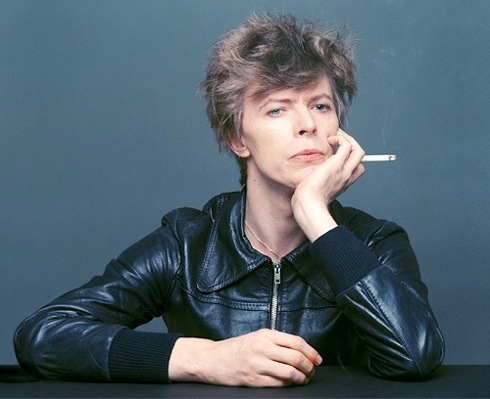
Heroes-era Bowie in 1977 © by Masayoshi Sukita

David Bowie,Yamamoto Sukita, Kansai Yamamoto ,Speed of Life, Genesis Publications

Bowie as Ziggy in 1973 costumed by Kansai Yamamoto and photographed © by Masayoshi Sukita

❚ HERE WE SEE CLASSIC PIX of the early glam incarnations that broke the rules of rock and roll and put the gender-bending David Bowie into the headlines. Since 1972 Japanese photographer Masayoshi Sukita has gone on capturing the prolific flow of creations from the ever-inventive Bowie. This week in London his long-awaited book Speed of Life documenting their 40-year collaboration is launched by Genesis Publications in its 2,000-copy limited edition. Signed by both Bowie and Sukita, it is priced at £360 ($581) for 300 pages which they caption with their own recollections and memories. Bowie says: “It’s very hard for me to accept that Sukita-san has been snapping away at me since 1972 but that really is the case… May he click into eternity.”

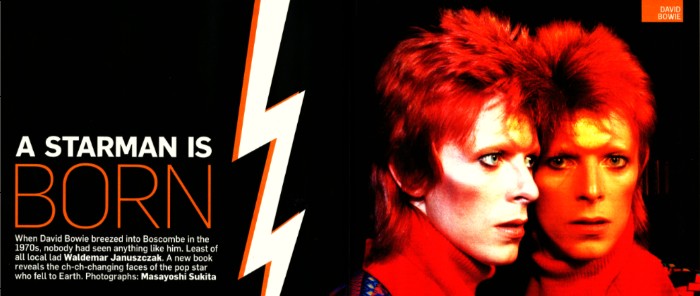
Meanwhile in today’s Sunday Times Magazine art critic Waldemar Januszczak recalls his teenage outing in 5-inch platforms when he paid 90p on the door of Starkers in Boscombe, Dorset, to discover the eye-popping mystique of Ziggy Stardust in August 1972 — minutes after Sukita the photographer arrived in Britain and caught Bowie’s shock show at London’s Royal Festival Hall. He described it as “like an astronomer finding a new planet”.

David Bowie, Masayoshi Sukita,Speed of Life, Genesis Publications,

Today’s Sunday Times Magazine: Bowie in 1972 © by Masayoshi Sukita

Januszczak writes: “It was Andy Warhol who invented the immensely attractive cultural idea that anyone could be whoever they wanted to be. It became Bowie’s big idea as well. And the tour he set out on in 1972 featured his most determined efforts yet to become lots of people at once: Ziggy Stardust, Aladdin Sane, Major Tom, The Man Who Saved the World. That was just the beginning. The bewildering multi-identitied career photographed for us so sympathtically by Sukita-san in Speed of Life features enough different David Bowies to constitute a football crowd…”

David Bowie, Masayoshi Sukita,Speed of Life, Genesis Publications,

Bowie in 1989 © by Masayoshi Sukita

Above images copyright Masayoshi Sukita, courtesy Genesis Publications

David Bowie, Masayoshi Sukita,Speed of Life, Genesis Publications,

Sukita then and now: left, with Bowie in the 70s

MAY 8: INVETERATE LIGGERS AT THE LONDON
BOOK LAUNCH PARTY

Paul Simper, Steve Norman, Bowie, Sukita, books, Speed of Life,Genesis Publications,Dover Street Arts Club,

Lads insane: The Spand sax-man also known as Spiny Norman ingratiates himself with Ballet biographer Paul “Scoop” Simper at tonight’s Speed of Life book launch. Spandau’s own official photo-book is promised for 2013 from Genesis Publications. Photograph by © Shapersofthe80s

➢ Condé Nast president Nick Coleridge tells book-launch party of his teen obsession with Bowie and his encounter with Angie — Evening Standard Diary, May 9

FRONT PAGE

➤ Trimphone aside, can you spot the designs that changed the look of Britain over 60 years?

British Design,exhibition ,Innovation, Modern Age, Victoria & Albert Museum,

British Design catalogue collage: road signs, high-rises, Kodak cameras, postage stamps, computers and Henry Moore — all are exhibited here

“Britain has since 1948 sustained an extraordinarily vigorous creative culture, even against a background of manufacturers leaving the stage like the instrumentalists in Haydn’s Farewell Symphony. It’s an inclusive culture, hence tapestries and Jaguars. It’s a culture that swoops artfully between high and low. It’s a culture that could import, with characteristic fairhandedness, both John Betjeman and Nikolaus Pevsner. The one in thrall to the village, the other in thrall to steel and glass. Wonderfully, each was a founder of The Victorian Society. Their contrasting spirits dominate British design in the years before The Beatles’ first LP. Thereafter, the Britain of crumpets-with-vicar became the undisputed global capital of youth culture whose furious organic vitality still invigorates business life.”

➢ Stephen Bayley, former chief executive of the Design Museum, writing in The Independent
Denys Lasdun, University of East Anglia,architecture

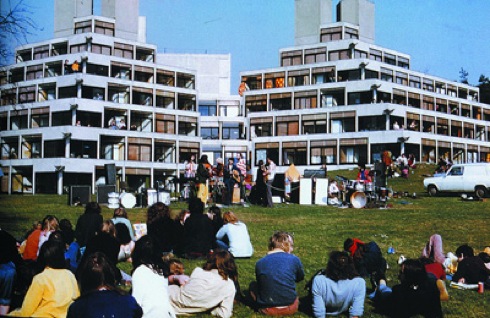
Architect Denys Lasdun’s University of East Anglia, 1962-68: raised walkways, striking ‘ziggurats’ and no building on campus more than five minutes’ walk away

❚ AN EXHIBITION TITLED British Design 1948–2012: Innovation in the Modern Age, is bound to infuriate as much as it excites. The grimly claustrophobic galleries that host temporary shows at the Victoria & Albert Museum abound with iconic and nostalgic everyday objects, rather as a good car-boot sale does. Yet the omission of much imaginative British media is unforgivable — the template for newspaper colour supplements laid out by The Sunday Times plus a serious investment in photo-reportage, for example… the more-British-than-British essence with which the American Joseph Losey propelled a whole chapter of stylish cinema… the sci-fi television fantasies of The Prisoner or Doctor Who…

Twiggy , Mary Quant ,miniskirt,Swinging London, youth culture

Twiggy models the Mary Quant miniskirt, 1965: named after the designer’s favourite car, the mini encapsulated the youth culture of Swinging London — energetic and unconventional

What the V&A show’s three themes propose — under the headings Tradition & Modernity, through the Subversion of pop, to Innovation & Creativity — amounts to a vital module for every art or design student in the education system, whose forebears, thank goodness, benefited from the shake-up imposed in 1960 by the Coldstream Report.

Ignore most dithering reviews of this hot-and-cold exhibition. Instead, do savour the argumentative Stephen Bayley, writing in that onetime model of new newspaper design, The Independent. He nails the paradox of this show in a daydream: “I became drunk on memories of whimsy, charm, gentility, wit and Macmillan-era futurism. My imagination never turned to the ruins of industry, the loss of technological competence, the barrenness of every British city except London and the fact that the economy of our once-busy island workshop is now based on the theory and practice of a dodgy casino.”

Bayley then comes to the nub of the matter: “The tricky thing is ‘design’ itself. It’s often muddled not only with ‘innovation’, but with invention, fashion and taste-making, sometimes even with art. After more than 150 years of promoting design at the V&A, no one seems to have any very clear idea of what it is. If it is a real subject, it must have a discipline. But what discipline connects Spence’s Coventry Cathedral with Damien Hirst’s 1997 Pharmacy restaurant in Notting Hill, west London, each of which features here?

“If, as the design lobby often insists, ‘everything has been designed’, then everyone is a designer. So what special qualities do professional designers bring to any task?”
British Design,exhibition ,Innovation, Modern Age, Festival of Britain, Skylon, Concorde

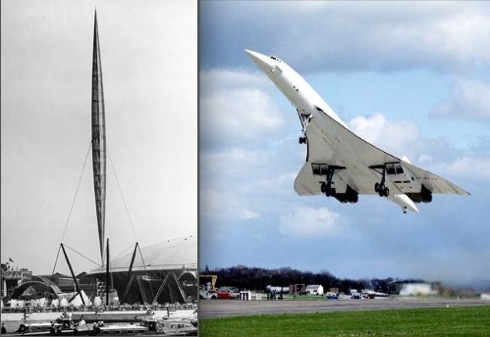
Notions of modernity: at the Festival of Britain, 1951, the Skylon designed by Powell & Moya was rendered by the practice’s junior architect James Gowan as a monumentalised missile, and symbolised the dawning age of science. In 1979, BA’s sixth Concorde took off on its maiden flight

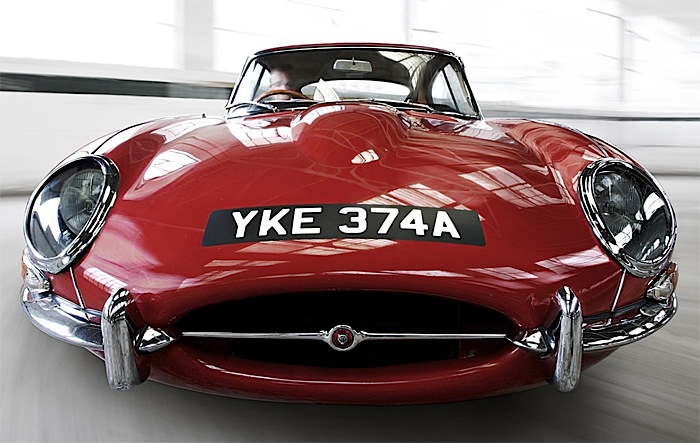
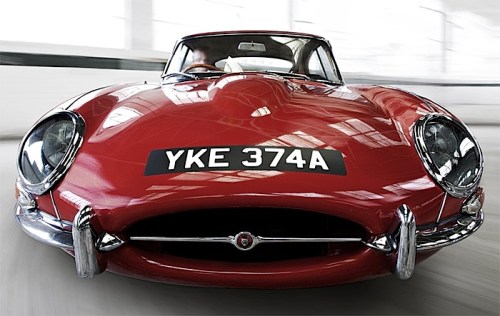
Aim Bayley’s question at three triumphs of design in the V&A show: the kinetic balancing act of the Festival of Britain’s Skylon structure; the bird-wing aerodynamics of Concorde miniaturised at the V&A in a 20-ft model; and the most thrilling artefact in the entire show: the skilfully lit Jaguar E-Type from 1961 which rival manufacturer Enzo Ferrari declared “the most beautiful car ever made”. Drop down to one knee and view the Jag diagonally from any corner and wonder at its lack of straight lines. One curve after another creates changing perspectives that conspire to emulate speed even as it stands motionless before you. Seldom will you hear both men and women purring over such a seductive silhouette! Seldom will you ever see such a thrilling manmade object.

There are a good number of breathtaking moments in this show that beg you to ask why and how an exhibit stopped you in your tracks, though not as many as you would wish.
Malcolm Sayer, Jaguar E-Type,sports car ,

Relish the curves: designed by Malcolm Sayer, the Jaguar E-Type 3.8-litre sports car was launched at the Geneva Motor Show in 1961 as a two-seat coupe or convertible, with a top speed of 150 mph. The car’s shape is the epitome of speed

➢ British Design 1948–2012: Innovation in the Modern Age, runs at the Victoria & Albert Museum, Mar 31 until Aug 12

FRONT PAGE

2012 ➤ All about reclusive Sade, the singer who trumps Adele in US list of top earners

Sade Adu, Letterman, TV shows,Billboard, Top 40 Money Makers,

Launching her album in Feb 2010: Sade meets US TV host David Letterman. (Videograb from his Late Show on CBS)

➢ Sade proves to be highest-earning British musical act in America last year — read Caspar Llewellyn Smith in today’s Guardian…

Viewers of the 2012 Grammys awards last month watched Adele, the 23-year old girl from Tottenham, north London, walk away with six awards, but the top-earning act from the UK in America last year was an artist who fans back home have to some extent forgotten.

BILLBOARD’S TOP EARNERS
1 Taylor Swift: $35.7m
2 U2: $32.1m
3 Kenny Chesney: $29.8m
4 Lady Gaga: $25.4m
5 Lil Wayne: $23.2m
6 Sade $16.4m
7 Bon Jovi: $15.8m
8 Celine Dion: $14.3m
9 Jason Aldean: $13.4m
10 Adele: $13.1m
[Touring and record sales 2011]

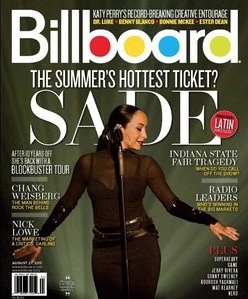
Sade raked in $16.4m (£10.5m) in 2011 on the back of her first tour in North America for a decade and the release of The Ultimate Collection. The 53-year-old singer came sixth on a list of the biggest-earning acts of last year, compiled by the American trade publication Billboard, eclipsing Adele, the only other Brit in the top 10, who earned $13.1m.

Sade [say it “Zhah-Day”] is the most successful solo female artist Britain has ever produced, selling more than 50m records in a career that stretches back to her 1984 hit Your Love Is King. Famously reclusive — nicknamed Howie by her friends, after millionaire hermit Howard Hughes — she toured the world for eight months last year, but the bulk of the tour was devoted to North America, where she played 59 shows. The tour started 18 months after the release of her US No 1 album Soldier of Love, a record that reached No 4 in the UK… / continued at Guardian Online

➢ Smooth Operator Sade is surprise US smash,
beating Adele and Take That to be Britain’s biggest music export
— today’s Daily Mail feature

➢ Billboard’s Top 40 Money Makers 2012

FLASHBACK TO SADE’S 2010 ALBUM LAUNCH

Rolling Stone described Sade’s studio album, Soldier of Love, as “unimpeachably excellent” … Billboard said: “It’s been 10 years since Sade released an album, but be forewarned – the giant has awoken” … People magazine said Sade’s enduring appeal was as “the voice of comfort to the wounded heart”

❏ In her American fan forums black guys are besotted with Sade, and here in an audience for a live TV performance we see doting female fans for whom she is a role model. On Jimmy Kimmel’s show in February 2010 (above), Sade performed Soldier of Love live as her eponymous album hit No 1 in the US (502,000 copies sold there in its first week — the best sales week for an album by a group since AC/DC in October 2008). Susan Boyle, the finalist from the Britain’s Got Talent contest, was holding steady at No 9.

❏ Backstage video interview with Sade by The Insider, June 2011 (above) — “I’m really a country girl. I don’t give too much of myself away. When I go in a studio I lose all my shyness.”

➢ Read Sade: The Billboard Cover Story by Mitchell Peters, August 19, 2011 — Preparing for a 100-plus-date international concert tour is daunting for even the most seasoned musical acts… “I do the opposite and pretend it’s not going to happen, immersing myself in the details of production as a way of distracting myself from reality,” says English singer Sade Adu. “When the time comes, I don’t test the waters — I just jump straight in.”

❏ Listen to The Moon and the Sky (remix featuring Jay Z):

SADE’S EARLY CAREER AT SHAPERSOFTHE80S

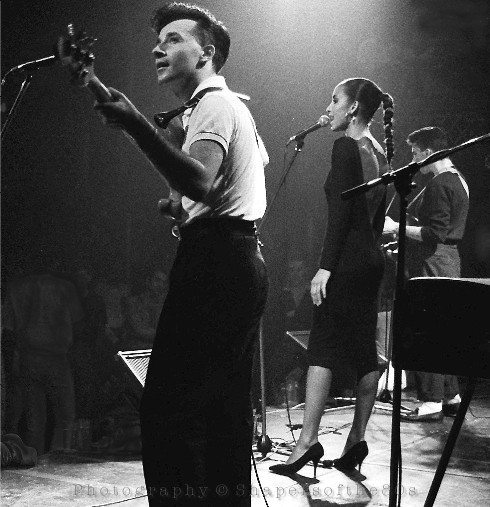
Sade’s debut with her own band in Aug 1983 at the Yow club, London, Paul Denman to the fore. Photographed © by Shapersofthe80s

➢ 1981 — Pix of fashion designer Sade’s Demob outfits during the first Blitz invasion of the US

➢ 1982 — Pix of Sade helping backstage during Steve Strange’s fashion show by Londoners in Paris

➢ 2010 — Her first interview in 10 years finds comeback Shard comfy as ‘Auntie Sade’ — On her new man, Ian Watts, who has been in turn Royal Marine, fireman and scientist: “I always said that if I could just find a guy who could chop wood and had a nice smile it didn’t bother me if he was an aristocrat or a thug as long as he was a good guy. I’ve ended up with an educated thug!”

FRONT PAGE