Category Archives: Fashion

➤ Visage: out of the 80s frying pan into the 21st-century fire

Steve Strange, Visage,Shameless Fashion

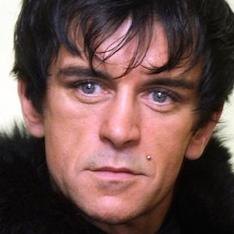
The face of Visage today: Steve Strange behaving shamelessly. Peter Ashworth Photography. Makeup by Lara Himpelmann
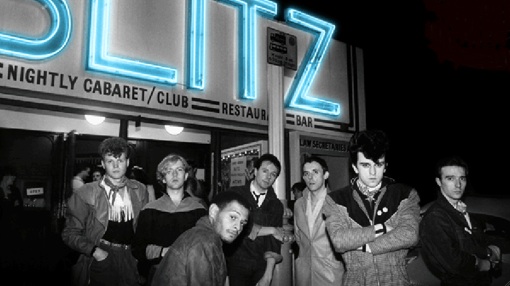
Visage 1979: Rusty Egan, John McGeoch, Barry Adamson, Dave Formula, Billy Currie, Steve Strange, Midge Ure. Photographed © by Sheila Rock

Visage 1979: Rusty Egan, John McGeoch, Barry Adamson, Dave Formula, Billy Currie, Steve Strange, Midge Ure. Photographed © by Sheila Rock

❚ THE STUDIO BAND VISAGE were central to defining the electropop sounds of 1980 thanks to the musical nous of Midge Ure, who had bought his first synthesiser in 1978 because he felt synths “embodied a kind of nostalgia for the future”. He’d been faffing around with Glen Matlock, Steve New and drummer Rusty Egan in the 60s-flavoured one-hit power pop group Rich Kids, and sensed an appetite in the zeitgeist for a more soulful version of Kraftwerk plus a return to melody. Intent on making vibrant dance music for the “visa age”, Ure dreamed up the name Visage, complete with simplified face as its logo,  for an new experimental band. Initially Ure rehearsed updating In The Year 2525, using up some spare Rich Kids time booked in an EMI studio. There he played around on synth and drum machine, then asked Egan to take over the drums.

They co-opted Rusty’s flamboyant Welsh pal Steve Strange as face-painted frontman to give visual expression to a range of what were being called “moderne” fashions. Dressing up in the face of a grinding economic recession was the destiny that Bowie’s children were to fulfil. Visage’s songs captured the sidelong humour and knowing irony that came to characterise the 80s, while their explosive backbeats, electronic fills and synth riffs changed the vocabulary of British chart pop. This TV generation dreamed in both sound and vision.
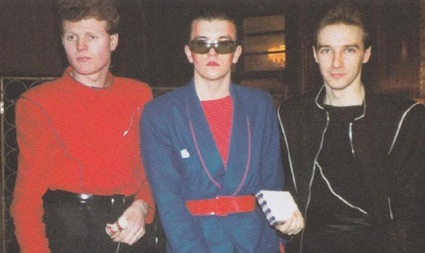
Supercool in ’78: Egan, Strange and Ure establish Visage

What Strange lacked in vocal proficiency he made up for in promotional value, since he soon became a walking advertisement for the cooler-than-cool clothes shop PX in Covent Garden where he was an assistant. Run by Stephane Raynor and Helen Robinson, they more than any other designers in 1980 set the template for New Romantics fashion, favouring oversized chemises, medieval doublets, breeches and frilly lace. The shop’s followers were soon dubbed posers, and the Pose Age was born. Disposable identities, portable events, looks not uniforms – for his disciples, Bowie’s imperatives became the norm.

As a studio project the original Visage lineup never played live, and was probably a case of too many cooks. In 1979 it took in four more musicians (Billy Currie, John McGeoch, Dave Formula, Barry Adamson), all of whom had loyalties to existing bands, while the creative drive came from Ure and Currie. Even so, Currie was persuading the restless Ure to help resurrect the synth band Ultravox following John Foxx’s departure. By 1982, when Ure quit Visage in favour of Ultravox, Visage had enjoyed four top-20 singles hits in the UK, two top-twenty albums with Visage and The Anvil, and a smattering of international hits with Fade to Grey.

As we now know, Ure went on to mastermind the Band Aid fundraising hit single in 1984, then the worldwide Live Aid charity concert with Bob Geldof, and duly earned himself an OBE.
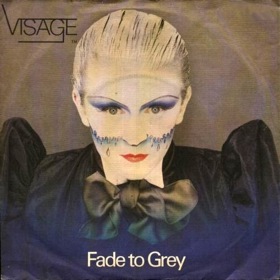
Visage, Fade to Grey,albumsIn 1984 a Visage lineup comprising Strange and Egan along with newer members Andy Barnett, Steve and Gary Barnacle put out a so-so third album, but when it flopped they soon called it a day. The truth was that Visage failed to invest single-mindedly in themselves as a musical enterprise: their progress simmered rather than blazed as individuals pursued their own favoured goals. Occasional tracks sizzled on the dancefloor – In the Year 2525, Fade to Grey, Mind of a Toy, Night Train – but the band lacked unity and commitment.

❚ NOBODY CAN DENY STRANGE’S FIZZ and chutzpah which in 1979 coralled a disparate group of post-punk no-wavers and outcast fashionistas when he co-hosted the agenda-setting Neon Night at the Blitz Club in Covent Garden. It lit up London in an explosion of inventive fashion, gender-bending and ridiculous hair. As the club’s stand-out stars suddenly became media celebrities, these exponents of modern dance and stance began forcing the pace of change across the creative industries. Rusty Egan proved to be a mould-breaking deejay who often added his own Syndrum accompaniment at the turntable, and his live mixing did much to change the sound of clubland music. During the early 80s the pair went on to reshape London nightlife at two notable venues, Club for Heroes in Baker Street and the Camden Palace. At the end of the decade, dance music as we knew it was swept aside by the craze for E’s and rave. Egan then set out to make a fine reputation deejaying on London’s boutique nightclub circuit, while Strange can claim a ghosted autobiography as full of fantasy and foggy memories as you’d expect from an arch-poser who’d been out on the town every night for 20 years.

Roll forward to 2010. John Pitcher, who fronts a music services provider called MRC, established a Blitz Club record label and an associated website, and Strange and Egan launched it in January 2011 by throwing a Return to the Blitz party at the site of the former club. The event raised a few media ripples but little groundswell and only three remixes have been released in as many years. With 80s band revivals making waves all around them, that old Blitz magic had lost its charm. Egan said this week: “Pitcher registered everything for us, so he owns everything, including the website and the Visage brand.” Growing personal differences hindered collaboration between the three. These worsened last year when Egan made allegations that Strange had squandered a substantial sum of accrued Visage royalties paid via Strange and that he failed to share them among the original band lineup. This week Egan said: “Try telling John McGeoch’s daughter her dad’s [share] was spent by Strange.”
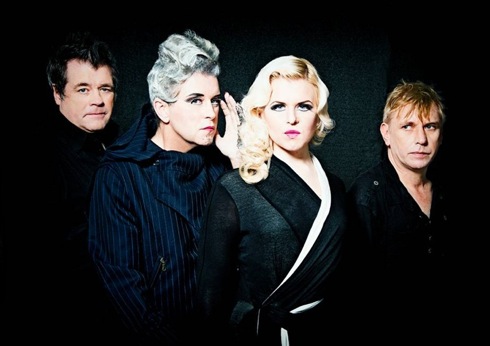
Visage, Steve Barnacle, Steve Strange, Lauren Duvall , Robin Simon

Visage 2013: Steve Barnacle, the inimitable Steve Strange, Lauren Duvall and Robin Simon. Photography © by David Levine

When Strange proposed reviving the band name of Visage after almost 30 years, neither Ure nor Egan could see the point and they disputed Strange’s right to do so. Ure told an American newspaper in January: “Visage was always something Rusty Egan and I created and controlled. The idea of doing a Visage 2 was never appealing to me so I wasn’t interested. I walked away from Visage when it got ridiculous and supremely hedonistic and I will probably leave it that way.” In response to Strange’s claim on German TV last November that Ure was collaborating on a new album together, Ure tweeted: “He is deluded if he thinks that. He knows that isn’t happening.”

EARLIER BACKGROUND

➢ 2013, A couple of slaps in the Visage
as Strange and Egan squabble

Rusty Egan remains aggrieved that Strange has not resolved recent differences. He is angry that Strange should make any claim to creative input into Visage’s lyrics and music, and maintained this week: “Strange had nothing to do with the music in The Blitz or Visage.” In January Egan said: “There has never been a Visage album without me. It’s my group and Strange is a singer. He is not Visage.”

Yet for all this, and Strange’s sad personal saga of ill-health, the vocalist has doggedly set about persuading a new circle of supporters to bring Visage back to life. In the face of widespread disbelief – the garrulous Strange’s little weakness, after all, has always been for exaggeration and melodrama – last year he announced a new “Visage” lineup, with a gorgeous singer called Lauren Duvall, plus Steve Barnacle (fretless bass) and Robin Simon (guitar). Keyboardist Mick MacNeil, from Simple Minds, was enlisted to contribute on a range of vintage analogue synthesisers which include an early Moog Source.

At last, what is being called a fourth “Visage” album titled Hearts and Knives is due to be released on May 27.

“It has been 29 years since the last Visage album and during that period it often seems like we have all lived through several lifetimes,” says Strange. Indeed, “bruised and wounded” declare the rueful lyrics of Shameless Fashion, the new group’s first single, available this week. It isn’t clear whether this refers to the very many contributors we see jostling for credits on the new “Visage” packaging. The Visage 2013 camp is probably keeping fingers crossed.

➢ A free download of the new single Shameless Fashion is available from today at the Visage website

➢ 1980 at the Blitz, Strange days, strange nights, strange people
FRONT PAGE

➤ Linard’s twist on classic Levi – add the kitchen sink

➢ Blitz magazine recalled on the V&A blog:

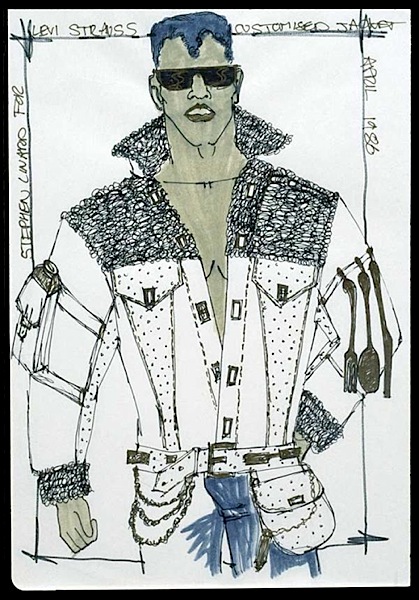
The Blitz designer collection of Levis denim jackets celebrates some of the most talented and creative designers working out of London in 1986 and it has been 27 years since London’s V&A museum last displayed them. These unique jackets were commissioned by the 80s style magazine Blitz in 1986 and customised by a host of top designers, including John Galliano, Vivienne Westwood, Bernstock Speirs and Paul Smith. In quirky twists on the classic Levis denim number, the 21 jackets, of which the V&A owns nine, push the boundaries of the term ‘customisation’. Onetime Blitz Kid Stephen Linard experimented by attaching a leather backpack and cutlery to his…

Blitz Kids, Stephen Linard, fashion,exhibition, Club to Catwalk ,V&A,,

Sketch on paper, Stephen Linard, Great Britain, 1986. Museum no. AAD/19972/34 © Victoria and Albert Museum, London/Stephen Linard

Seven of the nine jackets in the V&A’s collection will be on display in the summer exhibition Club to Catwalk, London Fashion in the 1980s (opening July 10), in addition to a loan of Zandra Rhodes’s jacket, which has been recently reunited with the group, and a Stephen Jones hat that was customised as part of the same project. The jackets will be displayed alongside many of their original sketches and a video wall which will show footage of the 1986 fashion gala… / Continued online

FRONT PAGE

➤ Bowie at V&A: more than a rock star, Bowie reveals the process of art and design

David Bowie ,V&A exhibition, Davie Jones, Manish Boys, 1960s,Denmark Street, Tin Pan Alley,joesalama,YouTube

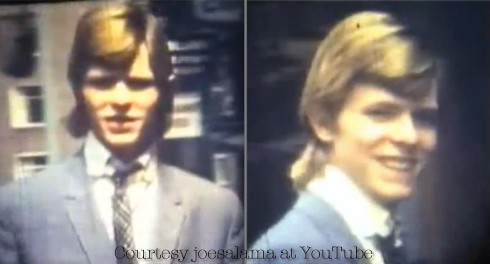
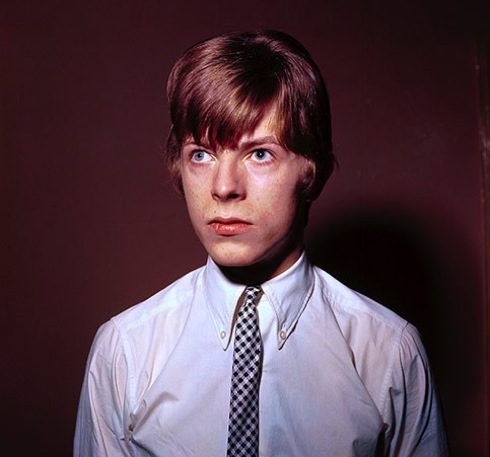
The first room at the V&A exhibition gives this glimpse of a pre-Bowie Davie Jones, aged 18, possibly filmed in Tin Pan Alley, London, in 1965… Click on pic to read the full story by Shapersofthe80s and view the home movie discovered in 2011

➢ 1965, Teenage Bowie flashes priceless smile to an amateur cine camera – read how the clip was found

V&A, review,exhibition, Geoffrey Marsh, David Bowie Is,

The V&A’s new exhibition David Bowie Is: “a grand stage for an inspirational artist who reshaped a generation”

MAR 20: PROFESSOR OF FASHION IAIN R WEBB
ON THE OPENING PARTY

❏ Just spent a blissed out evening at the V&A David Bowie is exhibition. It blew my mind! It is indeed a remarkable show… and to see all those pretty things that I’ve looked at in photos over and over again over the years is something akin to a religious experience… Not only is the clever curation of memorabilia and associated artefacts an inspiration (a lipstick stained tissue anyone?) but I got to personally thank both Mr Mick Rock and Mr Kansai Yamamoto for their wondrous workloads that helped transport me from village idiot to le freak! As the post-show party relocated from the V&A museum to The Rembrandt hotel across the road, the assembled fashion freaks, who also included fashion writer Judith Watt and costume designer Fiona Dealey, went crazy when Mr Yamamoto, who was responsible for many of Bowie’s flamboyant stage designs, entered. The fervour that greeted the legendary designer was akin to the Bowie-mania witnessed earlier in the evening when guests queued around the block to attend the private view.

➢ A great read about a great show – Sarah Crompton in the Telegraph, March 18:

In the opening room of the V&A’s new exhibition David Bowie Is, there is a four-second clip of film of a 17-year-old Bowie striding through the streets of Soho. The sun is shining, and as he catches sight of the camera he turns his bright blond head and smiles before vanishing from sight. The film was found on an old Super 8 camera. The amateur cameraman had been filming his wife in the Soho sunlight; it was quite by chance that he caught the nascent superstar. What is extraordinary is how, even then, Bowie behaves like the idol he was to become. If a camera is running, it must want to catch him in its lens. The mystery of David Bowie, the confidence that inspired a quiet boy from Bromley to become one of the most significant artists of his generation, hangs quietly over this entire show…

Geoffrey Marsh, a co-curator, says he is the first musical figure to be examined on such a scale: “This museum was set up to show how art and design work, to reveal the process. Although there have been a huge number of books about Bowie, they are by rock journalists and may not be of interest to the general public. The reason he is interesting is that he is more than a rock star”…

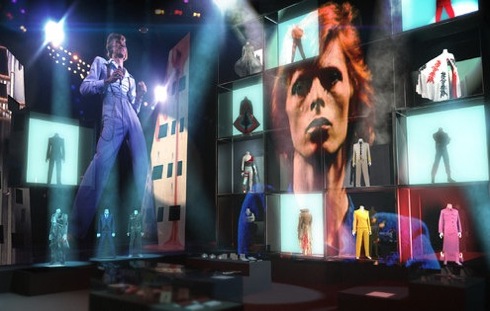
All the exhibits, presented using cutting-edge technology by – among others – the team behind the video projection at the opening ceremony of the Olympic Games, add to that sense of a fertile intelligence, changing constantly, shaping the world. You can see how firmly Bowie was in charge of everything he did.

The sheer grandeur [of the final room] brought tears to my eyes. I felt as I felt when I first saw Bowie live – simply glad to be in the same building as a man who could make music like this… / Full review at Telegraph online

➢ David Bowie is a retrospective exhibition of 300 possessions drawn from Bowie’s personal archive displayed at London’s Victoria & Albert museum, March 23–Aug 11.

David Bowie, NYC,The Next Day,Jimmy King, album charts,

Snowy Bowie, March 20: The Next Day debuts at #1 on charts in 12 countries and tops iTunes charts in 60. This week’s photo by Jimmy King

➢ Bowie is Go! Taster reviews for this week’s record-breaking V&A exhibition

FRONT PAGE

2013 ➤ Bowie is Go! Tasters for this week’s record-breaking V&A exhibition

+++V&A video trailer for the new exhibition, David Bowie is

➢ David Bowie is the enigmatic title of a retrospective exhibition of 300 possessions drawn from Bowie’s personal archive displayed at London’s Victoria & Albert museum, March 23–Aug 11. Appropriately, this week his first album in ten years, The Next Day, sits at No 1 in the Official UK Album Chart. It’s his ninth UK No 1 album (though spookily neither of his recent singles releases is anywhere near the singles chart). Before the V&A show launches, ticket sales exceed 42,000, more than double the advance sales of previous exhibitions at the museum. A few tickets are still available by booking online, in person in Kensington, or by phone +44 (0)20 7907 7073.

FROM THE BOWIE COMMENTARIAT

➢ David Bowie, the Return – Tony Parsons, Miranda Sawyer and La Roux’s Elly Jackson discuss Bowie’s music and influence for Radio 4’s Front Row (broadcast March 7, available on iPlayer for a year). Presenter John Wilson is guided through the V&A exhibits by the show’s curators Victoria Broackes and Geoffrey Marsh.

David Bowie, V&A exhibition, White Cloth Gallery, Leeds

Brian Duffy’s photography for the Lodger album sleeve 1979. © The Duffy Archive Limited

➢ The Duffy Collection of iconic Bowie images – which include three of his most famous album covers – goes on display May 2–June 4 at the White Cloth Gallery in Leeds LS1 4HT. The show documents Duffy’s special relationship with Bowie over ten years.

➢ A cryptic guide to the typography of Bowie – The V&A exhibition catalogue dissected by Gavin Lucas at Creative Review, 4 March 2013:

Jon Abbott at graphic design studio Barnbrook said of the book David Bowie Is: “We wanted to create an engaging pop-object for an audience who have come to expect the unconventional” … The book’s body typeface, Priori Serif, is one from Jonathan Barnbrook’s own foundry, Virus Fonts. Drawn by Jonathan Barnbrook and Marcus Leis Allion, the typeface was influenced by British typographers Gill and Johnston, and fittingly it found one of its first outings on the cover of Bowie’s 2002 album, Heathen … / Continued at Creative Review

Celia Philo,Brian Duffy,David Bowie, V&A exhibition,

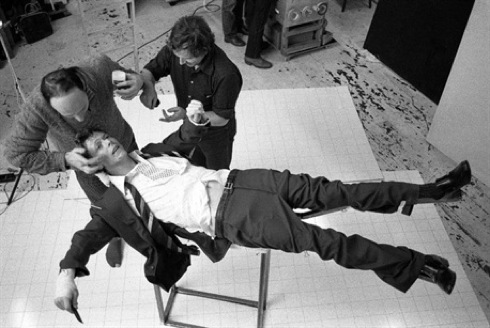
One of the rejected cover shots for the Aladdin Sane album taken by photographer Brian Duffy in 1973. © The Duffy Archive Limited

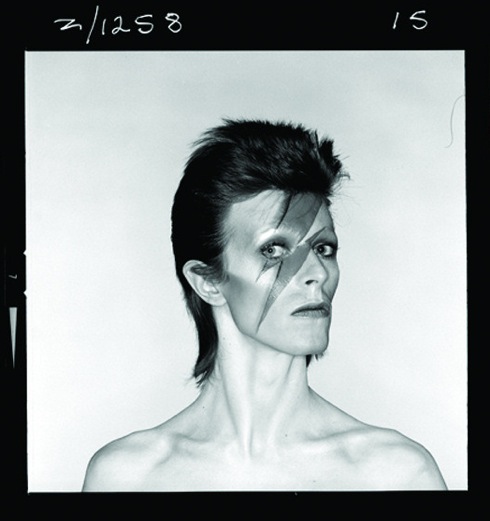
➢ The day that lightning struck Aladdin – In 1973, Celia Philo directed the photo shoot for David Bowie’s album Aladdin Sane. The result was one of the most iconic images ever created. She talks to Stylist magazine, 2013:

Sometimes, when you’re doing something that you know is going to be good, it’s because it’s come from an extreme end of the spectrum of experience: either it’s incredibly hard work, or it comes together almost effortlessly. The photographic shoot for the cover of Aladdin Sane happened like magic. Its success was the result of a lucky collaboration of people … / Celia Philo, continued at Stylist

David Bowie, V&A exhibition,Lower Third,Swinging 60s,

Setting out as Swinging 60s Mod: Bowie promo shot in 1966 for his first single on Pye, Can’t Help Thinking About Me, with his band The Lower Third which included producer Tony Hatch on piano. The NME decided: “Absorbing melody, weakish tune”

➢ Iain R Webb: How David Bowie liberated my wardrobe – As a 14-year-old boy living in a West Country village, Webb, the former Blitz Kid and fashion editor and now RCA professor, thought David Bowie’s style statements were a gift. And so have generations of fashion designers. Read feature in The Independent, March 16, 2013:

Bowie’s influence on my life has been major, from the fundamental desire to never be labelled or pigeonholed to my profound love of glitter and penchant for a spikey haircut. And I am not alone … / Iain R Webb, continued at The Independent

➢ Glam! The Performance of Style (Feb 8–May 12) is a seriously well-curated multi-media show at Tate Liverpool surveying the 1971–75 phenomenon on both sides of the Atlantic, across the whole spectrum of painting, sculpture, installation art, film, photography and performance. The in-depth survey comes in two halves, drawing a clear distinction between the playful subversion of pop music and fashion that characterised the British glam wave, and the American, which was driven much more profoundly by gender politics. Well worth a daytrip to Liverpool.

➢ 1970, Where to draw a line between glitter and glam: naff blokes in Bacofoil versus starmen with pretensions — analysis by Shapersofthe80s.

➢ How Glam Changed Britain, by Gary Kemp – feature written by the Spandau Ballet songwriter for The Times, Jan 28, 2013.

♫ EXPLORING BOWIE’S MUSIC

David Bowie, V&A exhibition, ,Berlin,Tony Visconti, Hansa Studios

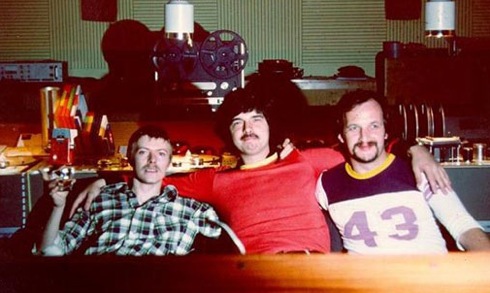
Berlin 1976: Bowie with moustache, Tony Visconti and assistant engineer, Edu Meyer, taken in the control room of Hansa Studios by Meyer’s wife, Barbara

♫ BBC Radio 6Music celebrates the life and work of David Bowie throughout Easter week, March 25–31. Gems from the archive feature concerts and interviews which have not been heard in 30 years.

♫ 2013, Shock and awe verdicts – Shapersofthe80s rounds up critical opinion on Bowie’s born-again single Where Are We Now? and the masterful new album The Next Day – “beautiful, obsessive and deliciously cruel”.

♫ News of special vinyl release at Bowie’s website – His second 2013 single, The Stars, is scheduled for a limited edition vinyl 7inch 45 Record Store Day release on April 20. Backed with Where Are We Now?


❏ Music video for the 1979 song DJ (above) sees Bowie sporting a pink onesie dungaree outfit designed by Willy Brown and walking through London streets being snogged by fans, both boys and girls.

FRONT PAGE

➤ A glamorous date with Margot Fonteyn and a feast of fabulous frocks

Margot Fonteyn,Fashion Museum ,,Fabulous Frocks,Bath

Shall we dance? Dame Margot Fonteyn’s ostrich feather evening coat by YSL at the Fashion Museum in Bath

❚ WOW FACTOR TIMES 50! The ostrich feather evening coat seen in close-up (above) and matching crystal and feather cocktail dress by Yves St Laurent (below) were owned by the English prima ballerina Margot Fonteyn and worn to go nightclubbing in the 1960s with her stage partner Rudolf Nureyev, the charismatic Russian dancer who had defected to work in the West. They are showing from today until end of the year in the exhibition, 50 Fabulous Frocks which have been chosen from a world-class collection of originals to celebrate the 50th anniversary of the council-run Fashion Museum in Bath. Dame Margot was a great supporter of the earlier Museum of Costume and donated a number of her personal clothes in the 60s.

Margot Fonteyn,Fashion Museum ,,Fabulous Frocks,Bath

F-A-B: YSL crystal and feather cocktail dress and 17th-century silver tissue dress (Fashion Museum, Bath)

Rosemary Harden, principal curator of the museum, wants to show the richness of its collection through personal wardrobe moments and key landmarks in fashion history “ranging from our oldest piece, an exquisite 17th-century silver tissue dress, to one of the latest Burberry creations”.

The display also includes a gold embroidered Georgian court dress and a delicate 1870s gauze bustle day dress alongside an Ossie Clark trouser suit, the Chanel suit and stars of 20th-century couture – Schiaparelli, Poiret, Vionnet, Dior – plus today’s most desired names such as Erdem and John Rocha.

The Fashion Museum originated with Doris Langley Moore, a designer, collector, writer and scholar who gave her famous private collection of costume to the city of Bath. Recently it was listed by CNN as one of the world’s Top 10 fashion museums.

➢ 50 Fabulous Frocks runs from Feb 2 at the Fashion Museum, Bath

➢ Bath in Fashion 2013 is a week-long festival (April 13–21) showcasing celebrities such Norman Parkinson in a centenary exhibition, an illustration masterclass with David Downton, talks with Michael Jackson’s costume designer Michael Bush, and Sir Roy Strong. Plus catwalk shows and craft workshops

FRONT PAGE