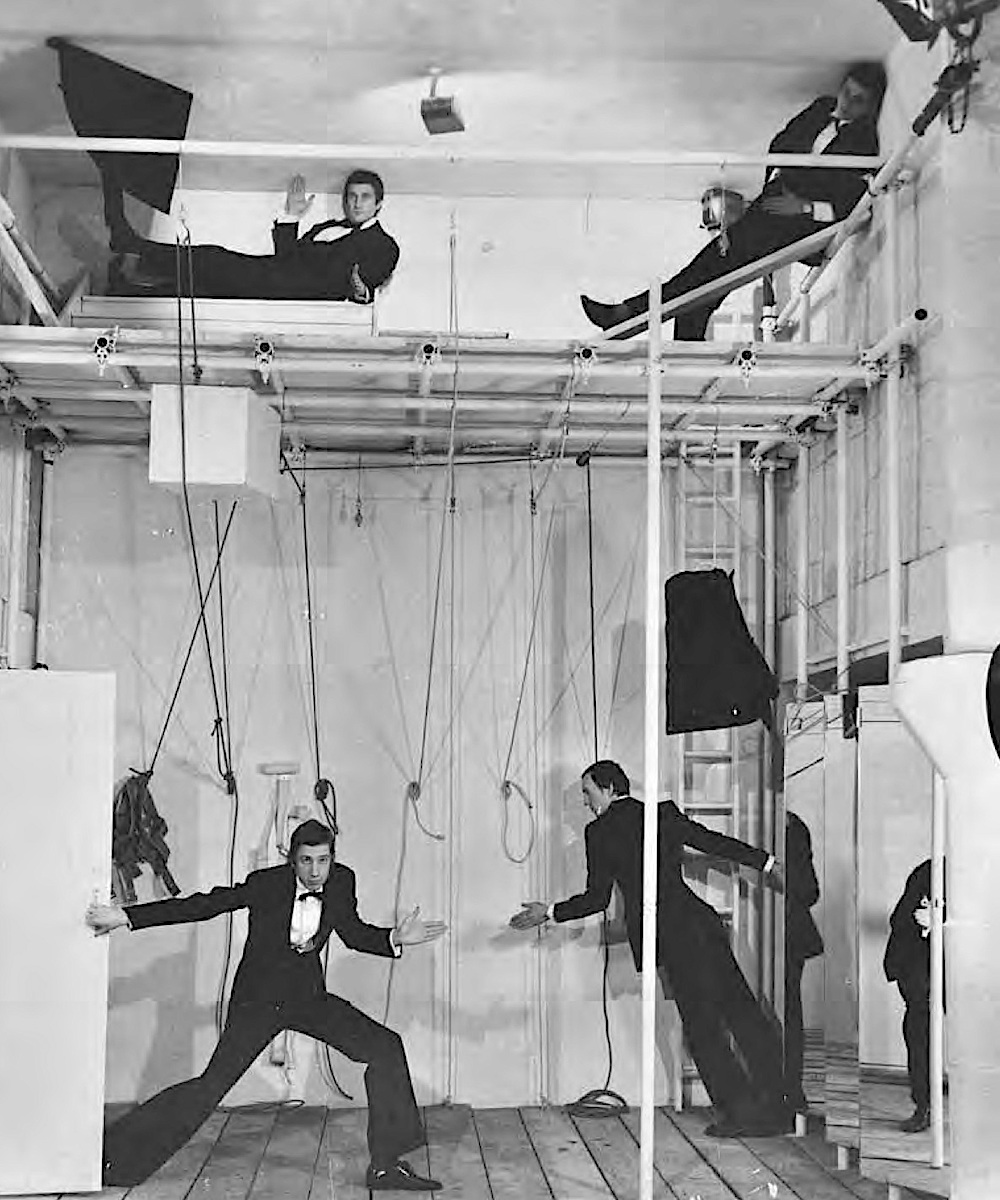
Nice Style posing at the Gallery, 1974: High up on a Baroque Palazzo. McLean himself is at top left. Photo by Craigie Horsfield
❚ SCOTTISH SCULPTOR BRUCE MCLEAN set out to satirise modern art in October 1974 with Nice Style, “the world’s first Pose Band”, pictured here. Read more about this startling occasion on our inside page along with the riveting review written by the Evening Standard’s art critic Richard Cork…
“ In the autumn of ’74 art critic Richard Cork took me to the Gallery in Covent Garden to witness one of the most exciting live performances I can recall, staged in a largish space full of ropes and pulleys, ladders and flapping doors, by four animated artists calling themselves Nice Style, “the world’s first Pose Band”, led by Bruce McLean. Stopping, posing and re-starting in 3-D for a full hour, three days a week, they were electric, fascinating and hilarious. We were being invited to laugh in an art gallery! ”
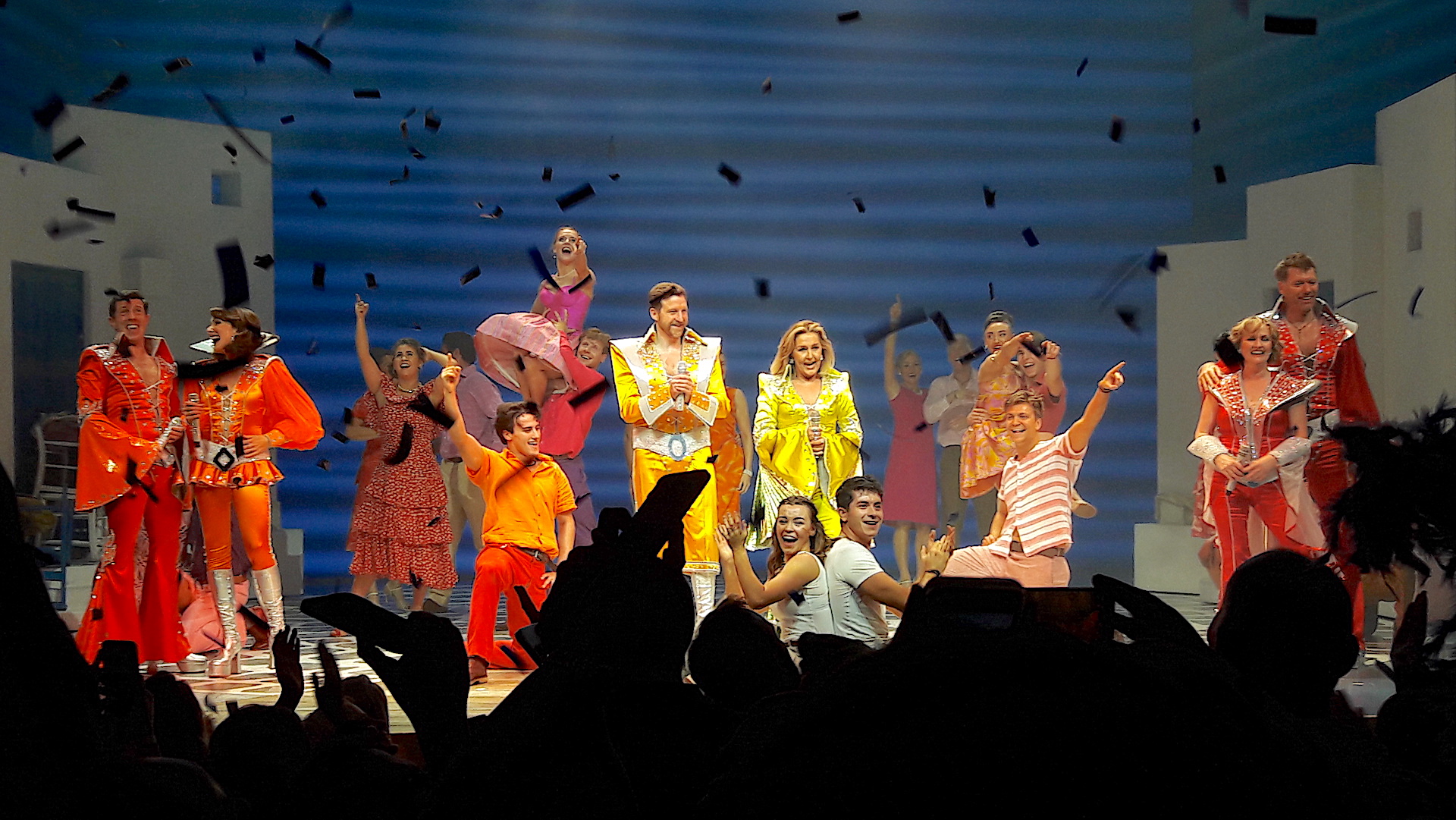
❚ WHETHER YOU LIKE ABBA’s SONGS or not, the scale of the West-End musical MAMMA MIA!’s success is staggering. Over 25 years it has been seen by 70 million people in 450 cities across the world, in 16 different languages. At the box office, the show has made £4.5 billion. Yes, billion !!!
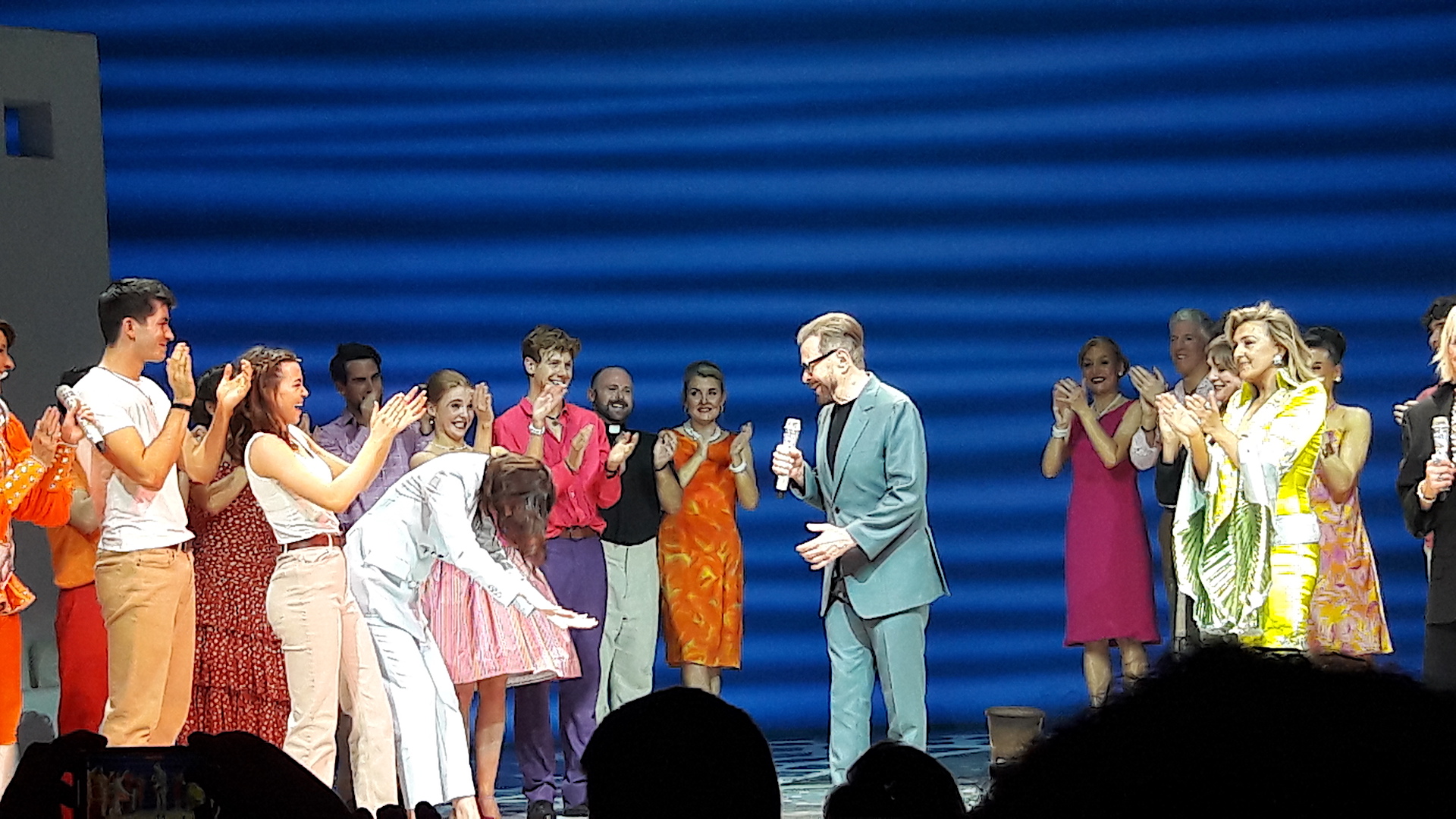
So not to have seen this award-winning show is quite a feat, I am ashamed to admit. Yet on the 25th anniversary performance of MAMMA MIA! this weekend at London’s Novello Theatre I was blown away by the sheer energy and quality of this showbiz landmark, with its 34-strong cast of athletic dancers and powerful singers (especially Mazz Murray playing free-love mother Donna) plus an astonishing live orchestra. Here was the essence of full-on theatre.
What was rare for a stage musical was that the audience already knew almost every one of the show’s 22 numbers, written during the decade after ABBA won the Eurovision song contest in 1974 with Waterloo. Yet the lyrics repeatedly proved to be eye-openers during MAMMA MIA!, acting as dialogue to provide a dramatic family plot around a young girl’s marriage on a sunny Greek island.
Crucially many songs were injected with a comic twist, as with Take a Chance on Me and indeed Honey Honey which, the programme tells us, had Björn Ulvaeus – its co-author along with Benny Andersson – falling off his chair laughing and insisting “I didn’t write this as funny!” On an emotional level there were several truly tear-jerking moments as the family saga unfolded, prompted by songs such as Knowing Me, Knowing You and The Winner Takes it All.
Given that today the four members of ABBA are multi-millionaires, it’s ironic that I profiled them as the first entry in an A-to-Z Sunday Times partwork titled 1000 Makers of Music in 1997 by noting that as Swedish journeyman songsmiths in the Seventies their sing-along melodies epitomised Europe’s dreaded folkloric tradition – in contrast to Anglo-American guitar heroes who mouthed youthful dissent. Nevertheless during their breakthrough decade before disbanding ABBA scored eight consecutive No 1 albums in Britain and 25 Top 40 singles, so catchy that everybody could hum one. A decade further along, the quartet had acquired cult status as exponents of what we had grown to appreciate as “pure pop”.
In 2023 ABBA were awarded the BRIT Billion Award which celebrates musicians who have achieved one billion UK streams in their career. Today they stand tall among the best-selling artists in music history. Last month, all four members of ABBA were appointed Commander, First Class, of the Royal Order of Vasa by His Majesty King Carl XVI Gustaf of Sweden. This is the first time in almost 50 years that the Swedish Royal Orders of Knighthood have been bestowed.
❚ ONE OF THE GOD-LIKE SHAPERS of the new music of the Eighties was playing live in London this week and afterwards we met again for the first time since 1981. He is August Darnell, aka Kid Creole frontman of the Coconuts, and when I remarked on what a vital conduit he had provided between New York, London and Paris assisting the exchange of new indie bands, no-wave dance music and other strange flavours on Michael Zilkha’s ZE Records label, he was flattered to be remembered that way. Yes they were fertile times, he agreed, as post-punk pop, disco, funk, dub and Latin all collided with artsy pretension spiced with irony. He loved that rules were being broken.
In 1980 Darnell became a producer at ZE and his collaborations boosted the careers of James Chance, Cristina, Was (Not Was), Don Armando’s Second Avenue Rhumba Band and Material, while introducing the category of “Mutant Disco”. The edgy compilation album bearing that name distinctly helped to make ZE “the most fashionable label in the world” in the opinion of The Face magazine by 1982. Woodwork squeaks and out come the freaks!, according to Was (Not Was).
Click any pic to enlarge in slideshow:
Kid in full swing in London… with his dancers Roos Van Rossum, Charlotte De Graaf, Kristina Hanford
Lounge lizard Kid in London: turning on that bazzazz. (Photos by Shapersofthe80s)
Onstage by invitation: a queue of London fans joined the Coconuts line-up
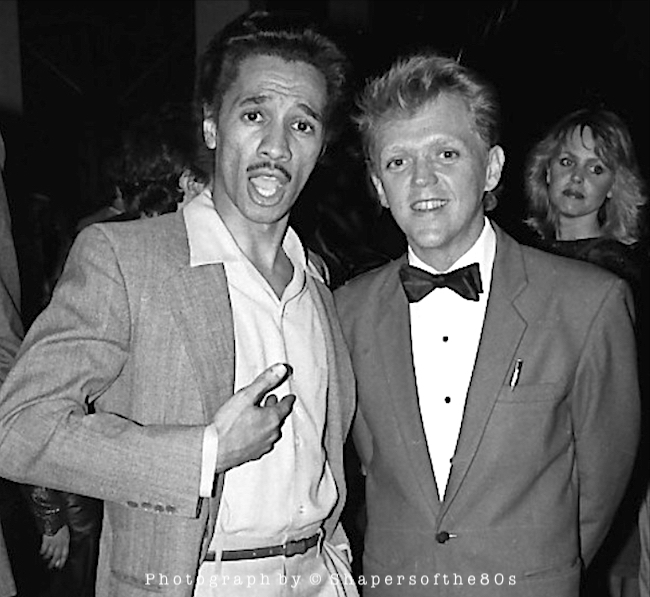
Backstage after the London show: Animal Nightlife’s singer Andy Polaris meets August Darnell to thank him for so much inspiration
Darnell had set out in 1974 writing lyrics with the funky Dr Buzzard’s Original Savannah Band in which vibraphone player Andy Hernandez was known as his “trusty sidekick” Coati Mundi. Hernandez served as Darnell’s on-stage comic foil, as well as his musical director and arranger. Their first hit single on RCA was Cherchez La Femme with Cory Daye the lead vocalist. The album went gold and the band was nominated for Best New Artist in the Grammy awards.
In 1980 he formed his own band as Kid Creole and the Coconuts, his style as lounge-lizard vocalist being defined by a Latinised Cab Calloway type in a zoot suit and broad-brimmed hat, alongside “Sugar-Coated” Coati Mundi in a line-up of instrumentalists and singing dancers. Sire released the Coconuts album, Fresh Fruit in Foreign Places, in June 1981, while the next album in May 1982 was boosted by its instant appeal in the UK under the title Tropical Gangsters. The LP hit number three, and three singles – I’m a Wonderful Thing Baby, Stool Pigeon and Annie I’m Not Your Daddy – made the Top Ten.
As a dynamic live act with unique visual appeal, the Coconuts toured the world, confirming Darnell as a respected composer, arranger and producer. They recorded 11 albums and scored more hit singles including Dear Addy, Endicott, The Sex of It, and My Male Curiosity.
And now here were many of those familiar strains being given brilliant new life on-stage at the Boisdale restaurant in Canary Wharf this week, thanks to a powerful seven-piece band and three slinky dancers. Of course August Darnell was showing his age – heavens, aren’t we all these days? Despite which, his generous set was driven by his own rich voice and every ounce of sheer bazzazz. There was no beating Don’t Take My Coconuts!
Michael Zilkha and Michel Esteban: in 1978 founders of the record label combined their initials to make ZE and based themselves in both New York and Paris
Bowie’s new look for 1976 when he became The Man Who Fell to Earth, here in a Haywain shirt. Photographed by Steve Schapiro and published on the cover of the Sunday Times Magazine
David Robert Jones 8 January 1947 – 10 January 2016
Every January, two dates stir the souls of Bowie fans: the 8th being his birthday and the 10th the day he died. On the seventh anniversary of his death, Eighties Blitz Kid and pop singer ANDY POLARIS recalls the dramatic influence Bowie had on his early teens in the way that his fan base would also be galvanized by his art to inspire their own creative dreams. This extract comes from a much longer piece at his own website Apolarisview.wordpress.com … Andy writes:
“ Much has been written about Bowie’s Starman performance in 1972. I had begun a fascination with his image a little earlier after the Melody Maker interview, thanks to an older teenager who also had the album, Hunky Dory.
I began to spend the little pocket money I had on buying all the magazines and music papers that featured him, especially on the cover. Fab 208, PopSwop, Music Star, Music Scene and Jackie thankfully were relatively cheap and I began my scrapbook collection. Ziggy Stardust with his bold make-up and glamorous wardrobe (courtesy of Freddie Burretti and Kansai Yamamoto) was unlike anything seen before and blurred the line between sexes. This beautiful creature offered a world of possibilities to this youth already bored with football and the teenybop fandom that dominated our era. Clothes, style, identity – normal teenage rites of passage – all took on a greater importance over the next few years but now helped define a more alternative journey.
Seeking out Bowie’s references in lyrics opened a new door to imagination. His creative output eased my inner void of loneliness and probably kick-started my interest in science-fiction. Humdrum suburbia was replaced by the magical worlds of Alfred Bester, Philip K Dick, George Orwell and Robert Heinlein to a soundtrack of Ziggy Stardust, Aladdin Sane and Diamond Dogs.
Scissors, Pritt Stick or Gloy Gum and a large desk were my 1970s iPad, and all that were needed, as I lovingly read and then pasted articles onto A4 note paper into a hard grey binder. This became a ritual that continued for my teenage life. I never liked to create collages because I hated cutting up articles too much and words were equally important. What Bowie was saying or what people were saying about him seemed as important as the visuals. That shape-shifting style (musically and visually) meant I never got bored and felt that I evolved along with him, my anticipation becoming almost tangible with news of a new release or a TV appearance… ”
❚ IN POST-PUNK 1979 The Specials and their 2 Tone Records label were just about the only credible sounds in the blandly irrelevant pop charts of the time. This ska-revival band from Coventry defined the anger characterising the concrete jungle in recessionary Britain from their debut single Gangsters to Ghost Town in 1981. They notched seven chart hits while the fashion-conscious stylists who turned London’s Blitz Club into a poser’s paradise set about creating employment among their own ranks by reinventing the UK music scene itself.
The frontman of The Specials, Terry Hall, who from the outset felt uncomfortable becoming a pop celebrity, died on Sunday aged only 63 after a tough and often traumatic life. Yet his singing voice and charisma as a political militant, also expressed with the ironically named Fun Boy Three, ensured a substantial following in later life so that a comeback album titled Encore topped the UK chart in 2019.
Here’s how today’s Guardian obituary of Terry Hall starts, written by Adam Sweeting: “Singer with the Specials whose chart-topping Ghost Town evoked the sense of social collapse gripping Britain at the turn of the Eighties”…
“ Famously deadpan, dour and slightly menacing, Terry Hall, who has died aged 63 after a short illness, shot to fame at the end of the 1970s with Coventry’s ground-breaking multi-racial band the Specials. They emerged in the aftermath of punk, with a fizzing, politically charged mix of ska and new wave, and enjoyed instant success with their debut album, The Specials, which reached No 4 on the UK chart. For a time, the Specials’ 2 Tone Records operation became the UK’s most successful record label, with releases from Madness, the Beat and the Selecter alongside the Specials’ own.
“ Hall commented that “I don’t believe music can change anything” because “all you can do is put your point across”, but the Specials caught the fraught and dangerous atmosphere of the turn of the 1980s with an eerie intensity. Ghost Town in particular chillingly evoked the sense of social collapse and economic decline gripping a riot-torn Britain.
“ The Specials found themselves in the eye of the storm, with neo-Nazis frequently targeting their gigs. Hall and the band’s keyboards player, Jerry Dammers, were both arrested when they waded in to try to break up fighting between fans and security guards at a gig in Cambridge. They were found guilty of “incitement to riot” and fined £400 each… ” / Continued at Guardian online
➢ Choose “View full site” – then in the blue bar atop your mobile page, click the three horizontal lines linking to many blue themed pages with background article
MORE INTERESTING THAN MOST PEOPLE’S FANTASIES — THE SWINGING EIGHTIES 1978-1984
They didn’t call themselves New Romantics, or the Blitz Kids – but other people did.
“I’d find people at the Blitz who were possible only in my imagination. But they were real” — Stephen Jones, hatmaker, 1983. (Illustration courtesy Iain R Webb, 1983)
“The truth about those Blitz club people was more interesting than most people’s fantasies” — Steve Dagger, pop group manager, 1983
PRAISE INDEED!
“See David Johnson’s fabulously detailed website Shapers of the 80s to which I am hugely indebted” – Political historian Dominic Sandbrook, in his book Who Dares Wins, 2019
“The (velvet) goldmine that is Shapers of the 80s” – Verdict of Chris O’Leary, respected author and blogger who analyses Bowie song by song at Pushing Ahead of the Dame
“The rather brilliant Shapers of the 80s website” – Dylan Jones in his Sweet Dreams paperback, 2021
A UNIQUE HISTORY
➢ WELCOME to the Swinging 80s ➢ THE BLOG POSTS on this front page report topical updates ➢ ROLL OVER THE MENU at page top to go deeper into the past ➢ FOR NEWS & MONTH BY MONTH SEARCH scroll down this sidebar
❏ Header artwork by Kat Starchild shows Blitz Kids Darla Jane Gilroy, Elise Brazier, Judi Frankland and Steve Strange, with David Bowie at centre in his 1980 video for Ashes to Ashes
VINCENT ON AIR 2026
✱ Deejay legend Robbie Vincent has returned to JazzFM on Sundays 1-3pm… Catch up on Robbie’s JazzFM August Bank Holiday 2020 session thanks to AhhhhhSoul with four hours of “nothing but essential rhythms of soul, jazz and funk”.
TOLD FOR THE FIRST TIME
◆ Who was who in Spandau’s break-out year of 1980? The Invisible Hand of Shapersofthe80s draws a selective timeline for The unprecedented rise and rise of Spandau Ballet –– Turn to our inside page
SEARCH our 925 posts or ZOOM DOWN TO THE ARCHIVE INDEX
UNTOLD BLITZ STORIES
✱ If you thought there was no more to know about the birth of Blitz culture in 1980 then get your hands on a sensational book by an obsessive music fan called David Barrat. It is gripping, original and epic – a spooky tale of coincidence and parallel lives as mind-tingling as a Sherlock Holmes yarn. Titled both New Romantics Who Never Were and The Untold Story of Spandau Ballet! Sample this initial taster here at Shapers of the 80s
CHEWING THE FAT
✱ Jawing at Soho Radio on the 80s clubland revolution (from 32 mins) and on art (@55 mins) is probably the most influential shaper of the 80s, former Wag-club director Chris Sullivan (pictured) with editor of this website David Johnson
LANDMARK FAREWELLS. . . HIT THE INDEX TAB UP TOP FOR EVERYTHING ELSE











 ➢➢ Shapers of the 80s ➣➣