Monthly Archives: Dec 2012

➤ Barcelona celebrates Adriá, magician of edible art, and a totally useless machine

exhibition,Barcelona, Ferran Adrià, El Bulli

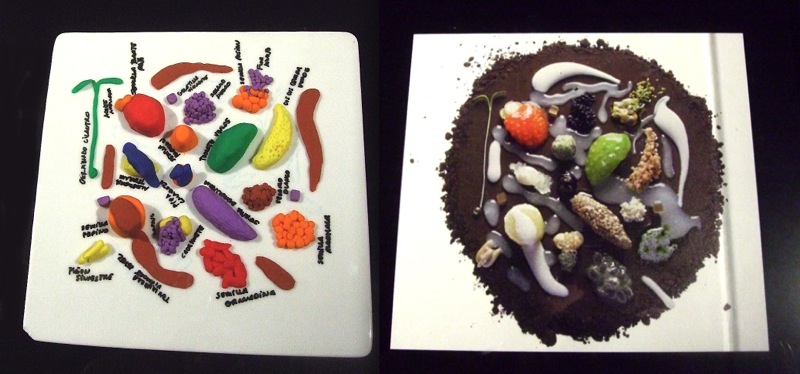
Before-and-after designs: left, coloured Plasticine model … right, real food on the plate by El Bulli chefs

❚ EATING CAN BE THEATRE, just as food can be art. The Catalan chef Ferran Adriá is Houdini and Picasso in one, commonly lauded as the best in the world. His three-Michelin starred restaurant El Bulli, two hours north of Barcelona, was an academy repeatedly garlanded by scholars who take dining seriously. Since 1987 it grew to serve 1,500 plates daily, prepared by 50 cooks and served by 30 staff typically to only 50 companions at table. Its culinary revolution is known as “molecular gastronomy” famed for scented gels and foams and for using every part of every animal and plant.

exhibition,Barcelona, Ferran Adrià, El Bulli

Adrià’s manifesto: No 10 of his 23 principles that summarise El Bulli’s cuisine

Now after 25 years of experiments, Adriá is replacing the restaurant with an inspirational foundation, while his career is being celebrated in Spain’s first major exhibition about cooking. In a series of galleries at Barcelona’s Palau Robert, we are blown away by a fearsomely complete collection of photos, letters, utensils, mementoes, and a vast poster of the 1,846 dishes catalogued by the restaurant. Best of all are the videos in which we see his edible creations being conjured. Another simple but charming glimpse behind the magician’s hand is a table-top displaying before-and-after designs of individual dishes: ingredients modelled from coloured Plasticine are composed as templates for his chefs to translate – abracadabra! – into the resulting plates of food shown alongside.

➢ The free exhibition Ferran Adrià and El Bulli runs at Palau Robert, Barcelona, until Feb 3, 2013


➢ Should I eat it or frame it? The Guardian’s art critic Adrian Searle reviews 40 courses of art food at El Bulli

Tonight’s dinner involves all the senses, it engages the mind, and is also, at times, a strangely emotional experience. The dishes can be confrontational as well as exquisite… The constant stream of surprises continues for more than four hours – the green leaf that tasted exactly of oysters; the grilled strawberry with ginger on the outside and an injection of gin on the inside; the polenta gnocchi with coffee and saffron yuba; the perfect razor clam with its gelatin twin in the other half of the opened shell. Playful, arresting, occasionally alarming, the meal is almost like a story… / Continued at Guardian Online

❚ THE “WORLD’S MOST USELESS MACHINE” is not new news but it did raise a smile during a trip to the year-old Museum of Ideas and Inventions – essentially a hands-on diversion for restless children – while Christmassing in Barcelona. The co-founder of Massachusetts Institute of Technology’s laboratory of artificial intelligence, Marvin Minsky, came up with the idea in 1952. Electronics engineer and the “father of information theory” Claude Shannon, who worked with Minsky at IBM, liked the idea so he built the machine. It is a battery powered box, the sole purpose of which is to turn itself off after some human hand has turned it on.

You too can assemble your own useless machine in beginner-level electronics kit form (from US$35 + shipping), or in a ready-soldered version (from US$55 + shipping). Both include printed circuit board.

➢ Museum of Ideas and Inventions lies a few yards away from Plaza Sant Jaume, in Barcelona’s Gothic quarter

➢ Buy your own Ultimate Useless Machine online from Frivolous Engineering Company in Canada
FRONT PAGE

2012 ➤ Why Brains, Parker and Lady P stayed cults long after Thunderbirds had Gone!

Gerry Anderson, Thunderbirds,Supermarionation, TV series, 1960s,

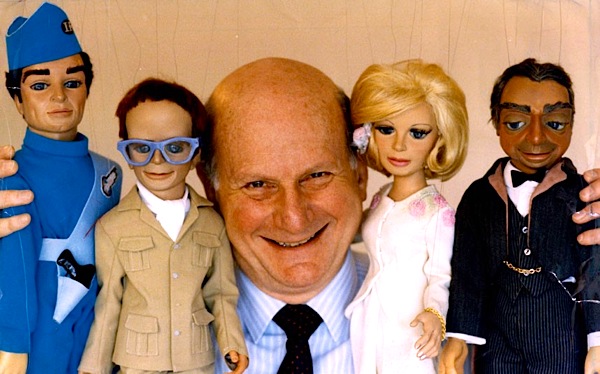
Futuristic puppet stars: Gerry Anderson with Virgil, Brains, Lady Penelope and Parker the chauffeur. (Picture: David O’Neill / Rex)

➢ Thunderbirds creator who made some of the most popular children’s TV shows of the 1960s – Gerry Anderson obituary at The Guardian

Gerry Anderson, who has died aged 83 after suffering from Alzheimer’s disease, was the main mover behind a number of puppet series commissioned by Lew Grade’s Independent Television Corporation. They made the company a fortune from the space age: perhaps the best known was Thunderbirds (1965-66), and among the others were Fireball XL5 (1962-63), Stingray (1964) and Captain Scarlet and the Mysterons (1967-68).

Factoid: Thunderbirds hero Jeff Tracy and
his sons John, Scott, Virgil, Alan and Gordon were all
named after early American astronauts

Gerry Anderson, Thunderbirds,Supermarionation, TV series, 1960s,

Captain Scarlet as Royal Mail postage stamp last year

The pre-ITV world of the early 50s had been one of puppets such as Muffin the Mule and the Flowerpot Men, a mirror for a Britain on extremely visible strings. Rocket men, on BBC radio, Radio Luxembourg and in the Eagle comic, meant Dan Dare and Jet Morgan – recycled Biggles and Battle of Britain pilots. After Anderson, they were destined for the galactic dole queue, just as Eagle’s demise was hastened by the arrival of Anderson spin-offs such as TV Century 21 (1965-71). “Everything we did,” Anderson told his biographers Simon Archer and Marcus Hearn, in What Made Thunderbirds Go! (2002), “was in an endeavour to sell to America”, and Grade spectacularly achieved that with Fireball XL5, a US network sale to NBC. Thunderbirds, shown across the world and more than a dozen times on British TV, is the show that defines the Anderson achievement, yet never attracted a US network… / Continued at Guardian Online

➢ F-A-B gallery of Gerry Anderson creations at Guardian Online

➢ 2011, Brains explains “lenticular” Thunderbirds postage stamps

Gerry Anderson, Thunderbirds

Thunderbirds’ secret base at Tracy Island: model kit comes with miniature versions of the Thunderbird 1, 2, 3, 4, and 5. “Some assembly required.” From Dragon Models USA, $115

‘Anything can happen in the next half hour’

➢ Paul Hammans on the extraordinary dynamics of Stingray:

Gerry Anderson, Stingray,Supermarionation, TV series, 1960s,

Stingray’s Troy Tempest and “Aqua” Marina (Photo: ITV)

Anderson’s third series in Supermarionation brought a new level of emotional literacy to the genre, albeit one difficult to define. Gradually the move had been made and puppetry was continuing to move toward greater realism, but let’s not get this out of proportion; it was not the end of innocence. Puppetry of the Gerry Anderson variety, despite being set in an imaginary future began to appear more relevant at a deeper level for the audience of the day. The transaction in any learning process depends upon emotional involvement and increasingly the puppet series got you involved… / Continued at Cult Britannia

FRONT PAGE

➤ Do they know? How modest Midge wrote the biggest selling pop single of his generation

Do They Know It’s Christmas?, Band Aid, Live Aid, Midge Ure, Bob Geldof, 1984,pop music, UK charts,

Pop artist Peter Blake’s Band Aid sleeve… The original vinyl can be yours today for £6.99, US$11.25, €8.60 at eil.com

◼ 1.1 BILLION VIEWS FOR GANGNAM STYLE at YouTube!!! Merry Christmas, pop pickers. Now spare a few minutes to listen to the original demo of the tune that in its day became the biggest selling UK single of all time. In 1984 was at No 1 in the pop charts.

Midge Ure: recording the Band Aid single, here with Paul Young and Tony Hadley © 1984 Mercury Records

Midge Ure: recording the Band Aid single, here with Paul Young and Tony Hadley (© 1984 Mercury Records)

It was recorded under the artist name of Band Aid by a megagroup recruited from 47 of the biggest hitters in British rock and pop. It raised huge funds for famine relief in Africa and a year later led to Live Aid, the biggest global rock concert ever, viewed by two billion people in 60 countries, who coughed up still more dollars. Live Aid is said to have raised £150m (about £400m or US$650m at today’s prices).

The idea for Band Aid was proposed by one down-on-his-luck musician, Irishman Bob Geldof, who had been moved by a horrifying BBC TV news report on the famine in Ethiopia. The project sprang out of a telephone call with Midge Ure of Ultravox when he was appearing on The Tube, the weekly pop TV show broadcast from Newcastle. The song was written and produced in a flash by Scotsman Midge, who has emerged as one of the most genuinely multi-talented shapers of the 80s.

WALKING OUT OF THE SHOPS

Do They Know It’s Christmas?, Midge Ure, Bob Geldof, Band Aid, Record Mirror, cuttings
❏ The Band Aid single became the fastest seller of all time in its first week of release, ironically keeping one of its participants, George Michael and his band Wham! off the coveted No 1 spot in the Christmas singles chart, which would have been their third No 1 in a row. Bob Geldof, mover and shaker behind the charity project, told Record Mirror in the December 1984 page shown here: “It’s NOT a Geldof plot to get back in the limelight as some people are claiming. It allowed people who understandably felt a sense of impotence about Ethiopia to express their support.” DTKIC endured as the biggest-selling single of all time in the UK for 13 years, until it was overtaken in 1997 by Elton John’s Candle in the Wind, released following the death of Princess Diana.

HERE’S MIDGE’S ORIGINAL SOLO DEMO…

AND HOW IT SOUNDED A YEAR LATER AT LIVE AID

MORE BAND AID STORIES AT SHAPERS OF THE 80S

➢ 1984, Band Aid, when pop made its noblest gesture but the 80s ceased to swing

➢ 2001, Hear about the many lives of Midge Ure, the Mr Nice of pop

➢ Midge Ure and Gary Kemp lift the lid on the shenanigans that led up to Band Aid

FRONT PAGE

1970s ➤ Yowsa! A crackly festive vinyl top ten from Chic, James, Minnie, Funkadelic and friends

+++
+++
+++
+++
+++
+++
+++
+++
+++
+++

❏ iPAD, TABLET & MOBILE USERS PLEASE NOTE — You may see only a tiny selection of items from this wide-ranging website about the 1980s, not chosen by the author. To access fuller background features and site index either click on “Standard view” or visit Shapersofthe80s.com on a desktop computer. ➢ Click here to visit a different random item every time you click

FRONT PAGE

➤ Smash Hits and other mould-breakers of the 80s

Neil Tennant ,Smash Hits, Radio 4, documentary

1983: Neil Tennant as Smash Hits writer. (Photo by Virginia Turbett)

❚ ANOTHER NICELY PACKAGED Radio 4 documentary today celebrated the crucial years 1982–85 which Neil Tennant describes as “the golden age of 80s pop”. They luckily coincided with his tenure as a writer on Smash Hits magazine before stepping into the pop charts himself as half of the Pet Shop Boys. Obviously in a prog titled Neil Tennant’s Smash Hits Christmas Tennant and his cronies were full of back-slapping at the moulds they broke with the mass-selling fan mag, driven initially by two selling points – song lyrics and pull-out pinup posters.

Smash Hits, Radio 4, documentary,Pete Murphy

1982: Peter Murphy of Bauhaus (you really don’t want to see its Christmas cover star)

Launched in Nov 1978 as a monthly title, Smash Hits trailed “The words to 18 top singles” as its key feature. The mag was the invention of former NME editor (and later founder of The Face) Nick Logan who conceived it on the kitchen table and initially toyed with the title Disco Fever, presumably in homage to that year’s horror movie Saturday Night Fever. He chose the Belgian new-wave joker Plastic Bertrand for the cover of a pilot issue in the post-punk vacuum when any new direction seemed significant, but actually launched with Blondie. Smash Hits soon went fortnightly, ran for 28 years, and died with Celebrity Big Brother’s Preston gracing its last cover in 2006. In his Guardian obituary for the mag, Alexis Petridis wrote: “The period between the rise of Adam and the Ants and the collapse of Stock, Aitken and Waterman’s ‘Hit Factory’ empire may prove to be the last truly great pop era, in that it produced not just great pop music, but great pop stars.”

Tennant ignores the fact that 80s classic pop began with the music of Spandau Ballet and Adam Ant a couple of years earlier than his joining the mag. Also unmentioned in today’s doc was that the mould-breaking writing of this era was actually led by The Face and the subcultural flagship magazine New Sounds New Styles, which gently parodied the posers of the New Romantics movement and closed in 1982 through lack of promotion by its publisher Emap, who also happened to publish Smash Hits. The fresh rebel writers of NSNS had adopted a tongue-in-cheek tone which kickstarted a shift of power away from stars and their publicists into the hands of writers themselves. Once the 80s had revived the long-dead credibility of pop music – dubbed “pure pop” in vigorous public debates – Smash Hits took its cue by adopting a knowing approach to pop journalism and providing a cheeky foil to Britain’s four seriously po-faced weekly rock-music newspapers. We cannot underestimate how its humour helped sophisticate the Smash Hits reader, pragmatically described by Tennant as “the 12-year-old girl in Grantham”. Which was a neat way of deflating his own pomposity.

Spookiest quote today came from Toyah, after remarking that the pop scene has lost the airy optimism of the 80s: “We now view fame as something dark and faintly abusive.” Oo-er.

Neil Tennant ,Smash Hits, Radio 4, documentary, Pet Shop Boys

April 1985: Tennant as cover star and Pet Shop Boy with Chris Lowe

FRONT PAGE