Tag Archives: Reviews

➤ A second squadron of high-octane British artists zaps the Saatchi space

❚ TODAY’S NEW STARS OF BRITISH ART are quieter and more thoughtful than the YBAs in the Sensation survey of 1997 — this was the progressive critic Waldemar Januszczak’s verdict in June on Part 1 of the millionaire Charles Saatchi’s latest survey when it opened in London. “A rousing exhibition, Saatchi’s best for many a year,” he wrote. Part 2 of Newspeak, British Art Now, opens to the public today and it too proves to be another sprawl of hits and misses, yet the hits do unsettle and send a tingle through your aesthetic nerve. Shapersofthe80s has chosen a dozen of the more hyper-intense images for the gallery below.

This slideshow requires JavaScript.


For the sake of balance, let’s give the caustic old traditionalist his turn. Even after he “walked sickened away” from the 1997 Sensation show, Brian Sewell has actually conceded that “Saatchi did more for British contemporary art and the economic blossoming that it engendered than all the Tates, the Arts and British Councils put together.” Yet faced with the 2010 selection, he pronounced Newspeak Part 1 to be “Oldspeak rather than new, and we have seen it all before… The Newspeak group are hardly new kids on the block, for all have substantial exhibition histories, many of them international, yet very few have reached further than the low levels of skill, aptitude and common sense demonstrated every year in exhibitions mounted by students in the benighted art schools up and down the land.”

He concluded: “Newspeak is at best cliché, kitsch and the ironic subversion that is the joke so often played by the post-postmodernist… One might reasonably conclude that British art is dead.”

Shapersofthe80s sides with Januszczak in finding more experiment and curiosity than indifference at Newspeak. Januszczak identifies the Saatchi touch thus:
“What Saatchi has always done, and what Tate Modern can never do, is back hunches with cash. The Tate doesn’t have any FU money. Its investments are our investments. Which is why it remains so chronically and conspicuously image-conscious. When it comes to rewriting agendas, the Tate is a scaredy-cat. Saatchi, on the other hand, is not.”

Of Newspeak, he concludes: “[The] clash of new and old, scientific and irrational, experiment and belief, is typical of the show’s prevailing mood.”

❏ Newspeak: British Art Now — Part 2 runs at the splendid new Saatchi Gallery in Chelsea, October 27-Jan 16, 2011
➢ “One might reasonably conclude that British art is dead” — Brian Sewell’s review of Part 1 in the Evening Standard, June 3, 2010
➢ “Britain still has talent” — Waldemar Januszczak’s review from the Sunday Times Culture, June 6, 2010

FRONT PAGE

➤ How Keith Richards’s life of debauchery became an inexplicable sign of alien invasion at The Times

Keith Richards, autobiography, sex-and-drugs-and-rock-and-roll

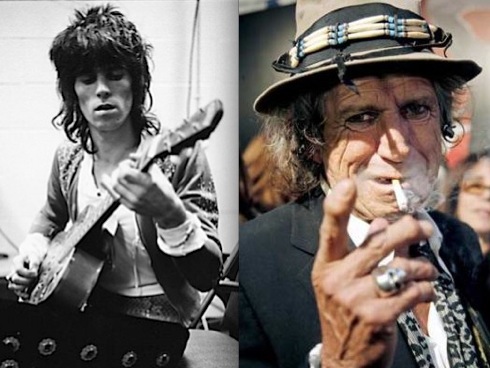
Boy into man: Keith Richards in 1969 and after 40 years of living the life (EPA). Note in particular the hat and read on...

❚ BY THE MID-60S THE ROLLING STONES had become global superstars, though demonised for the raw sexuality of their songs and performance style. Guitarist Keith Richards is the man whose debauchery epitomises the ethos of sex-and-drugs-and-rock-and-roll, and on October 26 his “long-awaited” autobiog called Life is published by Weidenfeld & Nicolson. As if the UK’s tenth richest musician needed the cash — he is worth £175m in The Sunday Times Rich List — reports say he received an advance of £4.8m ($7.3m!!!) after a bidding war for the text, written with James Fox.

It amounts to a tawdry sequence of profane, drug-fuelled, low-life anecdotes from which nobody emerges with much integrity, like a bunch of amoral delinquents. Quite what excited The Times of London to devote three days-worth of space to this book is beyond comprehension. Under the headline Muddy Waters, Saturday’s main editorial in the paper actually damned the Richards yarn as “filthy” and “depraved”, while seeking to justify serialising massive chunks on the ground that “the music of the Rolling Stones has endured”, thanks to the band’s “sheer work ethic” !!! (Since they didn’t rise up to ridicule this lavish serialisation, we can only assume the entire staff of The Times has been zombified under Plan 9 from Outer Space.)

Almost the whole front page of The tabloid Times trailed the Richards extracts with the stark headline “Sex, drugs and me”. Highest common denominators, evidently, for Her Majesty’s newspaper of record. And a spectacular nadir for dignity in the Thunderer’s 225-year history.

As a time-saving service to discriminating readers of Shapersofthe80s, here are the juiciest bits, but be warned — do not raise your expectations above the navel. Ready with the sickbag, James!

In Friday’s interview with 66-year-old Richards, 35-year-old Caitlin Moran called the book a “total hoot” and through its sordid junkie haze introduced us to every mother’s idea of the son-in-law from hell. Right from chapter one, she said, he’d worn a hat made of drugs (“There was a flap at the side in which I’d stowed hash, Tuinals and coke”) and driven a car made of drugs (“I’d spent hours packing the side-panel with coke, grass, peyote and mescaline”).

Moran reports that Richards “gave up heroin in 1978, after his fifth bust, and he reveals today that he has finally given up cocaine, too — in 2006, after he fell from a tree in Fiji and had to have brain surgery:

❏ “Yeah, that was cocaine I had to give up for that,” he says, with a sigh. “You’re like: ‘I’ve got the message, oh Lord’.” He raps on the metal plate in his head. It makes a dull, thonking sound. “I’m just waiting for them to invent something more interesting, ha ha ha. I’m all ready to road-test it when they do.”

Throughout the Moran interview, he was of course smoking Marlboros and drinking vodka. His idea of totally clean, presumably.

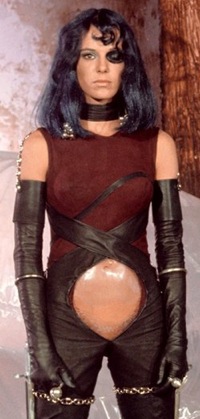
Anita Pallenberg ,Barbarella

Anita Pallenberg in the Roger Vadim film Barbarella, 1968

In Saturday’s Times serialisation of Life, Richards recalls the Stones’s founding guitarist Brian Jones, who originally proposed the band’s name in 1962 and was to drown needlessly at the age of 27 in circumstances that remain unclear. He was neurotic, suffered from deteriorating health, he pushed friendships to the limit and treated women despicably. In Marrakesh in 1967 he and his girlfriend Anita Pallenberg had reached the end of their tethers. Richards writes:

❏ “They’d beaten the shit out of each other. And of course Brian starts trying to take Anita on for 15 rounds… Once again he breaks two ribs and a finger… Then Brian dragged two tattooed whores down the hotel corridor and into the room, trying to force Anita into a scene, humiliating her in front of them. He flung food at her. At that point Anita ran into my room… She was in tears. She didn’t want to leave but she realised that I was right when I said that Brian would probably try to kill her.”

Having “stolen” Anita Pallenberg from Jones to become Richards’s common-law wife, back in the 1970s some reciprocal bed-hopping took place between Richards and Mick Jagger’s girl Marianne Faithfull, and between Anita and Mick. This was when Richard learned his best friend was a disappointment in the sack, giving rise to his verdict on the over-rated Jagger jewels:

❏ “[Anita] had no fun with his tiny todger. I know he’s got an enormous pair of balls, but it doesn’t quite fill the gap, does it?”

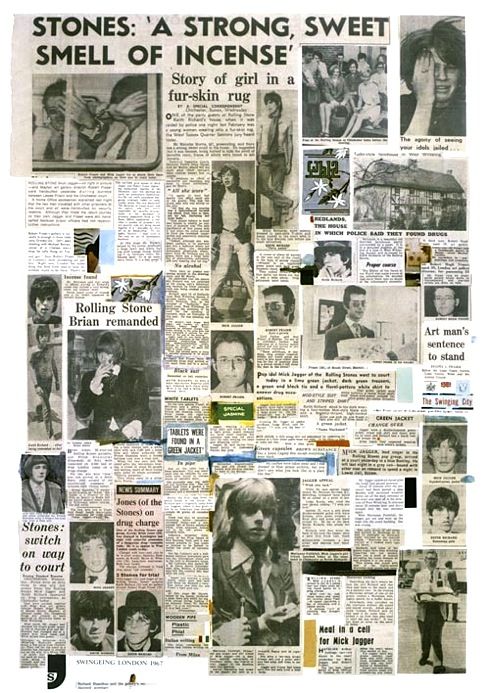
Swingeing London 67 — Poster 1967-8: One of pop artist Richard Hamilton’s protest pictures in his Swingeing London series, commenting on the severe judgment passed on his friend, gallery owner Robert Fraser, and popstar Mick Jagger, for possession of drugs. (Photolithograph © Richard Hamilton published by ED912, in Tate collection)

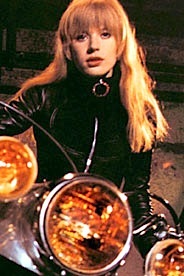
Marianne Faithfull, Girl on a Motorcycle

Marianne Faithfull in the British film Girl on a Motorcycle, 1968

Life describes in detail the fabled 1967 drug bust at the Richards Sussex house, Redlands [reported in the collage above], which became a totemic cause célèbre when William Rees-Mogg — the down-with-the-kids editor of The Times — took on the crusty old establishment by denouncing the harsh jail sentences which followed. Richards writes that the raid was “a collusion between the News of the World and the cops, but the shocking extent of the stitch-up, which reached to the judiciary, didn’t become apparent until the case came to court”. He also sets the record straight on the role of a legendary Mars bar:

❏ “[Marianne Faithfull] had taken a bath upstairs, and I had this huge fur rug, and she just wrapped herself up in that. How the Mars bar got into the story I don’t know. There was one on the table — there were a couple, because on acid you get sugar lack and you’re munching away. And so she’s stuck for ever with the story of where the police found that Mars bar. And you have to say she wears it well.”
Etc etc etc etc

➢ “The Mars bar was a very effective piece of demonizing” — Marianne Faithfull in her own autobiography. More pictures and background at Another Nickel In The Machine

➢ Who was the Redlands informer? — All about the police drugs raid on Keith Richard’s home on Feb 12, 1967 at the History of Rock Music

Michele Breton ,Mick Jagger, Performance, films

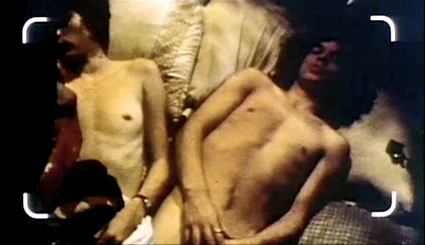
“The most sexually charged film ever”: the androgynous Michele Breton and Mick Jagger in Performance, 1970

➢ Judge the Jagger todger for yourself at Another Nickel: Anita’s footage of Mick’s meat and two veg filmed during the making of Performance at 81 Powis Square in 1968

➢ Rolling Stone magazine has more Richards book excerpts plus slideshow on October 28, 2010

Keith Richards, David Courts , Bill Hackett, skull ring,

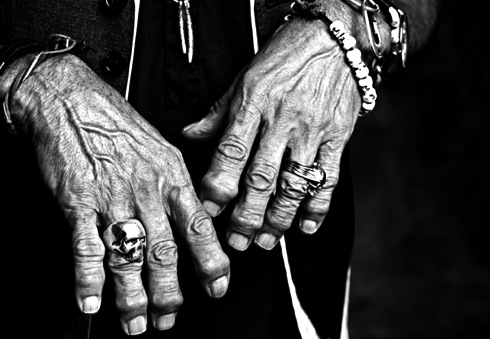
The guitarist’s hands in 2010, photographed © by Mario Sorrenti: the original skull ring that has become a rock-and-roll icon was given to Richards by London goldsmiths David Courts and Bill Hackett as a birthday present in 1978

FRONT PAGE

2010 ➤ Kylie dazzles London with laser-love

➢➢ VIEW ♫ ♫ Get Outta My Way! – Ropey iPhone video of Kylie’s next single live at Heaven this morning, but a visual feast, jam-packed with energy:

❚ AN EYE-POPPINGLY CREATIVE LASER SHOW capturing every colour of the rainbow was hurled towards a bouncing audience of Londoners in the early hours of this morning at Heaven. A euphoric Kylie Minogue was making a surprise 40-minute PA in the sweltering heat of high summer. This week she launched her 11th studio album in the UK, the dance-driven Aphrodite which marks her return to joyous pure-pop, and moves her on from the tragic events of adult life she calls her “dark period”.

Kylie Minogue, Heaven,London,live,All The Lovers

All The Lovers, live today: photograph © Christie Goodwin

According to host Jeremy Joseph, Aphrodite had gone straight to No 1 in the album chart – her fifth No 1 album – and he produced a multi-candled cake by way of congratulations. He also reminded us all that this was Kylie’s tenth appearance at London’s G-A-Y venue since its predecessor Bang! became the mainstream gay mega-clubnight that virtually launched Kylie’s British pop career in 1988. Since then the Australian-born singer has become the most successful female artist in the UK charts and the second richest British popstar from the 1980s.

Onstage from 1.35 this morning she performed six numbers in a clingy-and-swishy shredded gold Cinderella dress plus golden knuckle-duster, then three encores in a bewitching mirrored black top with thigh-high Puss-in-boots, climaxing with her erotic new single All The Lovers elegantly framed by five of her beefcake dancers and as many more females. Heaven had, perhaps foolishly, handed out whistles to everybody in the audience, so whether you could hear Kylie’s vocals above the non-stop barrage became slightly theoretical – a fact she accepted by just letting the audience get on with the verses as well as choruses to almost every number.

When asked in a recent interview with Popjustice if Aphrodite would make a good farewell album, 42-year-old Kylie responded: “I think so. It’s joyful. It’s like the jus of all the best bits of my musical career.” We also discover exactly what “a Kylie moment” is.

Kylie Minigue, Heaven, London ,Aphrodite, interview

Kylie’s own tweeted pix: backstage at G-A-Y with her female dancers, and with the monster teddy presented by Jeremy Joseph to mark her becoming an auntie for the third time

➢➢ VIEW ♫ ♫ Delectable rendering of All The Lovers – Kylie Minogue on the Jonathan Ross show, June 25, 2010 (spot Dawn Joseph and David Tench in support) – Oops, this has been removed from YouTube. Instead here’s her UK TV performance one month later with Alan Carr:

FRONT PAGE

2010 ➤ Manc agog at Gaga’s Monster Ball tour

Gary Ryan’s eyes were out on stalks last night for Lady Gaga’s concert in Manchester’s MEN Arena – here’s a taste of his review for City Life

Lady Gaga, Monster Ball, tour,

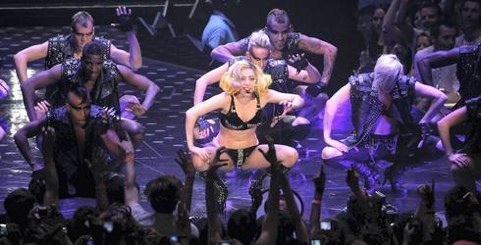
Gaga on tour with her merry men: Has she just killed Madonna?

❚ THOSE WHO MIGHT DOUBT THE LIBERATING FORCE for good Lady Gaga represents need have only glanced around the audience of her Monster Ball tour. Everywhere you look, there are women with their faces painted in the singer’s lightning flash make-up, and men wearing so much kohl, they resemble the Hamburgler.

At its core, the concept of the show is that she’s a Pied Piper for the misfits and the freaks; and has created the show as a place where “you can be free”. It’s heartening when you remember that ten years ago, the same audience would have been watching S-Club…

“You know what I hate more than money?”, says the woman who is charging £70 per ticket. “The truth.” It shows: she works harder to maintain a smoke-and-full-length-mirrors aura than any other act around. And, with an ambition and confidence that suggests she’s just killed Madonna and is wearing her skin as a tribal pelt, this night proves she’s the first true pop icon of the 21st century.

➢➢ READ Gary Ryan’s full review for City Life

FRONT PAGE

1980 ➤ 2010, the stage magic that inspires Romantics ancient and Neo

An exceptional cabaret performer called Taylor Mac
hit London this week in 2010. He subverted not only
theatrical conventions but several classic Bowie songs
to glorious effect. His shimmering presence sent out
echoes of how we defined itzy-Blitzy when 1980 dawned…
Billy’s club,Helen Robinson, nightlife, London ,Steve Strange, PX

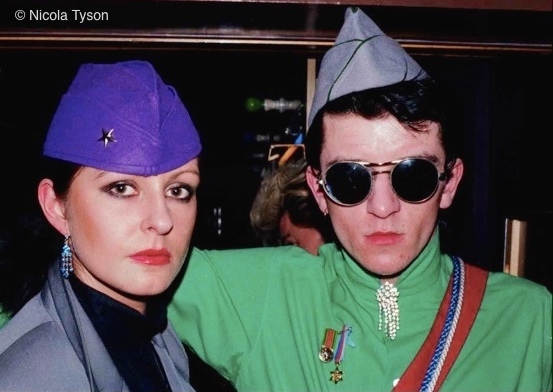
Billy’s club 1978: Strange as Ruritanian Space Cadet alongside PX designer Helen Robinson. (Photograph by © Nicola Tyson)

❚ LET’S RECALL WHAT MADE THE BLITZ KIDS unique in 1980. Singer Andy Polaris said soon after: “Anyone who thought it was all a pantomime got the wrong end of the Pan Stik. Blitz people had to be larger than life. It was a compulsion. If it doesn’t possess you, you can’t acquire it.”

An evening within the orbit of London’s Blitz club superstars – and we’re talking about 50 people here – was more than entertaining. You were zapped with a very tangible electric shock – what we’d call today “sensory overload” – as if these exquisite, compulsive posers had revitalised Gilbert & George’s notion from 1969 of processing through the world as living sculptures. The Blitz Kids generated their own crackling versions of hyper-reality that defined the space around them. They included Kim, Julia, Judi, Melissa, Fiona, Jayne, Theresa, Myra, Scarlett, Clare, Michele, Darla, Sade, Kate, Stevie, Naomi, Mandy, Helen, Jo, Perri, Christine and Franceska . . . the Stephens Linard and Jones, Lee, John, Cerith, Simon, Iain, Andy, George, Marilyn, Wilf, Greg, Jeffrey, Christos, Graham, Neil, Dencil, Robert, the Holah brothers, the Richards Ostell and Sharah. A fair few other Blitz Kids, like Strange, Egan, Elms, Sullivan, Dagger, Haines, Ure, O’Donnell, Mole, Ball and Lewis, had the motormouth skills of energetic talkers and schemers who were, as we say today, “good in the room”. Above all, the best among them “made things happen” wherever they set foot. That’s why spending time with them was the best kind of fun – stimulating, argumentative and constructive, whether idling at a bar or bounding around the beach on Bournemouth bank holidays.

Kim Bowen, Stephen Linard, Blitz Kids, London

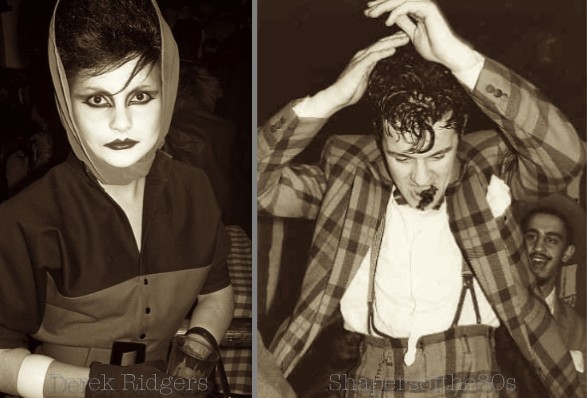
Doyennes among the Blitz Kids, 1980: Kim Bowen and Stephen Linard stamp themselves on that week’s zombie leitmotif. Photographed © by Derek Ridgers

Even so, what marked out the fashionistas especially was that, not only in the club, but in shop, café and bus, the style stars were constantly emitting auras of the force you imagined once surrounded Dietrich or Garland or Bogart or Caine. There’s nothing accidental about style. It is by definition a considered stance. In the presence of the Blitz superstars you could hold up your hands and almost feel the crumpet-toasting tingle. Even jaded Londoners turned their heads when Kim walked the half mile from Warren Street to St Martin’s school of art swathed only in surgical bandages. Or when George paraded past Buckingham Palace as a helmeted and toga’d Britannia at the annual royal ceremony of trooping the colour.
Princess Julia, Chris Sullivan, deejays, Vintage 2011,Southbank Centre, clubbing

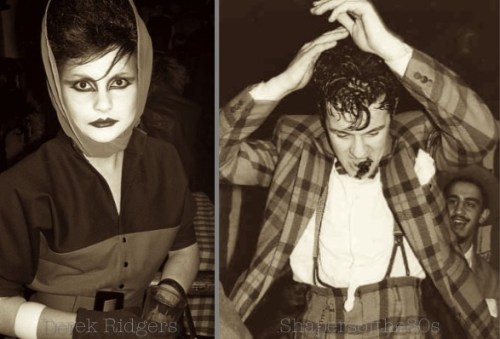
Vintage deejays: original Blitz Kids such as Princess Julia and Chris Sullivan have continued spinning the vinyl that recreated legendary 80s club soundtracks from the Blitz to the Wag

Wherever there was a party, premiere, exhibition or club opening you’d see a dozen more such creatures who lived hyper-reality 24 hours a day… Lee perhaps as Nosferatu, Julia as Bride of Frankenstein, Fiona saying “Non!” to couture by wearing a grosgrain coat back-to-front, Sullivan as 1920s cad, blue-lipped Linard as 1920s flapper, Marilyn as, well, Monroe, Stewart as geisha boy, Theresa as Little Bo Peep, a part she played at work in the Fleet Street offices where our paths often crossed.

Aplomb came naturally to Kim Bowen as the queen of the Blitz Kids. One night when some friends came back to mine after celebrating my birthday, Kim walked into the kitchen and said: “I’m not going to let you live with this wallpaper one more day.” She picked at the edge of a stiff vinyl-coated strip, printed with very 1960s pepperpots and pans. Then she ripped it off the wall in one heave. The kitchen walls were bare within 20 minutes. Kim declared: “Minimalism, David, that’s you need.”
Clare Thom, Michele Clapton, Blitz Kids

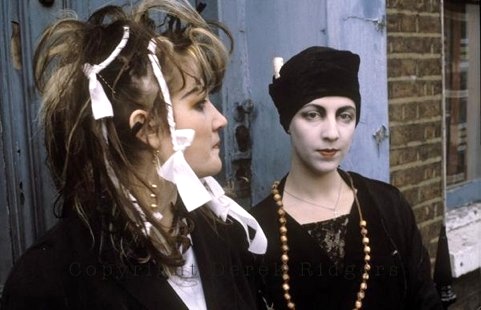
Blitz Kid style: Outside the Carburton Street squat, Clare-with-the-Hair and Michele Clapton displaying awesome repose. Photographed © by Derek Ridgers

As time would reveal, the lead Blitz Kids outflanked not only their peers, but most of the copyists who followed their Bowie-inspired passion for change. You’d find the second-league clubbers at Studio 21 in Oxford Street, or in a back barrel at Birmingham’s Rum Runner – those were the self-proclaimed New Romantics you see dancing in the YouTube videos, and being photographed wearing too much of everything, from Boots No 7 to lacy frills. A couple of years after the Blitz caravanserai had passed, designer Fiona Dealey said candidly: “You look at these little Bat-people with it dribbling down their necks and you feel like saying, ‘Sorry darling, not enough loose powder’. The difference was that our make-up was stage slap, Leichner not Factor. The clothes came from a costumier, Charles Fox, not Flip. Dressing for the Blitz was real theatre. It wasn’t just another uniform. You felt glamorous.”
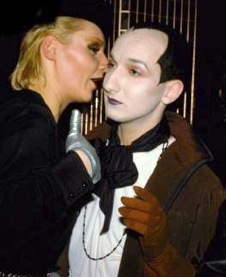
Stephen Jones, Blitz Kids

Immaculate: Hatter Stephen Jones

Aha, real theatre! This is the realm Shakespeare championed as “an improbable fiction” and John Updike blasted as the “unreality of painted people”. A flesh-and-blood craft where the basic requirement is for a living audience to be watching living actors. The Blitz Kids fully understood what Shakespeare’s Player has to explain to Rosencrantz and Guildenstern in Tom Stoppard’s spoof version of Hamlet: “We’re actors. We’re the opposite of people.” Actors pledge themselves to the belief that somebody will be watching. Nothing to do with vanity. Entirely a means of confirming their identity. Ditto the Blitz Kids.

The digital natives (and the self-styled Neo Romantics) of Generation Z who today are being raised on computer shoot-em-ups and quaking cinema enjoy precious little exposure to live theatre, to the “magic” that emanates from the contract eagerly agreed between actor and audience – for the one to perform at the same time as the other watches. Only when, as one towering example, Sir Michael Gambon allows a Pinteresque pause to elapse onstage can auras crackle “in the moment” with sufficient intensity to be felt physically, and thrillingly, by a theatre audience. Gambon’s aura crackled like a fire god’s last Christmas in No Man’s Land, before a wrapt audience the day after its author Harold Pinter had died.
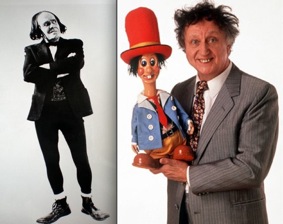
Max Wall, Ken Dodd

Masters of the comedian’s art: Max Wall and Ken Dodd

Comedy is where the theatrical contract of give-and-take fights for life most ostentatiously. As you laugh helplessly at the veteran comic Ken Dodd’s rapid-fire patter, you needn’t know that he has subjected his live stand-up routine to a lifelong time-and-motion study that concluded he must hurl eight gags per minute at his audiences to ensure everybody laughs at least once every minute he’s onstage.
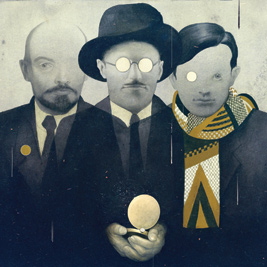
Travesties, Tom Stoppard, theatre

Travesties: what a coincidence that in 1917 the revolutionary Lenin, the novelist James Joyce and the Dadaist poet Tristan Tzara all happened to live in Zurich

In London in 1982 it was no less a pleasure to witness the top-of-the-bill variety legend Max Wall give wondrous live masterclasses entitled An Evening with Max Wall in which, aged 74, he laid bare how comedic timing works from one second to the next, how facial expression and vocal cadence, as well as silly walks can turn laughter instantly on and also off. Demonstrating with us as guinea-pigs how performer’s and viewer’s mutual responses keep each other on their toes.

The playwright Tom Stoppard has spent his career writing pyrotechnic scripts that read wittily enough sitting on the page, but are transformed several hundredfold the moment they are enacted on the stage, by for example exploiting the improbability of time-warps where the actors and the action are rewound and rerun in “unreal time” – actors reverse back through doors to leave the stage and re-enter immediately giving a subtly adjusted performance – as in Travesties, his hilarious comedy of coincidence. His plays are overtly “about” theatricality, yet shrouded by the mischievous apologia that, as one of his characters ultimately insists, “It’s a mystery”.

☐++++++☐++++++☐

GETTING BACK TO Taylor Mac,
his little bit of itzy-Blitzy glitz gives
shape to all of the above
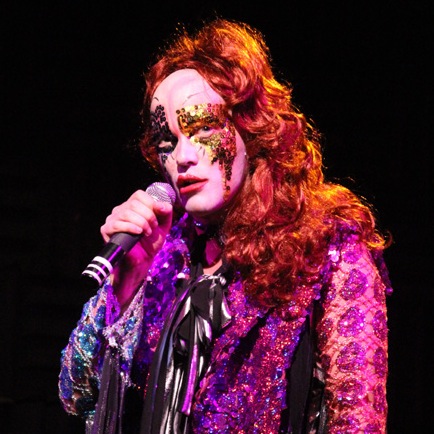
Taylor Mac, Glasgow, London, Bowie, Comparison is Violence,cabaret

Taylor Mac 2010: sequinned, painted and bewigged as Bowie-cum-Tiny Tim. Photographed © by Tim Hailand

SO WHERE MAY TODAY’S young Neo Romantic seek inspiration if he or she wishes to aim beyond the slap and the zhoosh to summon up solar-powered charisma of Blitz Kid proportions? The answer is in the UK right now (Soho Theatre London this week, The Arches in Glasgow next) and he is an incandescent and witty Californian called Taylor Mac.

TAYLOR MAC

Mac as himself

Clad in more sequins than a sultan’s harem could shake at you, he gives a full-throttle musical cabaret that is unexpectedly poignant, invigorating and original. You also laugh more than you ever did at Eddie Izzard’s last side-splitting tour. Mac’s audacious dissection of the essence of theatre, vaudeville and other performing arts evokes Merman and Garland, Wainwright and Brel while asserting his own unique brio. He reinvents pop classics by David Bowie and Tiny Tim (yes, you do remember his hits Tiptoe Through the Tulips and I’ve Never Seen a Straight Banana) by delivering them with an earnestness that moistens the tear-ducts. The evening’s ironic sub-title is The Ziggy Stardust Meets Tiny Tim Songbook, because these are the comparisons reviewers draw about Mac, yet they seldom remark on how he turns Starman and Heroes, those holy invocations of the 80s Bowie fan, into altogether heart-rendingly new songs.

His themes are love and longing and role-play and tolerance for what society calls a gender-bending misfit who sprang fully formed from the egg, craving the glue that fixes eyelashes. What results is the most stupendous spectacle, charged with insights as mere as how to signal the end of a song, one way being a sustained high note, another to deliver a wide-eyed “Cha-cha-cha!” through smiling teeth, but the coup de grace is a solemn downward arm gesture LIKE SO! For 90 minutes Mac fills the Soho Theatre many times over with a sustained rush of theatre magic. And yes of course he’s on YouTube, but that entirely defeats the point the past 1,700 words have been making.

➢➢ Read Donald Hutera’s London review of Mac
in The Times, June 3, 2010

➢➢ Read Charles Isherwood on Mac’s 2009 play
The Lily’s Revenge in the New York Times

FRONT PAGE