Tag Archives: Reviews

1980s ➤ So many shapers shaped the decade that people think was all down to Margaret Thatcher

A handful of key books this year have added to our estimations of that much demonised decade, the 1980s, and to our understanding of its cultural shifts. Shapersofthe80s has of course always drawn a distinction between the youthful creativity of the earlier Swinging 80s, and the ethos that finally took hold in Britain and earned the name of “Thatcherism”

Loadsamoney, Harry Enfield, Thatcherism1980s

Emblem of the 80s: Harry Enfield’s yob character, Loadsamoney. © Rex features

➢ Rejoice, Rejoice!: Britain in the 1980s,
by Alwyn W Turner (Aurum Press, 426 pages)

Alwyn Taylor, Rejoice!,1980s,book❏ A SHARP AND WITTY ANALYSIS of the 80s came this year from cultural historian, Alwyn Turner. Its savage title Rejoice! Rejoice! echoes the triumphal cry that burst from the lips of prime-minister-turned-warrior-queen Margaret Thatcher in 1982 when victory was declared over Argentina in the Falklands War (910 dead, 1,965 casualties). Reviewing the book in The Sunday Times, Dominic Sandbrook wrote: “One of the pleasures of Alwyn Turner’s breathless romp through the 1980s is that it overflows with unusual juxtapositions and surprising insights. Who knew, for example, that not only Alan McGee’s Creation Records but the bawdy magazine Viz were set up with money from Thatcher’s Enterprise Allowance Scheme, dismissed at the time as a feeble attempt to disguise the horrors of mass unemployment?

“Where this book really shines is on the intersections between politics and popular culture… For Turner, the defining characteristic of the 1980s was its obsession with size: big money, big hair, big issues, big politics. But what also emerges from his account is the sheer, unashamed nastiness of public life during the Thatcher years. This was a time, after all, when Thatcher’s cheerleader [disc-jockey] Kenny Everett publicly joked about kicking [the elderly opposition leader] ‘Michael Foot’s stick away’, while thousands chanted ‘Ditch the bitch’ at anti-government demonstrations.

“It is a refreshing surprise, however, to read a book on the 1980s in which Thatcher, while naturally dominant, does not entirely drive out all other voices. As Turner admits, the Iron Lady cast a larger shadow over national life than any other prime minister since Churchill: the style magazine i-D, a quintessential product of the decade, called her ‘almost a fact of nature’. But the results of her revolution were mixed at best, and the irony is that in many ways her policies had the opposite effect from what she hoped.”

Turner is not alone in presenting Harry Enfield’s comic character Loadsamoney as the emblematic figurehead for Thatcherism, a swaggering slob waving a fistful of banknotes while yelling, “Look at my wad!”. In the Financial Times Francis Wheen follows through: “Even if many Britons eventually accepted [Thatcher’s] economic remedies, Turner infers in his history of the 1980s, Rejoice! Rejoice!, ‘culturally the country was unconvinced’. Ideals of enterprise were all very well but winning at all costs, with no thought for the loser and no care for the way one played the game, ‘seemed somehow wrong’. The British still sided with heroic failures and doomed underdogs such as the hopeless ski-jumper Eddie (the Eagle) Edwards.”

30-UP FOR A CLUBBING TREASURE

➢ Gaz’s Rockin’ Blues: The First 30 Years,
by Gaz Mayall (direct from Trolley, 280pp)

Gaz Mayall, Jarvis Cocker, Radio 2,

Gaz Mayall on 6Music: celebrating his 30th clubbing anniversary talking with Jarvis Cocker on The Sunday Service in October. © BBC

❏ GAZ MAYALL IS one of UK clubbing’s national treasures, and the paperback Gaz’s Rockin’ Blues is a nostalgic first-person collection of great club photos and comic-strip flyers that tell their own tale of London’s oldest continuous club-night, where Tracey Emin was once the cloakroom girl. The lad in the hat, who has kept his tiny nightspot jumping since July 3, 1980, supplies a brief but breathless string of anecdotes about live guests such as Prince Buster, Desmond Dekker and Joe Strummer. Gaz was one of the pathfinders who perfected the then brilliant notion of throwing a party every Thursday and playing his favourite rebel dance-tunes. As the 22-year-old Gaz told Shapersofthe80s that year: “People come here for good music”, which essentially meant his own heritage as a kid raised amid rock royalty and steeped in ska, reggae, rockabilly, rock and R’n’B.
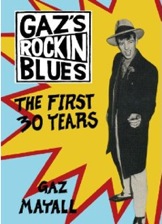
Gaz's Rockin Blues, book, 1980sOn his club’s 30th anniversary, Kate Hutchinson wrote in Time Out: “It’s still going strong: you’ll find throngs of people swinging to guest live bands and DJs every Thursday night at the Soho basement dive St Moritz. It’s also the kind of hangout that keeps new generations coming, so the crowd always stays fresh. Those who aren’t old enough to go yet can mingle with everyone else at Gaz’s sound-system at Notting Hill Carnival, where he’s been causing a roadblock since 1982, or at his stage at Glastonbury, which he has run for the past three years.”

SHUFFLING BETWEEN STRAVINSKY AND ARMSTRONG

➢ The Music Instinct : How Music Works and Why We Can’t Do Without It, by Philip Ball (Bodley Head, 464pp)
➢ Listen to This, by Alex Ross (Fourth Estate, 400pp)
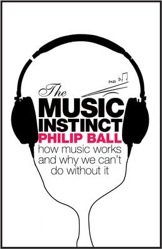
The Music Instinct, Philip Ball, books❏ TWO IMPRESSIVE BOOKS THIS YEAR have dissected how music works its magic. They are not posited on the 80s at all, though they may well be emergent phenomena of our era of musical diversity. Critics heaped praise on Philip Ball’s The Music Instinct, an engaging survey by a popular science writer. Bee Wilson in The Sunday Times called it a “wonderful account of why music matters, why it wrenches our souls and satisfies our minds and sometimes drives us crazy”. In The Guardian Steven Poole praised Ball’s “deft analyses of the limitations of attributing ‘emotion’ to music, or considering it as a ‘language’ (Lévi-Strauss: if music is a language, it is an ‘untranslatable’ one)”. And the Amazon reviewer Steve Mansfield liked the author’s scope “by drawing his examples from across the spectrum of music, equally comfortable discussing and occasionally comparing music as diverse as J.S. Bach, John Coltrane, Eliza Carthy, gamelan orchestras, ragas, Schoenberg, and the Sex Pistols”.
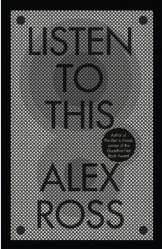
Alex Ross, Listen to This, books❏ IN 2008 ALEX ROSS, music critic for The New Yorker, landed an unlikely bestseller with his gripping survey of 20th-century music, The Rest is Noise, plus a torrent of highbrow praise. This year he packages some choice essays under the title Listen To This, which David Smyth in the London Evening Standard said “ranges even more widely, making century-spanning, triple-jumping connections in the same way his shuffling iPod leaps from Stravinsky to Louis Armstrong. Coming from a background of listening to nothing but classical music in his teens and discovering rock’n’roll in adulthood, Ross can explain the brute appeal of, say, Radiohead’s Creep in a way that makes you feel your mind enlarging as you read”.

TWO WHO CHANGED THE CHARTS

➢ I Know This Much: From Soho to Spandau,
by Gary Kemp (Fourth Estate, 320pp)

➢ If I Was, by Midge Ure with Robin Eggar
(Virgin Books, 288pp)
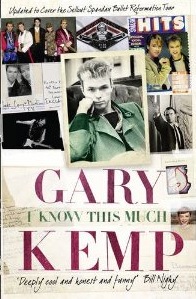
Gary Kemp, I Know This Much❏ FOR A MUSICIAN, the music really tells the life story. It’s rare for many of them to try to flesh out the story in prose, let alone as autobiography. Two who starred centre stage in 1980 were Ultravox’s Midge Ure and Spandau Ballet’s Gary Kemp, and though their accounts of the early transformative years of the decade weren’t actually first published this year, their paperback reprints continue to act as intelligent correctives to the hyperbole that accompanies some of the 30th-anniversary air-punching.

Songwriter Gary Kemp surprised many when last year’s autobiography, I Know This Much, proved so eloquent, encouraging rock writer Paul Du Noyer
to claim that it “sets a new standard for rock memoirs”. One of Amazon’s top reviewers, Mr Steve Jansen, believed that Kemp’s perceptive memories of a London now transformed make a “a touching testament to spiritual growth”. He wrote: “Kemp is able to reflect with great poignancy on a young man’s journey into, and through the shining city of dreams. In Kemp’s case that city, metaphorically, but more often literally — and literary in its evocation — is unmistakably London, and the metropolis is ever present like a ghost, framing his actions and attitude.”

The prominent journalist Robert Sandall of The Sunday Times, who died in July, had made Kemp’s his book of the year: “A sharply observed account by a quintessential London musician. Kemp exudes confidence, candour and a keen appreciation of the capital’s club culture.” This year’s paperback edition brought the story up to date with a postscript on his band’s reunion.
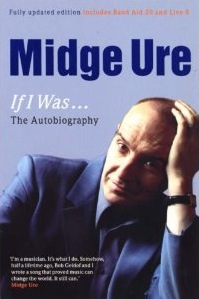
Midge Ure, If I Was❏ MIDGE URE IS THE OTHER eye-witness to the birth of Blitz culture, and his memoir, If I Was, hasn’t been out of print since published in 2004, and a revised edition is slated for next summer. Here, the musician tells with exceptional vigour a no-holds-barred story of his own journey from impoverished Glasgow childhood to new-wave superstar .

Amazon reviewer Lisby writes: “Ure writes fluidly and conversationally, imparting the kind of tactile detail that takes readers to the place and time of which he speaks. Ure is astonishingly honest, yet never vindictive. He is, in his prose, much as he is in his lyrics, a good person trying to be a better one while hoping the same for us all.” Another Amazon regular called thedouses adds: “Midge’s autobiography is a very well written, frank and honest book, which offers a fascinating insight into his own career and life but also other notable musical figures of the 80s and 90s music scenes in Britain, as well as providing background to the Band Aid and Live Aid events. He doesn’t use the opportunity to settle scores as so many of his contemporaries have done.”

Apart from being a busy wizard stirring the magic cauldron from which emerged many musical innovations in the 80s, Ure here establishes his central role in the production of Band Aid’s charity single, Do They Know It’s Christmas?, which led to Live Aid, the globally televised rock concert in 1985 which raised millions for famine relief.

NOT FORGETTING…

David Bowie, 1975 ➢ Any Day Now: David Bowie The London Years (1947-1974), by Kevin Cann (Adelita, 336 pages) was reviewed here on Dec 11. “Being a Bowie fan for almost 40 years I am flabbergasted. Many, many never before seen pictures” — Amazon reviewer Peter Gooren

FRONT PAGE

2010 ➤ A feast of Bowie-ana served in waffeur-thin slices

David Bowie, review,Curious magazine, Any Day Now,Brian Ward,Arnold Corns,Man Who Sold The World,Mr Fish,Freddi Burretti, Ziggy Stardust,Yours or Mine,Malcolm Thomson

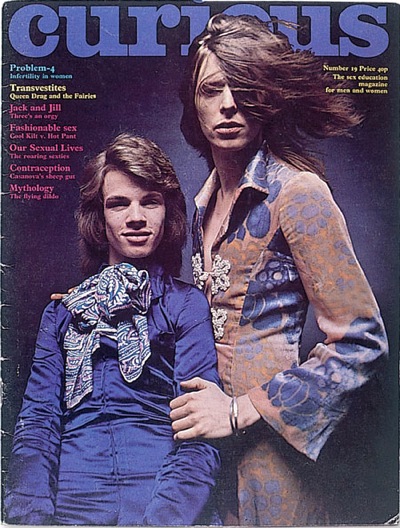
Candid cover for Curious magazine from 1971: Bowie spotted the dress designer Fred Burrett (aka Rudi Valentino) at the Kensington disco Yours or Mine wearing white spandex hot pants. He became a close friend Bowie determined would be “the next Mick Jagger” in a specially created band called The Arnold Corns. In the event, as Freddi Burretti he made Ziggy Stardust’s outfits from the first quilted jumpsuit onward… Bowie here drags up in the Mr Fish “man-dress” that appears on the sleeve for The Man Who Sold The World — one of many mementoes in Any Day Now, Kevin Cann’s new book about Bowie. Photographed © by Brian Ward

❚ DAVID BOWIE HAS BEEN THE SINGLE MOST INFLUENTIAL FORCE IN POPULAR MUSIC SINCE [Fill in the benchmark of your choice, eg:] Mozart/ Schubert/ Marie Lloyd/ Gershwin/ Little Richard/ Sondheim/ Spinal Tap. In which case, this Christmas there can be no better present for anybody with the slightest interest in the godlike creator of Ziggy Stardust than Kevin Cann’s new photobook Any Day Now, The London Years 1947-1974 (Adelita, £25).

It is impossible adequately to acknowledge the trainspotterish, yet deeply rewarding scope of this sheer labour of love that has amassed 850 pictures — friends, lovers, costumes, contracts, doodles, laundry bills, performances, candid snaps — on 336 pages. Why, it even has a backstage photo I’ve never seen of the day I met Bowie at the London Palladium when he sang Space Oddity for charity (and met the cult ukulele player Tiny Tim, going on to record one of his B-sides, Fill Your Heart, on Hunky Dory).

This book is a feast of Bowie-ana served up like La Grande Bouffe, in ever more tempting waffeur-thin slices. Cann is a veteran chronicler of the pop star’s work and here neither attempts a long-form biography, nor detracts from Nicholas Pegg’s much more musically appreciative survey, The Complete David Bowie, last updated in 2006. Any Day Now is more a chronology that feels as if it has an entry for every day in the star’s first three decades, running to 140,000 words (original interviews, press reports, eye-witness accounts), all diced and dispersed through the calendar. Contributions include a foreword by Kenneth Pitt, Bowie’s gifted manager 1967-1970.

Any Day Now, Kevin Cann, Adelita

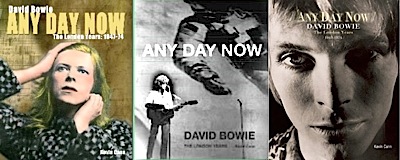
Early cover designs for Any Day Now, publicised during the past year. At centre, the Palladium performance of Space Oddity

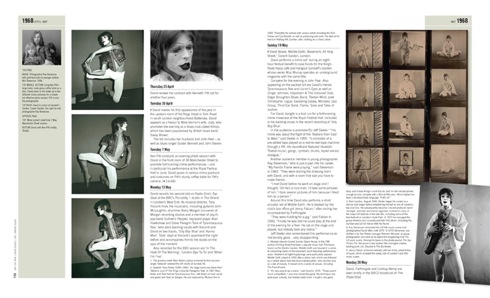
A typical spread [see below] might contain six images and as many short items, some of which are set in a font so small as to demand a magnifying glass for reading. An efficient index helps you to pick your topic and start panning for gold.

So for example, the “seminal” filmed version of Space Oddity, Bowie’s biggest hit, that has been exhumed then forgotten four times in the past 40 years, is finally accounted for in all its charmingly improvised glory. Since 2005, we have been able nonchalantly to click on YouTube to view this paradigm of all pop videos dating from before the word was invented. Yet originally it was a mere segment in a half-hour TV film about Bowie titled Love You Till Tuesday (LYTT) and directed by Malcolm Thomson.

While America was testing its first unmanned Apollo Lunar Module in 1968, the Space Oddity segment was of course inspired by that year’s visionary 70mm movie release, Stanley Kubrick’s 2001 A Space Odyssey. Cann’s chronology documents Thomson filming what Bowie evidently intended as a tongue-in-cheek spoof from its conception in Oct ’68 to wrap in Feb ’69. Bowie wrote the song itself, a forelorn meditation on love and fame, as his own love-life was falling apart and after viewing the Kubrick film “while stoned” (allegedly) that January, six months before the first Moon landing.

Ultimately in a studio in Greenwich, Bowie dons a barely-plausible zip-up silver space suit, blue visored helmet and Major Tom breast-plate while Samantha Bond and Suzanne Mercer as Barbarella-esque astro angels (more ’68 iconography), flaunting ludicrous blonde wigs and diaphanous gowns, simulate weightlessness among inflatable plastic furniture. It’s a modest little dig at Swinging 60s ephemera to set beside Barbarella, Blow-up and the incomparable Modesty Blaise.

Despite the single spending 14 weeks in the charts in 1969 and reaching No 5, Cann reports, TV networks showed “no interest” in the film, LYTT, containing this musical jewel, so it did not have its first public airing until 1972, on the BBC’s Old Grey Whistle Test. It then vanished until 1975 and the re-issue of Space Oddity when the clip was supplied as a promo to broadcasters, which doubtless helped the song’s progress to No 1 in the charts. Even then, the film clip did not receive a release until an album of same name, LYTT, came along in 1984. We then had an even longer wait until a DVD release in 2005 delivered the remastered version we enjoy today.

Not many people know this, 1 – In the same month, Feb 1969, Bowie auditioned for the hippy stage musical Hair! Twice! [Any Day Now, page 146]

Not many people know this, 2 – The book’s timeline ends in 1974 because Bowie left the UK on March 29 that year, aged 27, and has never resumed residency here since. Sob! Onboard the SS France bound for New York, the harmonica legend and Gershwin protege Larry Adler gives a recital. When the crew hear that Bowie is not going to do likewise while aboard and express their disappointment, Bowie gives them an impromptu performance in the canteen: 10 songs including Space Oddity. A few crew members took instruments and they played with him. What a jam session that must have been!

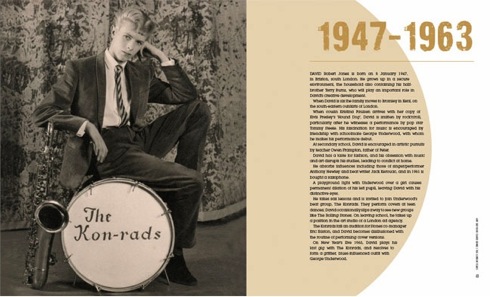
Any Day Now, Bowie, Kevin Cann,Kon-rads,Bowie

Spread from Any Day Now, the new book about Bowie’s formative years: here seen in his David Jones era when he formed his first band the Kon-rads at the age of 15

Melissa Alaverdy,Lindsay Kemp,Bowie , Any Day Now, Kevin Cann, Adelita

Another spread from Any Day Now, designed by Melissa Alaverdy: Bowie learning white-faced mime under Lindsay Kemp

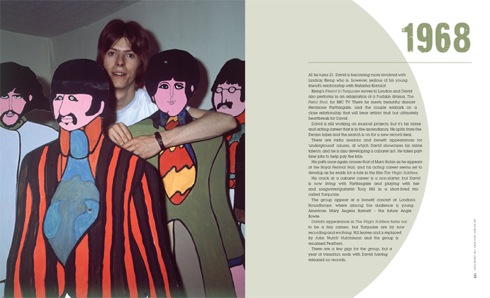
Melissa Alaverdy , Any Day Now, Kevin Cann, Adelita,Bowie,Beatles

Another spread from Any Day Now, designed by Melissa Alaverdy: Bowie is seen here with Yellow Submarine-era Beatles

➢ Why there will never be another David Bowie — Caspar Llewellyn-Smith says Lady Gaga has got it wrong if she thinks the Thin White Duke’s brilliance comes down merely to striking a decent pose (from The Observer, Oct 10, 2010)

➢ Review in the Guardian: Two Bowie biographies shed new light on the career of pop’s greatest chameleon, but the man himself remains elusive

FRONT PAGE

➤ Whatta they like? Essex reality stars shake their vajazzles in the face of Hollywood

The Only Way is Essex, vajazzle,reality TV, soap opera,ITV2,
❚ IN THE SPACE OF TWO MONTHS The Only Way Is Essex has become “totally must-watch TV”, an addiction and an education for anybody who does not live in Essex. The huge county lies along the north bank of the Thames estuary, stretching from the east of London to the coast, and socially it might as well be another nation. “I compare Essex to LA — we live the same lifestyle, we’ve got as much money and got the same tans,” says hunky reality-star and club promoter Mark Wright, 23.

“The boobs may be fake” say the opening titles but the cast of 20-somethings are “real people” thrust into to this enhanced reality show that is the jaw-dropping hit of the season. They’ve given the English language new buzzwords spoken in their unique variant on Estuary English: “jel”, “vajazzle”, “shu’ up”, and “whatta we like?” Get up to speed with YouTube’s clips ahead of series two, plus the fight-back from authentic East-End Londoners.

The Only Way is Essex,Amy Childs, ITV2

Spot the essential assets: beautician Amy Childs in The Only Way Is Essex © itv.com

The 10-episode series was filmed mainly in the towns of Brentwood where the The Sugar Hut bar is located, Gants Hill, Chigwell, Buckhurst Hill, and The Manor House nightclub in Woodford Bridge. It was shot only days before being broadcast, presumably so cast members had little chance to object to the odd scene where they might have felt like prize twerps. Unsurprisingly, ITV2 has received plenty of complaints for the show’s “negative representation of Essex”. Surprisingly, the first series was such minority cult viewing on ITV2 between Oct 10 and Nov 10 that its biggest single audience was only 1.2m viewers.

The Only Way Is Essex, Jessica Wright, Lydia Bright,Essexmas,nativity, New magazine

Essexmas: Jessica Wright and Lydia Bright in a nativity scene shot for © New! magazine

The tabloid press was unusually slow in conceding that the show made compelling viewing. Series two faces one mighty hurdle that may well stymie the innocent charm of the original format — key members of the cast are being snapped up by pushy big-hitting agents who will no doubt insist on contracts that guarantee more respec’ for the talent.

A Christmas special called The Only Way Is Essexmas to due air at 9pm on Christmas Eve.

❏ XMAS UPDATE — The paradox of such a calculated TV format is how quickly it backfires. The Christmas special was as joyless as the format is heartless. In the end, these non-professional, often tongue-tied actors are simply pushed from one pedestrian stunt to another daft costume party set-up, where they are humiliated on camera and in front of their friends as their relationships crumble and their social ineptitude is laid bare. The two or three fun boys and girls in the cast have been reduced to polyfilla between the slimebags whose mums and dads really ought to tell them what prats they are making of themselves. The pet “micro-pig” as Christmas present proved to be a cringemaking booby-trap, just like Arg’s party singalong, while the two-timing antics of lothario Mark and his female sidekicks were blatantly egged on by the TV professionals. The crude splicing to turn shots into scenes indicates how desperately short of plausible footage the producers are. The Essexmas special stank of shameless exploitation by all at Lime Pictures.

Sociological footnote

❏ ESSEX IS OF COURSE the county which has created almost every British subculture since World War 2, from Mods to Soulboys-and-girls to Vajazzlers ! Essex Man and Essex Girl are pejorative terms that have been colloquial currency for 30 years. Essex Man was rated as a serious political force in the 1979, 1983 and 1987 elections which put Margaret Thatcher in power and kept the Conservative Party there. The stereotypical Essex Girl can be heard before you see her coming, she wears white stiletto heels, peroxide blonde hair, an orange tan, and is famed for being free with her sexual favours. Essex Girl jokes reached mania levels in the 90s when the classic of its kind went like this. Q — What’s the difference between an Essex Girl and a supermarket trolley? A — A supermarket trolley has a mind of its own.

The Only Way Is Essex, Lola

Lola, the Essex girl group: Lauren, Jess, Amba & Linzi being groomed for pop success, though by the Christmas special Linzi had dropped out

➢ Tease trailer with best bits from The Only Way Is Essex remixed by Cassetteboy

➢ The Only Way Is Essex: Totally Vajazzled — Best of series one compilation is on the highly temperamental ITV player until Jan 6

➢ East London thumbs its nose at Essex

➢ Three new TOWIE video clips — view Mark, Arg, Kirk, Lauren Pope, Candy and Michael talking about Christmas

FRONT PAGE

1984 ➤ Band Aid, when pop made its noblest gesture but the 80s ceased to swing

Band Aid , Do They Know It’s Christmas?

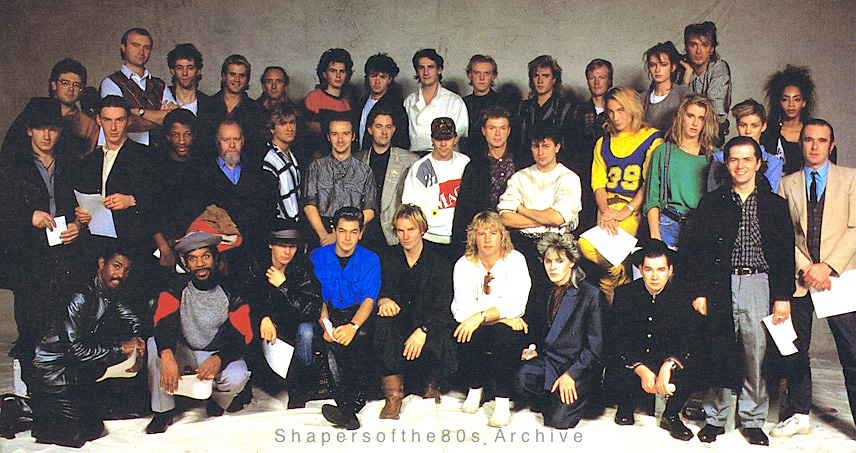
The Band Aid band, Nov 25, 1984: most of the pop stars who performed, plus artist Peter Blake who created the record sleeve for Do They Know It’s Christmas?

◼︎ TODAY WAS THE DAY IN 1984 THEY RECORDED the song that became, for 13 years, the biggest selling UK single of all time. Do They Know It’s Christmas was released four days later, stayed at No 1 for five weeks, sold over three million copies and raised significant funds for famine relief in Africa. The project lead naturally the next year to Live Aid, the biggest globally televised rock concerts ever, viewed by two billion people in 60 countries, who coughed up still more dollars. It is estimated that Live Aid raised £150m (about $283m). Last year a poll of 5,000 people, who were surveyed across Europe, named Live Aid as the most important music event of the past 30 years. The hit single sold for £1.35, of which 96 pence went to the fund. Rerecordings of the song charted again in 1985 and 1989.

The idea for Band Aid was proposed by one man, Bob Geldof, since granted an honorary knighthood but in 1984 a musician down on his luck, who enlisted the much more successful go-getter, Ultravox’s Midge Ure (who remains unknighted for no good reason), to bring the dream to fruition as its producer. They created a megagroup from 45 of the biggest hitters in British music, who included the supergroups dominating world charts at the time — Culture Club, Duran Duran, Spandau Ballet, Wham! — plus AOR giants Sting, Genesis and U2, plus Kool and the Gang from the States. In a sea of mullets and bleached highlights, rival musicians united under the name Band Aid in a daring act of charity that was unprecedented in the competitive commercial arena.

Band Aid,Bob Geldof ,Midge Ure,SARM

Leaders of the Band Aid pack in 1984: Bob Geldof and Midge Ure outside SARM Studios in London. © Pictorial Press

The enterprise marked the end of an era, as this website documents. The Band Aid collaboration signalled the final chapter of the innovation which Shapersofthe80s believes defined the Swinging 80s as six dynamic years of subcultural initiative between 1978 and 1984. Britain’s visual kaleidoscope of cults was exactly what fed MTV from its launch in 1982 and loosened the stranglehold that music radio had previously enjoyed in the USA. The unlikely Band Aid scrum of Britain’s rival image bands who had risen on the same new wave  substantially defined a new show-business elite who had come to epitomise mainstream tastes.

 Michael Buerk , Ethiopia

Michael Buerk in his BBC report from Ethiopia

Nobody can doubt the uniqueness of the pop fraternity’s gasp of altruism through Band Aid. Geldof had been genuinely distressed by the now landmark teatime TV report broadcast on October 23, 1984, by Michael Buerk, a popular BBC journalist. It still makes for grim viewing. In Ethiopia 7m people were threatened by famine, and 40,000 refugees had converged on the town of Korem in the hope of finding food and medical aid.

The film footage shocked the world and Buerk’s opening words still resonate today: “Dawn, and as the sun breaks through the piercing chill of night on the plain outside Korem, it lights up a Biblical famine, now, in the 20th century. This place, say workers here, is the closest thing to hell on earth…”

CONTRARY VERDICTS ON BAND AID

Morrissey, 1985 — “I’m not afraid to say that I think Band Aid was diabolical. Or to say that I think Bob Geldof is a nauseating character. Many people find that very unsettling, but I’ll say it as loud as anyone wants me to. In the first instance the record itself was absolutely tuneless. One can have great concern for the people of Ethiopia, but it’s another thing to inflict daily torture on the people of England. It was an awful record considering the mass of talent involved. And it wasn’t done shyly, it was the most self-righteous platform ever in the history of popular music.”

The World Development Movement described the Band Aid lyrics in 2004 as “patronising, false and out of date” and regretted it did not “provide a more accurate reflection of Africa and its problems”.


❏ IN THEIR RESPECTIVE AUTOBIOGRAPHIES, Ultravox’s Midge Ure and Spandau Ballet’s Gary Kemp provide entertaining and detailed accounts of the Band Aid venture, spiced with the frankness that comes from hindsight . . .

➢ Ure and Kemp on the shenanigans
that led up to Band Aid

FRONT PAGE

➤ If Paradise Point aren’t the pop tip for 2011, you decide who is!


❚ HIT ACT, HOT VIDS SHOT BY YOURS TRULY. Here’s the first public sighting of livepop band of the moment Paradise Point, in concert on Friday at Steve Strange’s club-night in Soho. Those crazy Neo Romantics were larging it at The Face, along with a bunch of proud parents from the previous showbiz generation. These concert vids capture two of PP’s four debut singles, Run in Circles, and Tears, all tracks downloadable at their MySpace page. Aren’t the kids doing well!

➢ CLICK FOR THE FIRST FULL REVIEW
OF PARADISE POINT’S DEBUT

“…The singer swivels 90 degrees, one hand grips his thigh, his legs are a-tremble, his arms stretch to there measuring the extent of his despair, his entire body emotes its socks off. He’s intense, handsome and fit, as his gymnastics confirm. He is the vocal storm at the centre of a pool-table-sized stage at the club Punk in central London, and the energy beaming off it is fierce…”

“… PP’s music is the magnet and their lyrics are your reward. Wait till you get home and play the band’s downloads and pay attention to the words. They prick the teen heart and they pull at everyone’s. These lyrics share some of the emotional intelligence of Morrissey & Marr, who can reduce you to jelly in a phrase, yet PP avoid the confessional mode and so spare us the Mancunian melancholy.”

FRONT PAGE