Tag Archives: photography

1980 ➤ Ribald tales of excess as the kids from The Blitz took over West End clubbing

+++
❚ FRIDAY NIGHT WAS AN EXCUSE for the wags to tell their tall tales of clubbing in the 80s. This was the first reunion in recent memory of the bright sparks the media once called Blitz Kids and New Romantics. We’re talking about the straighter faction tonight — the make-up brigade had their day at Boy George’s 50th birthday party in June. All of them, whatever their persuasion, were diehard nightowls, the spiritual offspring of the mighty innovator who shaped the 1970s pop scene almost singlehandedly, David Bowie. He taught them to adopt stances: individualism, transgression. He bequeathed them principles for living amusing lives: disposable identities, looks not uniforms. In turn, they then shaped the sounds and styles of the Swinging 80s set in motion by 1976 and the birth of punk, along with a passion for black dance music, on through the decadent glamour of the Blitz Club years, to the watershed of Band Aid in 1984.

On Friday, photographer Graham Smith took over Soho’s newest rendezvous, the Society Club, for a gallery show of his 80s photographs, which capture the panache and derring-do of style leaders such as PX, Stephen Jones, Kim Bowen Melissa Caplan, Stephen Linard, Fiona Dealey, John Maybury and such nascent popstars as Spandau Ballet, Visage, Animal Nightlife, Sade, Blue Rondo à la Turk and others.

Our two videos capture the essence of Smith’s collaborators, Robert Elms and Chris Sullivan, powering through their often unprintable anecdotes, edited on video down to bite-sized chunks and garnished with Graham’s images. The highspot was meant to be Sullivan as guest speaker, but when he was reportedly “still on his way”, in stepped writer and broadcaster Elms to recall the early one-night clubs he also helped to run. He sounded genuinely shocked by the precociousness of his peers — “We were kids!” — who persuaded West End nightclubs to hand over door control to them as teenagers. Eventually, Sullivan  arrived in the guise of Vladimir Ilyich Lenin, and of course excelled at spinning his “ribald tale of excess” about the mayhem he helped cause in clubland, en route to running Soho’s Wag club for 19 years.

+++
The photos form a dossier creative endeavour, as we’ll soon see in We Can Be Heroes, a 320-page coffee-table book containing 500 mostly unseen images and 100 voxpop interviews by Graham Smith. Warts-and-all main text is penned by the mellifluous Welshman Sullivan, with other contributions from Robert Elms, Boy George, Steve Strange and Gary Kemp.
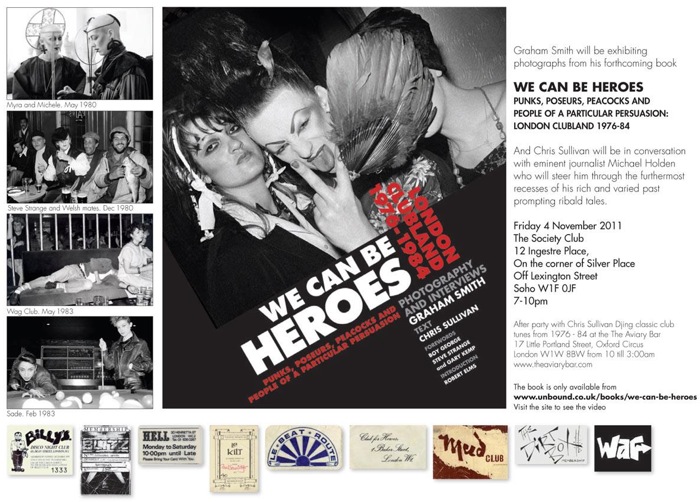
We Can Be Heroes, Graham Smith, Chris Sullivan, Robert Pereno, Society Club , Soho ,books,Unbound Publishing,photography, exhibition,afterparty, Aviary Bar, Robert Elms, Boy George, Gary Kemp ,Steve Strange, Blitz Kids,Wag club,

Smith & Sullivan’s invitation to a party

➢ Visit the publisher Unbound.co.uk to place your order for We Can Be Heroes and secure your name in the limited first edition. This month the authors aim to hit an advance sales target by this new “crowd-funding” technique in order to guarantee publication.

➢ Visit The Society Club, London W1F 0JF where Graham Smith’s photographs are on sale until Christmas. Subjects include Boy George, Sade, Steve Strange, Spandau Ballet, Iggy Pop, Siouxsie Sioux, the Sex Pistols and many more.

➢ Skimmable list of media coverage of We Can Be Heroes so far
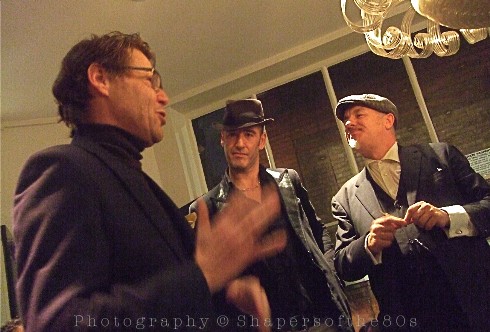
Making up the rules of 80s clubbing: Robert Elms, Phil Dirtbox and Chris Sullivan at Friday’s nostalgia fest. Photograph by Shapersofthe80s
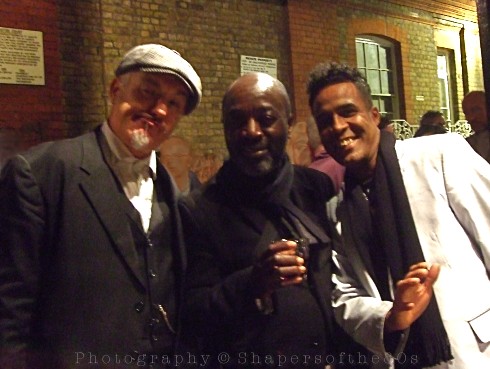
Fanatical about music: Chris Sullivan, Jo Hagan (remember 1983’s Gold Coast?) and Darrell Gayle at the Society Club. Photograph by Shapersofthe80s

FRONT PAGE

➤ Meet Smith & Sullivan, the wags behind the story of the heroic 80s

Wag telling tales: Sullivan in full flow at an earlier photography show by Smith, right. Photograph by Shapersofthe80s

Update Nov 22:

➢ Although the first edition of We Can be Heroes has sold out, a special cloth-bound edition is now on sale for £35, plus a Deluxe edition for £350, at the Unbound Publishing website

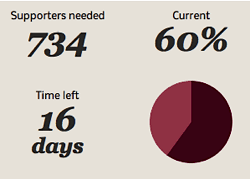
❚ HERE’S AN IRRESISTIBLE PARTY INVITATION. As their fund-raising barometer hits 60% of target, the authors of We Can Be Heroes, a ribald account of Britain in the 80s, announce another soirée
 to raise public awareness. Their nightlife peers changed the face of the UK club scene which created dozens of new bands, artists and designers. Born with the mutant party-animal gene, Graham Smith & Chris Sullivan are taking over Robert Pereno’s new Society Club in Soho for two reasons: to show off Graham’s stylish clubland photos, which will be selling there until Christmas; but chiefly to win over buyers who are dithering over investing £30 in their huge coffee-table book that is garnished with tall stories from Sullivan as well as 100 other club-world collaborators.

Come along next Friday to meet them over a drink and to hear the garrulous Welshman Sullivan “in conversation with eminent journalist Michael Holden” — in other words, talking hind legs off donkeys. Orders for the book can be placed only online at Unbound Publishing (where Graham has an explanatory video) so they won’t be prising your wallet open on the spot. Inevitably, a further high point of the evening will be a free-entry after-party where Sullivan will be deejaying classic club tunes from 1976-84 half a mile away at The Aviary Bar.

We Can Be Heroes, Graham Smith, Chris Sullivan, Unbound Publishing,photography,As of today there are only 16 days left to buy your prestige 
limited first-edition of We Can Be Heroes (there won’t be a second edition unless they reach 100% on the first) and you get your name printed in it. You’ll be within the same hard covers as starry contributors such as Robert Elms, Boy George, Gary Kemp and Steve Strange. The clock is ticking because of the new “crowd-sourcing” technique to raise funds. This is being pioneered in books by Unbound, a new offshoot of Faber, whose authors include Python Terry Jones, cultural taste-maker Jonathan Meades, and creator of TV’s This Life series, Amy Jenkins.

One of the reasons fund-raising has been a slow burn for S&S is that, uniquely on the Unbound list, We Can Be Heroes is the only photo-book, requiring quality paper and classy printing. Sullivan says: “Ours needed six times as many pledges as the other text-only titles.”

Smith says: “Dig out your espadrilles and book yourself a baby sitter now!”

➢ Exhibition and talk, Friday Nov 4 … 7–10pm at The Society Club, 12 Ingestre Place, W1F OJF … and afterwards 10–3am at The Aviary Bar, 17 Little Portland Street, W1W 
8BW … Graham Smith’s photos remain in exhibition and on sale here until Christmas

➢ Skimmable list of media coverage of We Can Be Heroes so far

We Can Be Heroes, Graham Smith, Chris Sullivan, Robert Pereno, Society Club , Soho ,books,Unbound Publishing,photography, exhibition,afterparty, Aviary Bar, Robert Elms, Boy George, Gary Kemp ,Steve Strange, Blitz Kids,Wag club,

Smith & Sullivan’s invitation to a party: click to enlarge

FRONT PAGE

2011 ➤ Pay now — so We Can Be Heroes goes ahead!

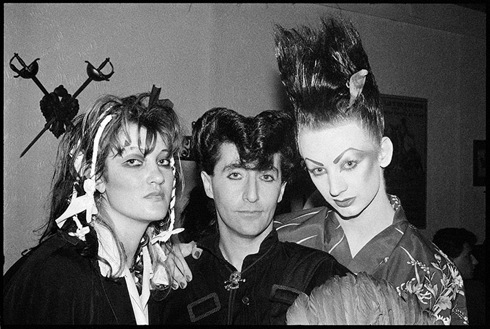
1980: Clare Thom, Philip Sallon and George O’Dowd on a coach trip to Margate. Photograph by Graham Smith/grsmith@mac.com.jpg from his book We Can Be Heroes

WE CAN BE HEROES
must be funded by November 12 17 [update]

❚ NOBODY IS BETTER QUALIFIED to chronicle the whirlwind six years between punk and the death of the New Romantics than Graham Smith through his eye-witness photography, and the writer Chris Sullivan, one of the core movers-and-shapers of his generation. UK music and style evolved out of all recognition in a mighty resurgence of youth subcultures that directly triggered a rejuvenation of mainstream media for the rest of the decade. Shapersofthe80s was on hand as an observer. But these two wags were in the thick of the action — major players in a spontaneous youthful collaboration to regenerate the UK’s ailing music and style scenes as 1980 dawned. With contributions by a galaxy of stars, who include Gary Kemp and Boy George, this will become the definitive story of one of the great explosions of creativity in British youth culture.

The authors aim to get their large-format 320-page coffee-table photobook We Can Be Heroes to you in time for Christmas. Their “crowd-funding” venture requires them to raise the cash first by asking YOU to buy your copy in advance, before 6pm GMT on November 12 17. Your reward is to see your name printed as a Supporter in the limited first edition. The clock is ticking.

View Graham’s video today at Unbound Publishing, a new company under the patronage of Faber, the most prestigious publisher in Britain. Here you can purchase your book and enjoy other perks such as an invitation to the launch party. Join the clubbers at Facebook who are submitting their own photos and tales of merriment.

➢ Twitter directly with the publisher, Unbound

READ WHAT HAS ALREADY BEEN SAID
ABOUT WE CAN BE HEROES

+++

➢ Unbound aims for 40 books in year one … Supported by Faber, the platform was created by QI writers John Mitchinson and John Pollard, and Crap Towns author Dan Kieran — The Bookseller

➢ Funded by the people — Channel 4 News video on “crowdfunding”, the process that decides when and how Graham’s book gets published

➢ Why creative clubbing ended with the 80s — the credentials that equipped Smithy, Sullivan and Elms (and a few other crazies) to start changing the world

➢ Boy George says the 70s were the best time ever to be a teenager — and Tweets that “it’s a brilliant book about the New Romantics! Really!” He has also written a foreword in We Can Be Heroes. (So have Gary Kemp, Steve Strange and Robert Elms)

➢ A slideshow of Graham’s Blitz-era gems at Guardian online

➢ Thirty years of punk and post-punk photo imagery — by Disneyrollergirl, one of The Times’ 40 bloggers who count

➢ Huffington Post: All about 1980s club kids — former Blitz Kid and Times fashion editor Iain R Webb writes about Bowie’s impact on the Blitz scene

➢ A legacy that has inspired each decade since the 80s — Princesss Julia, international deejay and fabulous Blitz Club coat-check girl, writes for i-D about stripping away the posers’ facade

➢ Update Nov 6: priceless storytelling about 80s mayhem with Elms and Sullivan on video

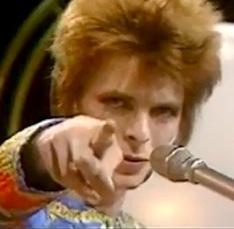
➢ Promo video for Blue Jean (1984) starring David Bowie as Screamin’ Lord Byron before a London clubland audience … Below is the alternate version of Blue Jean for MTV, starring Bowie and the Aliens, shot live before an audience in Soho’s Wag club, which was hosted for 19 years by Chris Sullivan

+++

FRONT PAGE

2011 ➤ Oo-er, Metamodernists say: Go forth and oscillate

Annunciations,installations, Luke Turner, photography,Metamodernism,manifesto, fine art

Annunciations (installation view), 2011 © by Luke Turner: The Annunciations series revolves around the experience of art, the visual realm, and the ghosts of art history

❚ YOU READ IT HERE FIRST. As the V&A’s exhibition on Postmodernism lays bare the cultural malaise of recent decades, a bright new dawn is announced  “with emphatic optimism (and a pragmatic romanticism)” by the publication of “The Metamodernist manifesto”…

  1. We recognise oscillation to be the natural order of the world.
  2. We must liberate ourselves from the inertia resulting from a century of modernist ideological naivety and the cynical insincerity of its antonymous bastard child.
  3. Movement shall henceforth be enabled by way of an oscillation between positions, with diametrically opposed ideas operating like the pulsating polarities of some colossal electric machine, propelling the world into action…

➢ Continue reading The Metamodernist manifesto

➢ Luke Turner’s Annunciations 2011 reviewed by Siobhan Wall — “Each photograph in Annunciations is named after a famous Renaissance painting, and it’s apparent that these largely abstract images are a carefully considered distillation of what lies beyond the figurative and literal in the well-known masterpieces…”

➢ Notes on metamodernism is the webzine that documents current developments in politics and aesthetics that can no longer be explained in terms of the postmodern, proposing instead “a sensibility that oscillates between modern positions and postmodern strategies; between construction and deconstruction (indeed, reconstruction); a desire for sens and a doubt about the sense of it all; between sincerity and irony; hope and melancholy”.

Peter Doig, Figure in Mountain Landscape, New Romanticism,Death of Painting,

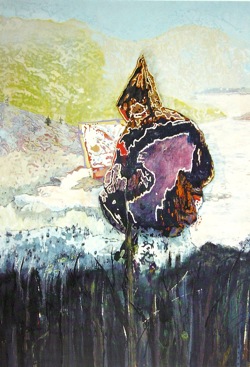
Peter Doig, Figure in Mountain Landscape, 1997-8

➢ The new New Romanticism — “the act of presenting the commonplace with significance, the ordinary with the mysterious, etc, and this undertaking’s inevitable and necessary failure… But why now? … To express a dissatisfaction about a present that is increasingly uninhabitable, and a desire for a future whose blueprint has yet to be drawn”.

➢ Peter Doig and the “Death of Painting”  — “His work explores a tension between the designs of humanity and the wild, natural world it has to reckon with… He seems to paint about painting, each canvas becomes an allegory of the strangely beautiful problems, inadequacies and imperfections of creative vision.”

❏ iPAD, TABLET & MOBILE USERS PLEASE NOTE — You may see only a tiny selection of items from this wide-ranging website about the 1980s, not chosen by the author. To access fuller background features and site index either click on “Standard view” or visit Shapersofthe80s.com on a desktop computer. ➢ Click here to visit a different random item every time you click

FRONT PAGE

2011 ➤ Leee Childers interviewed: risqué tales of Warhol, glitter and Iggy’s best feature

+++

❚ LAST NIGHT BRITISH PARTY PROMOTER Chris Sullivan sat in a new London gallery cafe to ask Leee Black Childers about his formative years leaving Kentucky for New York City and getting drawn into Andy Warhol’s Factory crowd of the late 60s and 70s. For more than an hour at The Society Club in Soho, Childers confessed all about his formative years when Warhol encouraged him to “say” he was a photographer, after which he snapped many informal early pix of David Bowie, Iggy Pop, Debbie Harry, Lou Reed, New York Dolls, Patti Smith, Jayne County. All the photographs on display are on sale for the next week.

Our two videos catch a few ribald moments verbatim. Other landmarks included Danny Fields and Andy Warhol taking him to see this “terrific new band”. Using the camera his brother had given him on his 17th birthday, Leee produced sensational pix of the young misfit Iggy Pop at the Stooges’ first New York concert. Leee lived for a year with Iggy. “You should know that he had a really great mind. He would talk about Schopenhauer and Nietzsche, and kept me awake talking about philosophy all night. He was also a very kind person and had one of the best penises I’ve seen.”

Lee attributes the birth of the glitter phenomenon in 1970 to Theatre of the Ridiculous director John Vaccaro’s production of Heaven Grand in Amber Orbit which was set in a circus, to which he brought “giant, huge barrels of glitter and he said, Put it everywhere, and everyone onstage was covered in glitter”.

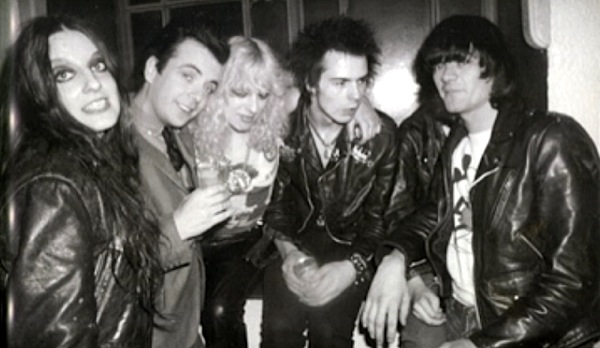
Linda Clark, Leee, Nancy Spungen, Sid Vicious, Dee Dee Ramone. (Photo by Danny Fields)

In 1971 Leee visited London when Andy Warhol’s ground-breaking show Pork took over the Roundhouse with nude scenes that revelled in the recent abolition of theatre censorship in the UK. During this trip he met David Bowie performing at the Country Cousins nightspot in Fulham: “I’d never heard of him but I went because they said he wore a dress, but he wasn’t wearing a dress. We also met Angie Bowie who was not wearing a dress either. That show was pretty lame.” Yet when Bowie later came to play in New York, Leee was asked to be the vice-president of his US company. He subsequently travelled with Bowie through Russia in 1973 and was tour manager for Johnny Thunders and The Heartbreakers when they supported the Sex Pistols on their 1976 Anarchy tour across the UK.

Leee hung out with the Sex Pistols in both London and New York. Asked from the floor “Who killed Nancy?”, Leee replied: “Nancy killed Nancy. She created the situation where it was impossible to go on” — referring to her fractious relationship with Sid Vicious. Though Vicious was charged with her murder in 1978, Leee says: “We all know it was not Sid.”

+++
➢ Last week’s report: Leee Childers brings his slice of 70s New York to London

+++
❏ iPAD, TABLET & MOBILE USERS PLEASE NOTE — You may see only a tiny selection of items from this wide-ranging website about the 1980s, not chosen by the author. To access fuller background features and site index either click on “Standard view” or visit Shapersofthe80s.com on a desktop computer. ➢ Click here to visit a different random item every time you click

FRONT PAGE