Tag Archives: exhibition

➤ Barcelona celebrates Adriá, magician of edible art, and a totally useless machine

exhibition,Barcelona, Ferran Adrià, El Bulli

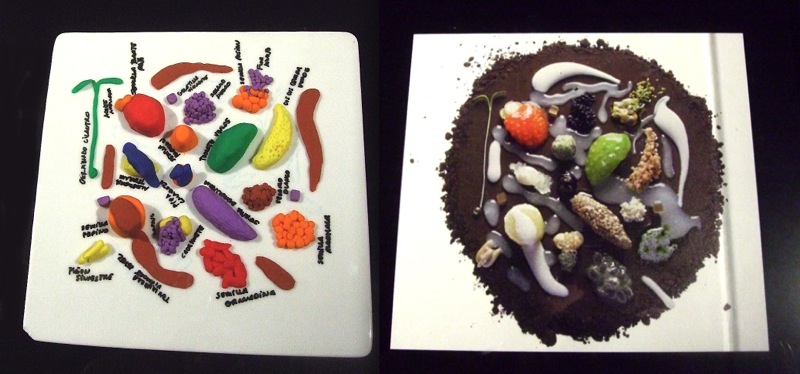
Before-and-after designs: left, coloured Plasticine model … right, real food on the plate by El Bulli chefs

❚ EATING CAN BE THEATRE, just as food can be art. The Catalan chef Ferran Adriá is Houdini and Picasso in one, commonly lauded as the best in the world. His three-Michelin starred restaurant El Bulli, two hours north of Barcelona, was an academy repeatedly garlanded by scholars who take dining seriously. Since 1987 it grew to serve 1,500 plates daily, prepared by 50 cooks and served by 30 staff typically to only 50 companions at table. Its culinary revolution is known as “molecular gastronomy” famed for scented gels and foams and for using every part of every animal and plant.
exhibition,Barcelona, Ferran Adrià, El Bulli

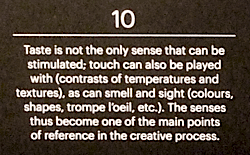
Adrià’s manifesto: No 10 of his 23 principles that summarise El Bulli’s cuisine

Now after 25 years of experiments, Adriá is replacing the restaurant with an inspirational foundation, while his career is being celebrated in Spain’s first major exhibition about cooking. In a series of galleries at Barcelona’s Palau Robert, we are blown away by a fearsomely complete collection of photos, letters, utensils, mementoes, and a vast poster of the 1,846 dishes catalogued by the restaurant. Best of all are the videos in which we see his edible creations being conjured. Another simple but charming glimpse behind the magician’s hand is a table-top displaying before-and-after designs of individual dishes: ingredients modelled from coloured Plasticine are composed as templates for his chefs to translate – abracadabra! – into the resulting plates of food shown alongside.

➢ The free exhibition Ferran Adrià and El Bulli runs at Palau Robert, Barcelona, until Feb 3, 2013


➢ Should I eat it or frame it? The Guardian’s art critic Adrian Searle reviews 40 courses of art food at El Bulli

Tonight’s dinner involves all the senses, it engages the mind, and is also, at times, a strangely emotional experience. The dishes can be confrontational as well as exquisite… The constant stream of surprises continues for more than four hours – the green leaf that tasted exactly of oysters; the grilled strawberry with ginger on the outside and an injection of gin on the inside; the polenta gnocchi with coffee and saffron yuba; the perfect razor clam with its gelatin twin in the other half of the opened shell. Playful, arresting, occasionally alarming, the meal is almost like a story… / Continued at Guardian Online

❚ THE “WORLD’S MOST USELESS MACHINE” is not new news but it did raise a smile during a trip to the year-old Museum of Ideas and Inventions – essentially a hands-on diversion for restless children – while Christmassing in Barcelona. The co-founder of Massachusetts Institute of Technology’s laboratory of artificial intelligence, Marvin Minsky, came up with the idea in 1952. Electronics engineer and the “father of information theory” Claude Shannon, who worked with Minsky at IBM, liked the idea so he built the machine. It is a battery powered box, the sole purpose of which is to turn itself off after some human hand has turned it on.

You too can assemble your own useless machine in beginner-level electronics kit form (from US$35 + shipping), or in a ready-soldered version (from US$55 + shipping). Both include printed circuit board.

➢ Museum of Ideas and Inventions lies a few yards away from Plaza Sant Jaume, in Barcelona’s Gothic quarter

➢ Buy your own Ultimate Useless Machine online from Frivolous Engineering Company in Canada
FRONT PAGE

➤ K West sign ‘possibly’ for sale in Bowie memorabilia show

Ziggy Stardust ,K West, Brian Ward,David Bowie,memorabilia ,Movie Poster Art Gallery,Paul Burston,Alex Hopkins

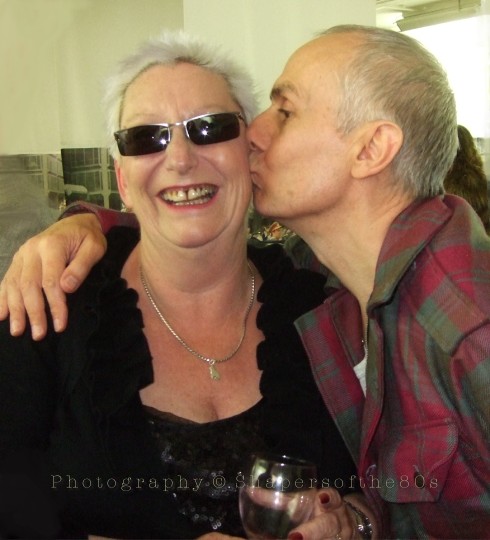
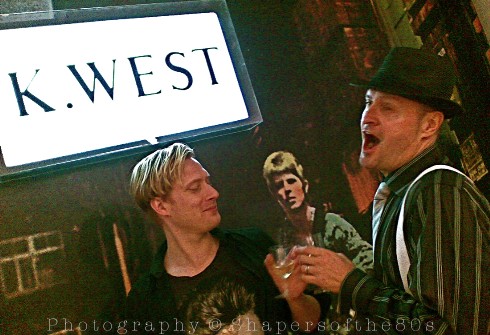
The long-lost K West sign in all its magical luminescence: the restored emblem of the Ziggy Stardust album sleeve is on display at MPAG, London. Captured in its mystic rays (above), writer Alex Hopkins of the quarterly Lifestyle magazine beigeuk.com with the always-on Paul Burston of Time Out London. (Nokia snap © Shapersofthe80s)

❚ AFTER ZIGGY’S 40TH ANNIVERSARY HULLABALOO comes a unique selling exhibition of Bowie graphic art and memorabilia from his golden years 1969–1981. On display this week in London for the first time in 30 years is the original K. West sign that featured in Brian Ward’s covershot for Bowie’s springboard 1972 album, The Rise and Fall of Ziggy Stardust and the Spiders From Mars. The record sleeve itself has long been as iconic a London image as Abbey Road’s zebra crossing. At last, the illuminated sign from 23 Heddon Street has been rescued by a music industry veteran and restored, and is on show at the Movie Poster Art Gallery, run by 80s Mud Club regular, Tim Maddison. He revealed to Shapersofthe80s that it may be for sale “at the right price”.

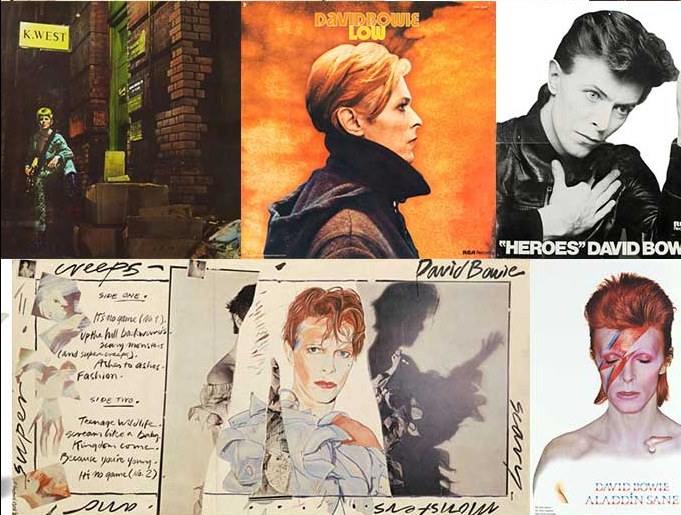
The exhibition highlights celebrated images created for Bowie by talents such as Brian Duffy, Edward Bell, Masayoshi Sukita, Guy Peellaert, Steve Shapiro and Eric Stephen Jacobs. Original posters and large-format promotional displays on Bowie in the 70s are hard to come by, let alone buy, so this show is a treat. At the preview, a 3-ft wide original RCA in-store display for Diamond Dogs was snapped up at £1,250. A fab Scary Monsters in-store stand was still for sale today at £950.

Bowie graphics: five of the images for sale this week

➢ David Bowie: Sound and Vision at the The Movie Poster Art Gallery, London (Nov 17–Dec 1)

➢ View more classic Bowie images for sale this week

This slideshow requires JavaScript.

A MORE PAINTERLY TAKE ON BOWIE

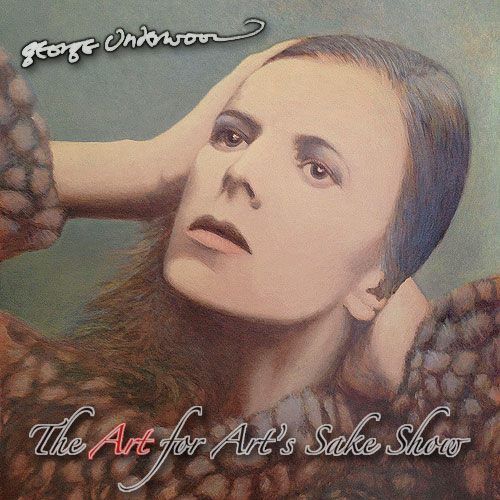
❚ KNOWN AS THE MAN WHO changed the colour of Bowie’s left eye, painter George Underwood is showing his recently discovered 1975 oil painting of the Hunky Dory cover shoot [below] in London next month. He stumbled upon the 32 x 38-inch original while sorting through some old artworks and now it’s on sale for £16,000.

Bowie’s schoolfriend and former musician, Underwood as a painter adopted an imaginative style that refers to Bosch, Bruegel and mannerism. He is among an eclectic mix of ten contemporary artists selling direct through The Art for Art’s Sake Show at The Gallery in Cork Street next month. Rather more affordable Bowie mementoes are his limited edition giclée prints which include Width of a Circle (1969, £500), seen on the back cover of the UK David Bowie LP on Philips… Stardust Memories (1972, £350), a Ziggy era painting that was reproduced as a poster… The Man Who Fell to Earth (1975, £650), seen on the cover of the Pan Books film tie-in.

George Underwood , Hunky Dory,David Bowie,Cork Street, artwork

Rediscovered: George Underwood’s 1975 painting of the Hunky Dory cover

➢ The Art for Art’s Sake Show: the New Kids on the Block (Dec 3–8)

➢ At Underwood’s own online gallery, collectable enamel brooches of Ziggy Stardust cartoons

FRONT PAGE

2013 ➤ Bowie officially not “devastated” as fab retrospective show goes ahead at the V&A

David Bowie, lyrics, pop music, retrospective, memorabilia, exhibition, William Burroughs,Victoria & Albert Museum

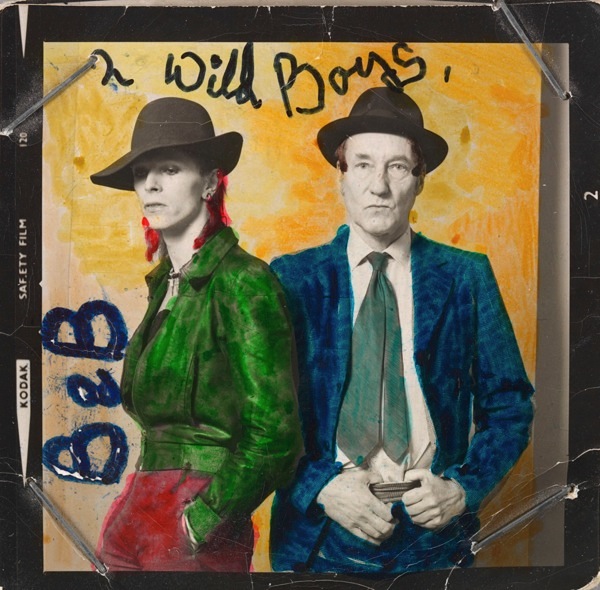
Photography showing at the V&A: David Bowie and William Burroughs, 1974. Photograph by Terry O’Neill. Courtesy of The David Bowie Archive 2012

❚ WHAT A COUP! FIRST CAME THE OFFICIAL DENIAL. A press release from Bowie Towers last week denied the godlike one’s involvement in an upcoming retrospective exhibition in London at the Victoria & Albert Museum. “I am not a co-curator and did not participate in any decisions relating to the exhibition,” he said, adding however: “The David Bowie Archive gave unprecedented access to the V&A and museum’s curators have made all curatorial and design choices. 

A close friend of mine tells me that I am neither ‘devastated’, ‘heartbroken’ nor ‘uncontrollably furious’ by this news item.

”

➢ Listen online to World At One discussing
next year’s Bowie exhibition

Then came today’s official announcement. When the V&A confirmed that its show will “explore the creative processes of Bowie as a musical innovator and cultural icon”, the BBC’s lunchtime current affairs bulletin, World at One, interviewed a key curator without a single mention that this show doesn’t open until next spring.

Ziggy Stardust, David Bowie,stage costume, Kansai Yamamoto

Ziggy stage costume by the Japanese fashion designer Kansai Yamamoto who described Bowie in 1972 as “neither man nor woman”. This outfit goes on show next year. (Photograph by Polkadot.tv)

After three years of negotiation, Geoffrey Marsh, the curator of performance, and Victoria Broackes, curator of theatre, were rightly exultant to have pulled out the Bowie plum. “He has had so much influence in other areas — film, theatre, fashion, design. In fact, he impacts on all departments of the V&A,” Marsh said, heading off recent criticism that pop-star memorabilia was rather a lightweight subject to justify its own claim to be “the world’s greatest museum of art and design”.

Most of the 300 objects going on show were collected by Bowie over his lifetime: handwritten lyrics, costumes, posters, instruments, stuff he regarded as important records of his career. Marsh says: “It is an extraordinary collection and there are very few performers who have hung on to their collections. In all areas of Bowie’s creativity, he is still having an impact today.”

Potential exhibits shown off at today’s press launch included a model of the set for the Diamond Dogs tour, the spangly catsuit designed by Freddi Burretti for Bowie’s 1972 performance of Starman on Top Of The Pops, Natasha Korniloff’s Pierrot costume from the 1980 video for Ashes to Ashes, and Alexander McQueen’s Union Jack coat created for the cover of Earthling in 1997.

➢ Showtime at the V&A — from The Guardian’s coverage, Sep 5:

No one from the V&A has sat down face to face with Bowie and, given he does not fly, it would be a surprise to everyone if he even made it along.

David Bowie, portrait, retrospective,  exhibition, Victoria & Albert Museum

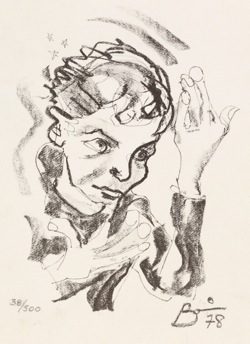
Self portrait in pose also adopted for the album cover of “Heroes” 1978. © The David Bowie Archive 2012. Image © V&A Images

“I’m sorry to say I’ve never met him,” said co-curator Victoria Broackes. “Of course I’d love to and I really hope he likes it but in a way, because the V&A always takes editorial control of what it produces, it is better that we haven’t met him.”

Geoffrey Marsh said there were piles of books on Bowie – “I’m sure there will be many more university doctorates” – but this is the first significant exhibition and he promised it would be “groundbreaking” and hopefully achieve the almost impossible task of appealing to both diehard fans and an audience too young to really know how much of an influence Bowie was and still is.

That present tense is important and the V&A has called its show David Bowie is. “It underpins a key tenet of the exhibition,” said Broackes. “David Bowie’s impact today.”

It will examine what has influenced him – German expressionism, music hall, Theatre of Cruelty, French chanson, surrealism, Brechtian theatre, avant-garde mime, musicals and Japanese kabuki to name a few – and the countless artists he in turn has influenced… / Continued at Guardian Online

RAPACIOUS V&A PRICING EXPLOITS AN EAGER PUBLIC

➢ Enigmatically titled David Bowie is, the exhibition runs March 23–July 28, 2013, at the V&A, London SW7 2RL. Book online, in person at the museum, or by phone +44 (0)20 7907 7073 where you will spend a lifetime on hold. Top ticket price is an outrageous £15. By booking online you avoid being blackmailed into making an additional donation to the museum, though the V&A has the cheek to add a “handling charge” to all purchases! (Update: Ticketing has subsequently been farmed out to a theatre agency which has upped the price to £15.80 to include its own “booking fee”!)

How dare they, with Gucci sponsoring the exhibition? Gucci could readily pick up the whole bill for the show, and the V&A’s exploitative tactics let the institution down badly. Brace yourselves for a catalogue priced in similar “We saw you coming” mode (a catalogue for the last major show, British Design, cost £40). This is an ugly and accelerating trend among the capital’s cultural institutions.

Is Bowie alive or dead?

➢ Definitely alive — but busy on the school run, says The Times’s chief rock critic, Sep 5:

Ever since 2006, when he last performed live, rumours have circulated that David Bowie is at death’s door. What has he been doing? Taking his 12-year-old daughter to and from school in New York, according to his publicist. Having been too busy as an epoch-defining rock star to be a hands-on father to his son Zowie (now the film-maker Duncan Jones), Bowie is now helping out with his daughter’s homework. He is living through a period of normalcy that his early fame denied him. The state of his heath is unknown… / Continued at Times Online

David Bowie, Starman, 1972, Top of the Pops,V&A , exhbition, tipping point, BBC

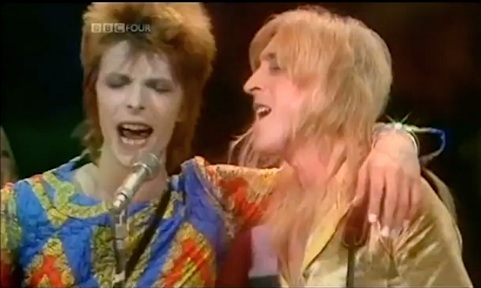
The moment the earth tilted July 6, 1972: During Starman on Top of the Pops, David Bowie drapes his arm around the shoulder of Mick Ronson and a new generation of pop is triggered. The spangly 26-inch waist catsuit by Freddi Burretti will be on show at the V&A retrospective in 2013. Videograb © BBC

1970 ➤ Where to draw a line between glitter and glam:
naff blokes in Bacofoil versus starmen with pretensions
— analysis by Shapersofthe80s

FRONT PAGE

➤ Six rewrites punk history with an outlandish claim about the Not-Really-From-Bromley Contingent

Simon Barker, Six, Punks Dead, Jordan, photography, exhibition

Reunited: a plonker from Six for Jordan at Divus Gallery © Shapersofthe80s

❚ OLD HABITS, EH? A day in the spotlight and Simon Barker, aka Six, starts rewriting history! There we were last night in a Spitalfields gallery, chatting for the first time in 20 years at Punk’s Dead, his new show of early photographs of the now fabled Bromley Contingent, the posse of a dozen fashionistas who helped put the Sex Pistols on the map back in 1976. Having staked his claim to fame as the only person clapping at the end of the Pistols’ sixth gig (Dec 9, 1975, at Ravensbourne College) and being one of four fans with the band during the infamous “Filth & Fury” TV interview (Dec 1, 1976), Simon today works as a photographer in Prague.

Why Prague, I ask, as a big fan of the Bohemian medieval city? He groans: “Oh no! Why Prague? Why does everyone ask me the same question?” You’d never guess Simon and I used to natter away as if we liked each other back in the 80s when I’d pop into Viv’s Worlds End shop after going for a haircut next door at Smile. OK then, Six, why *Bromley*? As in Bromley Contingent. What was in the water in Bromley that produced his posse of poser punks?

“Ah, excellent question!” he replies. “We hated the name. It was created by the media — that woman Caroline Coon.” This is a double-edged dig at both the middle-class, ex-hippy Melody Maker writer who coined the phrase after seeing the “very striking” posse at three Pistols gigs in a row and asking where they came from (Bromley is a town in the south London commuter belt)… and also at me for being another member of the despised legion of journalists.

His Always-a-Punk gene is really kicking in now. “In actual fact, only two of us — me and Steve [Bailey, aka Severin] — came from Bromley. Siouxsie [Susan Ballion, later singer with the Banshees] was from Chislehurst. Billy [Broad, later Idol] lived in Bickley. And Jordan [born Pamela Rooke] came up from Seaford.

“For me and Steve, living in that bit of suburbia, Bromley had the best connection into London — 20 minutes by train. Any further away and it wouldn’t have been so easy to visit for gigs, sex, Louise’s…”

Aha, the location-location transport solution! A recurring theme, because in a surprisingly cooperative interview in 2002 Six did admit that his reason for moving to the Czech Republic “was its location. It is the heart of Europe and a great base to travel from.”

Six was either being pure-punk cussed by splitting hairs about his posse, or possibly was having a bit of a hashtag_Senior_Moment. Bickley is after all the next stop down the line from Bromley, only 2,000 metres away, and Chislehurst another 1,000 metres further on. But fair enough, he’s got a point. Even if you include Sioux and Idol and Bertie “Berlin” Marshall, who lived three doors away from Bowie’s mum in Bromley, five out of a posse of 12 does not a “Bromley” Contingent make. So last night, we witnessed history being rewritten.

WHO waS WHO in the “Bromley” Contingent

Bromley Contingent, Soo Catwoman, Jordan, punks

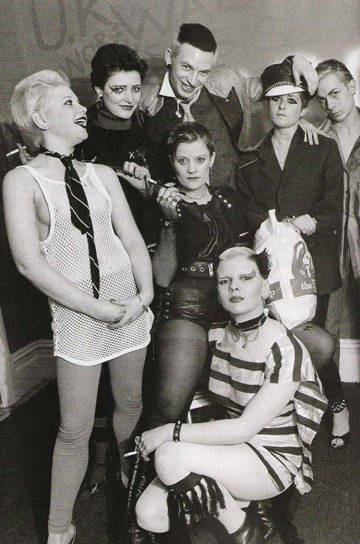
Ray Stevenson’s classic 1976 pic of some of the Bromley Contingent, plus Soo Catwoman who came from Ealing

According to Wikipedia: Siouxsie Sioux, Jordan, Soo Catwoman, Simon “Boy” Barker, Debbie Juvenile (née Wilson), Linda Ashby, Philip Sallon, Alan Salisbury, Simone Thomas, Bertie “Berlin” Marshall, Tracie O’Keefe, Steve Severin, Billy Idol and Sharon Hayman.

Caroline Coon’s 1977 book The New Wave Punk Rock Explosion remains a fresh and pro-fan account of the movement’s origins, less prone to mythologising than later histories

➢ Fresh pix from the “14 months” of punk and the last word on what it all meant

➢ Simon Barker chats to Dazed about the anarchic punk era

➢ Another epic Stevenson picture of the Bromley Contingent, 1976

Simon Barker, Six, Punks Dead, Jordan, photography, exhibition

Jordan then and now: the Queen of Punks with Simon Barker’s 1977 photo showing for a month at Divus Temporary Gallery, London E1 6QF © Shapersofthe80s

❏ Mind you, the true superstar present in the Spitalfields gallery was Jordan herself, Queen of Punks, artfully positioned in front of Six’s truly iconic portrait of her on the wall, priced at £300 a pop. There wasn’t a moment all evening when she wasn’t surrounded by a buzz of fans and old stars of punk and she was such easy company, chatting away without airs or graces. She said: “I’m a veterinary nurse now and I breed Burmese cats. Look at the number of photos here of me and Siouxsie with cats.”

She has returned to live in Seaford but loves telling the 70s stories about travelling up to London from the south coast resort, being harangued by commuters for her spiky hair and outrageous bondage clothes from McLaren and Westwood’s Chelsea shops Sex and Seditionaries. To keep her out of trouble, one British Rail guard told her to go sit in first class. “The day I came up to apply for a job at Sex, it was shut, so I wandered over to Harrods and applied there in my blonde spikes and green face foundation. They gave me a part-time job in Way In” (their trendy top-floor fashion department).

As the single most inventive pioneer of definitive punk looks, Jordan soon joined Sex, however, becoming their totemic house model and honorary fifth member of the Sex Pistols, all too willing to flash her tits for the press at their ninth gig in Andrew Logan’s loft. In 1977 she briefly managed Adam & The Ants in their hardcore phase, but most notoriously starred in Derek Jarman’s dystopian fantasy movie, Jubilee, singing a raunchy version of Rule Britannia.

➢ Punk’s Dead by Simon Barker is an exhibition of his intimate punk photographs, open for a month from June 7, at Divus Temporary Gallery, 4 Wilkes Street, London E1 6QF.

➢ Punk’s Dead the book by Simon Barker is published by Divus

Click any pic below to launch slideshow

The Year Of Punk 19/12/77

Six, Simon Barker, Punk 1977, LWT, Janet Street-Porter, video

“You don’t have to be a fantastic musician”: Six explains the magic at 7:15 in Janet Street-Porter’s LWT documentary, The Year of Punk, 1977 … Click pic to view video at YouTube

FRONT PAGE

➤ Trimphone aside, can you spot the designs that changed the look of Britain over 60 years?

British Design,exhibition ,Innovation, Modern Age, Victoria & Albert Museum,

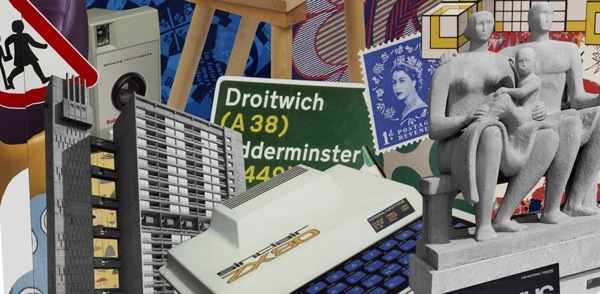
British Design catalogue collage: road signs, high-rises, Kodak cameras, postage stamps, computers and Henry Moore — all are exhibited here

“Britain has since 1948 sustained an extraordinarily vigorous creative culture, even against a background of manufacturers leaving the stage like the instrumentalists in Haydn’s Farewell Symphony. It’s an inclusive culture, hence tapestries and Jaguars. It’s a culture that swoops artfully between high and low. It’s a culture that could import, with characteristic fairhandedness, both John Betjeman and Nikolaus Pevsner. The one in thrall to the village, the other in thrall to steel and glass. Wonderfully, each was a founder of The Victorian Society. Their contrasting spirits dominate British design in the years before The Beatles’ first LP. Thereafter, the Britain of crumpets-with-vicar became the undisputed global capital of youth culture whose furious organic vitality still invigorates business life.”

➢ Stephen Bayley, former chief executive of the Design Museum, writing in The Independent

Denys Lasdun, University of East Anglia,architecture

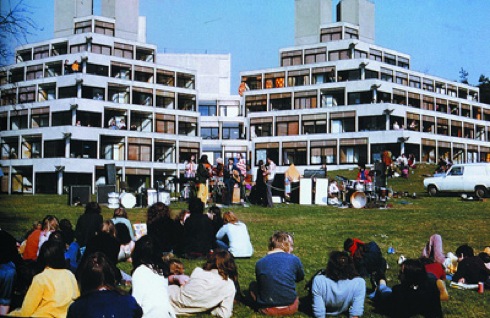
Architect Denys Lasdun’s University of East Anglia, 1962-68: raised walkways, striking ‘ziggurats’ and no building on campus more than five minutes’ walk away

❚ AN EXHIBITION TITLED British Design 1948–2012: Innovation in the Modern Age, is bound to infuriate as much as it excites. The grimly claustrophobic galleries that host temporary shows at the Victoria & Albert Museum abound with iconic and nostalgic everyday objects, rather as a good car-boot sale does. Yet the omission of much imaginative British media is unforgivable — the template for newspaper colour supplements laid out by The Sunday Times plus a serious investment in photo-reportage, for example… the more-British-than-British essence with which the American Joseph Losey propelled a whole chapter of stylish cinema… the sci-fi television fantasies of The Prisoner or Doctor Who…

Twiggy , Mary Quant ,miniskirt,Swinging London, youth culture

Twiggy models the Mary Quant miniskirt, 1965: named after the designer’s favourite car, the mini encapsulated the youth culture of Swinging London — energetic and unconventional

What the V&A show’s three themes propose — under the headings Tradition & Modernity, through the Subversion of pop, to Innovation & Creativity — amounts to a vital module for every art or design student in the education system, whose forebears, thank goodness, benefited from the shake-up imposed in 1960 by the Coldstream Report.

Ignore most dithering reviews of this hot-and-cold exhibition. Instead, do savour the argumentative Stephen Bayley, writing in that onetime model of new newspaper design, The Independent. He nails the paradox of this show in a daydream: “I became drunk on memories of whimsy, charm, gentility, wit and Macmillan-era futurism. My imagination never turned to the ruins of industry, the loss of technological competence, the barrenness of every British city except London and the fact that the economy of our once-busy island workshop is now based on the theory and practice of a dodgy casino.”

Bayley then comes to the nub of the matter: “The tricky thing is ‘design’ itself. It’s often muddled not only with ‘innovation’, but with invention, fashion and taste-making, sometimes even with art. After more than 150 years of promoting design at the V&A, no one seems to have any very clear idea of what it is. If it is a real subject, it must have a discipline. But what discipline connects Spence’s Coventry Cathedral with Damien Hirst’s 1997 Pharmacy restaurant in Notting Hill, west London, each of which features here?

“If, as the design lobby often insists, ‘everything has been designed’, then everyone is a designer. So what special qualities do professional designers bring to any task?”

British Design,exhibition ,Innovation, Modern Age, Festival of Britain, Skylon, Concorde

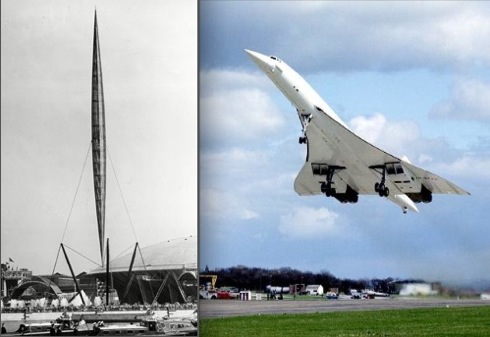
Notions of modernity: at the Festival of Britain, 1951, the Skylon designed by Powell & Moya was rendered by the practice’s junior architect James Gowan as a monumentalised missile, and symbolised the dawning age of science. In 1979, BA’s sixth Concorde took off on its maiden flight

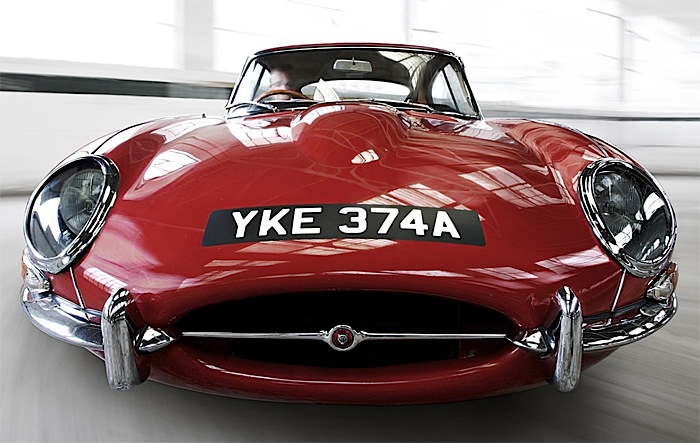
Aim Bayley’s question at three triumphs of design in the V&A show: the kinetic balancing act of the Festival of Britain’s Skylon structure; the bird-wing aerodynamics of Concorde miniaturised at the V&A in a 20-ft model; and the most thrilling artefact in the entire show: the skilfully lit Jaguar E-Type from 1961 which rival manufacturer Enzo Ferrari declared “the most beautiful car ever made”. Drop down to one knee and view the Jag diagonally from any corner and wonder at its lack of straight lines. One curve after another creates changing perspectives that conspire to emulate speed even as it stands motionless before you. Seldom will you hear both men and women purring over such a seductive silhouette! Seldom will you ever see such a thrilling manmade object.

There are a good number of breathtaking moments in this show that beg you to ask why and how an exhibit stopped you in your tracks, though not as many as you would wish.

Malcolm Sayer, Jaguar E-Type,sports car ,

Relish the curves: designed by Malcolm Sayer, the Jaguar E-Type 3.8-litre sports car was launched at the Geneva Motor Show in 1961 as a two-seat coupe or convertible, with a top speed of 150 mph. The car’s shape is the epitome of speed

➢ British Design 1948–2012: Innovation in the Modern Age, runs at the Victoria & Albert Museum, Mar 31 until Aug 12

FRONT PAGE