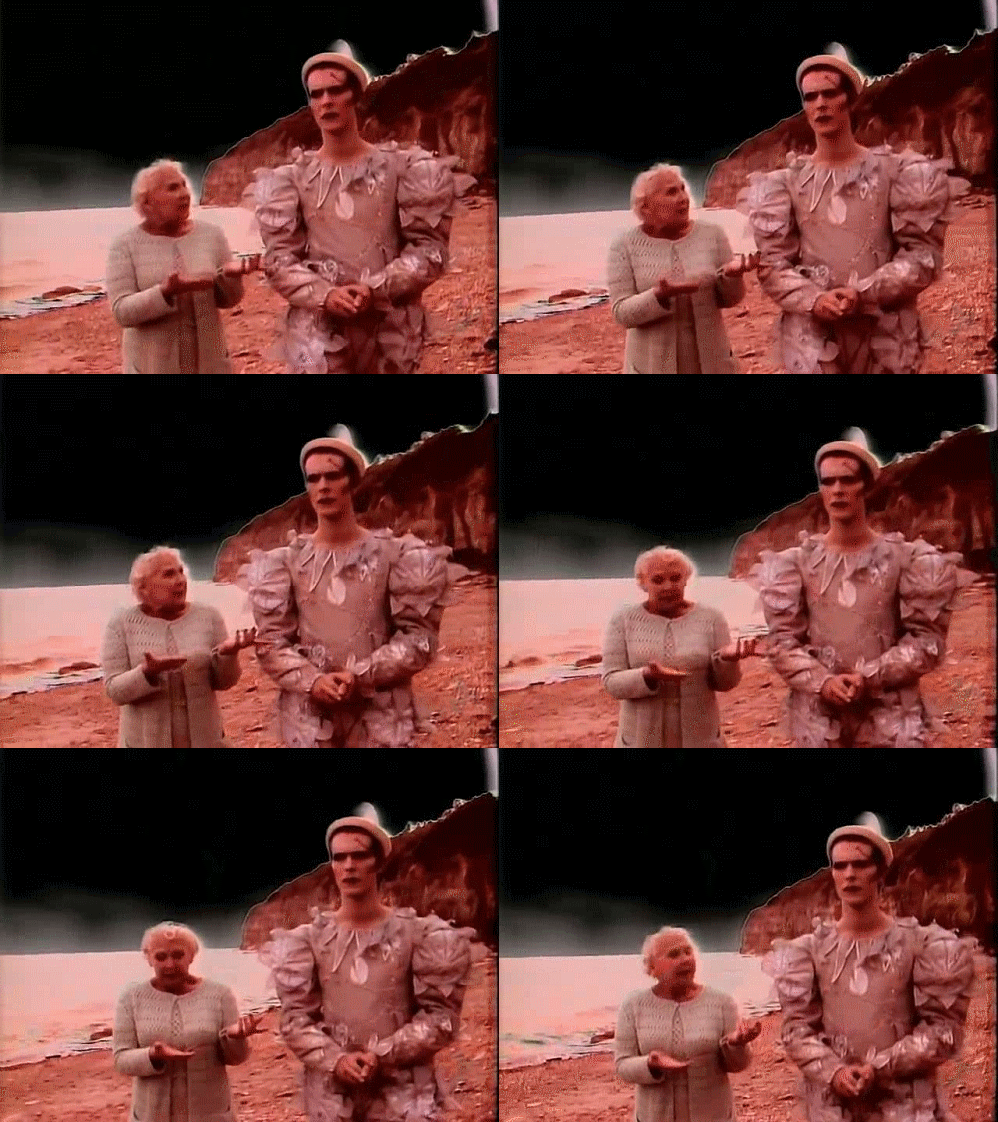
❚ THE OFFICIAL DAVID BOWIE WEBSITE has polled his fans to elect their five favourite videos by the musical genius whose career transformed pop music over 50 years. No surprise perhaps that Ashes to Ashes came out top, capturing a crucial turning point in Bowie’s own progress in 1980 and becoming his second No 1 UK single and an international hit. It was an arty track from his 14th studio album, Scary Monsters, with a funky bassline, refined lyrics reaching back to his debut single Space Oddity and its astronaut Major Tom, while its dreamy solarised visual effects also reflected Bowie’s own experiences with drugs. Several critics declare Ashes to be among Bowie’s best songs musically and for inventiveness, and the video itself stands at number 44 in Rolling Stone’s 100 best.
For both its sleeve and video, Bowie commissioned a Pierrot pantomime costume. Significantly, the video starred four overdressed figureheads (including Steve Strange) from London’s nightlife scene, which was exploding into a gloriously colourful new subculture as a reaction to the bleakness of punk. Let’s not forget that Ashes was the most expensive music video made to date, costing £35,000 (about £140,000 in today’s money) and MTV had yet to be launched. [Read the full background story behind recruiting and filming the Blitz Kids for Ashes here at Shapersofthe80s.]
The team at DBHQ doff their hats to video director David Mallet for achieving nine entries in their video top 20, more than a third.
BEST VIDEOS HIS FANS VOTED FOR
#01 – Ashes to Ashes 1980 – David Bowie and David Mallet
#02 – Life on Mars? 1973 – Mick Rock
#03 – Boys Keep Swinging 1979 – David Mallet
#04 – Jump They Say 1993 – Mark Romanek
#05 – I’m Afraid of Americans 1997 – Dom and Nic
#06 – ★ Blackstar – 2016 – Bo Johan Renck
#07 – DJ 1979 – David Mallet
#08 – The Hearts Filthy Lesson 1995 – Samuel Bayer
#09 – Lazarus 2016 – Bo Johan Renck
#10 – The Stars (are out Tonight) 2013 – Floria Sigismondi
#11 – The Next Day 2013 – Floria Sigismondi
#12 – Let’s Dance 1983 – David Mallet
#13 – Look Back in Anger 1979 – David Mallet
#14 – Strangers when We Meet 1995 – Samuel Bayer
#15 – China Girl 1983 – David Mallet
#16 – Loving the Alien 1985 – David Bowie and David Mallet
#17 – Little Wonder 1997 – Floria Sigismondi
#18 – Blue Jean / Jazzin’ for Blue Jean 1984 – Julien Temple
#19 – Fashion 1980 – David Mallet
#20 – Wild is the Wind 1981– David Mallet
#21 – Thursday’s Child 1999 – Walter Stern
#22 – Where are We Now? 2013 – Tony Oursler
#23 – Absolute Beginners 1986 – Julien Temple
#24 – Space Oddity 1972 – Mick Rock
#25 – The Jean Genie 1972 – Mick Rock
#26 – Be my Wife 1977 – Stanley Dorfman
AMONG THE COMMENTS AT FACEBOOK:
Adam Paramore: Great list, interesting that there’s nothing from Ziggy Stardust (IIRC, some concert clips were used as music videos), no Labyrinth tracks, no Modern Love, and no Dancing in the Street with Bowie & Jagger. Anthony LeBaron: One notably absent video from the list I would add is No Plan. Released a year after his passing, it captures the enormous loss and despair I still felt at losing him. Rudy Fuentez: Ashes to Ashes is probably his best video, but to me his best song is too hard to decide. Cat People (Putting out the Fire), Always Crashing in the Same Car, Young Americans, Absolute Beginners, This is not America… too many songs. Might as well ask what do you think is the brightest star in the heavens. Andrew Seear: I agree. Always Crashing in the Same Car I think is an astonishing piece, even by Bowie’s standards. I’ve never heard despair expressed so elegantly. Stacey Rich: Coolest thing was cycling to Pett Level [where Ashes was filmed] – totally unchanged on the day, a little overcast, the beach empty. Grew up in America & never realised it was an actual place but had shown my partner the video and he recognised the beach immediately. Actually teared up. Stephen Oldfield: The lyrics and music on this track [Ashes] are stunning. The closing synthesiser must be the greatest on any song ever.
PLUS TWO VERY SPECIAL PERFORMANCES ON VIDEO
In December 1979 Saturday Night Live aired the most immaculate performance of TMWSTW by Bowie, Klaus Nomi, Joey Arias, Stacey Hayden on guitar and Jimmy Destri on keyboards, which some say was the night “he transformed live television”. This nine-minute clip also includes brilliant versions of TVC 15 with Bowie in skirt and heels, plus a hilarious performance of Boys Keep Swinging where he sports a life-sized nude puppet costume. Click on the picture to view, though don’t be surprised if you cannot reach the video. For rights reasons, this unrivalled video keeps being removed from the web by its broadcaster, so we stay on our toes scouting for alternative postings!
❏ I TOTALLY AGREE with the first three videos topping this DB poll, and draw special attention to Mick Rock’s remarkable promo for Life on Mars. Another that haunts my imagination is 2014’s Where are We Now? Moving on, I’d urge those who haven’t seen two other very special performances by Bowie to seek them out. One is an exquisite interpretation of his enigmatic song The Man who Sold the World which some claim “transformed live television” [pictured above]. Admittedly this is not a promotional video and yet it was uniquely choreographed and costumed for live performance on American TV’s Saturday Night Live in 1979 before its audience of millions. Idiosyncratic backing singers Klaus Nomi and Joey Arias provide immaculate support, while carrying Bowie forward as a kind of giant pierrot, clad in an oversized black plastic dinner jacket over a tapered tubular body – all inspired by artist Sonia Delaunay’s designs for a subversive Dadaist play from 1923. When written in 1970, the lyrics and the singer were evidently sharing an identity crisis and since his death Rolling Stone has regarded this number as “essential”.
❏ HERE’S A SECOND profoundly affecting video that’s often ignored yet it reveals the extraordinary range of Bowie’s singing voice. Possibly the purest experimental jazz number of his career, the nerve-tingling Sue (or in a Season of Crime) was created in 2014 during a session with 17 jazz soloists including saxophonist Donny McCaslin, all improvising under Maria Schneider’s guidance and running beyond seven minutes. The role of jazz in Bowie’s musical temperament seldom gets discussed, though his producer Tony Visconti says the jazz influence had always been there in the music but beneath the surface. The haunting four-minute video was directed in monochrome by Tom Hingston to promote Bowie’s “best-of” collection, Nothing Has Changed.
All taking place as Bowie was being diagnosed (discreetly) with liver cancer, Sue evokes a discomfiting tale of infidelity inspired by the poet Robert Browning, in which the narrator murders his wife and the last verse begins with the phrase “Sue, I never dreamed”, the title of the first song he recorded in 1963. Such a weepie. (An edgier, punchier, superior re-recording of Sue followed on Bowie’s final album Blackstar, released two days before his death.)
❚ TODAY WAS THE DAY in 1980 when London’s now fabled Blitz Club was blessed by a visit from David Bowie. He came with a purpose – to whisk away four of the most outlandish Blitz Kids to strut with his pierrot through the video for his new number, Ashes to Ashes, from an imminent new album. It earned each of them £50, helped Bowie to No 1 in the singles chart the following month and boosted demand for black ankle-length robes among trendsetters.
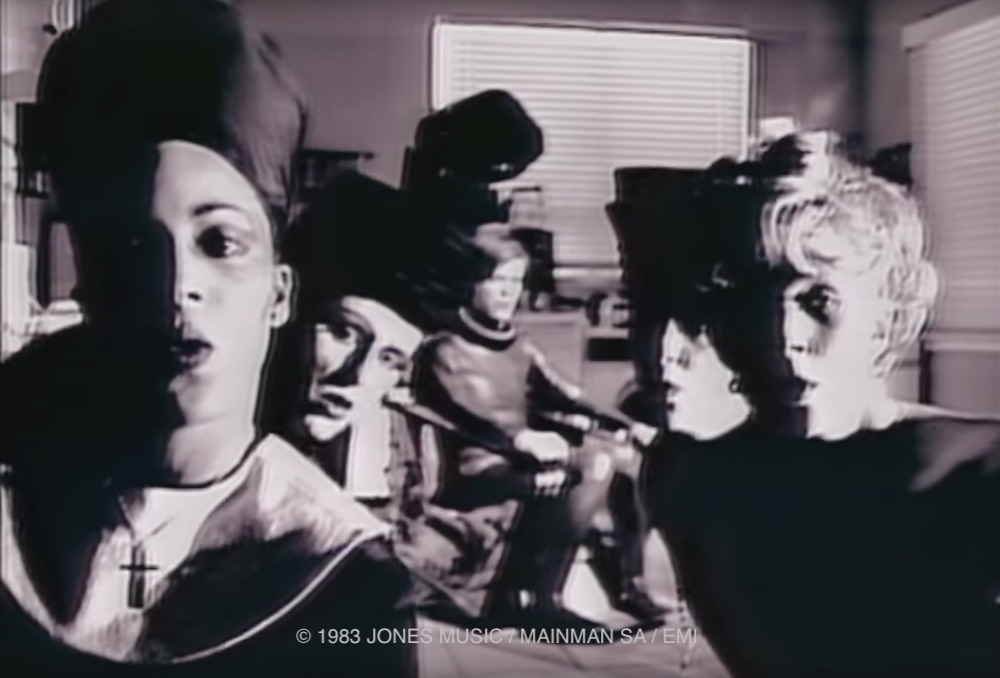
Ashes To Ashes video 1980: Blitz Kids as chorus to Major Tom
Every Tuesday for 16 months, king of the posers Steve Strange had been declaring a “private party” in the cheap-and-cheerful Blitz wine bar near Covent Garden, along with his co-host Rusty Egan who was pioneering Elektro-Diskow dance music as deejay. Your Look was everything and outrage ensured entry. Inside, precocious 19-year-olds presented an eye-stopping collage, preening away in wondrous ensembles, in-flight haircuts and emphatic make-up that made you feel normality was a sin. Hammer Horror met Rank starlet. These were Bowie’s offspring, individualists who had taken him at his word to be “heroes just for one day”, living amusing lives, creating disposable identities, and wearing looks not uniforms. Now, on this day, their god came among them with the very serious mission of paying homage to some of his bizarre principal characters and moving himself on into the next phase of his life… Unwittingly the Blitz Kids would become his little helpers.
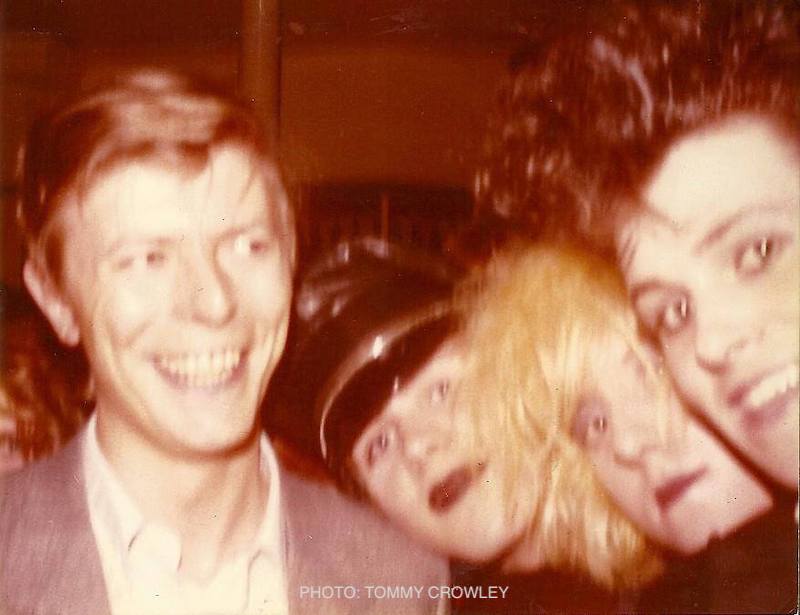
Bowie at the Blitz Club 1980: Russ Williams, John Lockwood and Andy Bulled papped by Tommy Crowley
Memories of Tuesday 1 July vary. The 21-year-old Steve Strange found himself requesting extra security to stem what the soon-to-become pop singer Andy Polaris also records in his diary as a “minor riot”. In contrast, the coolest heroes in the club refused to pander to the great star and merely contemplated their drinks.
Strange writes in his autobiography, Blitzed: “We had no prior warning, and [Bowie] arrived with two other people and his PA [Corinne] ‘Coco’ [Schwab], whom I didn’t think was very nice.” The guests whose names Strange forgot were, according to the Polaris diary, singer Karen O’Connor (daughter of comedian Des) and painter-photographer Edward Bell, who designed the cover artwork for the imminent Scary Monsters album and singles.
Strange’s book claims: “We managed to sneak them into the club the back way to avoid a fuss and usher him upstairs to a private area. David himself was charming and asked if I would join him upstairs for a drink when I had finished on the door. I wanted to go straight away, but, annoyingly, I had to do my job first and stay at the door.”
The book continues: “Word soon spread like wildfire that David Bowie was there. He was probably the reason most people at the club had got into pop music in the first place. He had changed his look and his sound so many times, there were more than enough images to go round. The alien from Low and The Man Who Fell To Earth, Aladdin Sane, Diamond Dogs, Ziggy Stardust. He was the one person that everyone there would cite as an influence, even more important than punk.
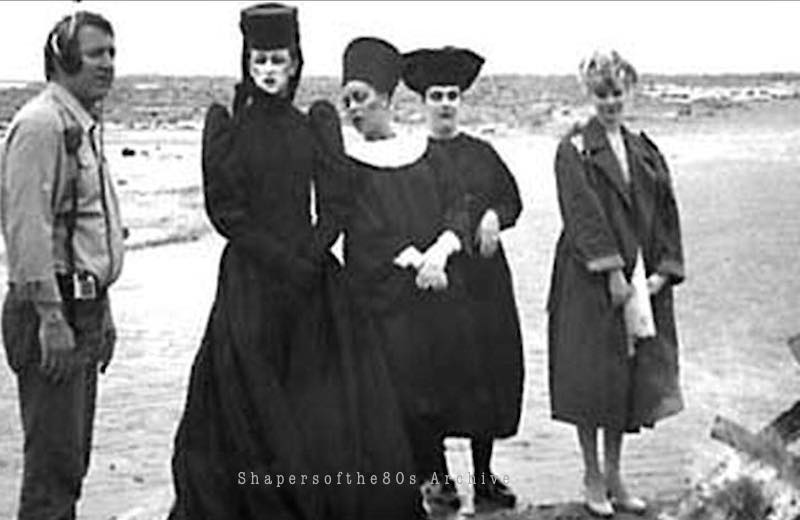
Bowie’s chorus near Hastings, July 1980: Polaroid snapped by a crew member on the beach during filming of Ashes to Ashes with Blitz Kids Steve Strange, Darla-Jane Gilroy, Judi Frankland and Elise Brazier keeping warm in a mackintosh between takes. When they got back to London, they all went clubbing at Hell
“He said it was a great scene and asked me if I would like to appear in the video for his next single, Ashes To Ashes. He also asked me if I could suggest a make-up artist for him, and I recommended Richard Sharah, the man who did my make-up. He said: ‘I’d like it left to you to pick the clothes you are going to wear, and to choose three other extras for the video.’ This was the most important moment of my life. I rushed around and found Judith Frankland, Darla-Jane Gilroy and another girl [Elise Brazier] for the video.” Here, as with so much of his flaky book, Strange’s memory leaves the rails. Other witnesses suggest subtle variations to his account…
Ashes To Ashes video 1980: Darla-Jane Gilroy with Bowie between takes
Ashes To Ashes video 1980: Blitz Kids as mourners at a sacrificial pyre
Enter the next witness, Ravensbourne graduate Judith Frankland, designer of Steve Strange’s Fade to Grey outfit and of two gowns worn in the Ashes video which were inspired, she says, by the nuns in The Sound of Music and coincidentally had been unveiled in her sensational degree collection “Romantic Monasticism” at the Café Royal during June. She says: “In a wonderful twist of fate, Steve was resplendent in my black wedding outfit that night and was chosen straight away. He was asked to select people he felt could be right. Bowie did see George O’Dowd but as I remember he was wearing his big leather jacket look that night, so he was out. I was invited as was Darla up to the table where David and Coco were sitting and offered a glass of champagne. Darla and I were both dressed in a similar ecclesiastic style, Darla in her own black outfit with white collar, and we were also asked to take part for what at that time was a decent sum of money for penniless, decadent students.
“We were told Coco would call us the following day with the details. I woke the next day thinking I’d dreamt it and you know I guarded that communal pay phone on the landing like a rottweiler until she did: be outside the Hilton the next morning, Thursday, she said, at some ungodly hour, fully dressed and made up the same way I had been at the Blitz, and to get the coach to a secret location.
“When we arrived at the beach near Hastings [not Southend, as Strange reports], the crew was set up and David Bowie greeted us dressed in the pierrot outfit he would be wearing. He coached us for a few minutes on the words we were to mime and then the day was spent in what we Lancastrians call sinking sand, sloppy sand, and the further out we got on the beach the messier and sloppier and muddier it was. I wore flats which was a wise choice. Then we were up and down that field with the bulldozer and every time we had to do a take it had to back up and the field got muddier. The bulldozer wasn’t that close but if he’d stepped on the gas we would all have been gonners.
“We were finally told we had all ‘done well’ and set off in the coach straight from the shoot to Hell [Strange’s Thursday club-night with a sacrilegious flavour] – well, home first to get freshened up. Steve dropped off his very muddy wedding dress and Hell was a rowdier night than usual. Steve brought one of the labourers from the bulldozer site with him and dressed him up in a Modern Classics suit. The poor guy was disturbed by it all, to say the least.
“We’d also been asked to go to the Ewart Studios in Wandsworth that weekend to shoot another scene – the kitchen with Major Tom in the chair and us providing the chorus. This involved an explosion behind us four as we faced the camera. We were told to duck out and run after we had mimed our lines or we could be hurt. This was difficult in a hobble dress, so I hoisted it up as high as I could and got ready to run. Quite a sight for the superstar sat behind me! Health and Safety would be all over that now.
“May I add that at the studios David Bowie joined us mere mortals in the canteen. Yummy. What a nice man he was, well he was to me, very kind and patient with us all.”
London’s Cafe Royal, 1980: Judith Frankland’s graduation show climaxed with a wedding dress in black and white taffeta, brocade, velvet and satin. All crowned by Stephen Jones’s veiled head-dress. As worn by Blitz Club host Steve Strange in the Ashes to Ashes video. (Niall McInerney’s slides scanned by Shapersofthe80s)
CRUCIAL MOTIFS DECODED
St Martin’s Alternative Fashion Show in May 1980: Stephen Linard’s “Neon Gothic” collection modelled by his most stylish friends, Myra, George O’Dowd and Michele Clapton, with Lee Sheldrick in white as a space-age pope
❏ Co-directed by Bowie and David Mallet, location scenes for Ashes to Ashes were filmed on 3 July 1980 at Pett Level, a stony beach on marshlands about six miles east of Hastings in East Sussex, known to Mallet since he was a boy. The drama of waves splashing against a towering cliff excited him. The video was the most expensive music video made to that date, costing £35,000 (about £151,000 in today’s money). The whole dreamscape was enhanced with effects from the then novel Quantel Paintbox to create a visual enigma, echoing a distant past, yet suggesting “nostalgia for the future” in Bowie’s own words.
At the time Bowie dropped in on the Blitz, the fashion mood had darkened for post-punk no-wavers. Black was back in gothic style without that word being applied, mostly. One exception was Stephen Linard who stole the annual Alternative Fashion Show in his second year at St Martin’s with his “Neon Gothic” collection in May 1980, when the event was coordinated by Perry Haines. Fellow Blitz Kids modelled a stylish collision of Space 1999 meets liturgical gothic, strutting to the Human League’s newest release, Empire State Human. Among them, Lee Sheldrick, the gifted eminence gris behind so many other students’ creations, had also shaved his head bald to become the embodiment of Nosferatu the Vampyre. The following week Steve Strange teamed up with fellow Welsh soul-boy and Camberwell student Chris Sullivan to open a no-holds-barred club-night at Hell with the invitation “to burn in Hell – demoniacal dress is desired”. Bowie knew what he was looking for.
One of Bowie’s long-standing collaborators, Natasha Korniloff, designed his pierrot costume for the video and Gretchen Fenston his hat, while he gave Richard Sharah a free hand to design the make-up. On the night of Bowie’s visit to the Blitz, Steve Strange and Judi Frankland were sporting her graduation garments, Strange in the black wedding dress crowned with a Stephen Jones head-dress and veil made of stiffened lace on a metal frame. Judi recalls: “The wedding dress was the reason Steve and I got close. He called me up wanting to buy pieces of the collection. He also bought a jacket he wore on the cover of Fade to Grey and gave me a credit on the sleeve. That dress, all sand, sea and mud, ended up in the bottom of Steve’s wardrobe. It had a stand-up collar that was caked in his makeup. Never wore it again though he got some money off the video people to get it cleaned. The veil also got squashed in his wardrobe.”
Darla-Jane Gilroy wore an ecclesiastical black velvet dress designed and made by herself, silk grosgrain coat and white collar with crucifix, plus a Stephen Jones hat. Elise Brazier personified a ballerina in a party frock plus tantaliser in her hair. This and another hat came from Fiona Dealey and Richard Ostell. All would soon be finding fame in the fashion business, with Elise becoming one of Premier’s leading models.
Stephen Linard: sporting a wooden cross by Dinny Hall and the rabbinical outfit that caught Bowie’s eye in July 1980
Stephen Linard supplies his own footnote to that great Tuesday at the Blitz. “Bowie actually sat at the bar next to my sister Bev, with me on the other side of her and I told her “Don’t look. Be cool.” So of course she looked, she was only 17. So did I. I was only 21. I was in all my Jewish rabbinical gear and Bowie’s PA Coco asked if I would be in the Ashes to Ashes video, but they wanted us up at the crack of dawn and were only offering £50! Anyway, I was on a warning at St Martin’s over attendance, so I had to say No.”
Steve Strange has the last word: “It seemed like a very long day for a three-minute film. I was delighted when I was handed my wages of £50 by a member of the production team. I didn’t tell them, but I would have paid them to have appeared in a video with David Bowie.”
Storyboard for Ashes to Ashes, 1980: The opening scene of pierrot on the beach sketched by Bowie to guide his co-director David Mallet
BOWIE’S OWN VISION WITHIN THE ASHES
❏ Bowie’s brief to David Mallet for the video was simply: “A clown on a beach with a bonfire.” Yet you can be sure Freud would have a field-day turning over every mortal motif in Ashes to Ashes, which was originally titled People Are Turning to Gold… Bowie storyboarded the visuals himself (“actually drew it frame for frame,” he said) to include the pierrot of his Lindsay Kemp era, the number of “Madmen” in his own family symbolically in a padded cell, his first hit Major Tom the spaceman now in an exploding kitchen with his own Greek chorus, the images of mourners round a funeral pyre, the JCB bulldozer (that Bowie had spotted parked up near the beach and hired on impulse) to signify “oncoming violence” and seemingly pushing along the Blitz Kids in the pierrot’s wake like a funeral procession pulsating with a mother’s invocation “to get things done…” Not to mention the song’s title itself, derived from the burial service in the English Book of Common Prayer which commends: “earth to earth, ashes to ashes, dust to dust”.
All of which suggested a surreal sweeping away of the past, capped by the unleashing of the dove as an emblem of ritual cleansing, and so paving a way for the future. In September 1980, Bowie revealed his thinking to NME: “The sub-text of Ashes To Ashes is quite obviously the nursery rhyme appeal of it and for me it’s a story of corruption. When I originally wrote about Major Tom I thought I knew all about the great American dream and where it started and where it should stop. [Now] the whole process that got him up there had decayed and he wishes to return to the nice, round womb, the earth, from whence he started. It really is an ode to childhood, if you like, a popular nursery rhyme.”
Years later, Bowie told author Nicholas Pegg that with Ashes to Ashes he was “wrapping up the Seventies really” for himself, which “seemed a good enough epitaph”. On Bowie’s death his lifelong friend George Underwood called him an emotional, passionate person: “He had created this fierce storm, but he was the only one in it.” Take your pick.
➢ Choose “View full site” – then in the blue bar atop your mobile page, click the three horizontal lines linking to many blue themed pages with background article
MORE INTERESTING THAN MOST PEOPLE’S FANTASIES — THE SWINGING EIGHTIES 1978-1984
They didn’t call themselves New Romantics, or the Blitz Kids – but other people did.
“I’d find people at the Blitz who were possible only in my imagination. But they were real” — Stephen Jones, hatmaker, 1983. (Illustration courtesy Iain R Webb, 1983)
“The truth about those Blitz club people was more interesting than most people’s fantasies” — Steve Dagger, pop group manager, 1983
PRAISE INDEED!
“See David Johnson’s fabulously detailed website Shapers of the 80s to which I am hugely indebted” – Political historian Dominic Sandbrook, in his book Who Dares Wins, 2019
“The (velvet) goldmine that is Shapers of the 80s” – Verdict of Chris O’Leary, respected author and blogger who analyses Bowie song by song at Pushing Ahead of the Dame
“The rather brilliant Shapers of the 80s website” – Dylan Jones in his Sweet Dreams paperback, 2021
A UNIQUE HISTORY
➢ WELCOME to the Swinging 80s ➢ THE BLOG POSTS on this front page report topical updates ➢ ROLL OVER THE MENU at page top to go deeper into the past ➢ FOR NEWS & MONTH BY MONTH SEARCH scroll down this sidebar
❏ Header artwork by Kat Starchild shows Blitz Kids Darla Jane Gilroy, Elise Brazier, Judi Frankland and Steve Strange, with David Bowie at centre in his 1980 video for Ashes to Ashes
VINCENT ON AIR 2026
✱ Deejay legend Robbie Vincent has returned to JazzFM on Sundays 1-3pm… Catch up on Robbie’s JazzFM August Bank Holiday 2020 session thanks to AhhhhhSoul with four hours of “nothing but essential rhythms of soul, jazz and funk”.
TOLD FOR THE FIRST TIME
◆ Who was who in Spandau’s break-out year of 1980? The Invisible Hand of Shapersofthe80s draws a selective timeline for The unprecedented rise and rise of Spandau Ballet –– Turn to our inside page
SEARCH our 925 posts or ZOOM DOWN TO THE ARCHIVE INDEX
UNTOLD BLITZ STORIES
✱ If you thought there was no more to know about the birth of Blitz culture in 1980 then get your hands on a sensational book by an obsessive music fan called David Barrat. It is gripping, original and epic – a spooky tale of coincidence and parallel lives as mind-tingling as a Sherlock Holmes yarn. Titled both New Romantics Who Never Were and The Untold Story of Spandau Ballet! Sample this initial taster here at Shapers of the 80s
CHEWING THE FAT
✱ Jawing at Soho Radio on the 80s clubland revolution (from 32 mins) and on art (@55 mins) is probably the most influential shaper of the 80s, former Wag-club director Chris Sullivan (pictured) with editor of this website David Johnson
LANDMARK FAREWELLS. . . HIT THE INDEX TAB UP TOP FOR EVERYTHING ELSE











 ➢➢ Shapers of the 80s ➣➣