“It did all right, Culture Club, but, you know, move on” – Boy George the ex-singer
“Dance music is probably the most exciting it’s been in years” – Boy George the deejay
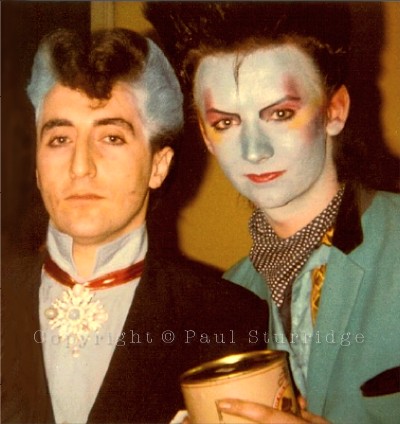
Philip Sallon partying with blue-faced George in 1980 when he was an obsessive record collector. (Photographed by Paul Sturridge)
❏ Feb 20 update: The new slimline beardie, tachioed George interviewed at the Brits:
“Twitter were very nice and got my name back [from somebody else] but Facebook won’t do it – so I actually don’t own my Facebook page. I’m Angela Gina Dust”
Worried About The Boy: Queens of London’s Blitz Club and pioneers of the 80s New Romantic style, Christopher (Daniel Wallace) and George (Douglas Booth) as fictionalised in the BBC drama
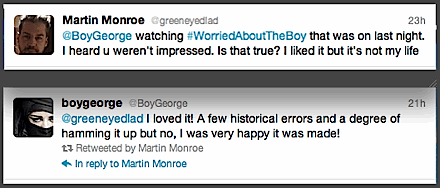
❚ FOR VIEWERS CATCHING UP TONIGHT on the repeat of Worried About The Boy, the BBC’s sanitised drama about Boy George’s teen romancings, read how Shapersofthe80s canvassed the reactions of original Blitz Kids live during its first transmission in 2010.
❏ iPAD, TABLET & MOBILE USERS PLEASE NOTE — You may see only a tiny selection of items from this wide-ranging website about the 1980s, not chosen by the author. To access fuller background features and site index either click on “Standard view” or visit Shapersofthe80s.com on a desktop computer. ➢ Click here to visit a different random item every time you click
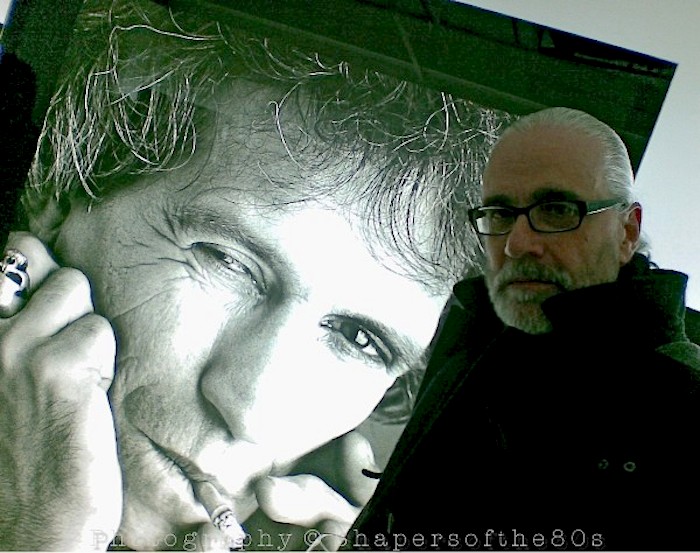
Snapper and Stone: Derek Ridgers seen at last night’s Sunday Times party at the Saatchi Gallery beside his photo of Keith Richards, published by the Magazine in 1986. (Nokia mobile snap by yours truly)
◼ WHAT ARE THE ODDS on any photographer having an iconic photograph included in the exhibition celebrating the 50th anniversary of The Sunday Times Magazine, the UK’s first newspaper colour supplement? Launched in the dull days of 1962 when papers appeared only in black-and-white, as did TV, the mag proclaimed itself the paper’s Colour Section to point up its USP. Since then it must have published at least 250,000 pages, so the odds of being shown in the powerful new exhibition at London’s Saatchi Gallery are stacked against most of its contributing photographers. Only 60 were chosen for the show.
This elegantly mounted selection of 100 historic pix, plus various supporting mementoes, packs a surprising punch. The vitality of the huge images is an object lesson in what makes photographic magic.
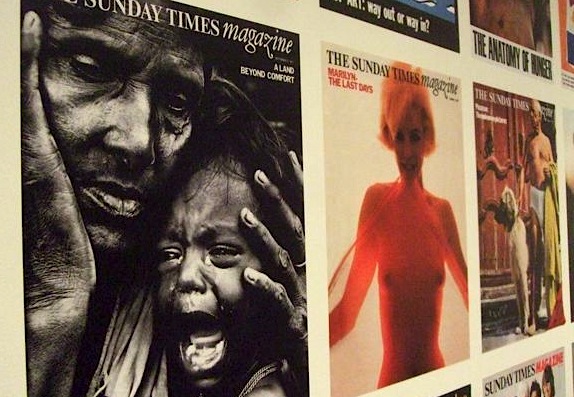
Grit and glamour on ST Magazine covers: Don McCullin’s exhausted mother and weeping child in Bangladesh, 1972 … Marilyn Monroe on a 1973 cover, photographed in a famous series of naked pictures by Bert Stern, a month before her death in August 1962
Right from the off, the Mag established its benchmark: “photographer first”. In Feb 1962 the 24-year-old David Bailey’s launch issue cover shots at Chelsea Reach showed the model Jean Shrimpton wearing a Mary Quant outfit and announced the dawn of Swinging London. Inside pages featured pop artist Peter Blake five years before he designed the Beatles’ Sgt Pepper album sleeve, and a short story titled The Living Daylights by 007 author Ian Fleming.
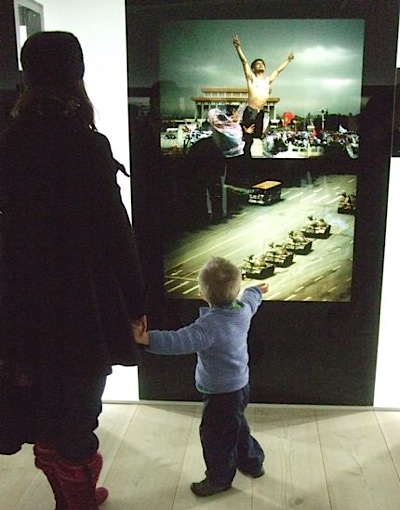
In the words of Michael Rand, the Mag’s art director for 30 years, its credo was “grit plus glamour — fashion juxtaposed with war photography and pop art”. This meant serious investment in photo-reportage from the world’s troublespots. He went on to champion the work of Eve Arnold, Snowdon, Terry O’Neill, Brian Duffy, Richard Avedon, Eugene Richards, Diane Arbus, Mary Ellen Mark. Rand says he felt a great responsibility to project the honesty of their pictures. Risking his life in the warzones of the late 20th century, Don McCullin survived sniper bullets to return with some of the century’s most haunting pictures, and to write movingly of the impact on his own soul from having witnessed at first hand the pain and the pity of shell-shocked soldiers and starving children in Biafra, Vietnam and Northern Ireland. In 1989, Stuart Franklin, onetime president of the Magnum agency, leant out of a hotel window to give the world the unforgettable image of a young man single-handedly halting a column of tanks in Tiananmen Square.
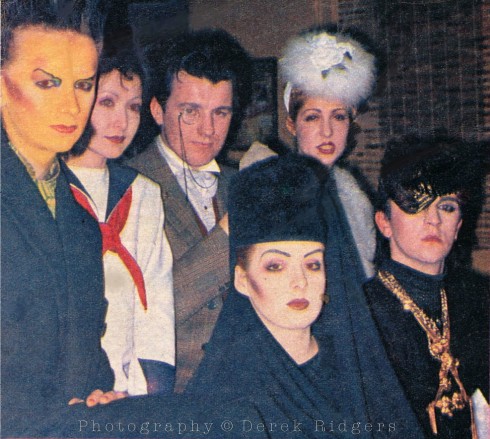
First group pic of key Blitz Kids, April 1980: George O’Dowd, Vivienne Lynn, Chris Sullivan, Kim Bowen, Pinkietessa and Steve Strange immmortalised by Derek Ridgers for The Sunday Times Magazine
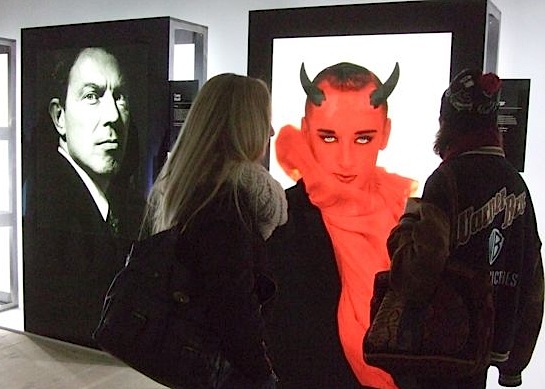
All the more reason to be extra-impressed at last night’s party launching the exhibition to meet my old ally on London’s clubbing scene in the 80s, Derek Ridgers. You know his pictures of everyone within a mile of Steve Strange, king of the posers, because they’re all over this website, and as half a dozen key Blitz Kids well remember, he snapped their first published group shot at the Blitz for the ST Magazine in April 1980. Last night Derek had been chatting on and off for at least half an hour while we sidestepped the namedroppy media luvvies and posey models to mingle with the veterans Mike Rand and Beatle biographer Hunter Davies, ST picture editor Ray Wells and snapper Uli Weber (standing in front of his demonic pic of Boy George sprouting a pair of satanic horns, while his pic of Kylie Minogue in the bath is on the poster for this show).
Eventually Derek, who is modest to a fault, asked if I was carrying a camera and I had to say no, thinking it a bit uncool at a swanky champagne bash for 700 media A-listers (which was obviously his view too since his own holster was empty). We did then discover that we were both toting the same unsmart workhorse Nokia 6300 mobile with 2Mp cams onboard. OK, they’ll do, so would I mind taking a pic of him beside his own exhibit at the end of the gallery? Excuse me, Derek? Nice old mild-mannered Derek with his long hair tied in a tail, and knapsack over his shoulder? Renowned for his book full of skinhead and punk portraits, not to mention the dodgy habitués of sexclubs like Skin Two, of David Claridge vintage? Derek’s IN this show? Yes he is. Even with the odds stacked at 250,000 to one against, it’s true. “I was amazed when they sent me an email asking if they could show this photograph,” he said. “So I said, yes, I didn’t mind.” How cool is that?
What we see is a charismatic mugshot of wrecked old Scary Stone, Keith Richards, snapped back in late 1985 when the face of the “10th greatest guitarist of all time” was engraved with a tiny fraction of the million lines it boasts now. He was settling into his marriage to the model Patti Hansen, and Derek persuaded the rock star to pose for him after a chance encounter at the Savoy hotel in London. He says: “There was no KR entourage whatsoever. He couldn’t possibly have been any more helpful. I guess that’s what makes him the guy he is.”
Full marks for initiative, Derek. In 2012 The Sunday Times remains the UK’s best-selling quality newspaper. In the season of Oscars and artsy prizegivings, to be included among the 60 top photographers in the life of its mighty Magazine is pretty well the best gong a lensman can win.
Grit and glamour at the Saatchi Gallery: Tim Hetherington’s photographs observe American soldiers asleep in 2009 in Afghanistan. He said they are about “the intimacy of war. We’re not talking about friendship. We’re talking about brotherhood.” He was killed in Libya in 2011 … Minutes before a tense Amy Winehouse went onstage at a Mandela tribute concert in 2008, Terry O’Neill persuaded the singer to pose for a pic dedicated to the great man. O’Neill said: “She steeled herself for it.” All published in the ST Magazine. Gallery views by Shapersofthe80s
Beijing 1989: Stuart Franklin photographed pro-democracy student protesters in Tiananmen Square which made a cover shot for the ST Mag. Two days after the massacre of hundreds of civilians, he caught “Tank Man” defying Chinese T-59 tanks armed only with his shopping bags
Glamour and grit: Faye Dunaway in Beverly Hills at 6am the day after winning her 1977 Oscar for Network, photographed by her future husband Terry O’Neill… Right, in 1976 Don McCullin catches six Christian Phalangist militia playing music over a girl’s corpse after they went into East Beirut to “clean up the rats”. One had a Kalashnikov and another a lute stolen from the home of the people they’d just killed. McCullin says: “It haunts me to this day.”
Grit or glamour, the eyes have it: Nigel Parry nails the steely ambition of Tony Blair in 1994, weeks before becoming the Labour Party leader and going on to win three general elections … Uli Weber nails the demons of pop singer Boy George on tour in 1993, after emerging from one of his early descents into drug-fuelled despair
➢ Update: The Sunday Times Magazine 50th Anniversary Exhibition runs at the Saatchi Gallery, London, was scheduled to run until Feb 19, excluding Feb 11–14, now extended to March 18. Entry is free. The Magazine published a dedicated anniversary issue Sunday, Feb 5.
What, me, pensioner? David Bowie and his wife the supermodel Iman attend the DKMS Annual Gala in New York City last April. (Photo by Andrew H. Walker/Getty)
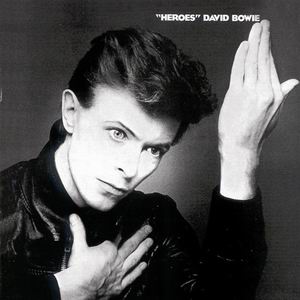
❚ HAPPY BIRTHDAY MR BOWIE. And thanks for the boggling, inspirational, poptastic ride so far —140 million albums sold and the rules of rock rewritten. You will be the genie waiting at the end of time. Boy George has this to say in his foreword to Graham Smith’s new book on 80s clubland, named after David Bowie’s song We Can Be Heroes: “Of the New Romantic moment I have always said, It was all Bowie’s fault.” What he refers to is the Bowie bequest to the teen generations he entertains. As a cultural lightning rod he has bequeathed insights into the realm of the imagination. As a performer he has delivered a repertoire of life-skills through a cast of mythical personalities invented for himself as a popstar, from the self-destructive Ziggy Stardust and the amoral Thin White Duke, to his romanticised “Heroes” (his own quote marks added to emphasise self-awareness). Through their formative years, Bowie invited his acolytes:
✰ to explore identity, androgyny, the primacy of the visual.
✰ to adopt stances: individualism, alienation, decadence, transgression.
✰ to follow his principles for living amusing lives: disposable identities, portable events, looks not uniforms, tastelessness “on purpose”.
His signature tune, “Heroes”, still echoes today as a heart-stirring anthem because he was passionate and optimistic and musically this number is brimming with awe. He sang about intimacy and love triumphing over the horrors of the outside world. Finding joy in simple pleasures could make heroes of us all, “just for one day”. As a creed to live by, it has underpinned his own life. “I’m an instant star,” he said. “Just add water and stir.”
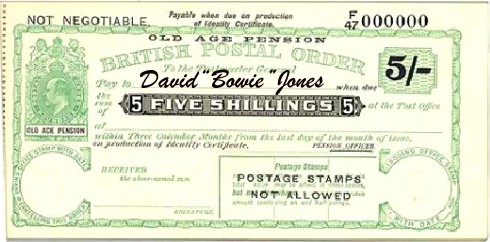
Were he still living in the UK, today’s birthday would designate him, in the idiom, “an old-age pensioner”, and the state would pay him slightly more than the five shillings a week handed over when the scheme began 100 years ago. He can’t be 65, you’re saying as you inspect the picture of him and his wife Iman [above] at a leukemia charity gala in New York last year. He looks too good for 65. “Waddayamean?” he’d be bound to snap, flinging back the old feminist line, “This is how 65 looks in the 21st century.”
True, if you start young, break the rules and push yourself to the max, as all geniuses do. While in short trousers, the little suburban Londoner David Jones was nothing if not prolific. At 11 he was playing a skiffle bass, buying and collecting the NME for future reference, learning the sax at 13 and soon moving up through a succession of bands: Konrads, Hookers, King Bees, Manish Boys, Lower Third, Buzz, and Riot Squad.
At school he fell under the spell of an art teacher, Owen Frampton, whose own son Peter went on to musical fame. Bowie has said: “I went to one of the first art-oriented high schools in England, where one could take an art course from the age of 12. Three-fourths of our class actually did go on to art school.”
Everybody knows how this liberal education shaped his outsider stance, how he redefined glam-rock, and how his incarnation as Ziggy Stardust made him an international star and one of the most iconoclastic forces in 70s music. How much more fun though to celebrate a grand milestone by looking back to the earliest expressions of that genius and to wonder aloud how else might the talents of the young David Jones have developed? Today, we find whole chapters of his formative experiments on video online, from mime artist and music-hall hoofer, to actor and fin-de-siècle soothsayer. In all the springboard moments pictured in the slideshow above, Bowie is no older than 24. At any moment the fickle finger of fate could as easily have pointed in any number of directions…
In 1969 Bowie’s manager Kenneth Pitt proposed to showcase his talents by producing a half-hour film called Love You Till Tuesday. The compilation showcased tracks from his 1967 debut album, plus a spanking new song, Space Oddity, which introduced Major Tom and became his first hit. Cleverly anticipating the first Nasa Moonwalk in 1969, the filming for this number pastiches Stanley Kubrick’s cine-epic premiered the previous year. It effectively proposed what today we call the promo video which, as Kevin Cann reveals in his exhaustive 2010 Bowie biographyAny Day Now, remained substantially unseen by the public until its release as a clip in 1984. The whole half-hour showreel went online for the first time only yesterday…
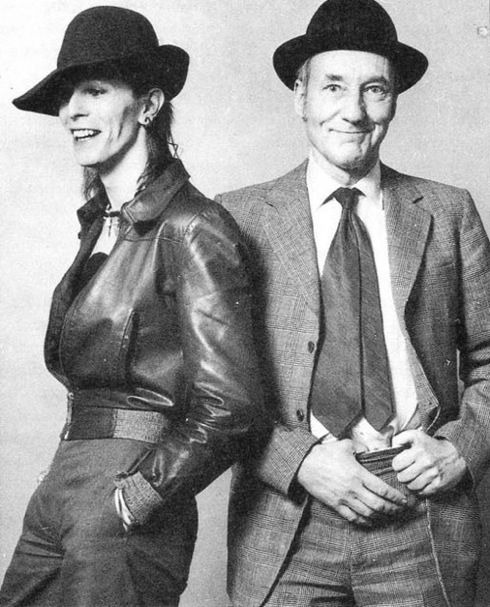
THEN HE MET WILLIAM BURROUGHS
1973: Bowie is interviewed for Rolling Stone with novelist Wiliam Burroughs and photographed by Terry O’Neill
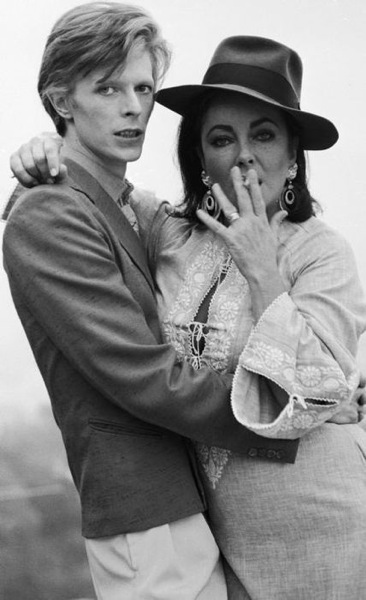
THEN HE MET LIZ TAYLOR
1975: Bowie meets Hollywood legend Liz Taylor. Photographed by Terry O’Neill
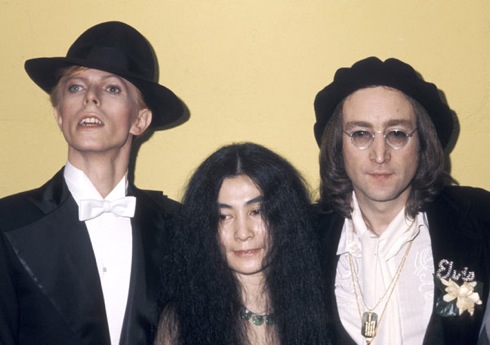
THEN HE WROTE A SONG WITH JOHN LENNON
1975: At the Grammys, Bowie upstages Yoko Ono and John Lennon — one day he gets jamming with David in a studio and turns a lick into the song Fame
❚ THE 80s REUNION OF THE NEW YEAR had been long touted and sceptically doubted. Yet suddenly on November 15 Australia’s number one breakfast show Sunrise on Channel 7 had a world exclusive: the 80s supergroup Culture Club were reforming to play live at the New Year’s Eve celebrations on Glebe Island right in Sydney harbour. That week Shapersofthe80s reported the amazing news. There on video we saw all four members of the chart-topping band with their vocalist Boy George sporting his powder blue Treacy hat, squeezed into a tiny studio in London.
But everybody’s body language looked awkward, not helped by the satellite link causing long silences in the London-Oz conversation. Once each member spoke up, however, they seemed able to laugh at themselves, including drummer and onetime lover of George, Jon Moss now married and aged 54, who attended George’s last birthday party with his wife. All three were papped there in a smiling embrace.
In the Sunrise interview, however, Jon wore a wearisome expression as he sat behind George, like some jaded husband who’s heard the wife making promises a million times before. And when asked why it had taken ten years to get together, Jon fessed up that “It takes that long to recover from the last time we worked with each other”. Nobody laughed, only averted their eyes. This might of course have been Jon being his usual sardonic self. Or, even then, he might have been suffering the terrible back pain which it is said has laid him low since Christmas .
In the event, on Tuesday as George watched the in-flight movie Senna aboard the plane out of London and tweeted “OMG, he was a beauty & so sweet”, Jon Moss was not beside him. When Culture Club stopped over to play a warm-up gig at the Tennis Stadium in Dubai, Jon was not at his drumkit, nor did he appear in Australia. A brief announcement before Culture Club took the stage in Sydney just after midnight on Jan 1 amounts to all the public has been told: Jon was stuck in London with a bad back, apparently a slipped disc. A sharp-eyed fan in the US called Gloria recalls that George tweeted about this on December 30. He said: “Jon is very unwell sadly. He was too poorly to travel. He’s gutted, so are we!”
Culture Club’s warm-up gig in Dubai Dec 29: while the poster includes Jon Moss, only Boy George, Mikey Craig and Roy Hay take to the stage with a stand-in drummer. (Videograb courtesy boypierreemmanuel)
Fans naturally started to ask what’s really up behind the scenes? Old friends initially suspected a classic attack with a hatpin, harking back to the old feuding of the 80s. But talk within Culture Club circles this week confirms that Jon has suffered an authentic injury and is due to go into hospital for treatment. The camaraderie between George, Jon, Roy and Mikey is reported to have been rekindled and rehearsals actually enjoyable and relaxed enough for whoever is around to join in with the writing. At band dinners in Dubai and Sydney there was agreement that the two shows had gone well. George was being particularly sociable with everyone after hours, rather than doing his own thing as in the old days.
All the more surprising then that George hasn’t offered Jon any further sympathy on Twitter or Facebook. Nor have we heard anything about Jon’s health expressed publicly. OK, there doesn’t seem to be an active official website for Culture Club as a band, but George’s own website has stayed schtum too. Amid George’s continual tweeting during the round trip (which included a bleat about a hotel charging $8 to deliver coffee to his room), the only reference to the show itself said: “I had such a great time tonight in Sydney. A very memorable NYE, with Neil Tennant from PSBs.”
Seven words spring to mind: Do you really want to hurt me?
One other interview during December gave a glimpse inside Culture Club family relations. With George sitting on ITV’s This Morning sofa [video below] plugging his £500 coffee-table photobook, Philip Schofield and Holly Willoughby quizzed him about the infamous Culture Club split back in 1986, and the 10-year gap since the band’s last reformation.
George said: “We never really ‘fell-out’ fell out. It was more personality things. It was never financial because they’re the worst fall-outs when people fall out financially, that’s hard to come back from. But we never had any of that stuff. It was just childish stuff… What’s funny about bands is it’s a bit like being in a dysfunctional family — and people don’t change. What happens is you change the way you react to people. The thing about being grown up. ‘That annoys me but I’m just going to take a walk’ — ‘I’m not going to tell you that that annnoys me.’ You have to learn to be tolerant.”
Make of that what you can!
THREE-MAN CULTURE CLUB PLAYING DUBAI DEC 29
… AND IN SYDNEY JANUARY 1
Culture Club live in Sydney 2012: Kevan Frost substituting for Jon Moss on drums. Photo courtesy samesame.com.au
❏ Standing in for Jon Moss as drummer in both Dubai and Sydney was Kevan Frost whose credits as a collaborator with George go back to the 90s, so the music was familiar territory for him. Prominent onstage, too, was the familiar bearded figure of John Themis on guitar, another long-standing co-writer and producer during George’s years as a solo performer. Also onstage, keyboard player, percussionist, four brass and three backing singers.
Culture Club live in Sydney 2012: Roy Hay and John Themis. Photo courtesy cyberchameleon.com
Culture Club live in Sydney 2012: Mikey Craig photographed by Johnny Au
➢ Choose “View full site” – then in the blue bar atop your mobile page, click the three horizontal lines linking to many blue themed pages with background article
MORE INTERESTING THAN MOST PEOPLE’S FANTASIES — THE SWINGING EIGHTIES 1978-1984
They didn’t call themselves New Romantics, or the Blitz Kids – but other people did.
“I’d find people at the Blitz who were possible only in my imagination. But they were real” — Stephen Jones, hatmaker, 1983. (Illustration courtesy Iain R Webb, 1983)
“The truth about those Blitz club people was more interesting than most people’s fantasies” — Steve Dagger, pop group manager, 1983
PRAISE INDEED!
“See David Johnson’s fabulously detailed website Shapers of the 80s to which I am hugely indebted” – Political historian Dominic Sandbrook, in his book Who Dares Wins, 2019
“The (velvet) goldmine that is Shapers of the 80s” – Verdict of Chris O’Leary, respected author and blogger who analyses Bowie song by song at Pushing Ahead of the Dame
“The rather brilliant Shapers of the 80s website” – Dylan Jones in his Sweet Dreams paperback, 2021
A UNIQUE HISTORY
➢ WELCOME to the Swinging 80s ➢ THE BLOG POSTS on this front page report topical updates ➢ ROLL OVER THE MENU at page top to go deeper into the past ➢ FOR NEWS & MONTH BY MONTH SEARCH scroll down this sidebar
❏ Header artwork by Kat Starchild shows Blitz Kids Darla Jane Gilroy, Elise Brazier, Judi Frankland and Steve Strange, with David Bowie at centre in his 1980 video for Ashes to Ashes
VINCENT ON AIR 2026
✱ Deejay legend Robbie Vincent has returned to JazzFM on Sundays 1-3pm… Catch up on Robbie’s JazzFM August Bank Holiday 2020 session thanks to AhhhhhSoul with four hours of “nothing but essential rhythms of soul, jazz and funk”.
TOLD FOR THE FIRST TIME
◆ Who was who in Spandau’s break-out year of 1980? The Invisible Hand of Shapersofthe80s draws a selective timeline for The unprecedented rise and rise of Spandau Ballet –– Turn to our inside page
SEARCH our 925 posts or ZOOM DOWN TO THE ARCHIVE INDEX
UNTOLD BLITZ STORIES
✱ If you thought there was no more to know about the birth of Blitz culture in 1980 then get your hands on a sensational book by an obsessive music fan called David Barrat. It is gripping, original and epic – a spooky tale of coincidence and parallel lives as mind-tingling as a Sherlock Holmes yarn. Titled both New Romantics Who Never Were and The Untold Story of Spandau Ballet! Sample this initial taster here at Shapers of the 80s
CHEWING THE FAT
✱ Jawing at Soho Radio on the 80s clubland revolution (from 32 mins) and on art (@55 mins) is probably the most influential shaper of the 80s, former Wag-club director Chris Sullivan (pictured) with editor of this website David Johnson
LANDMARK FAREWELLS. . . HIT THE INDEX TAB UP TOP FOR EVERYTHING ELSE

















 ➢➢ Shapers of the 80s ➣➣