➤ Lest we forget the 907 Falklands dead and the 1,965 injured

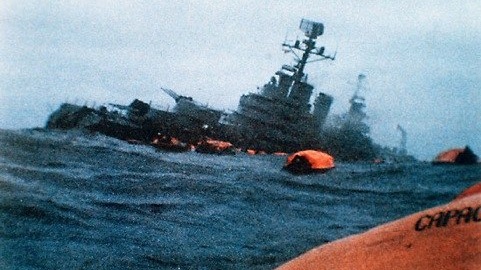
Belgrano, sinking, Falklands, 1982

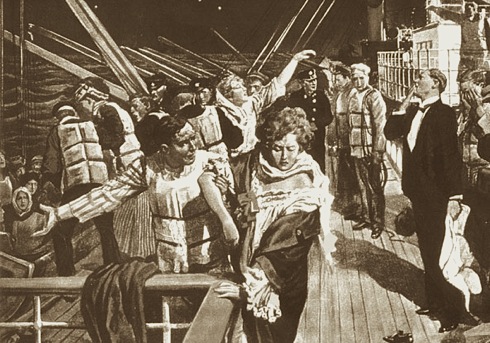
May 2, 1982: ARA General Belgrano lists heavily to port in the Atlantic Ocean, while its crew abandon ship. Sailor’s picture via Press Association

❚ TODAY WAS THE DAY 30 YEARS AGO that prime Minister Margaret Thatcher took Britain to war in the South Atlantic Ocean, all because a repressive dictatorship in Argentina had occcupied a tiny island with a handful of marines posing as scrap merchants. Since the 1800s, Britain had asserted sovereignty over the Falkland Islands (population 1,800) and its neighbouring dependencies, while Argentina repeatedly claimed its sovereignty over the colony it knew as the Islas Malvinas. They lie 300 miles away from Argentina and 8,000 miles from the UK.

Neither nation formally declared war on the other, yet the 74-day conflict led to the deaths of 649 Argentine and 255 British servicemen and 3 Falklands Island civilians. There were 1,188 Argentine non-fatal casualties and 777 British. The whole tragic saga was made more complex when the US declined to intervene because its Central Intelligence Agency had supported the military junta of Leopoldo Galtieri, the President of Argentina, against the Sandinistas in Nicaragua.

One month to the day after the Argentinian invasion, Sunday May 2, the British war cabinet headed by Margaret Thatcher, met at Chequers, the prime minister’s weekend retreat, and unanimously agreed to a naval order to sink the Argentine warship, General Belgrano, in the South Atlantic.

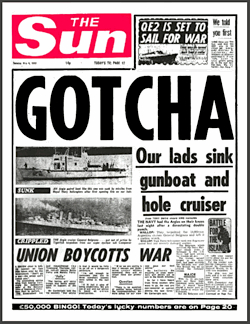
The Sun, Gotcha, 1982, Belgrano, Falklands War,Subsequently, to its eternal shame, Britain’s biggest selling daily paper The Sun boasted in its most notorious headline: “GOTCHA”. This rabid jingoism by middle-aged politicians and armchair media generals alike, as they relived memories of World War Two, drove a wedge into the generation gap that has never been equalled. Those of us under 40 — too young to remember WW2 — were appalled that a simmering 150-year-old squabble with Argentina over sovereignty of the Falkland Islands should now warrant military action by Britain. We were even more appalled at the near-total, gung-ho media hype that blessed it.

Britain initiated the first naval loss at 4pm that Sunday when the nuclear-powered submarine HMS Conqueror fired a pattern of torpedoes at the Belgrano which was patrolling south of the Falklands. Two struck the vintage light cruiser and within 20 minutes its captain ordered his men to abandon ship. It was more than a day before 770 were rescued from the open ocean. Meanwhile 323 crew had died.

In their superbly detailed chronicle The Battle for the Falklands (1983, republished 2012), journalists Max Hastings and Simon Jenkins report the reasoning of a senior British commander: “You have got to start something like this by showing that you’re bloody good and you’re determined to win.” After the sinking, a British destroyer captain said when he broke the news to his ship’s company: “There was a mixture of horror and disbelief. There certainly wasn’t any pride.” The legitimacy of this British action remains the subject of controversy today.

Retribution followed two days later, on May 4. An Argentine Exocet missile struck the British destroyer HMS Sheffield amidships, with devastating effect, ultimately killing 20 crew members and severely injuring 24 others. The ship sank six days later. In the Royal Navy, Hastings reported, officers and men were shocked at the ease with which a single enemy aircraft had destroyed a warship specifically designed for air defence.

On June 8, at Bluff Cove on East Falkland, Argentine aircraft bombed Britain’s civilian-manned landing ships Sir Galahad and Sir Tristram, causing the biggest loss of British forces in the conflict. A total of 32 Welsh Guards died, and 150 men suffered burns and injuries.

Bluff Cove, Falklands war,Sir Galahad,

Britain’s civilian-manned vessel Sir Galahad ablaze after the Argentine air raid on East Falkland, June 8, 1982. This videograb comes from newly unearthed footage shot by guardsman Tracy Evans, which is viewable on the BBC news website

➢ Welsh Guard’s film shows Falklands War scenes for first time (above)

➢ Falklands War 30 years on — by Simon Jenkins who co-authored the most detailed account of the conflict: “How British PM’s lucky gamble turned Thatcher into a world celebrity, not only repelled the Argentinian invasion but also paved way for her ideological reforms.”

FRONT PAGE

➤ Trimphone aside, can you spot the designs that changed the look of Britain over 60 years?

British Design,exhibition ,Innovation, Modern Age, Victoria & Albert Museum,

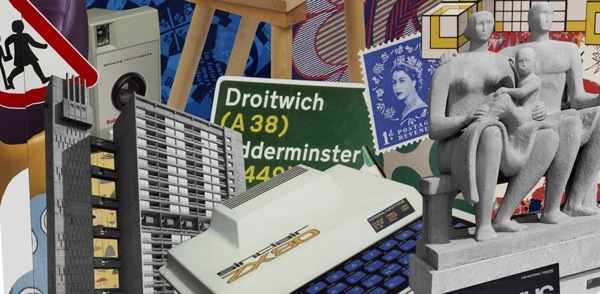
British Design catalogue collage: road signs, high-rises, Kodak cameras, postage stamps, computers and Henry Moore — all are exhibited here

“Britain has since 1948 sustained an extraordinarily vigorous creative culture, even against a background of manufacturers leaving the stage like the instrumentalists in Haydn’s Farewell Symphony. It’s an inclusive culture, hence tapestries and Jaguars. It’s a culture that swoops artfully between high and low. It’s a culture that could import, with characteristic fairhandedness, both John Betjeman and Nikolaus Pevsner. The one in thrall to the village, the other in thrall to steel and glass. Wonderfully, each was a founder of The Victorian Society. Their contrasting spirits dominate British design in the years before The Beatles’ first LP. Thereafter, the Britain of crumpets-with-vicar became the undisputed global capital of youth culture whose furious organic vitality still invigorates business life.”

➢ Stephen Bayley, former chief executive of the Design Museum, writing in The Independent

Denys Lasdun, University of East Anglia,architecture

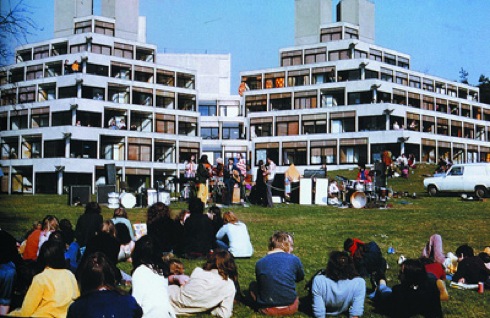
Architect Denys Lasdun’s University of East Anglia, 1962-68: raised walkways, striking ‘ziggurats’ and no building on campus more than five minutes’ walk away

❚ AN EXHIBITION TITLED British Design 1948–2012: Innovation in the Modern Age, is bound to infuriate as much as it excites. The grimly claustrophobic galleries that host temporary shows at the Victoria & Albert Museum abound with iconic and nostalgic everyday objects, rather as a good car-boot sale does. Yet the omission of much imaginative British media is unforgivable — the template for newspaper colour supplements laid out by The Sunday Times plus a serious investment in photo-reportage, for example… the more-British-than-British essence with which the American Joseph Losey propelled a whole chapter of stylish cinema… the sci-fi television fantasies of The Prisoner or Doctor Who…

Twiggy , Mary Quant ,miniskirt,Swinging London, youth culture

Twiggy models the Mary Quant miniskirt, 1965: named after the designer’s favourite car, the mini encapsulated the youth culture of Swinging London — energetic and unconventional

What the V&A show’s three themes propose — under the headings Tradition & Modernity, through the Subversion of pop, to Innovation & Creativity — amounts to a vital module for every art or design student in the education system, whose forebears, thank goodness, benefited from the shake-up imposed in 1960 by the Coldstream Report.

Ignore most dithering reviews of this hot-and-cold exhibition. Instead, do savour the argumentative Stephen Bayley, writing in that onetime model of new newspaper design, The Independent. He nails the paradox of this show in a daydream: “I became drunk on memories of whimsy, charm, gentility, wit and Macmillan-era futurism. My imagination never turned to the ruins of industry, the loss of technological competence, the barrenness of every British city except London and the fact that the economy of our once-busy island workshop is now based on the theory and practice of a dodgy casino.”

Bayley then comes to the nub of the matter: “The tricky thing is ‘design’ itself. It’s often muddled not only with ‘innovation’, but with invention, fashion and taste-making, sometimes even with art. After more than 150 years of promoting design at the V&A, no one seems to have any very clear idea of what it is. If it is a real subject, it must have a discipline. But what discipline connects Spence’s Coventry Cathedral with Damien Hirst’s 1997 Pharmacy restaurant in Notting Hill, west London, each of which features here?

“If, as the design lobby often insists, ‘everything has been designed’, then everyone is a designer. So what special qualities do professional designers bring to any task?”

British Design,exhibition ,Innovation, Modern Age, Festival of Britain, Skylon, Concorde

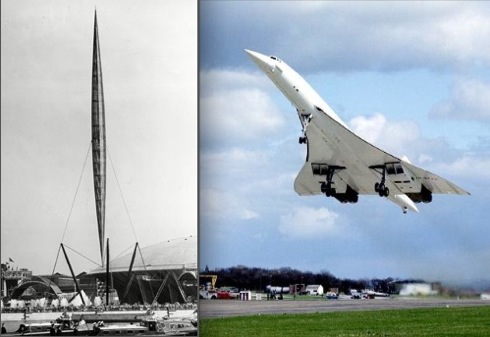
Notions of modernity: at the Festival of Britain, 1951, the Skylon designed by Powell & Moya was rendered by the practice’s junior architect James Gowan as a monumentalised missile, and symbolised the dawning age of science. In 1979, BA’s sixth Concorde took off on its maiden flight

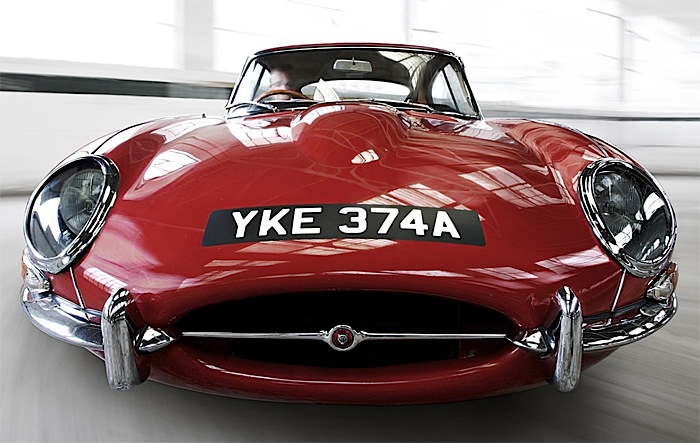
Aim Bayley’s question at three triumphs of design in the V&A show: the kinetic balancing act of the Festival of Britain’s Skylon structure; the bird-wing aerodynamics of Concorde miniaturised at the V&A in a 20-ft model; and the most thrilling artefact in the entire show: the skilfully lit Jaguar E-Type from 1961 which rival manufacturer Enzo Ferrari declared “the most beautiful car ever made”. Drop down to one knee and view the Jag diagonally from any corner and wonder at its lack of straight lines. One curve after another creates changing perspectives that conspire to emulate speed even as it stands motionless before you. Seldom will you hear both men and women purring over such a seductive silhouette! Seldom will you ever see such a thrilling manmade object.

There are a good number of breathtaking moments in this show that beg you to ask why and how an exhibit stopped you in your tracks, though not as many as you would wish.

Malcolm Sayer, Jaguar E-Type,sports car ,

Relish the curves: designed by Malcolm Sayer, the Jaguar E-Type 3.8-litre sports car was launched at the Geneva Motor Show in 1961 as a two-seat coupe or convertible, with a top speed of 150 mph. The car’s shape is the epitome of speed

➢ British Design 1948–2012: Innovation in the Modern Age, runs at the Victoria & Albert Museum, Mar 31 until Aug 12

FRONT PAGE

➤ Proustian frissons aplenty as Derek Ridgers’ photographs revisit three decades

Derek Ridgers, photography, exhibition, Society Club,Morrissey

Derek Ridgers in Soho last night: his portrait of Morrissey a bridge between two eras. Photographed by Shapersofthe80s

❚ SOME PHOTOGRAPHERS ARE as extrovert as their famous sitters, but Derek Ridgers has captured the essence of British street style and achieved a uniquely influential status by tip-toeing through the margins of life, feather-footed as the questing vole. Anyone who has followed the Punk and New Romantic scenes recognises the Ridgers types — “transient beings moving across an urban landscape, experimenters, flamboyant souls who cared more than anything about how they looked and whose greatest fear was of being ordinary”, as writer Val Williams noted in the Ridgers photobook of 2004, When We Were Young: Club and Street Portraits. His straight-up photographic style pinned those clubbing butterflies like curios into the display case labelled Swinging 80s. They trigger the involuntary remembrance of the texture of an era as readily as cake did for Marcel Proust: each image has the potential to become the “vase filled with perfumes, sounds, places and climates”.

Throughout April and May we may relish the Ridgers back catalogue in a new exhibition titled Unseen at Soho’s Society Club. The selection documents celebrities and street stylists from 35 years of commissions by music mags and national press. Here is an engaging mix of concert shots and powerfully intimate portraits in which eye-contact is key: Nick Cave, David Lynch, J G Ballard, Boy George, Tom Waits, The Cramps, Mick Jagger, plus the image of Keith Richards which is currently touring in the Sunday Times Magazine 50th anniversary show.

Another exceptionally striking portrait has the singer Morrissey eyeballing the Ridgers lens with an intense gaze that definitely says misunderstood but could just as easily be saying cussed. It was shot in London in 1985, year of The Smiths’ second album, Meat Is Murder, when Moz began raising the temperature with political views about the Thatcher government and the monarchy.

Derek Ridgers, photography, exhibition, Society Club, Keith Richards

Soho last night: Ridgers, Richards and a new snapper called Tracy Jenkins. Photographed by Shapersothe80s

Ridgers said: “He’s a bit of a strain to photograph in the sense that there is so little of his personality coming back at you. Or at least there wasn’t in those days. Maybe he was very shy but he seemed taciturn in the extreme. The two times we met, he gave the impression of not wanting to say boo to a goose. He honestly hardly said a word to me. Nothing at all like the extremely opinionated personality that comes across in interviews these days.”

The two characteristic Morrisseys of then and now — the one taciturn, the other curmudgeonly — bestride three decades which completely reinvented British notions of youth culture, music, sexuality and success, yet at last night’s preview it was salutory to be pulled up by a 26-year-old illustrator among the guests who had to ask: Who was Morrissey?

All the more reason to buy ourselves a cool black-and-white print as a Proustian trigger, either directly from the Ridgers Archive or from an earlier catalogue viewable at the Society Club. Titled Previously Unpublished, this takes us from an iconic 1982 lineup of the ever-evolving band The Fall, through Culture Club, John Galliano, Roddy Frame, Tim Roth, into the 90s of the Charlatans, Ray Winstone, Lee Scratch Perry and a pensive Kylie Minogue to a raunchy Boo Delicious and more in the new century.

Ridgers has published three books of photographs, has exhibited frequently, and was a judge in How We Are Now, an online photography project launched by Tate Britain in 2007.

➢ Derek Ridgers Unseen runs until May 31 at the Society Club, 12 Ingestre Place, London W1F 0JF

➢ Previously Unpublished can be bought in various formats from Blurb, “a creative publishing service”

➢ 50 Years of The Sunday Times Magazine is viewable in Bristol, Manchester and Birmingham until June

FRONT PAGE

➤ Uh-oh! Vice lifts the lid on the untold dramality of Dalston Superstars

Dalston Superstars, #Exposed , Vicedotcom,dramality, web TV,hipsters
➢ Click the pic to view the new #Exposed video

➢ Vicedotcom exhumes its hipster tragicomedy — and just look at the tags: Mark Ronson, Grace Dent, billie jd porter, Paul Morley

Dalston Superstars #Exposed is the untold story of the web series that changed everything. Back in 2011, Dalston Superstars was launched on an unsuspecting internet, clocking up a record three million Facebook likes.

At first glance the show appeared to be just another dramality show in the vein of TOWIE or Jersey Shore, but, on closer inspection, was Dalston Superstars more than that? Was it in fact a searing satire, not only of reality television, but also of the mindless young hipsters who populate East London’s streets? / Er, discuss at Vice online

❏ Top Commenter and bad speller Guy Turner declares at Vicedotcom: “I think you started it as a reality TV spin-off with your cool hipster freinds [sic] then realised they were nobs [sic] so pretended it was satire as the abuse came in from all quarters.”

➢ Catch up on the whole darn dramality of the original Dalston Superstars as it unfolded — only at Shapersofthe80s

FRONT PAGE

2012 ➤ Hockney paints Hawking — watch a glittering new portrait emerge as a movie

David Hockney,iPad portrait,Brushes,exhibitions , Stephen Hawking,London, Science Museum

David Hockney at work on his iPad portrait of Stephen Hawking, showing from today at London’s Science Museum. Photograph © Judith Croasdell

Britain’s best-known painter meets the world’s best-known scientist. The outcome is a dazzlingly intimate birthday portrait of the wheelchair- bound Prof Stephen Hawking, captured in February at his office in Cambridge looking serene and fascinating with strangely luminous violet eyes. Today’s Science Museum blog reports:

IMAGINE BEING ABLE TO SEE the British artist David Hockney create a new work, stroke by stroke, before your very eyes. Now imagine this work is a portrait, providing an insight into the way Hockney composes his famous likenesses. Even better, the subject is none other than the distinguished Cambridge University cosmologist, Stephen Hawking.

For the next three weeks the Science Museum will display an animated version of Hockney’s portrait, running on the artist’s own iPad for more than three minutes and showing exactly how it was created. Visitors can see how his skill has evolved since he was first introduced to the Apple iPhone in late 2008 and then the iPad. Hockney draws with an app called Brushes which removes the need to cart around supplies, easel and palette… It is exhibited alongside a rarely seen Hockney line-drawing, dating from 1978, owned by Hawking’s first wife, Jane… / continued online

➢ Stephen Hawking: A 70th birthday celebration display at London’s Science Museum until April 9 … The book that made a celebrity of cosmologist Hawking in 1988, A Brief History of Time, broke records by staying on the Sunday Times best-sellers list for 237 weeks.

➢ More on Hockney at Shapersofthe80s: 1983’s landmark interview when he revealed “Suddenly I see cubism differently, more clearly”. Plus more of his iPad art

Ubermensch ,sculpture,Stephen Hawking, Jake Chapman, Dinos Chapman

Ubermensch 1995, by Jake and Dinos Chapman: Hawking as Fiberglass “Superman”

➢ Thin line between art and hate: is this the most repellent work of modern art? “The Chapman brothers’ sneering sculpture of Stephen Hawking sickened me in 1995, and still does now. What do you think is the most hateful work of modern art?” — Guardian art critic Jonathan Jones writing in January … and Jones again today: “Hockney’s portraits of Hawking are important documents of what really mattered in the culture of our time. Like Epstein’s Einstein, they will still be looked at when much art that makes headlines is utterly forgotten.”

➢ Professor Stephen Hawking has filmed a cameo for TV sitcom The Big Bang Theory, due to be aired next month in the US (May in the UK) — BBC News reports: The famous physicist will appear in a scene with socially awkward scientist Sheldon Cooper, played by Jim Parsons. He previously recorded voice-overs for animations The Simpsons and Futurama. Last year, he fronted his own TV series Brave New World for Channel 4, which looked at new developments in science and how they might benefit mankind … / continued online

FRONT PAGE