➤ Edison’s wax cylinder throws beatboxer Singh back to the age of acoustic recording

Aleks Kolkowski ,beatboxer, Jason Singh,wax recording,phonograph

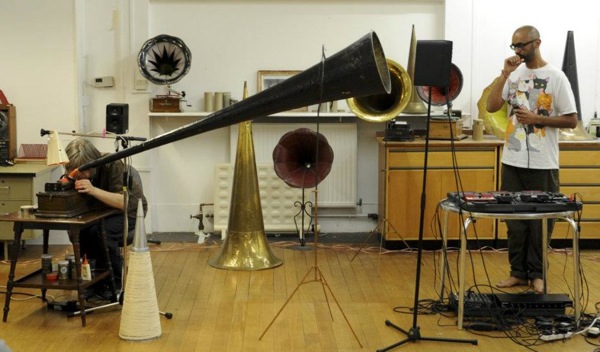
Wax recording at the Science Museum: Aleks Kolkowski tending his Fireside phonograph from 1909, while beatboxer Jason Singh improvises his mix of electronic samples and vocal sculpture through a speaker. (Photographed © by Marizu Okereke)

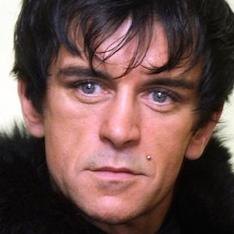
❚ SOUND ARTISTS IN RESIDENCE ARE, it seems, all the rage. Not only has London’s Victoria & Albert Museum got one (that’s him, the cool barefoot dude, above right), but so too has the Science Museum (the less cool dude from another planet, above left). And this week they got together to make some wax recordings on the kind of two-minute cylinders our great grandparents used to dance to. The big diff is the kind of beatbox sounds Jason Singh makes — scratchity screechity hoppity whack rhythms made using nothing but his mouth, lips and tongue. He styles himself a “vocal sculptor” since essentially it’s his voice making sinuously textured percussive music, the role of a microphone being simply to help amplify it.

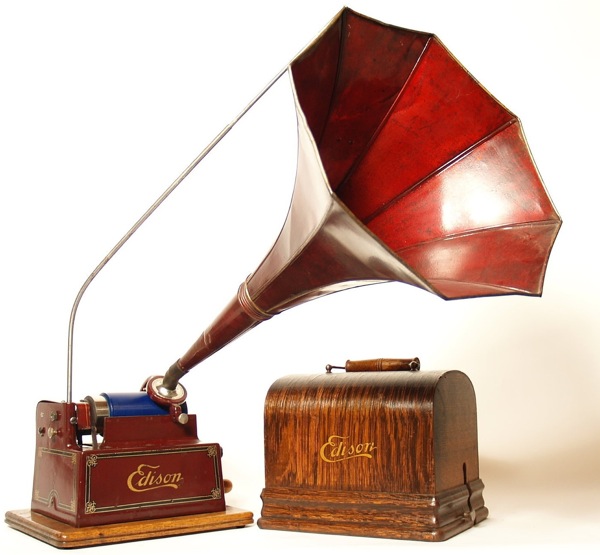
The reverse diff for him was not using a mic, but instead sticking his head deep inside a 7ft-long acoustic horn that channelled his voice down to a Mica membrane pressing on a flat-edged sapphire stylus, the vibrations from which cut a hill-and-dale spiral groove on a wax cylinder revolving at 160 rpm on a wind-up clockwork Edison phonograph Fireside model A, made in about 1909. His recording engineer was the shaggy professional musician, Aleks Kolkowski, who is running a series of experimental demonstrations during the next month on the art of acoustic recording. Each lunchtime session features a distinguished guest musician, artist or writer who will record acoustically by speaking or playing sounds without the aid electricity.

wax recording,phonograph

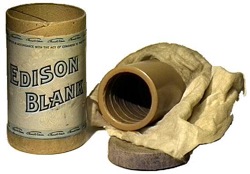
Edison cylinders: the earliest blanks were beeswax brown

In Jason Singh’s case, his performance was a piece of magic before the recording began. His sound test had you looking round the room for an orchestra and a chorus of jungle animals. It was unbelievable that everything we heard came from inside this lanky young man himself. Aleks warmed the cylinder with a red lamp to soften its ceresin and stearic wax mix. Jason’s head vanished inside the horn while his extremities twitched to his turntablist rhythms and the stylus cut the acoustic recording. It was unexpectedly thrilling to witness, with swarf flying off the recorder, though Jason’s voice was slightly too muffled inside the horn for the audience to judge the quality, so it was agony to have to wait to hear the outcome while the cylinder was set aside to cool.

A second session saw Jason mixing samples and loops at a console, these more complex sounds then feeding out through a regular loudspeaker which faced into the same acoustic horn. This utterly different sonic landscape was nearer to musique concrète which treats pre-recorded sound as raw material.

Aleks Kolkowski ,beatboxer, Jason Singh,wax recording,phonograph

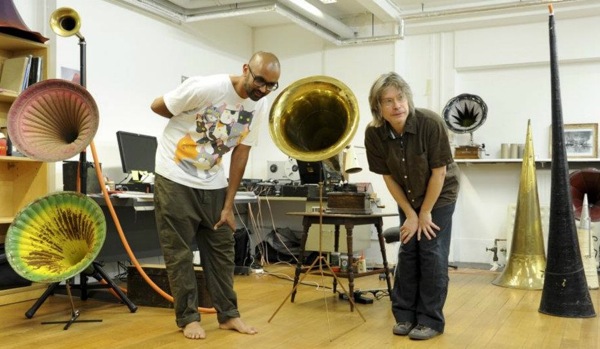
Playback at the Science Museum: Jason Singh and Aleks Kolkowski are as keen as the audience to know if the wax recording has worked. (Photographed © by Marizu Okereke)

Playback time arrived. Jason and Aleks positioned their ears on either side of the phonograph, now equipped with a pick-up stylus and a huge antique brass concert horn. From a low register, Jason’s human beatboxing slowly grew into distinct and intricate musical patterns, but suffused and somehow wonderfully other-wordly. He was rewarded with rapturous applause. His own verdict: “Wicked!” Aleks wondered whether the second more experimental recording would prove as successful, and indeed moments did give the effect of wind howling across the Arctic tundra. Jason’s verdict: “Exorcist!”

The best recording will soon be posted on Aleks’s archive website Phonographies where you can hear digital transfers of his many other recordings made on contemporary wax cylinders.

Aleks Kolkowski ,wax recording,phonograph

Armed with a brush: Aleks Kolkowski clears his Fireside phonograph of flying swarf during the recording process on to wax. (Photographed © by Marizu Okereke)

➢ The series of Phonographies, Wax Cylinder Recording Demonstrations, continues through June at the Science Museum, London SW7 2DD. They will feature an author, a wildlife sounds curator and a thereminist. Events are free but booking is advised through the museum line 0870 870 4868

➢ Jason Singh is Sound Artist-in-Residence at the V&A

➢ Introduction to Standard Beatbox Notation

Batteries not needed: This 1909 Edison Gem D cylinder phonograph, better known as the Maroon Gem, was auctioned for $4,305 in May 2012

FOOTNOTES TO PHONOGRAPHIC HISTORY

❏ Above: Edison Home Phonograph model A, No 825 made in 1879, playing a comic song by Scottish music-hall star Harry Lauder

➢ The Edison Speaking Phonograph Company was established on January 1878 to exploit the inventor Thomas Edison’s new machine by exhibiting it. He received $10,000 for the manufacturing and sales rights and 20% of the profits.

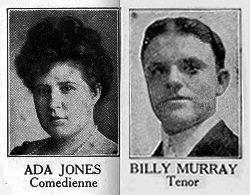
Ada Jones,Billy Murray, wax recording, phonographIn the late 1890s Edison began mass-producing cylinder phonographs though by 1905 flat-disc 78rpm machines began to outsell their cylinder rivals. Columbia, one of Edison’s chief competitors, abandoned the cylinder market in 1912. However, the Edison Company continued to make Blue Amberol cylinders until the demise of the company in 1929.

❏ Listen to Ada Jones & Billy Murray sing Come Josephine in My Flying Machine on an Edison Blue Amberol cylinder from 1911 (© Linda C. Joseph)

FRONT PAGE

2012 ➤ Central Saint Martins fashionistas graduate with street vibes, fantasy and outlandish colours

Central Saint Martins, fashion,BA,fashion, catwalk

First BA fashion show at CSM’s new King’s Cross campus, 2012: Designs by Natalija Mencek, Ruoxin Jin and Erin Hawkes who won the L’Oréal Professionnel Award award

➢ Central Saint Martins fashion design graduates presented an optimistic and upbeat offering at their swish new headquarters last night — Daily Telegraph report:

136 design students are graduating from the BA course this year, and the ultra modern postindustrial building they moved to last September has undoubtedly had an influence. The work was brighter, more optimistic and upbeat than it has been for years. Models actually smiled! Prof Jane Rapley, OBE, retired after 25 years at St Martin’s, six as Head of College … / Continued at Telegraph online

All 41 graduate collections for 2012
on the catwalk

➢ Will the magical blasts from the past follow
St Martin’s out of Soho?

FRONT PAGE

2012 ➤ Boogie on down, Your Maj, with three British maestros of the club mix

❚ A RIGHT ROYAL Diamond Jubilee knees-up courtesy of London clubland’s star deejays still going strong after 30 years . . .

Chris Sullivan, youth culture, Swinging 80s,Beat Route, clubbing

2011, Le Beat Route recreated for one night only: MC Sullivan sharing his sounds

Dj chris sullivan GROOVALICIOUSMIXaiff

“I guess it might be called of groovy disco funk” x 1h 16m


+++

Le Palace, Paris 1982: Egan aloft, Strange below. Photographed © by Shapersofthe80s

RUSTY EGAN 2012-03-01 Enjoy the silence

Claptone, Deep Mind, Jessica 6, Villa Nah, New Order and more x 60m


+++

Grace Jones, Mark Moore, Royal Albert Hall, Hurricane

2010: look who got to go back stage – photo courtesy of himself © Mark Moore

Mark Moore 13-5-12 Very Beautiful Lips Mix

“Mixed live on machines but not by machines. I left a couple of (tiny) mistakes on. I like the flaws. A flaw is what makes something beautiful truly interesting” x 62m

FRONT PAGE

2012 ➤ S’Express adds pizzazz to an alternative Pageant playlist for HM The Queen

River Thames ,Diamond Jubilee Pageant,

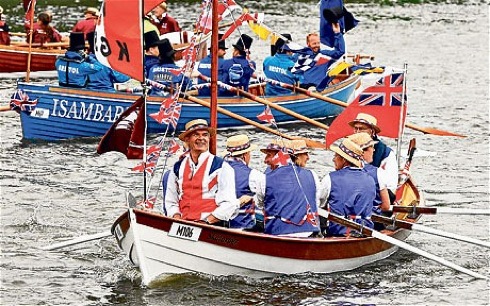
➢ 1,000 boats will muster on the River Thames — in case you hadn’t heard — on Sunday June 3, to accompany Her Majesty The Queen in the Thames Diamond Jubilee Pageant. The flotilla itself will be over seven miles long and will pass 25 miles of Thames river bank and under 14 bridges. It will take 90 minutes to pass any given point. A global TV audience is expected to number hundreds of millions… / continued online

London Philharmonic Orchestra ,Diamond Jubilee Pageant, Mark Moore, S’Express

Official and unofficial Pageant soundtracks: the London Philharmonic Orchestra’s CD, and DJ Mark Moore of S’Express

➢ The Guardian offers an alternative playlist for
Her Majesty’s water music

According to Adrian Evans, the “pageant master” tasked with arranging a London Philharmonic Orchestra soundtrack for the Jubilee flotilla’s voyage down the river Thames, the Kinks’ Waterloo Sunset didn’t quite make the cut. Come June 3, the 86-year-old monarch will instead be serenaded with movie themes and century-old chestnuts. Today, though, The Guardian offers its own fantasy flotilla playlist of 14 tracks which start from Albert Bridge with The Clash’s London Calling — 1979. (London is drowning and I live by the river. The video for this Thameside apocalypse was shot beside the bridge)…

It nods to Southwark Bridge with S’Express: Theme from S’Express — 1988. (Shoom, in nearby Southwark Street, was ground zero for British acid house. Supercool DJ Mark Moore is suitably lowkey today on Facebook, “Most amusing”, and reminds us he was frontman in the 80s act)…

And reaches Tower Bridge with Blur’s This is a Low — 1994. (The flotilla turns around here, but the song follows the river eastwards. And into the sea/ Goes pretty England and me)… / continued at Guardian online

River Thames, Diamond Jubilee Pageant,

The Queen’s royal barge, 2012-style: a specially adapted Thames river boat dressed for the Diamond Jubilee Pageant

HERE’S THE OFFICIAL MUSICAL ACCOMPANIMENT

➢ An iPad app creates a multimedia journey in time-lapse videos shadowing the Thames Diamond Jubilee Pageant in which the London Philharmonic Orchestra will perform popular works by great British and Commonwealth composers on the glass-fronted herald music barge, Symphony.

SAMPLE the LPO performance now!

FRONT PAGE

➤ Sir Harold’s memories of Fleet Street: cut and thrust, or be cut dead

The media “sale of the century”: Rupert Murdoch announcing his purchase of Times Newspapers on Jan 22, 1981. He is flanked by Harold Evans, editor of The Sunday Times, and William Rees-Mogg, editor of The Times. Captured here in what the photographer © Sally Soames calls her “best shot”

❚ HOW EXCITING THAT HARRY EVANS can still recount his rows with Rupert Murdoch in 1982 were as if they were “the day before yesterday”. The legendary former editor of The Sunday Times yesterday regaled the Leveson inquiry into British press standards via a video link from New York where he lives. He described one row almost ending in “fisticuffs”.

Murdoch had transferred Evans from The Sunday Times to its daily stablemate, The Times, once he had purchased the UK’s two most important newspapers in 1981. Evans told the inquiry there followed a year of constant editorial interference from Murdoch. Under the headline “Harold Evans tells Leveson of conflict and ‘vindictive’ atmosphere at Times”, today’s Guardian was impressed, 30 years later, that the ex-editor seemed to be “replaying the events as if they had occurred the day before yesterday”.

An insight into why the memories remain so fresh is delivered in an irresistible report elsewhere, at The Daily Beast website, doubly spiced because its editor-in-chief is Sir Harold’s wife, Tina Brown. Amid a blizzard of other Murdoch coverage, we see this headline:

➢ Sir Harold Evans Fights Back Against Rupert Murdoch
At Leveson Inquiry:

Evans described how he and Murdoch “almost came to fisticuffs” when Murdoch disagreed with a story published in The Times by an anti-monetarist writer. Evans resigned after only a year, over what he has long described as disagreements with Murdoch’s editorial interference. “I was disgusted, dismayed, and demoralized,” he said today… The vitriol between the two men has festered ever since Evans’s departure from The Times.

Sir Harold might as well have been reading Chapter 15 from the rip-roaring book Good Times Bad Times that he wrote the moment after resigning in 1982 and exiling himself to America soon after. The fireworks turn to warfare in the chapter headed “Plots” when Murdoch is giving Evans a dressing-down at The Times:

Murdoch: “Whad d’ya stand for? Nothing! The Times has no convictions.”
Evans writes: I accepted the provocation. I was glad to have it out in the open. I outlined five policy lines…
Then [Murdoch] added acidly: “Of course, I’m not supposed to speak to you like this. I’m supposed to ask the national directors” … [Murdoch] was not looking for debate. He was looking for weapons.

Today’s digerati will seldom experience the adrenaline rush produced by such instinctive cut and thrust.† It was survival of the fittest on a daily basis which was the lifeblood of old Fleet Street — or Print as we used to call it.

➢ 1981, The day they sold The Times, both Timeses
— read more at Shapersofthe80s

❏++++++❏++++++❏

THE THREE BEST BOOKS FOR UNDERSTANDING
HOW BRITISH JOURNALISM WORKS

+++
books, journalism TOUGHING IT
➢ Good Times Bad Times
by Harold Evans

The best account ever of the pitiless manners and mores of British newspaper executives and those they serve. The 525-page paperback is a thriller that starts with the Foreword: “Early in 1982, 10 months after he had taken over The Times and The Sunday Times, Rupert Murdoch went to see the prime minister Mrs Thatcher. They shared a problem: it was me.” The book is unputdownable. As my former editor Charles Wintour wrote in his review: “Enthralling… the narrative pace is tremendous… an immediacy and an excitement worthy of le Carré.”

Scoop , Evelyn Waugh, TV, films,Gavin Millar, DVD,Michael Maloney, books, journalism

Gavin Millar’s TV film of Scoop, 1987, now on DVD: Michael Hordern as Uncle Theodore, Michael Maloney as William Boot, Denholm Elliott as Salter

THE HOLLOW LAUGH
➢ Scoop by Evelyn Waugh

A satire so lithely comic that it prompts tears of mirth on almost every page. Though published in 1938, every one of its sublime characters is alive and well and working on national newspapers today. More, the all-too-plausible gaffe on which the entire plot tilts — a dinner-party name-drop sends wrong reporter off to cover a war — is true to the serendipitous decision-making that lands journalists in the least suitable of jobs. The novel’s inspiration was the dynastic rivalry between the best-selling newspapers of their day, the Daily Mail (owned by Lord Northcliffe then his nephew Lord Rothermere) and the Daily Express (Lord Beaverbrook), all fictionalised in the megalomaniac universe of Lord Copper of The Beast and Lord Zinc of The Brute. Most famous line: When Lord Copper was right, [the foreign editor] said: “Definitely, Lord Copper”; when he was wrong: “Up to a point.”

books, journalismTOOTH AND CLAW
➢ Slip-up: How Fleet Street Found Ronnie Biggs and Scotland Yard Lost Him, by Anthony Delano

Verdict of playwright and columnist Keith Waterhouse: “Perhaps the best analysis of Fleet Street at work ever written.” Every word is true (allegedly) in this preposterous page-turner, starring Fleet Street’s finest, Scotland Yard’s finest, and the Great Train Robber. The sheer guile, grit and ratlike cunning displayed by newsroom hacks from the 14 rival national newspapers is breath-taking as they try to second-guess each other during the manhunt for Ronnie Biggs, the most infamous of the villains who had pulled off what was then the greatest robbery of all time. During his 30-year sentence he escaped from jail. Years later, in 1974, the Daily Express discovered the fugitive in Brazil.

This was the scoop of the century and the 4million-selling Express endeavoured to keep the scoop secret from everybody except Detective Chief Superintendent Jack Slipper, head of the legendary Flying Squad. He was invited to join the hacks in Rio to deliver his best line: “Hello Ronnie. Long time no see.” Then a bombshell exploded. The secrecy of the mission meant nobody had applied for Biggs’s extradition. Fact was: Brazil had no extradition treaty with Britain. Slipper’s humiliation was crowned by the picture stealthily snatched by Mike Brennan of the Daily Mail showing him flying back home asleep beside the empty seat that should have held Biggs. Still, the exclusive Express story had already scooped the world. And Delano’s book became a £1m BBC TV drama in 1988.

Detective Chief Superintendent Slipper flies home from Brazil: photographer Michael Brennan snapped him asleep in flight. The caption was “The Empty Seat”

➢ The story behind the story of Slip-Up — In a 2008 update, Anthony Delano spilled more beans: keep scrolling to find Revel Barker’s account, more by Delano himself and by Keith Waterhouse who scripted the 1986 TV version titled The Great Paper Chase.

➢ Ten of the best books about journalism — As Vincent Mulchrone said: “Journalism is the only human activity where the orgasm comes at the beginning.”

† HISTORICAL FOOTNOTE ON
THE CUT V THE THRUST

cut and thrust, swordplay,debate,conflict,competition

Point over edge in swordplay: attacks with the point rely more on speed and finesse while those with the edge rely more on strength and momentum. Different swords do one or the other better. The fact is that thrusting requires much less strength to make a lethal wound while an effective cut can require a powerful blow. Both demand skill. Both will kill. You decide which one suits Rupert and which suits Harold

➢ Napoleonic Flame War by Richard Marsden — During the late 18th and early 19th century the definition of a proper sword varied from nation to nation. Initially, nations sought to choose the “best” sword for their light and heavy cavalry units so that on the battlefield they would be more effective. Tests and studies were done, data collected and proposals put forth. Somewhere along the line, however, the matter of the cutting sword or thrusting sword became more than one of facts and figures — it became one of national pride.

FRONT PAGE