1666 ➤ Pepys reveals a courtly fashion in the ashes of the Great Fire of London

Great Fire of London , Museum of London , Samuel Pepys

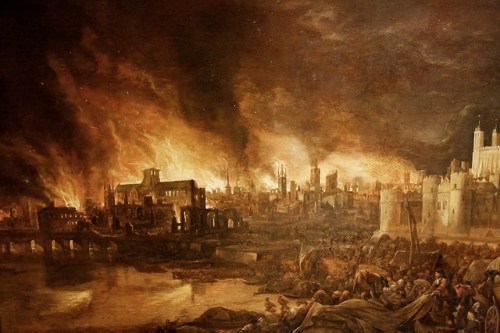
The Great Fire of London 1666, looking west from a boat near Tower Wharf. The painting depicts Old London Bridge, Old St Paul’s and the Tower of London. (Dutch School, probably 17th century, Museum of London prints)

◼ THE DIARY OF SAMUEL PEPYS might have been written for radio. Today’s eye-witness drama on BBC Radio 4 had plain Mr Pepys reliving the Great Fire of London which destroyed 75% of the City in September 1666, while confirming the essence of a great diary: that the events pictured and people’s voices are so vivid you needn’t think twice about believing them – even the apparent sincerity of the dandiest of all English kings, Charles II, rolling up his sleeves and “pulling together” among the citizen fire fighters in the street.
Samuel Pepys

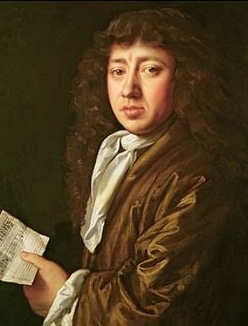
The obsessive diarist: Portrait of Samuel Pepys 1666, by John Hayls (National Portrait Gallery, London)

His humble employee, the civil servant Mr Pepys, was careful not to remind readers that His Maj was obliged to give his royal permission first before property-owners’ homes could be torn down to halt the march of the flames (the common practice in those days), a nuance which resulted in the Lord Mayor of London, Sir Thomas Bloodworth, emerging as the dithering fall guy in the history books. After all, the fire did start in the shop of the king’s own baker, Thomas Farynor, in Pudding Lane.

A more amusing footnote to history was revealed by today’s drama and this was the king’s perfectly serious response once the fire had been defeated. On October 8 Mr Pepys wrote in his diary: “The king hath yesterday in Council declared his resolution of setting a fashion for clothes, after so much is lost. It will be a vest, and it is to teach the nobility thrift, and will do good.”

A week later, Mr Pepys reports: “The king begins to put on his vest, and I did see several persons of the House of Lords and Commons too, great courtiers, who are in it; being a long cassocke close to the body, of black cloth, and pinked with white silke under it, and a coat over it, and the legs ruffled with black riband like a pigeon’s leg; it is a very fine and handsome garment. It is a fashion, the king says; he will never change.”

➢ Pepys: Fire of London – the terrific Radio 4 drama
is repeated 3 Sept 2016 and then on BBC iPlayer for the next week

Within a month news came to the English court that Louis XIV, the king of France, had put all his footmen and servants in this same dress as a livery. “Vests were put on at first by the King to make Englishmen look unlike Frenchmen; but at the first laughing at it, all ran back to the dress of French gentlemen.” All of which made Pepys “mightie merry, it being an ingenious kind of affront”, adding for appearance’s sake, “and yet makes me angry”.

Of course Charles changed his dress many times after his solemn assumption of a lifelong garment. The 17th century was a restless, trying time in men’s dress. “They had lost the doublet, and had not found the skirted coat, and stood ready to take a covering from any nation of the earth,” wrote the costume historian Alice Morse Earle.

Charles II , Nell Gwyn

Could this be the black vest as royal fashion statement? Charles II and Nell Gwyn, painted by Edward Matthew Ward, 1854 (detail, V&A collection)

The famous vest is said to be represented in a portrait of Lord Arlington, by Sir Peter Lely, but it’s hard to find much resemblance to Pepys’ description, or indeed any other contemporary portraits to capture this contribution to royal fashion. What we do find however is a 19th-century painting by Edward Matthew Ward, of Charles courting his mistress Nell Gwyn in an unusually all-black ensemble, a very sober expression of Charles’ innate flamboyance as the leader of fashion in his Restoration court. Can this be the black memorial vest?
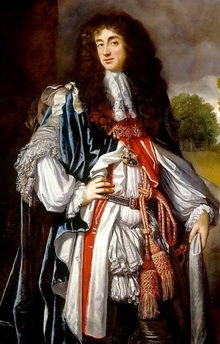
More usual royal swagging and drapery in this portrait, Charles II of England by Simon Verelst (The Royal Collection)

Typically the king favoured swagging and drapery in his daywear: Charles II of England by Simon Verelst (The Royal Collection)

The timing of Ward’s painting is right. As an actress – a profession the king had legalised for women – Nell was very much in favour with the Merry Monarch before and after the Great Fire, and gave birth to two sons by the king in 1670 and 1671 (among at least twelve illegitimate children that he acknowledged by various mistresses).

Compared with the king’s usual love of ornament, Ward’s rare depiction of simplicity in black may indeed be the monarch’s gesture of sympathy toward the losses inflicted by the Great Fire. Pepys reports that the cost in lost rent from the houses burnt was £600,000 per year, which would represent at least £115 million in today’s money.

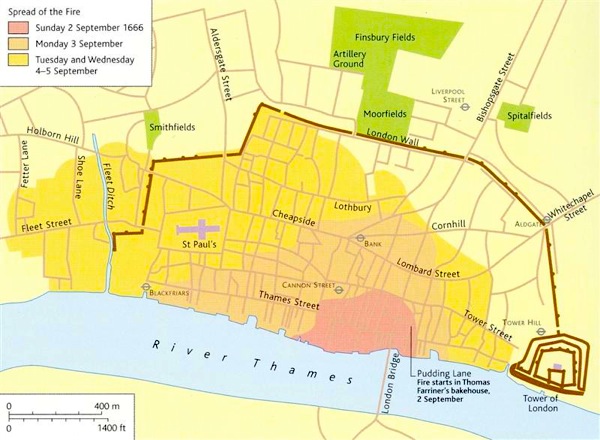
Great Fire of London, map

Colours show the progress of the Great Fire of London: it began on the night of September 2, 1666, on Pudding Lane, in the shop of Thomas Farynor, baker to King Charles II. It raged for four days, destroyed three-quarters of the City’s wooden buildings, and spread even beyond the medieval walls to the west. (Museum of London)

FRONT PAGE

➤ Reborn Alison Moyet lets herself off the mainstream leash

Robert Elms ,interview,album, Alison Moyet

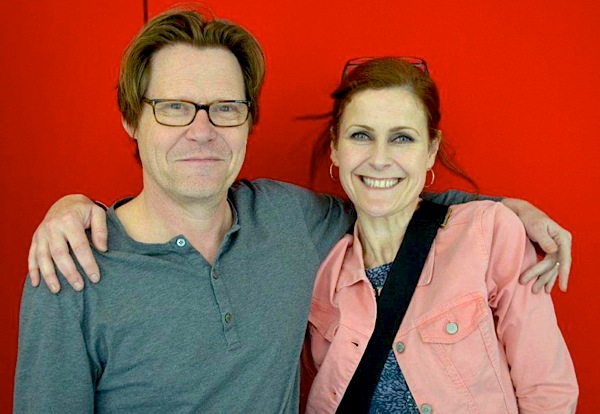
No longer “a cheap date”: Robert Elms with Alison Moyet today

❚ ALISON MOYET HAS COMPLETED her eighth solo album, The Minutes, with Guy Sigsworth on production creating a whole new synthesised sound. It is released on May 6 on the Cooking Vinyl label. Today she talked to Robert Elms on his BBC London show about slipping into “electro-jazz” and being able to say No to merely doing more cover versions. “I wanted to play a bit.”

She surprises Robert by saying, yes she is a mainstream artist, but regards herself as an instrumentalist, that her first instrument is “a voice – I love chanson, like Brel or Michel Legrand. But as well as being a voice, I’m an artist where voice is not the main thing, it can be about the lyric or the melody. I don’t always want the voice to be the focus!”

Alison Moyet, the Basildon punk, high priestess of electronic pop and peerless soul singer, set out as Genevieve Alison Jane. An Essex girl born to a French father and English mother, she left school at 16, became famous at 21 as singer in Yazoo, and released her triple-platinum solo debut, Alf, at 23. She found fame hard to handle at such a young age, but hindsight has helped her appreciate those experiences. “For a while in the mid-80s, it was amusing to be a pop bitch, but that changed, and it stopped being enough. Now I am able to put my early work into context and find pleasure in the innocence of it.” Between 1984 and 1987, Moyet was Britain’s biggest female solo star.

➢ Robert Elms interviews Alison Moyet on BBC London 94.9 and plays two singles, 4 May 2013 (last half hour) – on iPlayer for seven days

➢ On video, May 15: Alison Moyet talks to Absolute 80s Martyn Lee about her new album The Minutes

♫ Preview clips from Alison Moyet’s The Minutes, out May 6. The first single When I Was Your Girl is on sale already

➢ The Minutes tour starts Sep 30 in Cork and hits London’s Royal Festival Hall on Oct 15, ends Oct 31

➢ Moyet’s comeback single – ‘my happiest studio experience’

FRONT PAGE
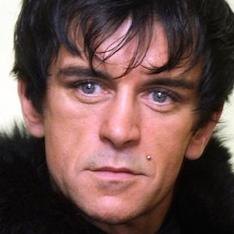
➤ Material Girl Madonna pops up in LA

Material Girl ,Madonna, Macy’s

Material Girl retrospective at Macy’s LA

➢ Sneak glimpse on the Material World blog of the Material Girl Collection on display at Macy’s Los Angeles – “We just got back from our Material Girl Madonna Pop-Up Fashion Exhibit. Where should we start? From Madonna’s iconic never-before-seen fashion pieces like Jean Paul Gaultier’s iconic corset, to the blasting music, to the amazing crowd of Material Girls and Boys – it was a night we’ll never forget”

FRONT PAGE

➤ 20 years ago today the free world wide web was born

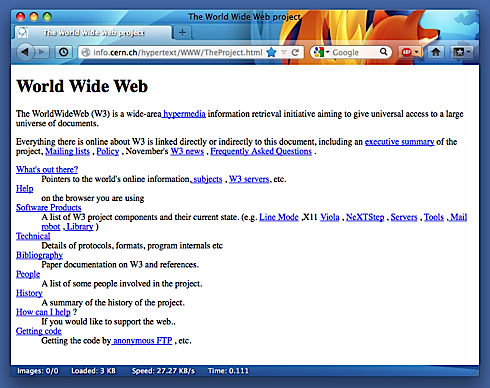
❚ TO COMMEMORATE THE 20TH ANNIVERSARY of the web being made available free to all, the international physics laboratory CERN has recreated the world’s first website and posted it today, at its original address and this is it – http://info.cern.ch/hypertext/WWW/TheProject.html The home page provided an explanation of what the world wide web was, and how to use a browser and set up a web server.

The British computer scientist Tim Berners-Lee proposed an information management system in 1989 and had a working version of the web in Dec 1990. The first website built was at CERN within the borders of France and went online on August 6, 1991, but by 1993 some user groups were positioning themselves to try to monopolise the web as a commercial platform. So on April 30, 1993, CERN announced that the world wide web would be free to anyone, with no fees due.

CERN, firsts, website, worldwideweb,

The web’s first home page: click on the image to visit the site at CERN

➢ The World Wide Web Became Free 20 Years Ago Today – By Mark Fischetti, senior editor at Scientific American:
“ You and I can access billions of web pages, post blogs, write code for our own killer apps – in short, do anything we want on the web – all free! And we’ve enjoyed free reign because 20 years ago, today, web inventor Tim Berners-Lee and his employer, the CERN physics lab in Geneva, published a statement that made the nascent “world wide web” technology available to every person, company and institution without royalty or restriction … ” / Continued online

➢ Long live the web: Tim Berners-Lee wrote a treatise for Scientific American in 2010 explaining why the web must remain for ever free:  “The web is critical not merely to the digital revolution but to our continued prosperity – and even our liberty. Like democracy itself, it needs defending.”

INTERNET VERSUS WEB

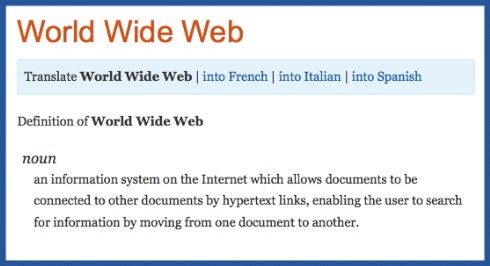
www13,OEDdefinition

Tim Berners-Lee at the Olympics opening ceremony (Photo: Getty)

Tim Berners-Lee at the Olympics opening ceremony (Photo: Getty)

❏ The internet is a global computer system that provides information and communication facilities, consisting of interconnected networks using standardised communication protocols. In contrast, the web is one of the services that runs on the internet. It is a collection of text documents and other resources, linked by hyperlinks and URLs (addresses), usually accessed through web browsers from web servers. A browser is a so-called “graphical user interface” which simply means an accessible visual entry point into the arcane world of computer coding. Mosaic is the web browser credited with popularising the world wide web and today most popular browsers (Google Chrome, Internet Explorer, Mozilla Firefox) retain the characteristics of the original Mosaic.

In July 2012 Tim Berners-Lee was honoured as the “Inventor of the world wide web” during the Olympics opening ceremony in London where he appeared in person, working at a NeXT computer, the model on which he worked at CERN in 1989. He tweeted the message: “This is for everyone.”

The mighty tweet: Tim Berners-Lee’s message to the world at the Olympics

The mighty tweet: Tim Berners-Lee’s message to the world at the Olympics

➢ EFF asks, How safe is your privacy? CISPA passes out of the House without any fixes to core concerns

➢ CERN’s original Public Domain document of April 30, 1993: “CERN’s decision to make the web foundations and protocols available on a royalty free basis, and without additional impediments, was crucial to the web’s existence. Without this commitment, the enormous individual and corporate investment in web technology simply would never have happened, and we wouldn’t have the web today.” – Tim Berners-Lee, Director, WWW Consortium

FRONT PAGE

1983 ➤ A True romance aboard Spandau’s triumphal Thames riverboat

Spandau Ballet,1983, tour, Gary Kemp

Spandau over Bournemouth, 1 April 1983: Gary Kemp teases the screamers at the Good Friday show in the Pavilion Theatre. © Shapersofthe80s

❚ YES IT’S 30 YEARS SINCE Spandau Ballet scored their only No 1 chart hit single with True, coinciding with their epic “Spandau Over Britain Tour”. By May 3, True the album reached No 1, while the single remained at No 1 as well. The band’s official website is celebrating with a month of recollections from 1983 and asking UK fans to offer their own memories. Naturally Shapersofthe80s was there on the waterfront and has a few inside stories of its own.

The month-long tour ended in triumph at London’s Royal Festival Hall 30 years ago today, on Friday April 29, because True hit the top spot in the UK singles chart and the night before Spandau topped the bill on Top of the Pops – only two weeks after its release. After the London gig there followed a right old knees-up for friends and family aboard a Thames riverboat. As it cast off Shapersofthe80s was onboard and snapped a True romance as Steve “Spiny” Norman took to the dance floor with bass-player Martin Kemp, while Steve’s mum Sheila tried to muscle in. Here are our snaps, never seen before.

CLICK ANY PIC TO LAUNCH CAROUSEL:

The band’s third album True, produced by Tony Swain and Steve Jolley, had preceded the tour and was to yield several chart hits across the world, Gold among them. The tour moved on to Europe in the summer and to North America in the autumn, when Shapersofthe80s will have some wild eye-witness scenes to report – laters…

➢ May 1 update: all five members of Spandau Ballet have agreed to an individual ‘TRUE’ Twitter Q&A session with fans, according to the official Spandau website – Q&A sessions start at 8pm (BST) on the official Spandau Twitter account, not their personal accounts, as follows: Gary May 3, Martin May 6, John May 7, Steve May 9, Tony tbc.

➢ 30th anniversary interview with Gary Kemp
at UK Official Charts website

The Observer OMM Oct 4, 2009

The Observer OMM Oct 4, 2009

HOW IT ALL BEGAN FOR
THE ANGEL BOYS

➢ Read the story of Spandau Ballet,
the Blitz Kids and the birth of the New Romantics
in my feature at The Observer

➢ Photographer Neil Matthews, another friend of Spandau from their earliest days, has been celebrating with an exhibition of his popstar photos titled My 80s Through the Lens, at The Great British Restaurant, 14 North Audley Street, London W1K 6WE. All images can be viewed online and are for sale in limited editions printed on smart archival paper. As well as Spandau, his subjects include Bananarama, Blue Rondo, Bauhaus, Haysi Fantayzee, Malcolm McLaren, The Jam, Nick Heyward, Bow Wow Wow and more.

FRONT PAGE