2010 ➤ Feast of remixes on new ‘Very Best’ of Visage album

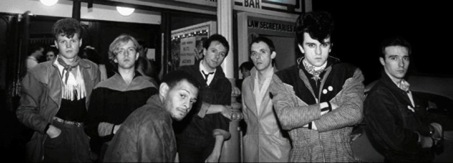
Visage 1980 outside the Blitz: Rusty Egan, John McGeoch, Barry Adamson, Dave Formula, Billy Currie, Steve Strange, Midge Ure. Picture © by Sheila Rock

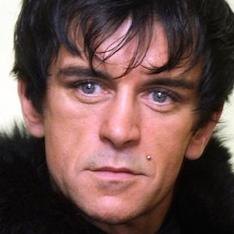
❚ MARCO PIRRONI, GARY KEMP AND BROADCASTER GARY CROWLEY were among the 80s faces who turned out for last night’s launch of a new CD compilation, The Face: The Very Best of Visage which goes on sale March 8. It contains 15 Visage tracks including new 2010 remixes of classic New Romantic dance anthems. To celebrate the 30th anniversary of their first chart hit from 1980, Fade to Grey, there are no less than four versions onboard (one by Michael Gray of The Weekend and Borderline, and another by Ministry of Sound deejay Lee Mortimer), plus remixes of Mind of a Toy, The Anvil, and a 12-inch dance mix of the single Visage.

Fronting their “Evening of sublime 80s self-indulgence” club-night in Chelsea were two 80s clubbing wizards Chris Sullivan and Rusty Egan (read more) who was the drummer with Visage and the Rich Kids.
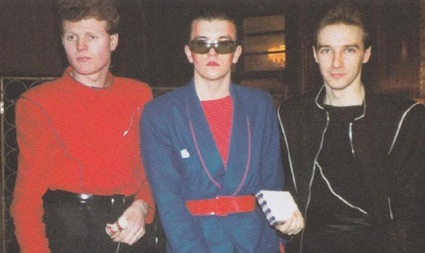
Supercool in ’78: Egan, Strange and Ure establish Visage

Egan also became a deejay because he hated those flash guys who talked incessantly over the music in discos. He wanted to pioneer a new kind of synth-driven British electro-diskow and sought inspiration in Germany from the likes of Kraftwerk and avantgarde producer Konrad “Conny” Plank. In 1979, the Blitz club-night in London became his sounding board and it went on to inspire a vast slipstream of new British bands who changed the sound of the charts during the early 80s.

Along with Egan, Visage’s founding members in 1978 were the Blitz greeter Steve Strange, and musical polymath Midge Ure, who simultaneously became the lead singer with Ultravox in April 1979. Echoes of their pioneering electropop resonate in the charts today through acts such as Lady Gaga, La Roux, Little Boots and MGMT.

➢➢ Steve Strange celebrates the launch of The Face album at London’s Green Carnation on March 19

➢➢ Read about the fashion show Steve Strange and Rusty Egan took to Paris in 1982
FRONT PAGE

2010 ➤ Comeback Shard comfy as ‘Auntie Sade’

Sade  1983

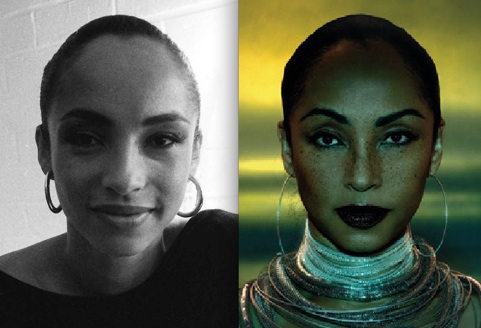
Wow! Then and now: Sade backstage in August 1983 while still seeking a recording contract and, right, as shot to launch her 2010 album. Vintage picture © by Shapersofthe80s

SADE IS TALKING FRANKLY AND REFLECTIVELY. It’s a rare treat from a singer who rarely ever breaks cover. Ten years on from her last album, Lovers Rock, she is said to be the most successful solo female artist Britain has ever produced – more than 50m albums sold over 26 years, valued at £30m in The Sunday Times Rich List. She is the first to acknowledge that Sade is a band, and together they have won a Brit Award for Best British Album of 1984 (view award speech) plus nine other Brit nominations, three Grammies (for 1985, 1993, 2001, plus two other nominations) and Sade herself was appointed an OBE, an order of chivalry, by the Queen (2002).

Sade Adu,New York, Axiom, fashion, Blitz Kids, Ian Watts,Princess Diana

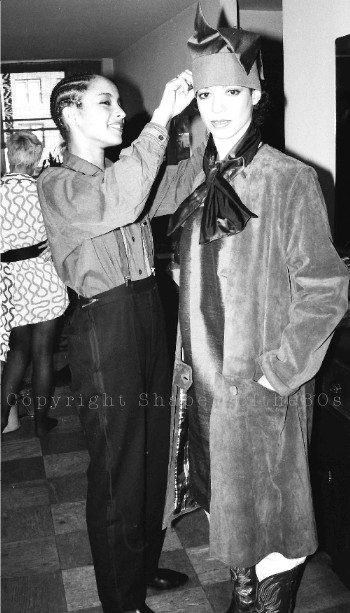
New York 1981, preparing for the Axiom show that accompanied Spandau Ballet on the first Blitz Kids invasion: In braided short hair and hallmark narrow pants, Sade fits a model with her outfit on the Demob label. Sade once told Shapers that Princess Diana’s question to her after a Prince’s Trust concert was: “Do you always dress like a man?” Photographed © by Shapersofthe80s

In yesterday’s Sunday Times Magazine, according to the writer Robert Sandall whom Sade knows of old, the Blitz clubbing veteran was giving the only face-to-face interview to coincide with this month’s release of her new album, titled Soldier of Love.

Sandall delivers full value as Sade really does let her guard down, surprisingly further than most of us who used to know her might have expected, especially about her “complicated” inter-racial family background. (She was born Helen Folasade Adu in Nigeria, raised in the UK at Clacton-on-Sea, and took a fashion BA at St Martin’s School of Art). She also talks about motherhood with a 13-year-old daughter and her several romances – “I’ve paid some rugged dues,” she observes. Highlights among many soundbites…

❏ On being a black singer in a white soul outfit: “I didn’t have any confidence as a singer, but I found that I liked writing songs.”

❏ The same band of clubbing wags from 1983 is reunited for the album – Paul Denman, Andrew Hale and Stuart Matthewman. They remain one tight unit on the new album, we’re told, under the control of a matriarch who likes the nickname “Auntie Sade”. [Note for newbies: say it Shah-day /ʃɑːˈdeɪ/. Only friends are allowed to use the nickname Shard.]

❏ On her new man, Ian Watts, who has been in turn Royal Marine, fireman and scientist: “I always said that if I could just find a guy who could chop wood and had a nice smile it didn’t bother me if he was an aristocrat or a thug as long as he was a good guy. I’ve ended up with an educated thug!”

❏ The old charge that Sade was the backdrop of the yuppie era still rankles: “With my family history, that really irks me. And it so annoyed me at the time, when we were secretly giving money we didn’t even have yet to Arthur Scargill and the striking miners.”

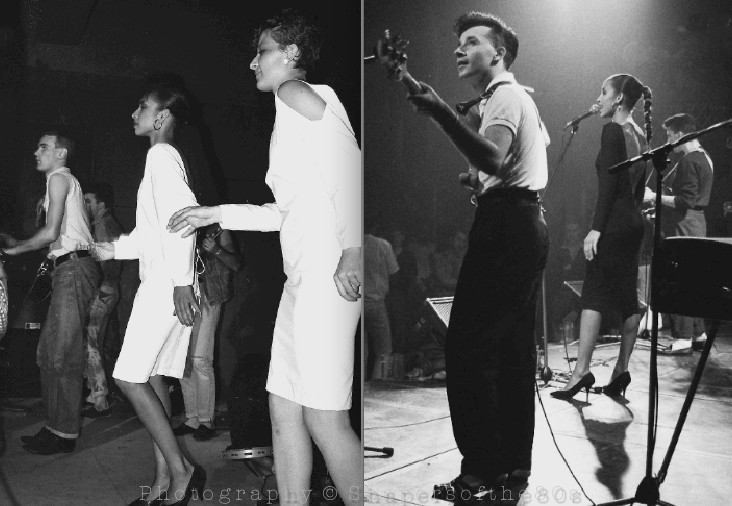
One year’s progress: left, Sade with Latin soul band Pride at the Fridge, Sep 1982; and with the smaller band Sade in Aug 1983 at the Yow club, London, Paul Denman to the fore. Ten months after splitting they had a record deal. Photographed © by Shapersofthe80s

Sade

Sade 2010: Talks us through her new album in a video documentary

➢➢ For links to new video documentary and tracks see Sade box in sidebar, right

➢➢ A Reluctant Return: In this month’s New York Times interview, Sade worries about being “too candid” with the press, yet reveals she is considering marriage

➢➢ Kanye collaboration rumours in this National Post interview, Feb 16, 2010

➢➢ Compare and contrast quotes with this version at ThisIsGloucestershire!

➢➢ Click for pix of Sade’s Demob designs during 1981’s first Blitz invasion of the US

➢➢ More pix of Sade helping backstage during Steve Strange’s 1982 fashion show in Paris

FRONT PAGE

2010 ➤ OMM goes out celebrating all our heritages

Caspar Llewellyn Smith, OMM

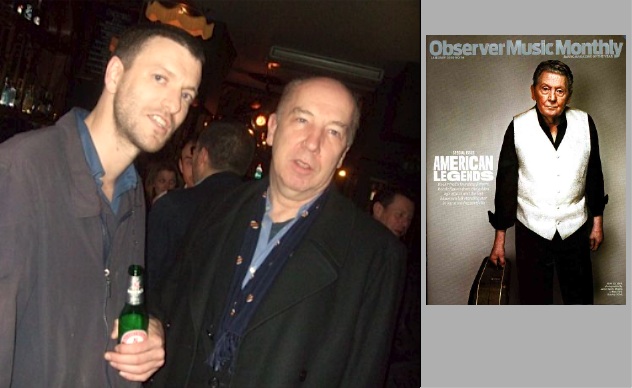
So farewell, then, OMM: editor Caspar Llewellyn Smith with Neil Spencer, iconic ex-editor of the NME, at the wake for the “anything goes” music mag (right). Main photograph © by Shapersofthe80s

❚ “AN ERROR,” said Neil Spencer, who edited the NME during the 1980s, passing verdict on this week’s closure of the Observer Music Monthly as part of a cost-cutting revamp of the world’s oldest Sunday newspaper, The Observer. “It broke the rules and went where other music magazines do not.”

Caspar Llewellyn Smith edited OMM from its launch in September 2003, since when OMM has patrolled the whole musical waterfront, excelling in its considered reportage of the indigenous musics of the third world, while also applying intelligent ears to chart fodder. Its respect for heritage was signalled the minute Spandau Ballet reformed last year. Caspar said: “We need to know the real story of the New Romantics – to overturn the view that it was a silly pop fad.” Unsurprisingly he quickly assembled a mélange of veteran contributors who included Spencer, Peter Culshaw and world-music guru Charlie (The Sound of the City) Gillett.

“A lot of Caspar’s peers haven’t got the same breadth of taste,” said freelance writer Sophie Heawood at last night’s farewell bash at the Albert and Pearl in Islington. “He’s someone who knows where the culture’s beautiful stuff is going on. Where eyes and ears are concerned, his can be trusted.”

Out of 76 issues Caspar said he was over-ruled from above on only two cover images, which is pretty nigh miraculous on a national newspaper. One of his favourite covers announced an unexpectedly revealing 2005 interview with Noel Gallagher, conducted with total irreverence by comedian and total Noel fan, David Walliams. Gallagher admitted to knowing “everything there is to know” about country and western music, and gave an appreciative nod to the 80s: “What struck me was that the boy bands of the day such as Spandau Ballet and Duran Duran could all play their instruments. It’s so far removed from the bands of today like Westlife and Boyzone, who are utter shit.”

Ambrose Campbell

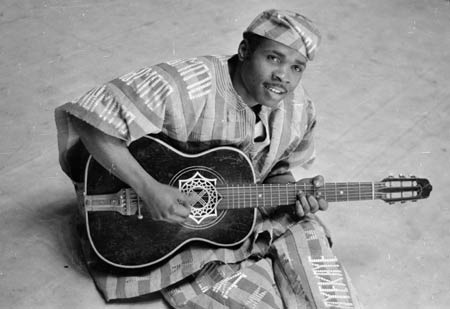
Ambrose Campbell: bandleader who died in 2006

Caspar is also chuffed to have championed British rapper Dizzee Rascal since the first OMM. Later, he brought the rapper Roots Manuva together in conversation about black Britain with octogenarian Ambrose Campbell, who led Britain’s first African band The West African Rhythm Brothers in 1945.

Last Sunday’s final issue of OMM features a superb portfolio profiling 21 founding fathers of rock ’n’ roll, blues, jazz and country – from Jerry Lee Lewis and Little Richard, Smokey Robinson and Chuck Berry, to Wanda Jackson and Dave Brubeck – and Observer readers sprinted online to start mewling dissent.

Lewis was photographed last year by Jamie-James Medina for the final cover (above). Inside, Ray Davies of the Kinks recalls his first sight of the hellfire pianist on British TV in 1957: “I’d literally never seen anything like it. He had that long curly hair and he was playing with one leg up on the piano. He looked like a complete punk, but really cool at the same time.”

If you missed Caspar Llewellyn Smith’s savvy defence of his own musical odyssey, Pop Life: A Journey by Sofa, you’ll find it still in print here.)

➢➢ Click here to visit Observer Music Monthly

FRONT PAGE

2010 ➤ Lady Gaga spices up i-D’s 30th birthday

❚ A LIGHTNING-FAST PHOTOSHOOT with Lady Gaga (above) was previewed before Christmas at Showstudio, the showcase website directed since 2000 by Nick Knight. Today Knight ranks among the world’s most original fashion photographers, but his association with i-D, launched as a street-style magazine in 1980, goes back to its earliest days. On i-D’s fifth birthday he photographed 100 “People of the 80s” (➢➢ link below) who had all appeared in the magazine’s formative issues.

During December 2009, as part of his Fashion Revolution exhibition at London’s Somerset House, Knight photographed a further 100 of London’s current creative leaders — including models, actors, musicians, artists and Lady Gaga — in the space of 20 days.

Nick Knight, People of the 80s, i-D fifth anniversary,

The snapper snapped: Nick Knight caught framing up yours truly during the i-D shoot, June 6, 1985. Photographed © by Shapersofthe80s

Knight says: “We started saying that we were going to do five portraits a day, so we did five one the first day and we thought it felt too easy. So we pushed it to 10, it felt reasonable, but then we sort of let things happen and we were looking at 20 a day!”

The 100 portraits are slated for inclusion in i-D’s 30th anniversary issue later this year, with video portraits captured from each of the sitters viewable on Showstudio in the weeks before publication.

➢➢ For more pix and the full monty on i-D’s metamorphosis from stapled fanzine to international fashion glossy, read on here…

FRONT PAGE

1978 ➤ To the edge and back with the lovely Julia

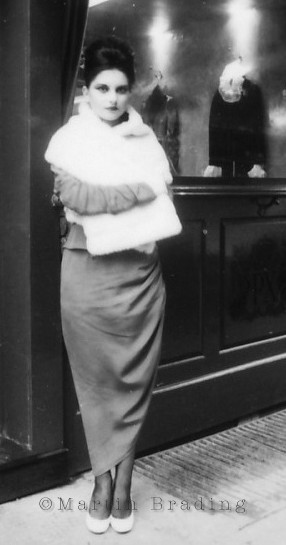
❚ PRINCESS JULIA IS A NATIONAL TREASURE. After three decades, she remains one of the UK’s coolest dance deejays, music editor at i-D and co-runs The P.i.X fanzine. She is as beautiful and immaculately attired as she was in the Swinging 80s. In those days Julia Fodor turned heads as the star sales assistant in PX, Helen Robinson’s inspirational New Romantic clothes shop in Covent Garden.

Nouvelle vague, Feb 1980: Julia outside PX, designer Helen Robinson’s home of New Romantic fashion. Photographed © by Martin Brading

Stunningly coiffed in a beehive hairdo, she could have stepped out of a French nouvelle vague movie – until she opened her mouth. “’Ello dahhlin’,” she greeted you, in broad Eliza Doolittle Cockney.

Once Steve Strange had put Julia in the cloakroom at the Blitz in 1979, her unique style ensured her a place at the centre of all the press coverage the club provoked, as well as in the Visage video for Fade to Grey. As one of the few true Blitz Kids, Julia never ventured into public without her Look.

This month, Julia began a photo-blog called The World of Princess Julia to record her nightlife activities in London and abroad – for her deejay residency at Queen in Paris, she has enjoyed being delivered to work by cross-Channel helicopter. Her first blog post introduces us to her life of what some might call notoriety. Here’s a taste, in Julia’s own words…

A lot of tinsel, that’s London, we love
our veneer, we love our sleaze

❚ I’M EIGHTEEN, ’78, [Covent Garden is] still boarded up ready for gentrification, coming down soon though. I work in a shop – PX. There’s a rehearsal space downstairs, band music bleeds up, Chrissie’s down there with her Pretenders, she tells me all about it. One day Michael Jackson came by, another time some local kids locked us in for a laugh, it was Cameron McVey and his mates.

I had a “look” then, one of many. I hobbled around in tight, tight skirts and high, high heels from Seditionaries. I took speed and learnt to smoke. I had a good beehive. What’s his name, Paul [Smith] from up north moved into Floral Street, Paul Howie and Lynne Franks had jumpers in Long Acre. There was nothing else round there then shop wise.

We had Bowie on, we played Kraftwerk, we kept a lookout for new music, new makeup, the future, futuristic. Dance moves, soul static robot. Berlin, film-noir. London ’79, cross-dressing melting vista of possibilities. No money, poverty breeds creativity, that’s what they say. Nevertheless perhaps it’s true, especially in London where people seem to gravitate towards seeking out an identity more vital than the one they’ve left behind. I did the same, left north London and headed uptown, central, on the Piccadilly line. London’s built on ley-lines, heard someone say that somewhere, I think it’s true because there’s certain energy here in London…

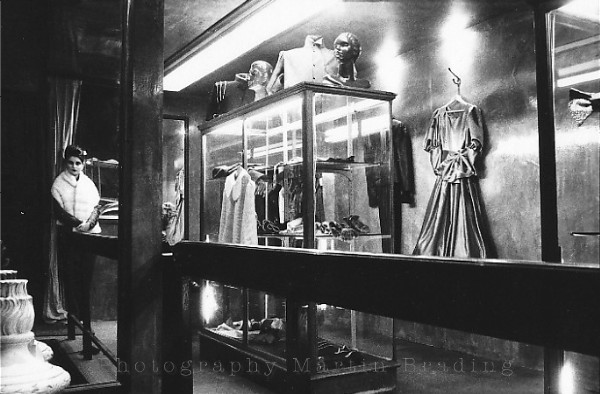
PX moves into Endell Street in Feb 1980: New Romantic satin gowns, Fauntleroy collars – and Julia. Photographed © by Martin Brading

FRONT PAGE