* Added to the heading to reflect protests by Peter and Chris
What do we want? – We’d quite like our rather good 6Music station not to be axed by the BBC, please.
When do we want it? – After our jolly nice picnic and a couple of flutes of champagne, if that’s OK with you.

Militant picnickers: Save 6Music campaigners plot their strategy – somewhere amid the champagne drinkers Peter Crocker is lurking. Picture © Claire Cant
VICTORY FOLLOWS A VERY BRITISH KIND OF PROTEST
❚ TODAY IT WAS REVEALED TO RADIO 4’s AUDIENCE that the BBC decided not to axe its digital music station 6Music as the result of a thoroughly British campaign strategy hatched over a couple of drinks and the odd outdoor picnic. 6Music campaigners like to boast that a bunch of marketeers called the CoolBrands Council (yes, seriously!) have dubbed it the coolest radio station in the land – easier perhaps to think of it as “rhythms for thinking persons”. Since March some “quite lively” street protests have surrounded Broadcasting House in London where the more strident slogans included “More 6 please, we’re British” … “Lord Reith would be vexed” … “Down With This Sort of Thing” and “6 into 2 doesn’t go” (a reference to merging with mainstream Radio 2). But afterwards, heads were put together to come up with a seriously cunning plan.
Peter Crocker told the tale on today’s Feedback, the Radio 4 listener soapbox. He describes himself as a “video restorer and member of the Doctor Who Restoration Team”. Also a Belle and Sebastian fan, he is passionate about 6Music and became incandescent in March when he heard of the BBC management’s threat to shut it down in a strategic review of BBC services.
He wrote to Feedback and was invited onto the weekly programme in March when he declared: “As with Radio 3, 6Music is unique. We need a serious modern non-orchestral music station.” This kick-started a process which ended up with him having a breakfast meeting with the chairman of the BBC Trust Sir Michael Lyons, who was tasked with considering the management proposals.
Crocker modestly insists his role was minor and points out that many, many others were involved in the campaign to save 6Music. The Facebook protest group, for example, is the “modern equivalent of a village hall”, he says, and it attracted 180,000 supporters.
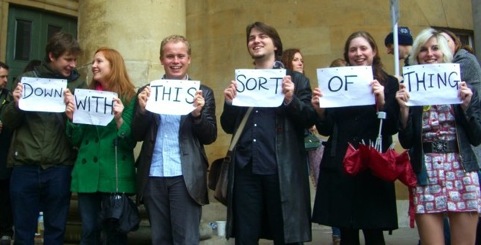
Too, too British: Save 6Music demonstrators outside Broadcasting House
What he did do after turning up to a demo was to meet up for occasional drinks with some of the other committed protesters “in hostelries around west London”. Here he met Chris Wiper, a Pixies fan (according to his Facebook profile), who proposed conducting a survey of 6Music listeners and 655 responses from adults yielded one eye-opening claim. As Crocker reported today: “For every £1 the BBC spent on 6Music, the station generated £13 for the UK economy”!
From Wiper’s survey the purchasing activity of the station’s listeners was analysed by Matt Forman and Colin Hammond who showed that 58% of their music purchasing in the previous year had been influenced by 6Music, resulting in an average spend of £134 that year on albums and singles. In other words, when extrapolated against the one-million weekly audience reached by the station, this amounted to a significant contribution towards the music industry’s coffers. (Further modest mutterings have ensued from Wiper, too: “My contribution was a very small part.”)

6Music listener ages: Mean 32.2, median 31, according to online petition data commissioned by ILF
Hence the bending of the Trust chairman’s ear and a reversal this week of the decision to axe the station.
Hammond has since offered further insights: “Sir Michael Lyons said that the cultural value argument had to be made. Alan Yentob made a speech that stated that the BBC yardstick was £2 of economic activity for £1 of BBC spend. We had had already several conversations about how many CDs etc we had bought solely from 6, Chris Wiper had set up a Facebook group and then his website. At my hunch that there was something in this, Matt Foreman did the maths for the initial ILF submission which the Trust were most interested in and so we encouraged more people to come forward, which gave the great final survey number.”
Result – even BBC director-general Mark Thompson declared on April 20: “It’s become clear to me that the station is completely unique and has significant cultural worth.”
As a successful campaigner, cheer-leading substantially through the web, Crocker today offered four golden rules: (1) don’t shout into a vacuum; (2) research your subject; (3) stick to facts not personal opinion; (4) enlist teamwork by meeting up in real life.
Let’s be on guard for the next round, however. Announcing 6Music’s reprieve on the BBC News Channel last Monday, Sir Michael Lyons also said: “It [6 Music] has opened up a much bigger debate about the need, first, to sort out the greater distinctiveness about the very popular Radios 1 and 2 and to make sure they are more different from each other and different from what’s available in the commercial sector. And even more important, to actually develop a coherent strategy for digital radio, which the BBC can’t do in isolation. It needs to do (that) with government and the commercial sector.”
A can of worms is about to be opened in the radio marketplace. In her weekly column in the Daily Telegraph, Gillian Reynolds was later to conclude: “ ‘Stick to facts.’ Please remember that when the dreaded BBC Director of Audio and Music Tim Davie returns, fully strategised.” The Facebook group cannily reminds us of future trends. Listen to 6Music online, it urges, so the powers-that-be can measure how many are listening. “BBC6 was not designed to be linear.”
➢➢ Listen to today’s Feedback and read presenter Roger Bolton at the Radio 4 blog
➢➢ Independent Listeners Forum – Final Submission to the BBC Trust, May 22 – Search sidebar for ILF Evidence, then click Economic Value Update
➢➢ Gillian Reynolds in the Daily Telegraph, July 12 – “The present digital delay, I think, is more a failure of markets than management”

Thinking music persons: Save 6Music protestors show their strength outside Broadcasting House. Picture © Steve Ransome
FRONT PAGE








 ➢➢ Shapers of the 80s ➣➣