➤ Slashed! Wallinger’s knife demonstrates a 25% cut on a Turner masterpiece

Reckless ,Mark Wallinger, The Fighting Temeraire, Turner ,National Gallery, arts cuts, petition, protest

Reckless by Mark Wallinger. Thanks to Jed Butterfield and Bob Pain at Omni Colour http://www.omnicolour.com and Nicholas Penny at the National Gallery

❚ A NEW WORK BY TURNER PRIZE-WINNING ARTIST Mark Wallinger is released today as part of a campaign supported by more than 100 leading British artists against the government’s proposed funding cuts of the arts.

Mark Wallinger’s work shows a copy of the masterpiece, The Fighting Temeraire, 1839 by Joseph Mallord William Turner, in the collection of the National Gallery in London. A slash in the painting carries a notice “25% cut” and beneath it a caption reads: “If 25% were slashed from arts funding the loss would be immeasurable.”

Turner refused ever to sell The Fighting Temeraire — depicting the final journey of the 98-gun ship which played a distinguished role in Nelson’s victory at the Battle of Trafalgar in 1805 — until he finally donated it to the National Gallery. When the BBC asked the nation to nominate the greatest painting on show in UK museums and galleries, this came first with 25% of the votes.
Turner’s concern was to evoke a sense of loss as the great battleship was towed to the breaker’s yard.

The title of Mark Wallinger’s new work is Reckless. He explains: “I describe the cuts as a reckless adventure. In fact temeraire means reckless in French and by removing the obsolete ship from the scene I am rendering the painting wreckless.”

➢ Click for full petition details at 

savethearts-uk.blogspot.com

FRONT PAGE

➤ Anna declares McQueen a pioneer of dreams and drama

St Paul’s Cathedral, McQueen, ceremony, Anna Wintour,Hilary Alexander

A hint of gold from the doyennes attending St Paul’s Cathedral for the McQueen ceremony: Anna Wintour, Vogue editor, and Hilary Alexander, Daily Telegraph fashion director. Photographs © Glenn Copus/PA/Getty

WITH LONDON FASHION WEEK IN FULL SWING, hundreds of leading fashionistas gathered in St Paul’s Cathedral today for a ceremony in memory of Alexander McQueen. A taxi driver’s son who grew up in London’s East End, he became Britain’s most confrontational, unfettered and theatrical designer. He died in February aged 40, having been appointed a CBE and named British Designer of the Year four times by the British Fashion Council.

St Paul’s Cathedral, Alexander McQueen, London Fashion Week, ceremony,  tributes,

Alexander McQueen: enfant terrible of the runway

The world’s most powerful arbiter of fashion, Vogue editor Anna Wintour, led today’s tributes. Models Kate Moss and Naomi Campbell, actress Sarah Jessica Parker, muse Daphne Guinness and designer Stella McCartney were among the congregation, which also included relatives and former colleagues of McQueen.

Anna Wintour is the English-born daughter of Charles — editor of the Evening Standard during the Swinging 60s when his London paper achieved international acclaim. After removing her sunglasses, something she rarely does in public, Anna paid a moving tribute to McQueen: “He was a complex and gifted young man who, as a child, liked nothing more than watching the birds from the roof of his east London tower block.

Bjork, Alexander McQueen, memorial,

Bjork performing Gloomy Sunday

“He had an 18-year-long career of pioneering his dreams and dramas. He cared what people thought of his clothes but not of him. He never appeared at ease with himself and hated to travel away from his beloved London.”

Björk sang the haunting hymn Gloomy Sunday, which reflects on the horrors of modern culture, and there were also addresses from jeweller Shaun Leane, model Annabelle Neilson, McQueen’s nephew Gary Hulyer and milliner Philip Treacy. Composer and pianist Michael Nyman and the London Community Gospel Choir gave musical performances.

➢ Fuller Evening Standard report of the McQueen service, plus gallery

➢ Backstage with Hilary — Cheek and effervescence spice the Telegraph doyenne’s videos and reports of the autumn shows in New York, London and Milan

➢ “My father really decided for me that I should work in fashion” — Anna Wintour in The September Issue. Out this week on DVD, the most gripping movie ever about editorial decisionmaking, OK, on the world’s most powerful fashion magazine, but for that very reason, junking $50k’s worth of photography is a measure of that power. [“Knocks All the President’s Men into a cocked hat” — Shapersofthe80s]

FRONT PAGE

The 1980s ➤ A new history of that most turbulent of decades

Orgreave, Yorkshire , miners' strike, riot police, ReportDigital

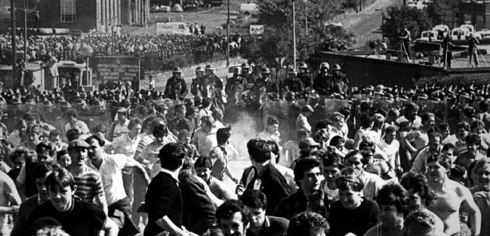
Mounted police attack striking miners picketing the Orgreave Coking Plant, South Yorkshire. Photographed © by John Harris/ReportDigital. The 1984-85 miners’ strike became a bitter industrial dispute and symbolic class struggle that saw picketing miners pitched against police officers, and colleagues — so-called scabs — who chose to return to work. The National Union of Mineworkers was protesting at the government’s plans for pit closures but the year-long strike proved a terrible defeat for the miners and for the coal industry. In 1984 there had been 170 coal mines open in the UK. By 2004 fewer than a dozen mines remained. The British trade union movement has never recovered.

❚ “MORE CHANGE AND MORE CONFLICT were crammed into the 1980s than any other decade in the second half of the twentieth century. Out of political chaos, Britain arrived at a settlement that lasted, for better or worse. The way we live now follows directly from the tumultuous events of the 1980s.”

In his new book, No Such Thing As Society, Andy McSmith, chief reporter and former political correspondent of the Independent newspaper, argues this was the conflict decade, defined by strikes, war and riots. He examines Britain in the decade of Thatcher and the City’s ‘big bang’, from the Falklands war and the miners’ strike to Bobby Sands and the Guildford Four, from Diana and the New Romantics to the Brixton riots and Band Aid, from the Rubik’s cube to the ZX Spectrum. He talks about the legacy of the 1980s and how this decade of extremes shaped contemporary Britain.

Margaret Thatcher, Spitting Image

Spitting Image's suited version of prime minister Margaret Thatcher gives a Churchillian V for Victory

“You know, there is no such thing as society. There are individual men and women, and there are families. And no government can do anything except through people, and people must look to themselves first.” — Margaret Thatcher, talking to Woman’s Own magazine, October 31, 1987


McSmith maintains that “the 1980s was the revolutionary decade of the twentieth century. To look back in 1990 at the Britain of ten years earlier was to look into another country. The changes were not superficial, like the revolution in fashion and music that enlivened the 1960s; nor were they quite as unsettling and joyless as the troubles of the 1970s. And yet they were irreversible. By the end of the decade, society as a whole was wealthier, money was easier to borrow, there was less social upheaval, less uncertainty about the future.

“Perhaps the greatest transformation of the decade was that by 1990, the British lived in a new ideological universe where the defining conflict of the twentieth century, between capitalism and socialism, was over. Thatcherism took the politics out of politics and created vast differences between rich and poor, but no expectation that the existence of such gross inequalities was a problem that society or government could solve – because as Mrs Thatcher said, ‘There is no such thing as society … people must look to themselves first’.”

➢ Andy McSmith discusses the 80s with Andrew Marr on Start the Week (R4, Sep 20)
➢ No Such Thing As Society: Andy McSmith’s history of Britain in the 1980s is published by Constable
➢ VIEW: BBC audio slideshow on the year-long miners’ strike
➢ VIEW: frontline slideshow of the miners’ strike by photographers from the independent picture library ReportDigital

FRONT PAGE

2010 ➤ Robinson takes the Cowell shilling — so whose bum is on the throne at Popjustice?

X Factor, X magazine, launch, Kelly Clarkson, American Idol, Simon Cowell

From the makers of The X Factor: a new magazine, edited by the man who toyed with Kelly Clarkson like a cat with a mouse

❚ WE LOVE HIM, THEY LOATHE HIM, the worst of them. One of the most influential and passionate commentors on the pop scene appears to have jumped ship in the direction of Simon Cowell’s entertainment goldmine. Peter Robinson, the 30-something wag and one-man Girls Aloud fanclub, has made his Popjustice blog a compelling read for fans who favour his surreal version of the truth, but a gunk tank for stars who imagine there’s any such thing as an even break.

Yet this morning’s Media Guardian unequivocally describes him as “formerly” the editor of PJ, while announcing the launch of X magazine, whose own website gives him the title of Senior Editor there. Sounds like a golden-handshake welcome to X which is to be the weekly print offshoot of the Cowell TV franchise, The X Factor. A 100-page launch issue appears tomorrow to coincide with series seven of the ITV talent show, and distribution is initially through Tesco supermarkets, price £1.95, even when the show is off-air.

Peter Robinson, Popjustice, previously editor, formerly editor,Senior Editor, X magazine

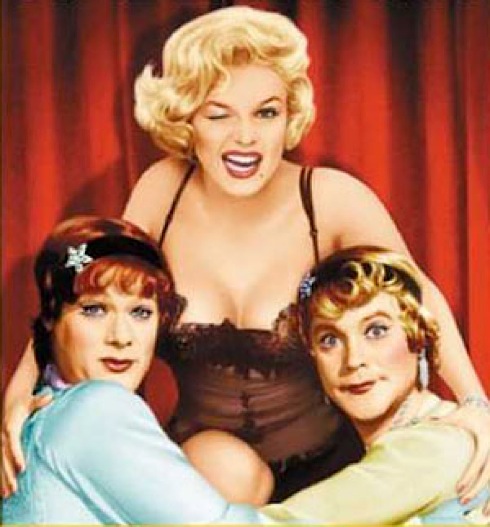
"Senior Editor" of X magazine: no, not the Peter Robinson who dresses as Marilyn, the other Peter Robinson

A “surprising” level of access to contestants is promised, though Robinson is reported to have feared that X would be “pretty much a glorified fan magazine”. The big cheese at its publisher, Haymarket Media Group, convinced him that the owners were happy for X to “not always toe the party line”. Some might think this a risky ploy. Is the cheese actually familiar with the Robinson technique? Does the cheese know how often his notoriously cringe-making interviews must have turned a star to jelly? In fact, has the cheese read the all-time car-crash sofa-chat Robinson conducted with American Idol winner Kelly Clarkson? In which he provoked her to confess: “I’m not a man and I don’t claim to be.”

There hasn’t been a decent mag purely about pop since the upstart Smash Hits doled out respect and ridicule in equal measure. It ran for almost three decades as a fortnightly, shuffling off-stage only in 2006. Channel 4’s Popworld spin-off died after two issues in 2007. Nevertheless, according to another Haymarket cheese, women’s weeklies are reckoned to be on “vibrant” form, and Robinson is talking up his new title: “Our editorial team is the strongest of any British pop magazine in almost 20 years and this certainly feels like the biggest pop magazine launch in Justin Bieber’s lifetime.”

Robinson was working as a freelance in 2000 when, for the love of it, he founded Popjustice as a music site with attitude. He has overseen its successful monetisation in cahoots with w00tmedia, and bolted on a record label called Popjustice Hi-Fi. The Times reckons PR is one of the music industry’s Top 20 star makers while The Observer rated Popjustice the world’s most powerful music blog. So has he truly relinquished the crown after 10 years? No, of course not! What? Give up the most powerful throne in pop? That was just “a mistake/assumption on Media Guardian’s part” PR assures us. Not for nothing have hacks long dubbed it the good old “Grauniad”! So rest assured that a familiar bum stills sits in the PJ hotseat, while steering the pop universe with his left hand.

FRONT PAGE

2010 ➤ Egghead versus bimbo: Paglia demolishes Gaga

Lady Gaga,sexual revolution,demolition job

Lady Gaga in performance: does she mark the end of the sexual revolution?

Camille Paglia,Hurricane Camille,Lady Gaga,death of sex

Paglia the hurricane

❚ CAMILLE PAGLIA describes herself as a “dissident feminist”. Others have dubbed her “Hurricane Camille”. With a PhD from Yale, she is one of America’s brightest women, variously expressing iconoclastic opinions as a social philosopher, cultural critic, author and educator who believes that most women are bisexual. Her powers of reasoning mean that she is not easily dismissed. So when in today’s Sunday Times Magazine she detonates a dynamite demolition job on the popstar Lady Gaga, we should perhaps take notice. She argues that Gaga is “sexually dysfunctional”, and marks the end of the sexual revolution. Then she savages Gaga’s “little monster” fans. Here are Paglia’s juiciest soundbites:

❏ “Despite showing acres of pallid flesh in the fetish-bondage garb of urban prostitution, Gaga isn’t sexy at all — she’s like a gangly marionette or plasticised android.”

❏ “How could a figure so calculated and artificial, so clinical and strangely antiseptic, so stripped of genuine eroticism have become the icon of her generation? Can it be that Gaga represents the exhausted end of the sexual revolution?”

❏ “For Gaga, sex is mainly decor and surface; she’s like a laminated piece of ersatz rococo furniture. Alarmingly, Generation Gaga can’t tell the difference. Is it the death of sex?”

❏ “Drag queens, whom Gaga professes to admire, are usually far sexier in many of her over-the-top outfits than she is.”

Stefani Germanotta,Lady Gaga,MTV

Stefani Joanne Angelina Germanotta: as brunette herself on MTV's Boiling Points in 2005, and as Lady Gaga last year, blonde but without make-up

❏ “Marlene and Madonna gave the impression, true or false, of being pansexual. Gaga, for all her writhing and posturing, is asexual.”

❏ “Most of her worshippers seem to have had little or no contact with such powerful performers as Tina Turner or Janis Joplin, with their huge personalities and deep wells of passion.”

❏ “Generation Gaga doesn’t identify with powerful vocal styles because their own voices have atrophied: they communicate mutely via a constant stream of atomised, telegraphic text messages. Gaga’s fans are marooned in a global technocracy of fancy gadgets but emotional poverty.”

➢ To read the rest of Paglia’s appraisal of Gaga visit The Sunday Times Magazine

‘Now, come on, people, do you really believe that Lady Gaga is 23 years old?’

➢ In her Salon column last November 10, Camille Paglia threw out this invective:

❏ “Do you really believe that Lady Gaga is 23 years old? I’ve been in advanced doubt about it for a while, particularly after seeing this ‘Rare pictures!’ video of early photos of her hanging with some mighty tough critters. (A friend of mine said of Gaga in this vid: ‘Too many miles of bad road there.’) I think Gaga was a hell of a lot sexier as a fun Italian-American brunette. This artificial, masklike, over-the-top Club Kids thing that she’s now into seems compulsive and wearily passé. Give it a rest, and focus on the music!”

➢ Tuesday top-up from the throne-room at Popjustice:

Camille Paglia wrote a big thing about Lady Gaga for the Sunday Times. Some of her points were good but a lot of it felt like she was writing the article for the benefit of one reader — Madonna — and most of the good bits were buried by an avalanche of General Missingthepointness. We particularly love an outraged Paglia railing against Lady Gaga for “rudely” wearing sunglasses in interviews, and the idea that Lady Gaga has gone on tour to escape scrutiny (?!). Give it a rest Paggo.

FRONT PAGE