Category Archives: Youth culture

1984 ➤ Band Aid, when pop made its noblest gesture but the 80s ceased to swing

Band Aid , Do They Know It’s Christmas?

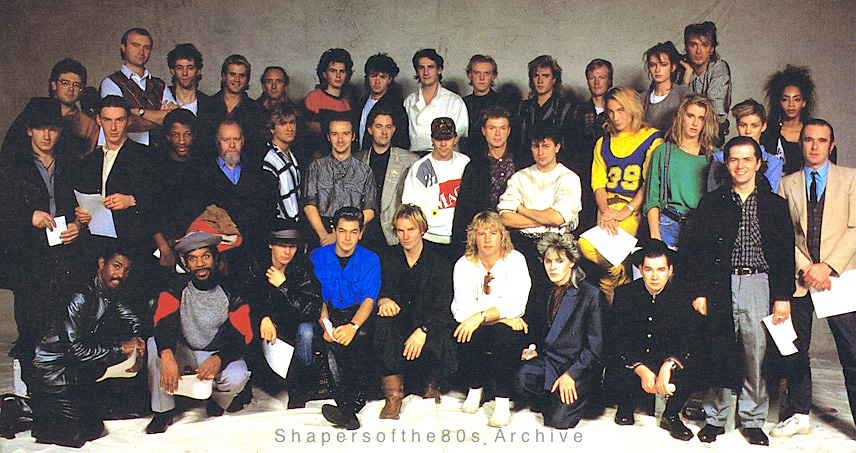
The Band Aid band, Nov 25, 1984: most of the pop stars who performed, plus artist Peter Blake who created the record sleeve for Do They Know It’s Christmas?

◼︎ TODAY WAS THE DAY IN 1984 THEY RECORDED the song that became, for 13 years, the biggest selling UK single of all time. Do They Know It’s Christmas was released four days later, stayed at No 1 for five weeks, sold over three million copies and raised significant funds for famine relief in Africa. The project lead naturally the next year to Live Aid, the biggest globally televised rock concerts ever, viewed by two billion people in 60 countries, who coughed up still more dollars. It is estimated that Live Aid raised £150m (about $283m). Last year a poll of 5,000 people, who were surveyed across Europe, named Live Aid as the most important music event of the past 30 years. The hit single sold for £1.35, of which 96 pence went to the fund. Rerecordings of the song charted again in 1985 and 1989.

The idea for Band Aid was proposed by one man, Bob Geldof, since granted an honorary knighthood but in 1984 a musician down on his luck, who enlisted the much more successful go-getter, Ultravox’s Midge Ure (who remains unknighted for no good reason), to bring the dream to fruition as its producer. They created a megagroup from 45 of the biggest hitters in British music, who included the supergroups dominating world charts at the time — Culture Club, Duran Duran, Spandau Ballet, Wham! — plus AOR giants Sting, Genesis and U2, plus Kool and the Gang from the States. In a sea of mullets and bleached highlights, rival musicians united under the name Band Aid in a daring act of charity that was unprecedented in the competitive commercial arena.

Band Aid,Bob Geldof ,Midge Ure,SARM

Leaders of the Band Aid pack in 1984: Bob Geldof and Midge Ure outside SARM Studios in London. © Pictorial Press

The enterprise marked the end of an era, as this website documents. The Band Aid collaboration signalled the final chapter of the innovation which Shapersofthe80s believes defined the Swinging 80s as six dynamic years of subcultural initiative between 1978 and 1984. Britain’s visual kaleidoscope of cults was exactly what fed MTV from its launch in 1982 and loosened the stranglehold that music radio had previously enjoyed in the USA. The unlikely Band Aid scrum of Britain’s rival image bands who had risen on the same new wave  substantially defined a new show-business elite who had come to epitomise mainstream tastes.

 Michael Buerk , Ethiopia

Michael Buerk in his BBC report from Ethiopia

Nobody can doubt the uniqueness of the pop fraternity’s gasp of altruism through Band Aid. Geldof had been genuinely distressed by the now landmark teatime TV report broadcast on October 23, 1984, by Michael Buerk, a popular BBC journalist. It still makes for grim viewing. In Ethiopia 7m people were threatened by famine, and 40,000 refugees had converged on the town of Korem in the hope of finding food and medical aid.

The film footage shocked the world and Buerk’s opening words still resonate today: “Dawn, and as the sun breaks through the piercing chill of night on the plain outside Korem, it lights up a Biblical famine, now, in the 20th century. This place, say workers here, is the closest thing to hell on earth…”

CONTRARY VERDICTS ON BAND AID

Morrissey, 1985 — “I’m not afraid to say that I think Band Aid was diabolical. Or to say that I think Bob Geldof is a nauseating character. Many people find that very unsettling, but I’ll say it as loud as anyone wants me to. In the first instance the record itself was absolutely tuneless. One can have great concern for the people of Ethiopia, but it’s another thing to inflict daily torture on the people of England. It was an awful record considering the mass of talent involved. And it wasn’t done shyly, it was the most self-righteous platform ever in the history of popular music.”

The World Development Movement described the Band Aid lyrics in 2004 as “patronising, false and out of date” and regretted it did not “provide a more accurate reflection of Africa and its problems”.


❏ IN THEIR RESPECTIVE AUTOBIOGRAPHIES, Ultravox’s Midge Ure and Spandau Ballet’s Gary Kemp provide entertaining and detailed accounts of the Band Aid venture, spiced with the frankness that comes from hindsight . . .
➢ Ure and Kemp on the shenanigans
that led up to Band Aid

FRONT PAGE

➤ If Paradise Point aren’t the pop tip for 2011, you decide who is!


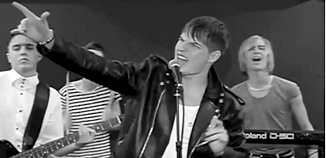
❚ HIT ACT, HOT VIDS SHOT BY YOURS TRULY. Here’s the first public sighting of livepop band of the moment Paradise Point, in concert on Friday at Steve Strange’s club-night in Soho. Those crazy Neo Romantics were larging it at The Face, along with a bunch of proud parents from the previous showbiz generation. These concert vids capture two of PP’s four debut singles, Run in Circles, and Tears, all tracks downloadable at their MySpace page. Aren’t the kids doing well!

➢ CLICK FOR THE FIRST FULL REVIEW
OF PARADISE POINT’S DEBUT

“…The singer swivels 90 degrees, one hand grips his thigh, his legs are a-tremble, his arms stretch to there measuring the extent of his despair, his entire body emotes its socks off. He’s intense, handsome and fit, as his gymnastics confirm. He is the vocal storm at the centre of a pool-table-sized stage at the club Punk in central London, and the energy beaming off it is fierce…”

“… PP’s music is the magnet and their lyrics are your reward. Wait till you get home and play the band’s downloads and pay attention to the words. They prick the teen heart and they pull at everyone’s. These lyrics share some of the emotional intelligence of Morrissey & Marr, who can reduce you to jelly in a phrase, yet PP avoid the confessional mode and so spare us the Mancunian melancholy.”

FRONT PAGE


➤ How Roman Kemp helped his dad Martin to pick up the bass again

Paradise Point in rehearsal, above: Roman, Johnnie, Cameron, Adam

❚ “I’M THRILLED FOR ROMAN’S BAND. It’s one of the most exciting bands I’ve heard for a while. They’ve been rehearsing downstairs in my games room for the past year and they’ve turned out really well. Their sound reminds me a lot of Duran Duran, but the singer Cameron looks like Tony Hadley when he was younger and he’s got the vibe of Tony. He’s got a great voice, very expressive — he’s got a long way to go this boy.”

Roman Kemp, Martin Kemp, Paradise Point, livepop,The Face club

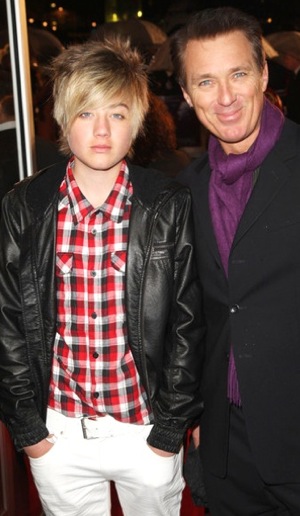
On the town: Roman and Martin Kemp a couple of years back. Photograph © Dave Hogan

OK, if that sounds like a doting father, yes it is. Martin Kemp is best known as one of British TV’s most popular actors after his stint as a villain in the leading soap, EastEnders, but the past year of course was spent touring as bass player with Spandau Ballet, his reformed 80s supergroup.

This Friday, the fourpiece called Paradise Point is unveiled at London’s coolest club-night, The Face, and Martin’s 17-year-old son Roman Kemp follows his father by opting to play bass. This group’s claim to novelty is that they all play their instruments live and their music is pop. They are the vanguard for a return to real Brit pop.

Martin says: “I’m just pleased for Roman that he’s in a proper band, rather than a boyband where five people stand up singing while working out when they’re going to sit on the stools. His band is very polished. If I think of the level Spandau had reached at their age, they’re well ahead of us, much more polished than Spandau were then.

“They look fantastic as well. It’s a band that’s made for girls to pin on their walls, which we haven’t had for a long time. That’s what needs to come around again.

“The whole thing of saying ‘Let’s be famous’ before you have a reason to be famous has meant being in a boyband is much easier than putting in the time and effort, learning to play your instrument, then finding mates who can play bass and the drums, bringing round the gear. That whole thing is a slog. But what you get out of that setup is a bonding experience with your band, which you’ve all been through. And that has disappeared at the moment. For me, it’s nice to see Roman inside a band where he’s got some real mates.”

Paradise Point, Cameron Jones, Firework,livepop
➢ Teen musicians call time for
 Cowell and his X-culture — First interview with Roman Kemp on
Paradise Point’s livepop debut this week

Paradise Point are determined to return credibility to teen pop music by playing their own instruments live onstage. They offer a determined farewell to the X-culture inflicted on the singles charts by Simon Cowell and his cloned songbirds. PP have had enough of manufactured pop idols and prancing boybands

Spandau Ballet had already broken up by the time Roman was born but with a pop-star mother too — Shirlie Holliman from Wham! — there was always music in the house. Martin says: “I taught him to play guitar when he was about six, then he got into rap for a while. Like all kids, this killed learning any kind of instrument, because they’re into the gangsta rap words.

“Then he picked up his guitar again and now he’s playing bass. He’s doing all right. He’s got a much better ear than I have, it’s brilliant. To tell you truth, when I was going back on tour with Spandau, after 19 years out, I couldn’t work out how I used to do some of the riffs. So I got Roman down to listen to the Spandau track to work out the fingering.

“He’s turning into a good bass player, a lot like John Taylor. Yes, from Duran! I don’t mind who he wants to turn into. If your kids go into the entertainment business, success isn’t about how much money you make — it’s about turning your hobby into your job. For me, that is success. If he can do that fantastic.”

So, Martin, are you coming down to The Face to see Paradise Point? “Absolutely. I’ll be roadying. Back to my original job with Spandau.”

➢ Four audio tracks and more by Paradise Point at MySpace
➢ Four audio tracks by Paradise Point at Facebook
➢ On the road with Martin: Shapersofthe80s’ coverage of Spandau Ballet’s 2009-10 Reformation tour

Pepsi & Shirlie, Holliman, Roman Kemp

Musical family: Roman Kemp’s mum Shirlie (right) in her glory days beside Pepsi with Wham!

FRONT PAGE

➤ Killing a king tells you who you are — so do your haircut and shoes

execution, painting,1649,Banqueting House , King Charles I

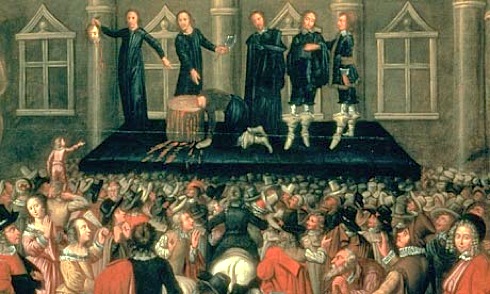
One of Schama’s six epic moments in British history: the execution of King Charles I in 1649, painted by John Weesop. Source: The Gallery Collection/Corbis

The Look, Rock & Pop Fashion❚ SHAPERS OF THE 80s? A STROLL DOWN MEMORY LANE or an antidote to complacency about the present? Let’s hope the vintage yarns on the inside pages of this website provide a constant foil to the topical blog posts on the front. Even on the pop-cultural timeline, parallels deliver insights: parallels between the Swinging 60s and the Swinging 80s, and what feels highly likely in 2010 to become the Swinging Tens. The signposts to every British youth cult since World War Two have always been the haircut and the shoes, as we’re constantly reminded at that absorbing online version of the book The Look: Adventures in Rock & Pop Fashion. So keep your eyes open.

What caused this momentary validity-check was an exhilarating read in today’s Guardian headlined “Kids need to know they belong”. Don’t wince when you hear that it amounted to a vigorous exhortation to schools that are failing to teach to the hilt the dreaded H-word, history. The history of how we came to execute our king, for example, gets short shrift from the national curriculum.

“Irreverent freedom” is a special aspect of life in Britain. “The endurance of rich and rowdy discord” is another. This was telly-don Simon Schama getting into his eloquent stride. Who needs history, he asked? Our children, of course, if they are to know who they are, and whose imaginations risk being held hostage in the cage of eternal Now… In full fig, Schama succinctly listed the benefits of examining the past:

To the vulgar utilitarian demand, ‘Yes, all very nice, I’m sure, but what use is it?’, this much (and more) can be said: inter alia, the scrutiny of evidence and the capacity to decide which version of an event seems most credible; analytical knowledge of the nature of power; an understanding of the way in which some societies acquire wealth while others lose it and others again never attain it; a familiarity with the follies and pity of war; the distinctions between just and unjust conflicts; a clear-eyed vision of the trappings and the aura of charisma, the weird magic that turns sovereignty into majesty; the still more peculiar surrender to authority grounded in revelation, be that a sacred book or a constitution invoked as if it too were supernaturally ordained and hence unavailable to contested interpretation.

➢ Read My vision for schools by Simon Schama
— six key events from the past that no child should miss out on

King Charles I, execution, warrant

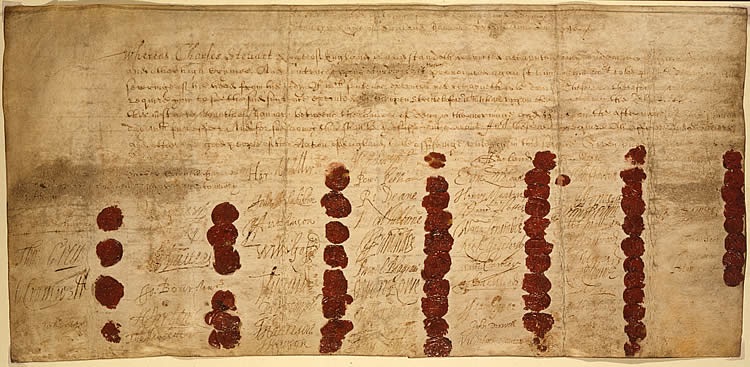
Death warrant of King Charles I (1649): Showing the signatures and seals of 59 of the commissioners who tried Charles I, including that of Oliver Cromwell. This document directly led to the execution of the king, the abolition of the monarchy, and the consequent establishment of a republic to govern England for the only time in its history, between 1649 and 1660. © Parliamentary Archives

FRONT PAGE

2011 ➤ Pulp: the Britpop comeback everyone’s been waiting for, hooray!

Pulp,  Jarvis Cocker,original lineup, Britpop, Sheffield, pop music,

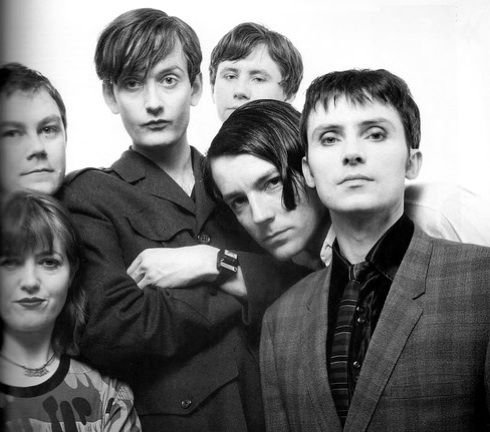
❚ ALL THE ORIGINAL MEMBERS OF PULP, the coolest band to represent Britpop, have decided to get together and play some concerts next summer, starting with May 27, 2011 at the Primavera Sound Festival in Barcelona, Spain, and on July 3 at the Wireless Festival in London, United Kingdom. Formed 1978 in Sheffield, England and originally called “Arabacus Pulp”, the six-piece achieved sudden success thirteen years later during the Britpop era as much for their music as for frontman Jarvis Cocker’s antics, ho-ho. Their unimpeachable breakthrough single was an ironic survey of class tourism titled Common People from their 1995 album Different Class which won the Mercury Music Prize the next year. The original lineup last played together onstage in 1996. They are frontman Cocker, drummer Nick Banks, keyboard player Candida Doyle, bass guitarist Steve Mackey, guitarist and violinist Russell Senior and guitarist Mark Webber.

➢ To know more, visit Pulppeople.com
➢ Catch Brian Eno on Jarvis Cocker’s Sunday Service on 6Music
➢ To hear and see Pulp, visit Last.fm

FRONT PAGE