Category Archives: Technology

➤ Edison’s wax cylinder throws beatboxer Singh back to the age of acoustic recording

Aleks Kolkowski ,beatboxer, Jason Singh,wax recording,phonograph

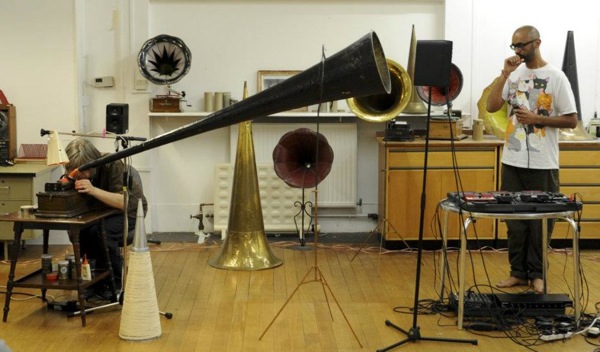
Wax recording at the Science Museum: Aleks Kolkowski tending his Fireside phonograph from 1909, while beatboxer Jason Singh improvises his mix of electronic samples and vocal sculpture through a speaker. (Photographed © by Marizu Okereke)

❚ SOUND ARTISTS IN RESIDENCE ARE, it seems, all the rage. Not only has London’s Victoria & Albert Museum got one (that’s him, the cool barefoot dude, above right), but so too has the Science Museum (the less cool dude from another planet, above left). And this week they got together to make some wax recordings on the kind of two-minute cylinders our great grandparents used to dance to. The big diff is the kind of beatbox sounds Jason Singh makes — scratchity screechity hoppity whack rhythms made using nothing but his mouth, lips and tongue. He styles himself a “vocal sculptor” since essentially it’s his voice making sinuously textured percussive music, the role of a microphone being simply to help amplify it.

The reverse diff for him was not using a mic, but instead sticking his head deep inside a 7ft-long acoustic horn that channelled his voice down to a Mica membrane pressing on a flat-edged sapphire stylus, the vibrations from which cut a hill-and-dale spiral groove on a wax cylinder revolving at 160 rpm on a wind-up clockwork Edison phonograph Fireside model A, made in about 1909. His recording engineer was the shaggy professional musician, Aleks Kolkowski, who is running a series of experimental demonstrations during the next month on the art of acoustic recording. Each lunchtime session features a distinguished guest musician, artist or writer who will record acoustically by speaking or playing sounds without the aid electricity.
wax recording,phonograph

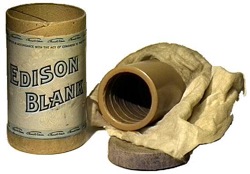
Edison cylinders: the earliest blanks were beeswax brown

In Jason Singh’s case, his performance was a piece of magic before the recording began. His sound test had you looking round the room for an orchestra and a chorus of jungle animals. It was unbelievable that everything we heard came from inside this lanky young man himself. Aleks warmed the cylinder with a red lamp to soften its ceresin and stearic wax mix. Jason’s head vanished inside the horn while his extremities twitched to his turntablist rhythms and the stylus cut the acoustic recording. It was unexpectedly thrilling to witness, with swarf flying off the recorder, though Jason’s voice was slightly too muffled inside the horn for the audience to judge the quality, so it was agony to have to wait to hear the outcome while the cylinder was set aside to cool.

A second session saw Jason mixing samples and loops at a console, these more complex sounds then feeding out through a regular loudspeaker which faced into the same acoustic horn. This utterly different sonic landscape was nearer to musique concrète which treats pre-recorded sound as raw material.
Aleks Kolkowski ,beatboxer, Jason Singh,wax recording,phonograph

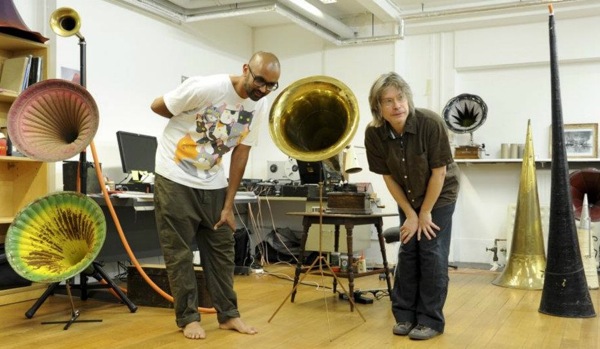
Playback at the Science Museum: Jason Singh and Aleks Kolkowski are as keen as the audience to know if the wax recording has worked. (Photographed © by Marizu Okereke)

Playback time arrived. Jason and Aleks positioned their ears on either side of the phonograph, now equipped with a pick-up stylus and a huge antique brass concert horn. From a low register, Jason’s human beatboxing slowly grew into distinct and intricate musical patterns, but suffused and somehow wonderfully other-wordly. He was rewarded with rapturous applause. His own verdict: “Wicked!” Aleks wondered whether the second more experimental recording would prove as successful, and indeed moments did give the effect of wind howling across the Arctic tundra. Jason’s verdict: “Exorcist!”

The best recording will soon be posted on Aleks’s archive website Phonographies where you can hear digital transfers of his many other recordings made on contemporary wax cylinders.

Aleks Kolkowski ,wax recording,phonograph

Armed with a brush: Aleks Kolkowski clears his Fireside phonograph of flying swarf during the recording process on to wax. (Photographed © by Marizu Okereke)

➢ The series of Phonographies, Wax Cylinder Recording Demonstrations, continues through June at the Science Museum, London SW7 2DD. They will feature an author, a wildlife sounds curator and a thereminist. Events are free but booking is advised through the museum line 0870 870 4868

➢ Jason Singh is Sound Artist-in-Residence at the V&A

➢ Introduction to Standard Beatbox Notation
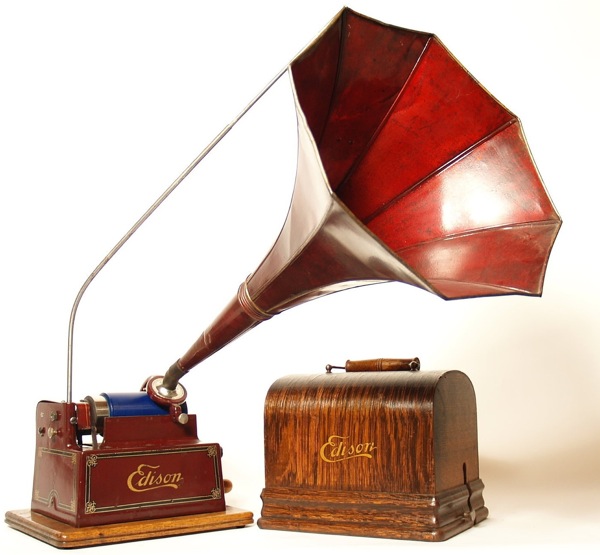
Batteries not needed: This 1909 Edison Gem D cylinder phonograph, better known as the Maroon Gem, was auctioned for $4,305 in May 2012

FOOTNOTES TO PHONOGRAPHIC HISTORY

❏ Above: Edison Home Phonograph model A, No 825 made in 1879, playing a comic song by Scottish music-hall star Harry Lauder

➢ The Edison Speaking Phonograph Company was established on January 1878 to exploit the inventor Thomas Edison’s new machine by exhibiting it. He received $10,000 for the manufacturing and sales rights and 20% of the profits.
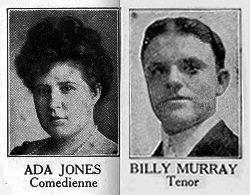
Ada Jones,Billy Murray, wax recording, phonographIn the late 1890s Edison began mass-producing cylinder phonographs though by 1905 flat-disc 78rpm machines began to outsell their cylinder rivals. Columbia, one of Edison’s chief competitors, abandoned the cylinder market in 1912. However, the Edison Company continued to make Blue Amberol cylinders until the demise of the company in 1929.

❏ Listen to Ada Jones & Billy Murray sing Come Josephine in My Flying Machine on an Edison Blue Amberol cylinder from 1911 (© Linda C. Joseph)

FRONT PAGE

2012 ➤ Welcome JLS to the pop millionaires club

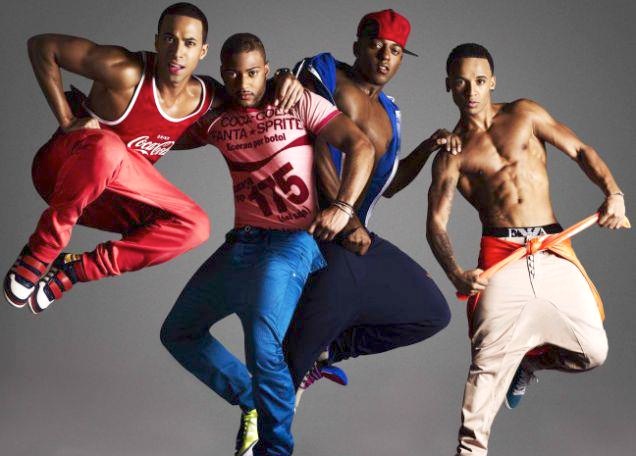
Rich List, JLS, Marvin Humes, JB Gill, Oritsé Williams, Aston Merrygold

£5m apiece: JLS’s Marvin Humes, JB Gill, Oritsé Williams, Aston Merrygold

❚ NO REALLY POPTASTIC SURPRISES in the annual Sunday Times Rich List for the UK and Ireland, published today. Adele, inevitably, tops the Richest Young Musicians after the past year’s runaway success that more than tripled her estimated wealth from £6m to £20m ($33m). There are only five newcomers each worth £5m ($8m) in the top 20 millionaires aged 30 and under. One is Jessie J, 24, the former Brit School student who has sold close to 1m copies of her album Who You Are and is currently mentoring on the television show The Voice UK. The others are all four members of JLS (short for Jack the Lad Swing), the UK’s coolest boy band, who came to fame on The X Factor and released their third album, Jukebox, last November.

♫ View video: JLS performing their January release,
Do You Feel What I Feel?

The under-30s millionaire list is nowhere in the same stratosphere as the main Sunday Times Music Millionaires Top 50. These are the grandees from the headier days of British rock who have had a lifetime in which to amass royalties — ex-Beatles, Stones and assorted moguls. Among pop performers, the 70s are still represented by David Bowie (today valued at £100m, $163m); the Swinging 80s only by George Michael (up this year to £100m); the 90s by Robbie Williams (£100m), as a new entry the joint husband-and-wife wealth of Coldplay’s Chris Martin and actress Gwyneth Paltrow (£72m), plus Take That’s Gary Barlow (£50m).

+++
The same trio as last year head the Young Entertainers Rich List, led by Daniel Radcliffe, aged 22, who starred in eight Harry Potter films and has increased his wealth by £6m in a year to £54m ($88m), helped by the success of his latest movie, the gothic thriller The Woman in Black. At No 2, Twilight star Robert Pattinson has added £8m in a year to his fortune and is now worth £40m. Keira Knightley is the third top-earning movie star, still worth £30m.

➢ 2010, Rich List puts George Michael top of the popstars from the un-lucrative 80s

➢ 2011, Soprano Jenkins tops pop’s young Rich List

Daniel Ek, Spotify ,Rich List, social media

Daniel Ek: Swedish entrepreneur who launched Spotify’s streaming service in 2008

➢ Britain’s top ten richest people in the world of social media are worth a combined £15.8bn — The Daily Telegraph reports that, sprinting fast behind the billionaires, is the 29-year-old co-founder of Spotify, the legal online music streaming service. London-based Arsenal supporter Daniel Ek is the highest new entry on the Music Millionaires Rich List as well as No 8 in the…

top ten Social Media Millionaires

1 Alisher Usmanov, Facebook: £12.3bn
2 Michael Moritz, LinkedIn: £1.08bn
3 Niklas Zennstrom, Skype: £600m
4 U2 (Bono), Facebook, Yelp: £514m
5 Andrey Andreev, Badoo: £500m
6 Michael and Xochi Birch, Bebo, TweetDeck: £270m
7 Vikrant Bhargava, SocialGO: £230m
8 Daniel Ek, Spotify: £190m
9 Tihan Presbie, Miniclip: £155m
10 Joanna Shields, Bebo, Facebook: £50m

FRONT PAGE

➤ Trimphone aside, can you spot the designs that changed the look of Britain over 60 years?

British Design,exhibition ,Innovation, Modern Age, Victoria & Albert Museum,

British Design catalogue collage: road signs, high-rises, Kodak cameras, postage stamps, computers and Henry Moore — all are exhibited here

“Britain has since 1948 sustained an extraordinarily vigorous creative culture, even against a background of manufacturers leaving the stage like the instrumentalists in Haydn’s Farewell Symphony. It’s an inclusive culture, hence tapestries and Jaguars. It’s a culture that swoops artfully between high and low. It’s a culture that could import, with characteristic fairhandedness, both John Betjeman and Nikolaus Pevsner. The one in thrall to the village, the other in thrall to steel and glass. Wonderfully, each was a founder of The Victorian Society. Their contrasting spirits dominate British design in the years before The Beatles’ first LP. Thereafter, the Britain of crumpets-with-vicar became the undisputed global capital of youth culture whose furious organic vitality still invigorates business life.”

➢ Stephen Bayley, former chief executive of the Design Museum, writing in The Independent

Denys Lasdun, University of East Anglia,architecture

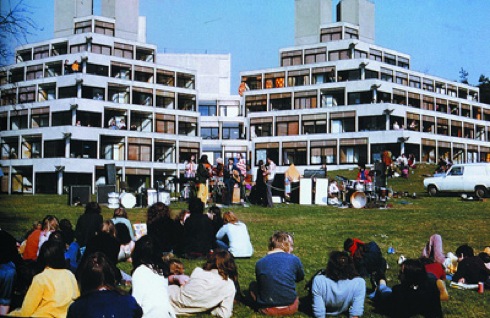
Architect Denys Lasdun’s University of East Anglia, 1962-68: raised walkways, striking ‘ziggurats’ and no building on campus more than five minutes’ walk away

❚ AN EXHIBITION TITLED British Design 1948–2012: Innovation in the Modern Age, is bound to infuriate as much as it excites. The grimly claustrophobic galleries that host temporary shows at the Victoria & Albert Museum abound with iconic and nostalgic everyday objects, rather as a good car-boot sale does. Yet the omission of much imaginative British media is unforgivable — the template for newspaper colour supplements laid out by The Sunday Times plus a serious investment in photo-reportage, for example… the more-British-than-British essence with which the American Joseph Losey propelled a whole chapter of stylish cinema… the sci-fi television fantasies of The Prisoner or Doctor Who…

Twiggy , Mary Quant ,miniskirt,Swinging London, youth culture

Twiggy models the Mary Quant miniskirt, 1965: named after the designer’s favourite car, the mini encapsulated the youth culture of Swinging London — energetic and unconventional

What the V&A show’s three themes propose — under the headings Tradition & Modernity, through the Subversion of pop, to Innovation & Creativity — amounts to a vital module for every art or design student in the education system, whose forebears, thank goodness, benefited from the shake-up imposed in 1960 by the Coldstream Report.

Ignore most dithering reviews of this hot-and-cold exhibition. Instead, do savour the argumentative Stephen Bayley, writing in that onetime model of new newspaper design, The Independent. He nails the paradox of this show in a daydream: “I became drunk on memories of whimsy, charm, gentility, wit and Macmillan-era futurism. My imagination never turned to the ruins of industry, the loss of technological competence, the barrenness of every British city except London and the fact that the economy of our once-busy island workshop is now based on the theory and practice of a dodgy casino.”

Bayley then comes to the nub of the matter: “The tricky thing is ‘design’ itself. It’s often muddled not only with ‘innovation’, but with invention, fashion and taste-making, sometimes even with art. After more than 150 years of promoting design at the V&A, no one seems to have any very clear idea of what it is. If it is a real subject, it must have a discipline. But what discipline connects Spence’s Coventry Cathedral with Damien Hirst’s 1997 Pharmacy restaurant in Notting Hill, west London, each of which features here?

“If, as the design lobby often insists, ‘everything has been designed’, then everyone is a designer. So what special qualities do professional designers bring to any task?”

British Design,exhibition ,Innovation, Modern Age, Festival of Britain, Skylon, Concorde

Notions of modernity: at the Festival of Britain, 1951, the Skylon designed by Powell & Moya was rendered by the practice’s junior architect James Gowan as a monumentalised missile, and symbolised the dawning age of science. In 1979, BA’s sixth Concorde took off on its maiden flight

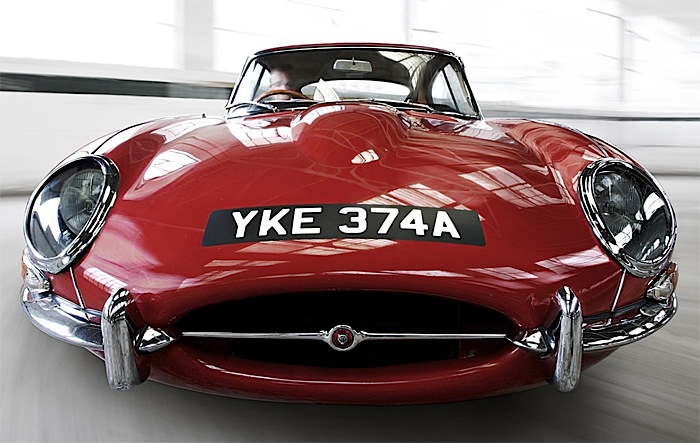
Aim Bayley’s question at three triumphs of design in the V&A show: the kinetic balancing act of the Festival of Britain’s Skylon structure; the bird-wing aerodynamics of Concorde miniaturised at the V&A in a 20-ft model; and the most thrilling artefact in the entire show: the skilfully lit Jaguar E-Type from 1961 which rival manufacturer Enzo Ferrari declared “the most beautiful car ever made”. Drop down to one knee and view the Jag diagonally from any corner and wonder at its lack of straight lines. One curve after another creates changing perspectives that conspire to emulate speed even as it stands motionless before you. Seldom will you hear both men and women purring over such a seductive silhouette! Seldom will you ever see such a thrilling manmade object.

There are a good number of breathtaking moments in this show that beg you to ask why and how an exhibit stopped you in your tracks, though not as many as you would wish.

Malcolm Sayer, Jaguar E-Type,sports car ,

Relish the curves: designed by Malcolm Sayer, the Jaguar E-Type 3.8-litre sports car was launched at the Geneva Motor Show in 1961 as a two-seat coupe or convertible, with a top speed of 150 mph. The car’s shape is the epitome of speed

➢ British Design 1948–2012: Innovation in the Modern Age, runs at the Victoria & Albert Museum, Mar 31 until Aug 12

FRONT PAGE

2012 ➤ Hockney paints Hawking — watch a glittering new portrait emerge as a movie

David Hockney,iPad portrait,Brushes,exhibitions , Stephen Hawking,London, Science Museum

David Hockney at work on his iPad portrait of Stephen Hawking, showing from today at London’s Science Museum. Photograph © Judith Croasdell

Britain’s best-known painter meets the world’s best-known scientist. The outcome is a dazzlingly intimate birthday portrait of the wheelchair- bound Prof Stephen Hawking, captured in February at his office in Cambridge looking serene and fascinating with strangely luminous violet eyes. Today’s Science Museum blog reports:

IMAGINE BEING ABLE TO SEE the British artist David Hockney create a new work, stroke by stroke, before your very eyes. Now imagine this work is a portrait, providing an insight into the way Hockney composes his famous likenesses. Even better, the subject is none other than the distinguished Cambridge University cosmologist, Stephen Hawking.

For the next three weeks the Science Museum will display an animated version of Hockney’s portrait, running on the artist’s own iPad for more than three minutes and showing exactly how it was created. Visitors can see how his skill has evolved since he was first introduced to the Apple iPhone in late 2008 and then the iPad. Hockney draws with an app called Brushes which removes the need to cart around supplies, easel and palette… It is exhibited alongside a rarely seen Hockney line-drawing, dating from 1978, owned by Hawking’s first wife, Jane… / continued online

➢ Stephen Hawking: A 70th birthday celebration display at London’s Science Museum until April 9 … The book that made a celebrity of cosmologist Hawking in 1988, A Brief History of Time, broke records by staying on the Sunday Times best-sellers list for 237 weeks.

➢ More on Hockney at Shapersofthe80s: 1983’s landmark interview when he revealed “Suddenly I see cubism differently, more clearly”. Plus more of his iPad art

Ubermensch ,sculpture,Stephen Hawking, Jake Chapman, Dinos Chapman

Ubermensch 1995, by Jake and Dinos Chapman: Hawking as Fiberglass “Superman”

➢ Thin line between art and hate: is this the most repellent work of modern art? “The Chapman brothers’ sneering sculpture of Stephen Hawking sickened me in 1995, and still does now. What do you think is the most hateful work of modern art?” — Guardian art critic Jonathan Jones writing in January … and Jones again today: “Hockney’s portraits of Hawking are important documents of what really mattered in the culture of our time. Like Epstein’s Einstein, they will still be looked at when much art that makes headlines is utterly forgotten.”

➢ Professor Stephen Hawking has filmed a cameo for TV sitcom The Big Bang Theory, due to be aired next month in the US (May in the UK) — BBC News reports: The famous physicist will appear in a scene with socially awkward scientist Sheldon Cooper, played by Jim Parsons. He previously recorded voice-overs for animations The Simpsons and Futurama. Last year, he fronted his own TV series Brave New World for Channel 4, which looked at new developments in science and how they might benefit mankind … / continued online

FRONT PAGE

➤ Quietly, quietly, lensman Ridgers talks about capturing life in the margins

Derek Ridgers, Ronnie Biggs, great train robbery,Rio de Janeiro,photography

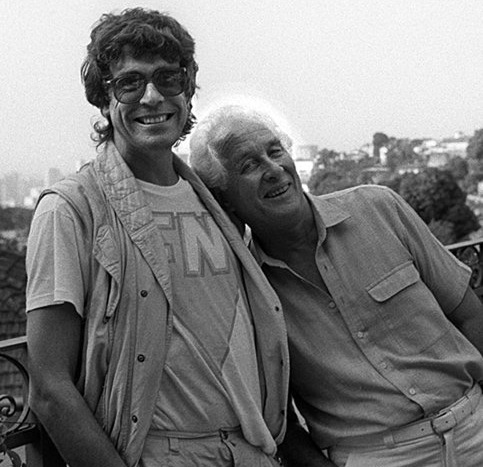
Derek Ridgers meets the fugitive Great Train Robber Ronnie Biggs in Rio, about 1985: “I played pool with Ronnie a few times and he was a lot better at it than I was. I suppose he had plenty of time to practise.” (Picture courtesy of Derek)

❚ WITH 35 YEARS OF EXPERIENCE, Derek Ridgers is one of the UK’s leading documentary photographers, notably of youth culture, its rock stars and its street tribes. “Derek Ridgers’ compulsion to photograph London clubs over two decades was an extraordinary one,” curator Val Williams wrote in his 2004 book, When We Were Young: Club and Street Portraits 1978–1987. Here were “transient beings moving across an urban landscape, flamboyant souls who cared more than anything about how they looked and whose greatest fear was of being ordinary. But it was the ordinariness that Derek Ridgers glimpsed in these costumed characters that makes his photographs so powerful.

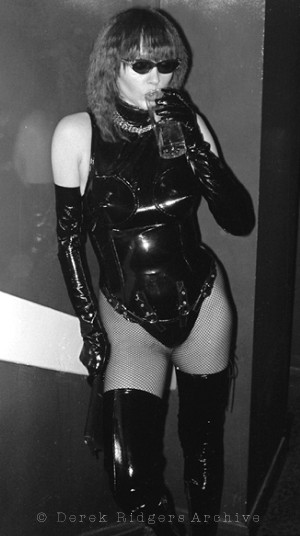
Witchity club, London, 1979

An era of conspicuous sexuality: clubber at Witchity, a David Claridge dive in 1979, photographed by Derek Ridgers

“Ridgers’ photographs are an undeliberate chapter in a decade of English social and cultural history which changed the way we thought about music, fashion and consumption. It was the decade of the handmade and the customised, of Oxfam shopping, conspicuous sexuality, of excess, wide success and dismal failure.” Well, that’s a point of view.

His earliest exhibitions in the 70s and 80s featured punk portraits and skinheads, and many seminal images of London’s clubland New Romantics. He has mainly worked for UK magazines and newspapers such as NME, The Face, The Independent, The Sunday Telegraph, Time Out and Loaded. He now runs the Derek Ridgers Archive where limited edition prints are for sale, and he blogs occasionally though thoughtfully at Ponytail Pontifications. Derek has always been the “quiet observer”. He collaborated only once with Shapersofthe80s and his fine shots can be seen on our inside page about the 1983 Face cover story, The making of UK club culture. He also brilliantly articulated what remains today the definitive description of Billy’s, the font of all 80s clubbing. You’ll read it in the feature.

Oomska, a new UK-based online arts and pop culture magazine, today asked Derek to share his views about photography. Here are some highlights:

Other than a camera, my favourite piece of equipment, if one could characterise it as such, is the sun.

❏ The digital age has probably added several years to my life expectancy — when I think about all the wasted time and expense of having clip tests made prior to getting the bulk of my colour film processed, I think I must have been mad.

❏ I love Garry Winogrand but some of his photographs (for instance the ones taken in the Ivar Theatre) suggest that he wasn’t necessarily always thinking about the art.

❏ It’s becoming harder and harder these days to earn a living as a professional photographer … I don’t particularly care.

❏ The most popular camera used on Flickr is now the iPhone 4. The rise of the hybrid consumer appliance will probably continue.

❏ For me it’s whatever works… Photoshop has brought all those darkroom techniques that took years to learn within the reach of everyone.

❏ A static image can still have more power than a moving one because you can live with it and study it and let its whole being seep into you and fix itself into your brain.

➢ Read the full Ridgers interview at Oomska

Derek Ridgers, photographer,Beat Route, clubbing

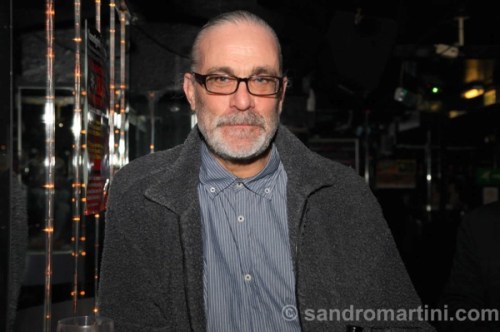
The snapper snapped: Derek Ridgers at last December’s party at the Beat Route reincarnation to launch somebody else’s photobook We Can Be Heroes. Snapped by Sandro Martini

FRONT PAGE