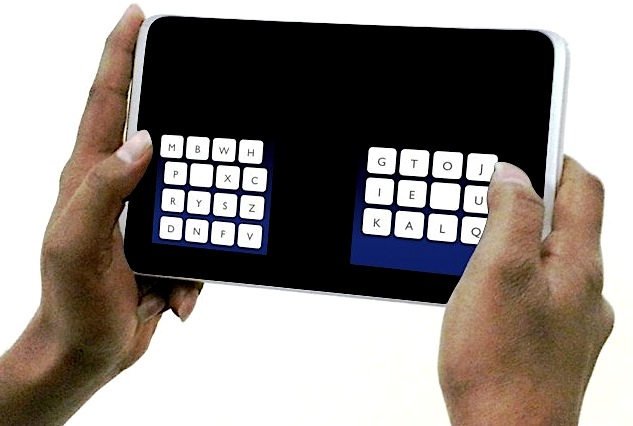
➢ Faster two-thumb typing devised by the Max Planck Institute: “ The research team of Antti Oulasvirta at the Max Planck Institute for Informatics has created a new keyboard called KALQ that enables faster thumb-typing on touchscreen devices. They used computational optimization techniques in conjunction with a model of thumb movement to search among millions of potential layouts before identifying one that yields superior performance. A user study confirmed that, after a short amount of practice, users could type 34% faster than they could with a QWERTY layout… ” / Continued at the Max Planck Institute
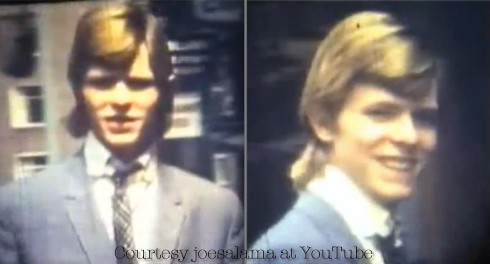
The first room at the V&A exhibition gives this glimpse of a pre-Bowie Davie Jones, aged 18, possibly filmed in Tin Pan Alley, London, in 1965… Click on pic to read the full story by Shapersofthe80s and view the home movie discovered in 2011
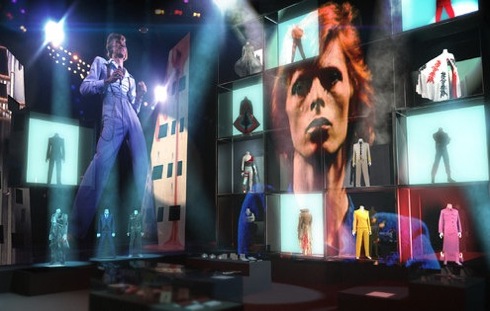
The V&A’s new exhibition David Bowie Is: “a grand stage for an inspirational artist who reshaped a generation”
MAR 20: PROFESSOR OF FASHION IAIN R WEBB
ON THE OPENING PARTY
❏ Just spent a blissed out evening at the V&A David Bowie is exhibition. It blew my mind! It is indeed a remarkable show… and to see all those pretty things that I’ve looked at in photos over and over again over the years is something akin to a religious experience… Not only is the clever curation of memorabilia and associated artefacts an inspiration (a lipstick stained tissue anyone?) but I got to personally thank both Mr Mick Rock and Mr Kansai Yamamoto for their wondrous workloads that helped transport me from village idiot to le freak! As the post-show party relocated from the V&A museum to The Rembrandt hotel across the road, the assembled fashion freaks, who also included fashion writer Judith Watt and costume designer Fiona Dealey, went crazy when Mr Yamamoto, who was responsible for many of Bowie’s flamboyant stage designs, entered. The fervour that greeted the legendary designer was akin to the Bowie-mania witnessed earlier in the evening when guests queued around the block to attend the private view.
“ In the opening room of the V&A’s new exhibition David Bowie Is, there is a four-second clip of film of a 17-year-old Bowie striding through the streets of Soho. The sun is shining, and as he catches sight of the camera he turns his bright blond head and smiles before vanishing from sight. The film was found on an old Super 8 camera. The amateur cameraman had been filming his wife in the Soho sunlight; it was quite by chance that he caught the nascent superstar. What is extraordinary is how, even then, Bowie behaves like the idol he was to become. If a camera is running, it must want to catch him in its lens. The mystery of David Bowie, the confidence that inspired a quiet boy from Bromley to become one of the most significant artists of his generation, hangs quietly over this entire show…
“ Geoffrey Marsh, a co-curator, says he is the first musical figure to be examined on such a scale: “This museum was set up to show how art and design work, to reveal the process. Although there have been a huge number of books about Bowie, they are by rock journalists and may not be of interest to the general public. The reason he is interesting is that he is more than a rock star”…
“ All the exhibits, presented using cutting-edge technology by – among others – the team behind the video projection at the opening ceremony of the Olympic Games, add to that sense of a fertile intelligence, changing constantly, shaping the world. You can see how firmly Bowie was in charge of everything he did.
“ The sheer grandeur [of the final room] brought tears to my eyes. I felt as I felt when I first saw Bowie live – simply glad to be in the same building as a man who could make music like this… ” / Full review at Telegraph online
➢ David Bowie is a retrospective exhibition of 300 possessions drawn from Bowie’s personal archive displayed at London’s Victoria & Albert museum, March 23–Aug 11.
Snowy Bowie, March 20: The Next Day debuts at #1 on charts in 12 countries and tops iTunes charts in 60. This week’s photo by Jimmy King
+++V&A video trailer for the new exhibition, David Bowie is
➢ David Bowie is the enigmatic title of a retrospective exhibition of 300 possessions drawn from Bowie’s personal archive displayed at London’s Victoria & Albert museum, March 23–Aug 11. Appropriately, this week his first album in ten years, The Next Day, sits at No 1 in the Official UK Album Chart. It’s his ninth UK No 1 album (though spookily neither of his recent singles releases is anywhere near the singles chart). Before the V&A show launches, ticket sales exceed 42,000, more than double the advance sales of previous exhibitions at the museum. A few tickets are still available by booking online, in person in Kensington, or by phone +44 (0)20 7907 7073.
FROM THE BOWIE COMMENTARIAT
➢ David Bowie, the Return – Tony Parsons, Miranda Sawyer and La Roux’s Elly Jackson discuss Bowie’s music and influence for Radio 4’s Front Row (broadcast March 7, available on iPlayer for a year). Presenter John Wilson is guided through the V&A exhibits by the show’s curators Victoria Broackes and Geoffrey Marsh.
➢ The Duffy Collection of iconic Bowie images – which include three of his most famous album covers – goes on display May 2–June 4 at the White Cloth Gallery in Leeds LS1 4HT. The show documents Duffy’s special relationship with Bowie over ten years.
“ Jon Abbott at graphic design studio Barnbrook said of the book David Bowie Is: “We wanted to create an engaging pop-object for an audience who have come to expect the unconventional” … The book’s body typeface, Priori Serif, is one from Jonathan Barnbrook’s own foundry, Virus Fonts. Drawn by Jonathan Barnbrook and Marcus Leis Allion, the typeface was influenced by British typographers Gill and Johnston, and fittingly it found one of its first outings on the cover of Bowie’s 2002 album, Heathen … ” / Continued at Creative Review
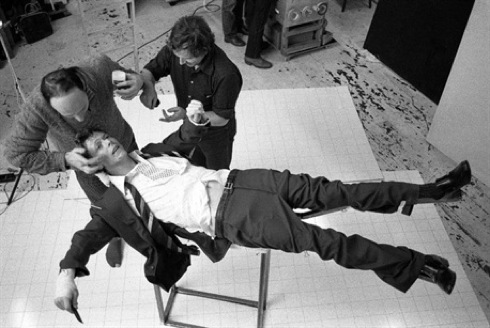
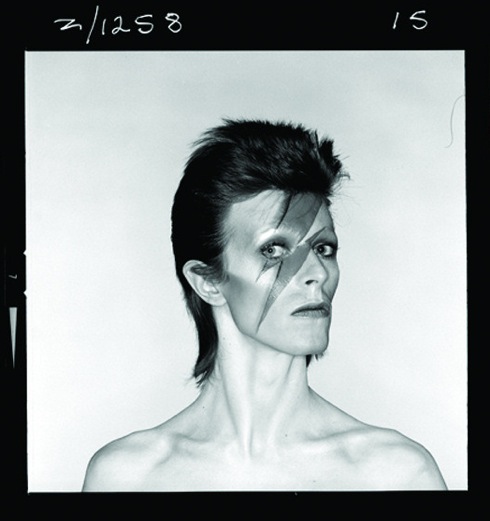
➢ The day that lightning struck Aladdin – In 1973, Celia Philo directed the photo shoot for David Bowie’s album Aladdin Sane. The result was one of the most iconic images ever created. She talks to Stylist magazine, 2013:
“ Sometimes, when you’re doing something that you know is going to be good, it’s because it’s come from an extreme end of the spectrum of experience: either it’s incredibly hard work, or it comes together almost effortlessly. The photographic shoot for the cover of Aladdin Sane happened like magic. Its success was the result of a lucky collaboration of people … ” / Celia Philo, continued at Stylist
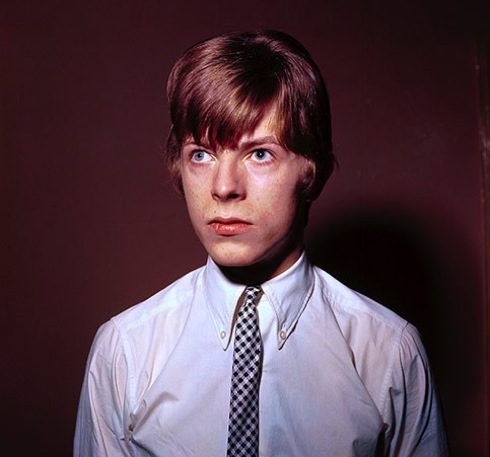
Setting out as Swinging 60s Mod: Bowie promo shot in 1966 for his first single on Pye, Can’t Help Thinking About Me, with his band The Lower Third which included producer Tony Hatch on piano. The NME decided: “Absorbing melody, weakish tune”
➢ Iain R Webb: How David Bowie liberated my wardrobe – As a 14-year-old boy living in a West Country village, Webb, the former Blitz Kid and fashion editor and now RCA professor, thought David Bowie’s style statements were a gift. And so have generations of fashion designers. Read feature in The Independent, March 16, 2013:
“ Bowie’s influence on my life has been major, from the fundamental desire to never be labelled or pigeonholed to my profound love of glitter and penchant for a spikey haircut. And I am not alone … ” / Iain R Webb, continued at The Independent
➢ Glam! The Performance of Style (Feb 8–May 12) is a seriously well-curated multi-media show at Tate Liverpool surveying the 1971–75 phenomenon on both sides of the Atlantic, across the whole spectrum of painting, sculpture, installation art, film, photography and performance. The in-depth survey comes in two halves, drawing a clear distinction between the playful subversion of pop music and fashion that characterised the British glam wave, and the American, which was driven much more profoundly by gender politics. Well worth a daytrip to Liverpool.
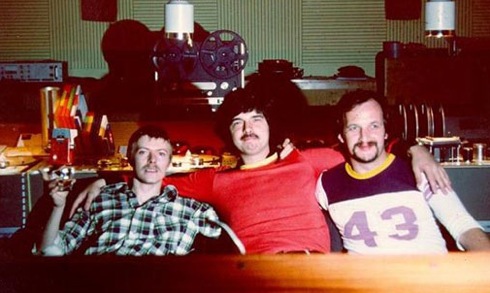
Berlin 1976: Bowie with moustache, Tony Visconti and assistant engineer, Edu Meyer, taken in the control room of Hansa Studios by Meyer’s wife, Barbara
♫ BBC Radio 6Music celebrates the life and work of David Bowie throughout Easter week, March 25–31. Gems from the archive feature concerts and interviews which have not been heard in 30 years.
♫ 2013, Shock and awe verdicts – Shapersofthe80s rounds up critical opinion on Bowie’s born-again single Where Are We Now? and the masterful new album The Next Day – “beautiful, obsessive and deliciously cruel”.
♫ News of special vinyl release at Bowie’s website – His second 2013 single, The Stars, is scheduled for a limited edition vinyl 7inch 45 Record Store Day release on April 20. Backed with Where Are We Now?
❏ Music video for the 1979 song DJ (above) sees Bowie sporting a pink onesie dungaree outfit designed by Willy Brown and walking through London streets being snogged by fans, both boys and girls.
Boombox clubber: “attempting to look like their MySpace profile”
➢ So, Vice Future Week – what is it? – Alex Miller, Editor-In-Chief, Vice UK, writes: “Well it’s a series of blogs (or essays – that’s how I’ve explained it to people who I’m intimidated by) about THE FUTURE.” Right ºOº. Fortunately, the essays mostly prove compelling, so here are a few online soundbites from Alex’s more focused commentators…
➢ In The Year 2022: Looking Back at the Decade – “The Islamic Republic of Catalonia seemed new and scary to a lot of people, but Islamic city-states are hardly an innovation in Spain. Prime Minister Boris Johnson was such a laughline ten years ago, like Mayor Boris Johnson before, that I think most people were prepared for it…”
Soft fashion: weighing us down
➢ Things That Need to Die Before British Culture Can Move Forwards – “British culture is in a weird place right now. Teenagers are buying their drugs on the internet, but getting their clothes from Hollister. Hardbody MCs are beefing with each other about the merits of Ed Sheeran, and Mail Online’s Sidebar of Shame is a cultural staple on which careers are born and killed… There are many facets of our culture that are really weighing us down. The albatrosses slowly breaking our necks, the clips on our cultural wings. So let’s name those things: gentrified fun… cocaine… bedroom vanity… consensus cool… soft fashion…”
➢ The Future of Fashion – “I’d like to think I’d be braced for the following bombs to drop in the next decade: China is set to rise from consuming only ten per cent of the world’s international luxury goods, to 44 per cent… The internet means that very specific city-based subcultures are catching on globally… Shops “will become more like showrooms”… The effect new browser systems will have on fashion will be similar to how East London venue Boombox was “a nightclub full of people attempting to look like their pictures on MySpace”. People will “try to look 3D, or like a computer”…”
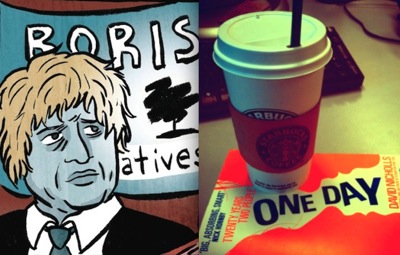
Inevitable: Prime Minister Boris Johnson and consensus cool. (Illustration by Julia Scheele)
➢ The Future of Guitar Music – “Guitar music, despite my best efforts, isn’t dead… Somehow, according to industry insiders at Radio One, NME and (that most respected and time honoured bastion of rock’n’roll) Kiss FM; without it ever having gone anywhere, the guitar is on its way BACK… Last year, Jack White, Linkin Park, Bruce Springsteen and Matchbox Twenty all scored Billboard number one albums in the US, while The xx, The Vaccines, The Killers and Muse all enjoyed number one records over here…”
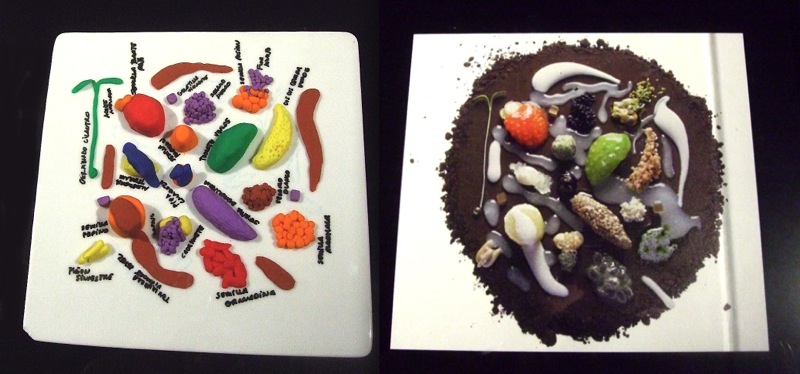
Before-and-after designs: left, coloured Plasticine model … right, real food on the plate by El Bulli chefs
❚ EATING CAN BE THEATRE, just as food can be art. The Catalan chef Ferran Adriá is Houdini and Picasso in one, commonly lauded as the best in the world. His three-Michelin starred restaurant El Bulli, two hours north of Barcelona, was an academy repeatedly garlanded by scholars who take dining seriously. Since 1987 it grew to serve 1,500 plates daily, prepared by 50 cooks and served by 30 staff typically to only 50 companions at table. Its culinary revolution is known as “molecular gastronomy” famed for scented gels and foams and for using every part of every animal and plant.
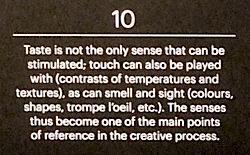
Adrià’s manifesto: No 10 of his 23 principles that summarise El Bulli’s cuisine
Now after 25 years of experiments, Adriá is replacing the restaurant with an inspirational foundation, while his career is being celebrated in Spain’s first major exhibition about cooking. In a series of galleries at Barcelona’s Palau Robert, we are blown away by a fearsomely complete collection of photos, letters, utensils, mementoes, and a vast poster of the 1,846 dishes catalogued by the restaurant. Best of all are the videos in which we see his edible creations being conjured. Another simple but charming glimpse behind the magician’s hand is a table-top displaying before-and-after designs of individual dishes: ingredients modelled from coloured Plasticine are composed as templates for his chefs to translate – abracadabra! – into the resulting plates of food shown alongside.
“ Tonight’s dinner involves all the senses, it engages the mind, and is also, at times, a strangely emotional experience. The dishes can be confrontational as well as exquisite… The constant stream of surprises continues for more than four hours – the green leaf that tasted exactly of oysters; the grilled strawberry with ginger on the outside and an injection of gin on the inside; the polenta gnocchi with coffee and saffron yuba; the perfect razor clam with its gelatin twin in the other half of the opened shell. Playful, arresting, occasionally alarming, the meal is almost like a story… ” / Continued at Guardian Online
❚ THE “WORLD’S MOST USELESS MACHINE” is not new news but it did raise a smile during a trip to the year-old Museum of Ideas and Inventions – essentially a hands-on diversion for restless children – while Christmassing in Barcelona. The co-founder of Massachusetts Institute of Technology’s laboratory of artificial intelligence, Marvin Minsky, came up with the idea in 1952. Electronics engineer and the “father of information theory” Claude Shannon, who worked with Minsky at IBM, liked the idea so he built the machine. It is a battery powered box, the sole purpose of which is to turn itself off after some human hand has turned it on.
You too can assemble your own useless machine in beginner-level electronics kit form (from US$35 + shipping), or in a ready-soldered version (from US$55 + shipping). Both include printed circuit board.
➢ Choose “View full site” – then in the blue bar atop your mobile page, click the three horizontal lines linking to many blue themed pages with background article
MORE INTERESTING THAN MOST PEOPLE’S FANTASIES — THE SWINGING EIGHTIES 1978-1984
They didn’t call themselves New Romantics, or the Blitz Kids – but other people did.
“I’d find people at the Blitz who were possible only in my imagination. But they were real” — Stephen Jones, hatmaker, 1983. (Illustration courtesy Iain R Webb, 1983)
“The truth about those Blitz club people was more interesting than most people’s fantasies” — Steve Dagger, pop group manager, 1983
PRAISE INDEED!
“See David Johnson’s fabulously detailed website Shapers of the 80s to which I am hugely indebted” – Political historian Dominic Sandbrook, in his book Who Dares Wins, 2019
“The (velvet) goldmine that is Shapers of the 80s” – Verdict of Chris O’Leary, respected author and blogger who analyses Bowie song by song at Pushing Ahead of the Dame
“The rather brilliant Shapers of the 80s website” – Dylan Jones in his Sweet Dreams paperback, 2021
A UNIQUE HISTORY
➢ WELCOME to the Swinging 80s ➢ THE BLOG POSTS on this front page report topical updates ➢ ROLL OVER THE MENU at page top to go deeper into the past ➢ FOR NEWS & MONTH BY MONTH SEARCH scroll down this sidebar
❏ Header artwork by Kat Starchild shows Blitz Kids Darla Jane Gilroy, Elise Brazier, Judi Frankland and Steve Strange, with David Bowie at centre in his 1980 video for Ashes to Ashes
VINCENT ON AIR 2026
✱ Deejay legend Robbie Vincent has returned to JazzFM on Sundays 1-3pm… Catch up on Robbie’s JazzFM August Bank Holiday 2020 session thanks to AhhhhhSoul with four hours of “nothing but essential rhythms of soul, jazz and funk”.
TOLD FOR THE FIRST TIME
◆ Who was who in Spandau’s break-out year of 1980? The Invisible Hand of Shapersofthe80s draws a selective timeline for The unprecedented rise and rise of Spandau Ballet –– Turn to our inside page
SEARCH our 925 posts or ZOOM DOWN TO THE ARCHIVE INDEX
UNTOLD BLITZ STORIES
✱ If you thought there was no more to know about the birth of Blitz culture in 1980 then get your hands on a sensational book by an obsessive music fan called David Barrat. It is gripping, original and epic – a spooky tale of coincidence and parallel lives as mind-tingling as a Sherlock Holmes yarn. Titled both New Romantics Who Never Were and The Untold Story of Spandau Ballet! Sample this initial taster here at Shapers of the 80s
CHEWING THE FAT
✱ Jawing at Soho Radio on the 80s clubland revolution (from 32 mins) and on art (@55 mins) is probably the most influential shaper of the 80s, former Wag-club director Chris Sullivan (pictured) with editor of this website David Johnson
LANDMARK FAREWELLS. . . HIT THE INDEX TAB UP TOP FOR EVERYTHING ELSE









 ➢➢ Shapers of the 80s ➣➣