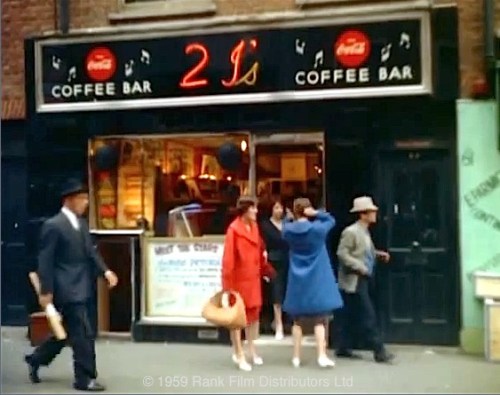
❚ FROM SMALL COFFEE BEANS a mighty fad exploded. The documentary film clip, above, immaculately preserved in rich Eastmancolor, takes us on a tour of Soho in 1959. The distinctly arch voice-over tells us: “ The coffee bar boom in Britain began in 1952 when the first espresso machine arrived from Italy and set up in London’s Soho. They reckoned that a cup costing tuppence to make could be sold for ninepence to 1s 6d [about £3 in today’s money], according to the trimmings. But for every three coffee bars that opened up, two closed down… ” / Continued at YouTube
CLICK ANY PIC TO LAUNCH CAROUSEL:
Frith Street, Soho, in 1959
Intellectuals are drawn to Le Macabre coffee bar in Soho
Bohemians frequent the French coffee bar
Home of rock’n’roll: Jive cats at the 2I’s in Old Compton Street
With the arrival of ITV in the mid-50s, the UK’s two television channels competed to bring the day’s news into living rooms. In Britain’s cinemas the Rank Organisation responded in 1959 with the weekly magazine Look at Life, a series of light-hearted short films to precede the main feature on their Odeon and Gaumont circuit. This episode, titled Coffee Bar, takes us inside a few of Soho’s many haunts that took care to attract their own social segment: at the 2I’s in the basement of 59 Old Compton Street, live rock groups ensured a young clientele of jive cats, for example, while artists hung out at The French, intellectuals at the Macabre, politicos at Le Partisan, while writers and actors favoured Legrain.
Fifty years on, you’d be hard-pressed to distinguish one Soho bar’s customers from another’s – rather like the vile burnt cinders they all sell in the name of “coffee”. One sad consequence is to see the genuinely delicious stuff being edged off our supermarket shelves, presumably driven out by tastebuds destroyed in the high-street branded coffee shops.
“ It was 27 April 1985 and the opening party for the second floor of the Wag Club – the nightspot I founded and ran in Soho – was in full, unrestrained swing. Fuelled by the unlimited free bar, the place was totally off the hook, the crowd dressed to the nines in their own inimitable fashion – pirates, preachers, punks and picture-postcard peaches – throwing themselves about with Bacchanalian abandon to a soundtrack as arcane and varied as they were.
“ High jinks indeed, yet looking around I realised that we as a group had come of age, were taken seriously and that this moment was ours. George Michael danced next to Siobhan of Bananarama overlooking Sade who nodded to the music in front of Suggs and Martin Kemp. Over the way, John Galliano camped it up alongside Leigh Bowery, Judy Blame, Boy George and one of the scene’s most innovative dressers and designers, Stephen Linard, while behind them stood Steve Strange and Princess Julia chatting to Vivienne Westwood… ” / Continued at High Life
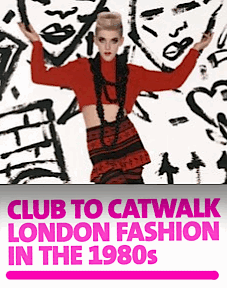
➢ Club to Catwalk: London Fashion in the 1980s runs at the Victoria & Albert Museum, July 10–Feb 16, 2014. Featuring more than 85 outfits, it showcases new looks from the decade’s most experimental designers and some remarkable photography from back in the day
Monica Curtin’s 1985 pic of Scarlett Cannon as “key identity” for the V&A Club to Catwalk show… Outfit by BodyMap’s AW 1984 collection, Cat in the hat takes a rumble with a techno fish. Stylist John Derry-Bunce. Background painting Simon Josebury. Hair and makeup Jalle Bakke
❚ “FASHION???” SCOFFED THE FASHION EDITOR of a leading women’s magazine who shared my flat in 1980, after meeting one of the more ornamental Blitz Kids over our breakfast table. “Those aren’t even clothes!” Yet within five years she was as keen as every other editor to be featuring BodyMap, Galliano, Jones, Auburn, Hogg, Hamnett, Bernstock Speirs et al. Scroll forward 30 years and London’s world-beating decorative arts museum, the V&A, weighs in with a necessary exhibition reappraising the UK’s style revolution of the 80s. What’s coming under scrutiny in its dedicated fashion galleries are the unique silhouettes of that extravagant shape-shifting decade and the clubland forces that moulded them. Only two weeks to go before Club to Catwalk, London Fashion in the 1980s, and there’s one crucial tipping point at its heart: the moment fashion became style.
Let’s hand over to fashion guru Iain R Webb, one of the central figures who defined his generation and whose impressive book As Seen in Blitz was published last month. Here’s a taste of the mighty personal essay he has written for the summer issue of the V&A Magazine…
V&A Magazine summer issue: the 80s deconstructed by Iain R Webb
Webb writes: “ The 1980s were all about being photographed. We dressed as if every day were a photo shoot and every night a party (it usually was). But there was another revolution happening.
The advent of the stylist who approached fashion as an artistic construct was something new. Alongside the contributors to BLITZ, The Face and i-D (Ray Petri, Judy Blame, Caroline Baker, Helen Roberts, Beth Summers, Simon Foxton, Mitzi Lorenz, Maxine Siwan and Caryn Franklin among them) were two thought-provoking arbiters whose importance is often overlooked. Michael Roberts at Tatler and Amanda Grieve at Harper’s and Queen added a subversive edge to their respective glossy titles. Roberts poking fun at old-school mores while Grieve (later Harlech) befriended St Martin’s graduate John Galliano and helped create the romantic whirlwind that shaped fashion for decades to follow.
The images produced by all these stylists merged fashion and art, questioned the accepted ideals of beauty and social status and enjoyed a sense of experimentation. Their vanguard imagery often highlighted specific issues such as the superficiality of fashion and consumerism with humour.
“At that time there was a group of stylists who were as creative as the designers, if not more so,” remembers PR Lynne Franks, who represented BodyMap, Katharine Hamnett and Wendy Dagworthy. “It prompted the question: What came first, the styling or the clothes? It was very spontaneous, like playing dress-up.”
Stefano Tonchi, editor of W magazine, then editor of Westuff, an alternative style periodical published in Florence, says: “Fashion was no longer fashionable. Style was used to describe many areas of the creative arts that came together. It made for a new category. Music dictated a lot of the emerging trends and there was experimentation in both photography and graphic design, but fashion was where these exciting changes were most evident. Think of the BodyMap fashion shows, they weren’t just about the clothes but involved music, graphic design and theatre… ”
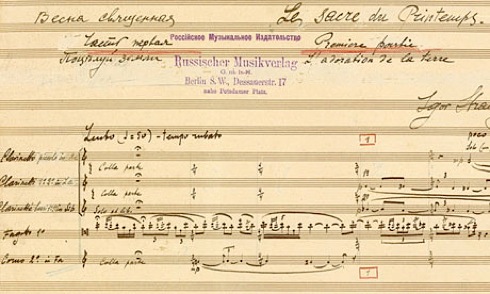
Section of a facsimile of Stravinsky’s manuscript for The Rite of Spring, which was published this year to mark the centenary
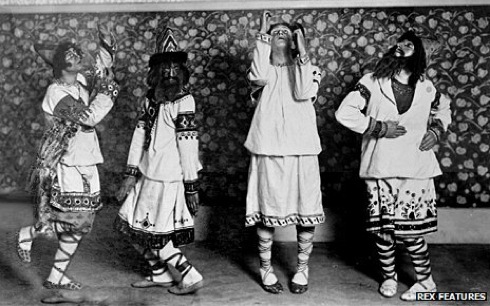
❚ IF IT’S GOOD ENOUGH FOR The Guardian’s front page 100 years after the event, readers of Shapersofthe80s will want to know about it. Here’s a fulsome appreciation by the leading British composer George Benjamin on the pivotal piece of music which was premiered 100 years ago today in Paris by Diaghilev’s Ballets Russes, why it caused a riot by the audience and became a model for masters who followed…
“ The Rite of Spring was a revolutionary work for a revolutionary time. Its first performance in Paris, exactly 100 years ago, was a key moment in cultural history – a tumultuous scandal. Written on the eve of the first world war and the Russian revolution, the piece is the emblem of an era of great scientific, artistic and intellectual ferment. No composer since can avoid the shadow of this great icon of the 20th century, and score after score by modern masters would be unthinkable without its model… ” / Continued at Guardian Online
“ Lydia Sokolova, one of the dancers said the audience came prepared: “They had got themselves all ready. They didn’t even let the music be played for the overture. As soon as it was known that the conductor was there, the uproar began,” she said in an interview recorded in 1965… ” / Continued at BBC Online
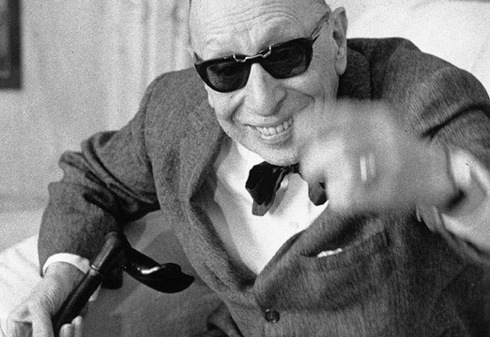
Igor Stravinsky on The Rite: “The 8-notes chord is new, but the accents are even more new … Give it 100 years”
❏ Robert Craft, now aged 89, the composer’s American confidant, wrote this immaculate summary of Stravinsky for 1000 Makers of Music (Sunday Times partwork published in 1997): “ In 1913, The Rite of Spring changed the rhythmic language of music: it is an epicentre of 20th-century modernism. Stravinsky’s music ranges widely, from the exaltation of Symphony of Psalms to the farcical fun of Renard, from the tenderness of Pulcinella, the deeply felt love-music of The Rake’s Progress to the grace of Apollo. The music is lyrical both in dramatic forms (Oedipus Rex) and purely instrumental (the violin-piano Dithyramb), and all of it dances as it sings. The ludic element (Circus Polka) is considerable, but much less so than the religious (Mass) and the humanist (Petrushka). Stravinsky’s influence is alive and immeasurable. He once said: “Music is the best means we have for digesting time.”
➢ Choose “View full site” – then in the blue bar atop your mobile page, click the three horizontal lines linking to many blue themed pages with background article
MORE INTERESTING THAN MOST PEOPLE’S FANTASIES — THE SWINGING EIGHTIES 1978-1984
They didn’t call themselves New Romantics, or the Blitz Kids – but other people did.
“I’d find people at the Blitz who were possible only in my imagination. But they were real” — Stephen Jones, hatmaker, 1983. (Illustration courtesy Iain R Webb, 1983)
“The truth about those Blitz club people was more interesting than most people’s fantasies” — Steve Dagger, pop group manager, 1983
PRAISE INDEED!
“See David Johnson’s fabulously detailed website Shapers of the 80s to which I am hugely indebted” – Political historian Dominic Sandbrook, in his book Who Dares Wins, 2019
“The (velvet) goldmine that is Shapers of the 80s” – Verdict of Chris O’Leary, respected author and blogger who analyses Bowie song by song at Pushing Ahead of the Dame
“The rather brilliant Shapers of the 80s website” – Dylan Jones in his Sweet Dreams paperback, 2021
A UNIQUE HISTORY
➢ WELCOME to the Swinging 80s ➢ THE BLOG POSTS on this front page report topical updates ➢ ROLL OVER THE MENU at page top to go deeper into the past ➢ FOR NEWS & MONTH BY MONTH SEARCH scroll down this sidebar
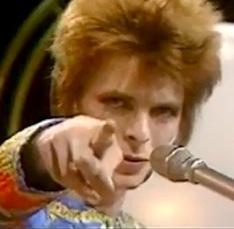
❏ Header artwork by Kat Starchild shows Blitz Kids Darla Jane Gilroy, Elise Brazier, Judi Frankland and Steve Strange, with David Bowie at centre in his 1980 video for Ashes to Ashes
VINCENT ON AIR 2026
✱ Deejay legend Robbie Vincent has returned to JazzFM on Sundays 1-3pm… Catch up on Robbie’s JazzFM August Bank Holiday 2020 session thanks to AhhhhhSoul with four hours of “nothing but essential rhythms of soul, jazz and funk”.
TOLD FOR THE FIRST TIME
◆ Who was who in Spandau’s break-out year of 1980? The Invisible Hand of Shapersofthe80s draws a selective timeline for The unprecedented rise and rise of Spandau Ballet –– Turn to our inside page
SEARCH our 925 posts or ZOOM DOWN TO THE ARCHIVE INDEX
UNTOLD BLITZ STORIES
✱ If you thought there was no more to know about the birth of Blitz culture in 1980 then get your hands on a sensational book by an obsessive music fan called David Barrat. It is gripping, original and epic – a spooky tale of coincidence and parallel lives as mind-tingling as a Sherlock Holmes yarn. Titled both New Romantics Who Never Were and The Untold Story of Spandau Ballet! Sample this initial taster here at Shapers of the 80s
CHEWING THE FAT
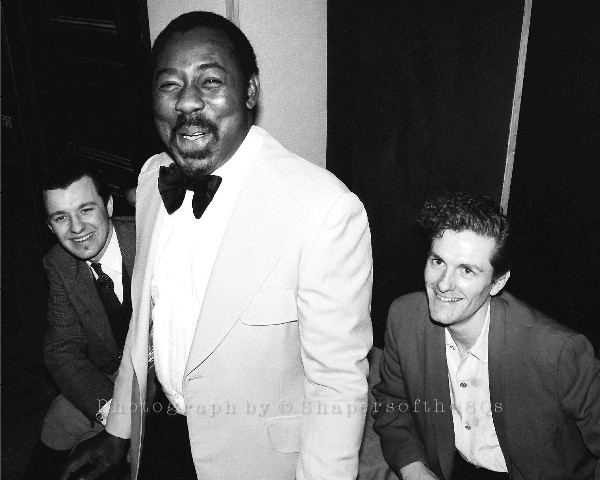
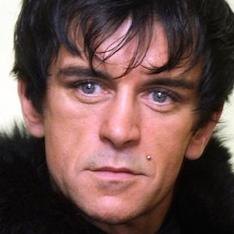
✱ Jawing at Soho Radio on the 80s clubland revolution (from 32 mins) and on art (@55 mins) is probably the most influential shaper of the 80s, former Wag-club director Chris Sullivan (pictured) with editor of this website David Johnson
LANDMARK FAREWELLS. . . HIT THE INDEX TAB UP TOP FOR EVERYTHING ELSE