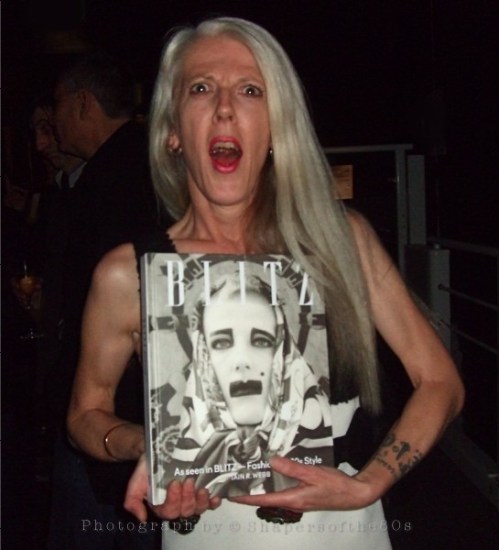
Cover girl: Scarlett Cannon at last night’s book launch . . . and covered in 1985 by photographer David Hiscock, scarfed by Hermès
CLICK ANY PIC TO LAUNCH CAROUSEL:

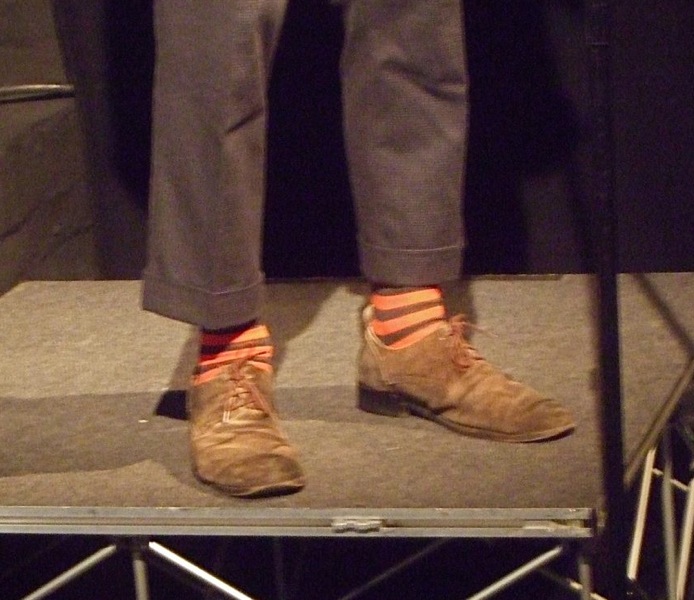
Webb’s ICA launch: the author declaims the introduction from his book. For the sake of completion: Jacket, Margaret Howell. Trousers, sale rail, £3, Shoes, model’s own

Webb’s ICA launch: 80s style icon Christos Tolera with cover girl Scarlett Cannon

Webb’s ICA book launch: author and cover girl cut facsimile cover cake

Webb’s ICA launch: the author’s fashion manifestos on display

Webb’s ICA launch: the author’s layout concepts on display

Webb’s ICA launch: name-droppy correspondence on display

Webb’s ICA launch: the author signing for Andrew Logan, eccentric and national treasure

Webb’s ICA launch: the author has just signed for Cynthia Grandfield, manager of Ryantown gallery

Webb’s ICA launch: Robert Leach, Rick Sky tabloid superstar, Stephanie Cooper

Webb’s ICA launch: Blitz magazine publisher Carey Labovitch with her fashion editor
+++
❚ LAST NIGHT DIEHARD 80s FASHIONISTAS celebrated the launch of an elegant hardback with far greater ambitions than most coffee-table photobooks. It’s a glorious personal CV posing as one man’s record of five energetic years. It doesn’t quite knock the sensationalist Casanova off his perch as the master memoirist, but Iain R Webb’s chutzpah certainly takes your breath away.
As Seen in BLITZ, Fashioning ’80s Style is among the most unabashed, single-minded, focused works of diarism you are likely to have read. In capturing his output as a fashion journalist, this book aspires to present social history expressed through fashion. He brings a new twist to the well-tried technique of oral history, because the 100+ collaborators who contribute to this book are constantly telling the author how marvellous he is, but in the second-person singular. They are talking to “you”, meaning “me”, the author whose name appears on the cover, Iain R Webb.
Its 272 pages record a series of testimonials: “You pulled so many creative people round you” … “We did it because you asked us to” … “You jump-started my career as a photographer” … “You were one of our earliest supporters” … “You had different ways of shooting things” … “You were doing the opposite of high fashion and glamour” … “You showed me a life that was different” … “You were so beautiful and excitingly aloof” … “I would have done anything you asked” … “You were the person who ––”.
There is no place in Webb’s memoir for Eng Lit’s Unreliable Narrator, or for self-doubt or inner struggle. His worldview is confirmed at every turn. Assertion is all: The 80s – we did it my way. We, the readers, are soon rocking on our heels at the sheer brass-necked cheek of it all!
Having said which, consider the credentials of everyone involved. They amount to a Who’s Who of the fashion shapers of the 80s: Jasper Conran, John Galliano, Jean Paul Gaultier, Katharine Hamnett, Marc Jacobs, Stephen Jones, Calvin Klein, Barry Kamen, Baillie Walsh, Martine Sitbon, Princess Julia, Nick Knight, David LaChapelle and many more.
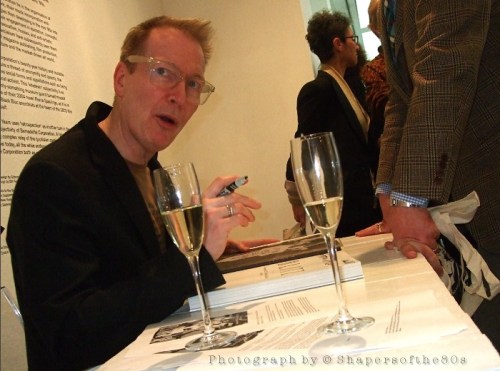
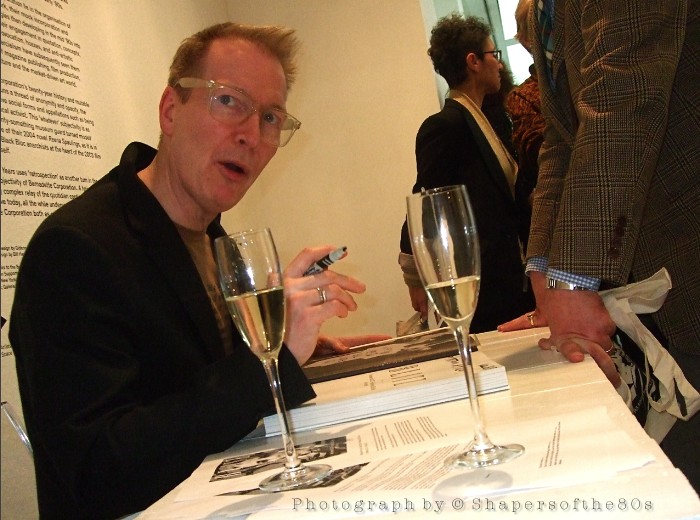
The author last night: Iain R Webb signing his book with lavish tributes to his former colleagues
We’ve heard enough about George O’Dowd’s tawdry version of events. Finally we have a much-needed corrective view of the youth cultural revolution that fired up the Swinging 80s. As Seen in BLITZ celebrates Webb’s own unique take on the decade of egotism through the pages he produced. We hear the voices of his co-stars – the photographers, designers, models and stylists who supported him as a lynchpin fashion editor – all dissecting the nuances of their subversive visions.
The whole momentum of post-punk street style during the decade’s dawn, 1980-83, is what drew the eyes of the world’s fashion industries back to Britain and put London Fashion Week on the agenda of every serious commentator twice a year.
While studying fashion design at St Martin’s, Webb was at the centre of London’s nightlife crowd at the now-legendary club called the Blitz – very much one of the 20 key Blitz Kids, as the media tagged them. He rightly claims: “At the dawn of a hedonistic club scene that saw the birth of the New Romantics … on the pages of Blitz, The Face and i-D, a new breed of young iconoclasts hoped to inspire revolution.” These were three new magazines, soon dubbed “style bibles”, which gave journalistic expression to the fertile innovations in UK pop culture and defined the era.
Blitz was a desultory magazine, almost entirely devoid of character in its early years. It was launched in 1980 with a title that its owner says seemed “catchy”, utterly oblivious to the pivotal club-night of the same name and the precocious youth-quake putting London back at the centre of the pop universe. It took until about 1983 for Webb to recognise the gap in the market for radical and purposeful fashion journalism and to infiltrate Blitz, the magazine.
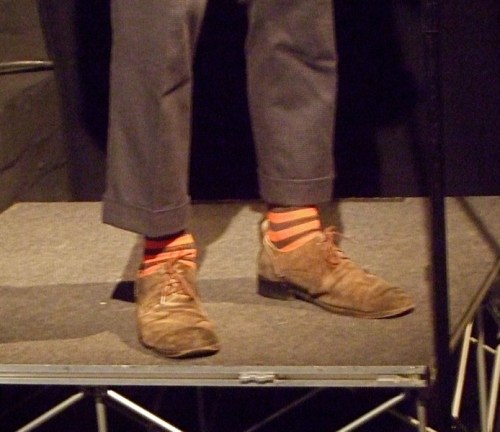
Webb’s ICA launch: the author sets the style for the evening. After Godot, out of skip? I stand corrected: After Wild Boys, out of Burroughs
Webb beavered his way up to becoming its fashion editor from Feb 1985 to August 1987 and was often given 20 pages a month to be filled with his “singular vision if they were to be taken seriously”. Webb’s USP was an “ongoing love/hate relationship with the fashion industry. It was not about selling a look, it was about saying something”. He expressed his ethos on a T-shirt in a 1986 photo shoot: “We’re Not Here to Sell Clothes”. When he was headhunted to join the London Evening Standard in 1987, his shoes at Blitz were filled by Kim Bowen, Queen Bee of the Blitz Kids, herself the wildest child in the club.
Webb’s purpose, he writes, “has always been to inspire or provoke, engage or enrage” and his images “manipulated fashion to explore ideas of transformation, beauty, glamour and sex”. His book brims with attitude and evidence that the fashion world did indeed tilt slightly on its axis during the 80s – as eye-witness accounts confirm in entertaining archive interviews.
How does an author cap all this? At his launch party last night at the Institute of Contemporary Arts, the savviest fashion editor of his day sported an awkward grey suit, and a battered pair of lucky suede shoes, every inch Beckett’s absurd tramps waiting for Godot, looking to all the world as if he’d spent the night in a skip. Anti-fashion to a T. Who’d have thought Webb had once held plumb posts at Harpers & Queen, The Times and Elle? And won the Fashion Journalist of The Year Award in both 1995 and 1996. And remains Professor of Fashion at the RCA and Central Saint Martins!
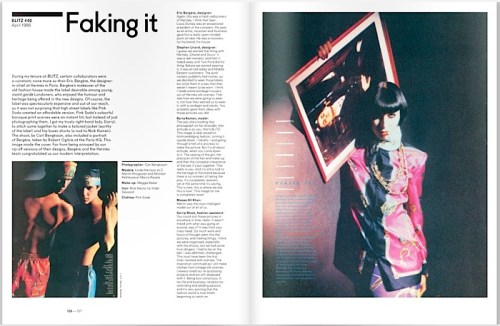
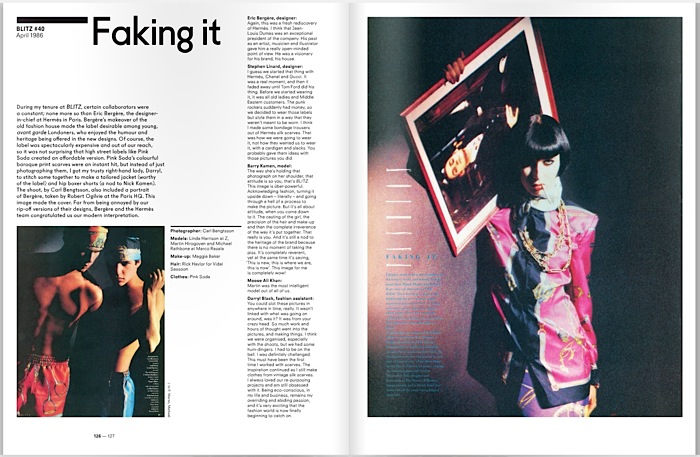
As Seen in BLITZ, 1986: classic Hermès scarves redeployed as boxer shorts and tailored jacket. Model Barry Kamen says says the female model’s attitude is so Webb, so BLITZ
❚ THIS BEAUTIFUL PHOTOBOOK, As Seen in BLITZ, precipitates a weekend of events at London’s ICA. Today there is a pop-up show in the ICA Theatre curated by the author Iain R Webb to display his own highly confessional memorabilia, plus a series of talks with special guests, film screenings.
In the darkened theatre only the 80s ephemera are visible as you enter: an array of toplit boxes on tables, containing notebooks, diary pages, sketches and name-droppy correspondence. These relics of a career lie in plain wooden showcases – “vitrines” would be an overstatement – more like pauper’s coffins. They amount to a novel kind of runway show of “my creations”. On one sheet of paper, Webb outlines his vision as fashion editor of Blitz, explaining London’s appeal: “The young English inherit a fight-back spirit, whilst the old fall sleepily into a heritage of traditional and quality goods … Of late the two have begun to merge, and the results have ensured the envy of the rest of the world.” Another note identifies the icing on a girl’s wardrobe as “an abundance of dishevelled accessorising – 1985 is a time to be ALIVE”.
➢ Webb’s As Seen in BLITZ discounted from £35 to £21
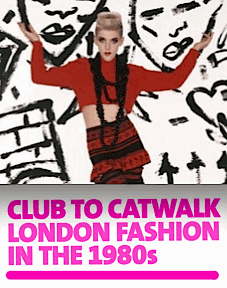
➢ The Victoria & Albert Museum exhibition Club to Catwalk: London Fashion in the 1980s runs from July 10, 2013 to Feb 16, 2014
FRONT PAGE

 “ High jinks indeed, yet looking around I realised that we as a group had come of age, were taken seriously and that this moment was ours. George Michael danced next to Siobhan of Bananarama overlooking Sade who nodded to the music in front of Suggs and Martin Kemp. Over the way, John Galliano camped it up alongside Leigh Bowery, Judy Blame, Boy George and one of the scene’s most innovative dressers and designers, Stephen Linard, while behind them stood Steve Strange and Princess Julia chatting to Vivienne Westwood… ” / Continued at High Life








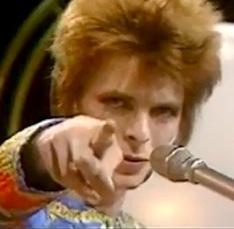
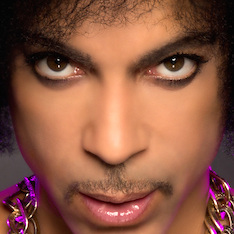
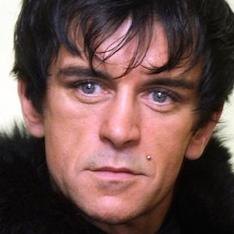

 ➢➢ Shapers of the 80s ➣➣